
 RSS Feed
 by Calculated Risk on 5/14/2020 12:11:00 PM
Thursday, May 14, 2020
The Changing Mix of Light Vehicle Sales
The low gasoline prices made me take another look at the mix of vehicles being sold.
This graph shows the percent of light vehicle sales between passenger cars and trucks / SUVs through April 2020.
 Click on graph for larger image.
Over time the mix has changed toward more and more towards light trucks and SUVs.
Only when oil prices are high, does the trend slow or reverse.
Recently oil prices have fallen sharply, and the percent of light trucks and SUVs was up to 77% in April 2020.
UCI Professor Chris Schwarz on the Economy at 1 PM ET
by Calculated Risk on 5/14/2020 11:48:00 AM
UCI Professor Chris Schwarz and I have presented together before.
He will be offering his thoughts on the economy at 10 AM PT (1 PM ET).
You can register here.
Hotels: Occupancy Rate Declined 55.9% Year-over-year, Slight Increase Week-over-week
by Calculated Risk on 5/14/2020 10:02:00 AM
From HotelNewsNow.com: STR: US hotel results for week ending 9 May
STR data for 3-9 May 2020 showed continues modest gains in U.S. hotel occupancy compared with previous weeks, but a similar level of year-over-year decline in the three key performance metrics.The following graph shows the seasonal pattern for the hotel occupancy rate using the four week average.
In comparison with the week of 5-11 May 2019, the industry recorded the following:
• Occupancy: -55.9% to 30.1%
• Average daily rate (ADR): -42.1% to US$76.35
• Revenue per available room (RevPAR): -74.4% to US$22.95
“The industry reported its fourth consecutive week-to-week increase in demand as the slow and steady ascent in national occupancy continued,” said Jan Freitag, STR’s senior VP of lodging insights. “More people are flying, as shown in daily checkpoint counts from the TSA, and more people are staying in hotels for a variety of purposes—the weekly number of rooms sold topped 10 million for the first time since the end of March. The markets benefiting more from leisure sources in areas with more relaxed distancing measures will see a sharper recovery line than others. Overall, the recovery will be uneven across the country.”
emphasis added
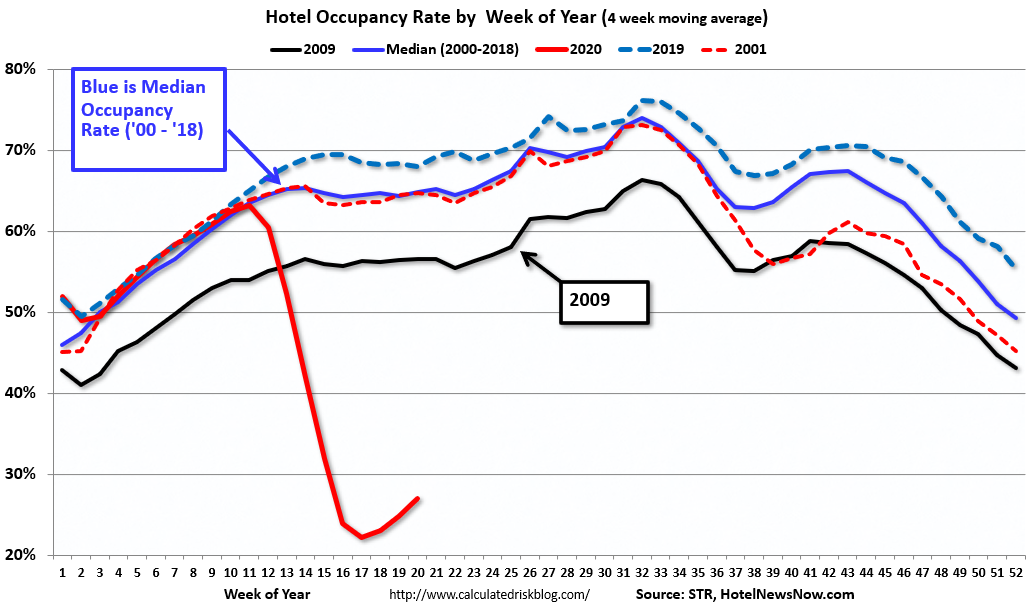 Click on graph for larger image.
The red line is for 2020, dash light blue is 2019, blue is the median, and black is for 2009 (the worst year probably since the Great Depression for hotels).
Note: I added 2001 to show the impact on hotel occupancy after 9/11.
2020 was off to a solid start, however, COVID-19 has crushed hotel occupancy.
Note: Y-axis doesn't start at zero to better show the seasonal change.
Weekly Initial Unemployment Claims decrease to 2,981,000
by Calculated Risk on 5/14/2020 08:35:00 AM
UPDATE: From Bloomberg: U.S. Jobless Claims in Millions Again, Connecticut Corrects Data
Later in the day, however, Connecticut corrected its figure to show 29,846 claims, rather than the 298,680 shown in the federal report, indicating an error inflated the national figures.The DOL reported:
In the week ending May 9, the advance figure for seasonally adjusted initial claims was 2,981,000, a decrease of 195,000 from the previous week's revised level. The previous week's level was revised up by 7,000 from 3,169,000 to 3,176,000. The 4-week moving average was 3,616,500, a decrease of 564,000 from the previous week's revised average. The previous week's average was revised up by 7,000 from 4,173,500 to 4,180,500.The previous week was revised up.
emphasis added
The following graph shows the 4-week moving average of weekly claims since 1971.
 Click on graph for larger image.
The dashed line on the graph is the current 4-week average. The four-week average of weekly unemployment claims decreased to 4,173,500.
This was higher than the consensus forecast of 2.5 million.
The second graph shows seasonally adjust continued claims since 1967 (lags initial by one week while increasing sharply).
 At the worst of the Great Recession, continued claims peaked at 6.635 million, but then steadily declined.
Continued claims have already increased to a new record high of 22.833 million (SA) and will increase further over the next couple of weeks - and likely stay at a high level until the crisis abates.
Wednesday, May 13, 2020
Thursday: Unemployment Claims
by Calculated Risk on 5/13/2020 08:42:00 PM
Note: the covid19 tracking project suspects that at least one state is including antibody tests in their daily report. If so, the positive rate of virus tests might be higher than reported.
There are still a large number of layoffs every week.
Thursday:
• At 8:30 AM ET, The initial weekly unemployment claims report will be released. The consensus is for a 2.500 million initial claims, down from 3.169 million the previous week.
May 13 Update: US COVID-19 Test Results: Possible Errors Cloud Data
by Calculated Risk on 5/13/2020 05:19:00 PM
This data is from the COVID Tracking Project. These people are doing amazing work. However, @alexismadrigal at the project has noticed a possible error. Alexis wrote yesterday:
We're aware of at least one state including [antibody tests], and this has led us to a broader investigation of which states might have lumped these tests in without telling anyone.If antibody tests were included, then the reported test count is too high - and the reported percent too low.
The US might be able to test 400,000 to 600,000 people per day sometime in May according to Dr. Fauci - and that might be enough for test and trace.
However, the US might need more than 900,000 tests per day according to Dr. Jha of Harvard's Global Health Institute.
There were 336,392 test results reported over the last 24 hours.
 Click on graph for larger image.
This data is from the COVID Tracking Project.
The percent positive over the last 24 hours was 6.4% (red line). The US probably needs enough tests to keep the percentage positive well below 5%. (probably much lower based on testing in New Zealand).
Hopefully the possible data issue will be clarified soon.
Fannie and Freddie: REO inventory declined in Q1, Down 20% Year-over-year
by Calculated Risk on 5/13/2020 03:11:00 PM
Fannie and Freddie earlier reported results earlier this month for Q1 2020. Here is some information on Real Estate Owned (REOs).
Freddie Mac reported the number of REO declined to 4,168 at the end of Q1 2020, compared to 6,714 at the end of Q1 2019.
For Freddie, this is down 94% from the 74,897 peak number of REOs in Q3 2010.
Fannie Mae reported the number of REO declined to 16,289 at the end of Q1 2020 compared to 18,998 at the end of Q1 2019.
For Fannie, this is down 90% from the 166,787 peak number of REOs in Q3 2010.
 Click on graph for larger image.
Here is a graph of Fannie and Freddie Real Estate Owned (REO).
REO inventory decreased in Q1 2020, and combined inventory is down 20% year-over-year.
This is close to the normal level of REOs.
It takes a long time to go from delinquency to foreclosure to REO. So any increase in REOs from COVID-19 won't happen for a long time. Since underwriting has been fairly solid over the last decade, I don't expect a huge increase in COVID-19 related REOs unless the health crisis goes on for a long period.
Houston Real Estate in April: Sales Down 21.6% YoY, Inventory Unchanged YoY
by Calculated Risk on 5/13/2020 12:16:00 PM
From the HAR: Houston Housing Feels COVID-19’S Sting in April
The Houston real estate market’s strong start to the new year was abruptly interrupted in April as the full impact of the coronavirus outbreak was felt across Texas and the rest of the country. Stay-at-home directives and social distancing weighed on the market as Realtors® began transitioning to virtual open houses and virtual property showings that enabled consumers to safely and conveniently market and tour homes on HAR.com....Sales in Houston set a record in 2019 and were off to a strong start in 2020. However the impact of COVID-19 (and lower oil prices) will be significant. Note that the closed sales in April were for contracts that were mostly signed in February and March.
According to the latest monthly Market Update from the Houston Association of Realtors (HAR), 6,199 single-family homes sold in April compared to 7,666 a year earlier, representing a 19.1 percent decline and ending a nine-month run of positive sales. ... Sales of all property types totaled 7,192, down 21.6 percent from April 2019. Total dollar volume for the month fell 20.4 percent to slightly more than $2.1 billion.
“We were bracing for a rough report and we got it, and the numbers are likely to remain this way until more Realtors® and consumers adapt to the use of virtual technology through HAR.com to safely market, tour and purchase or rent homes,” said HAR Chairman John Nugent with RE/MAX Space Center. “There is definitely no lack of consumer interest in real estate, as property listing views on HAR.com are up almost 60 percent from this time last year.”
...
Pending sales fell 17.6 percent due to market uncertainty, but total active listings, or the total number of available properties, were statistically unchanged at 41,151.
emphasis added
Fed Chair Powell: Current Economic Issues "May require additional policy measures"
by Calculated Risk on 5/13/2020 09:05:00 AM
Note: You can watch the speech here.
From Fed Chair Jerome Powell: Current Economic Issues
The coronavirus has left a devastating human and economic toll in its wake as it has spread around the globe. This is a worldwide public health crisis, and health-care workers have been the first responders, showing courage and determination and earning our lasting gratitude. So have the legions of other essential workers who put themselves at risk every day on our behalf.
As a nation, we have temporarily withdrawn from many kinds of economic and social activity to help slow the spread of the virus. Some sectors of the economy have been effectively closed since mid-March. People have put their lives and livelihoods on hold, making enormous sacrifices to protect not just their own health and that of their loved ones, but also their neighbors and the broader community. While we are all affected, the burden has fallen most heavily on those least able to bear it.
The scope and speed of this downturn are without modern precedent, significantly worse than any recession since World War II. We are seeing a severe decline in economic activity and in employment, and already the job gains of the past decade have been erased. Since the pandemic arrived in force just two months ago, more than 20 million people have lost their jobs. A Fed survey being released tomorrow reflects findings similar to many others: Among people who were working in February, almost 40 percent of those in households making less than $40,000 a year had lost a job in March.1 This reversal of economic fortune has caused a level of pain that is hard to capture in words, as lives are upended amid great uncertainty about the future.
This downturn is different from those that came before it. Earlier in the post– World War II period, recessions were sometimes linked to a cycle of high inflation followed by Fed tightening. The lower inflation levels of recent decades have brought a series of long expansions, often accompanied by the buildup of imbalances over time—asset prices that reached unsupportable levels, for instance, or important sectors of the economy, such as housing, that boomed unsustainably. The current downturn is unique in that it is attributable to the virus and the steps taken to limit its fallout. This time, high inflation was not a problem. There was no economy-threatening bubble to pop and no unsustainable boom to bust. The virus is the cause, not the usual suspects—something worth keeping in mind as we respond.
Today I will briefly discuss the measures taken so far to offset the economic effects of the virus, and the path ahead. Governments around the world have responded quickly with measures to support workers who have lost income and businesses that have either closed or seen a sharp drop in activity. The response here in the United States has been particularly swift and forceful.
To date, Congress has provided roughly $2.9 trillion in fiscal support for households, businesses, health-care providers, and state and local governments—about 14 percent of gross domestic product. While the coronavirus economic shock appears to be the largest on record, the fiscal response has also been the fastest and largest response for any postwar downturn.
At the Fed, we have also acted with unprecedented speed and force. After rapidly cutting the federal funds rate to close to zero, we took a wide array of additional measures to facilitate the flow of credit in the economy, which can be grouped into four areas. First, outright purchases of Treasuries and agency mortgage-backed securities to restore functionality in these critical markets. Second, liquidity and funding measures, including discount window measures, expanded swap lines with foreign central banks, and several facilities with Treasury backing to support smooth functioning in money markets. Third, with additional backing from the Treasury, facilities to more directly support the flow of credit to households, businesses, and state and local governments. And fourth, temporary regulatory adjustments to encourage and allow banks to expand their balance sheets to support their household and business customers.
The Fed takes actions such as these only in extraordinary circumstances, like those we face today. For example, our authority to extend credit directly to private nonfinancial businesses and state and local governments exists only in "unusual and exigent circumstances" and with the consent of the Secretary of the Treasury. When this crisis is behind us, we will put these emergency tools away.
While the economic response has been both timely and appropriately large, it may not be the final chapter, given that the path ahead is both highly uncertain and subject to significant downside risks. Economic forecasts are uncertain in the best of times, and today the virus raises a new set of questions: How quickly and sustainably will it be brought under control? Can new outbreaks be avoided as social-distancing measures lapse? How long will it take for confidence to return and normal spending to resume? And what will be the scope and timing of new therapies, testing, or a vaccine? The answers to these questions will go a long way toward setting the timing and pace of the economic recovery. Since the answers are currently unknowable, policies will need to be ready to address a range of possible outcomes.
The overall policy response to date has provided a measure of relief and stability, and will provide some support to the recovery when it comes. But the coronavirus crisis raises longer-term concerns as well. The record shows that deeper and longer recessions can leave behind lasting damage to the productive capacity of the economy.3 Avoidable household and business insolvencies can weigh on growth for years to come. Long stretches of unemployment can damage or end workers' careers as their skills lose value and professional networks dry up, and leave families in greater debt.4 The loss of thousands of small- and medium-sized businesses across the country would destroy the life's work and family legacy of many business and community leaders and limit the strength of the recovery when it comes. These businesses are a principal source of job creation—something we will sorely need as people seek to return to work. A prolonged recession and weak recovery could also discourage business investment and expansion, further limiting the resurgence of jobs as well as the growth of capital stock and the pace of technological advancement. The result could be an extended period of low productivity growth and stagnant incomes.
We ought to do what we can to avoid these outcomes, and that may require additional policy measures. At the Fed, we will continue to use our tools to their fullest until the crisis has passed and the economic recovery is well under way. Recall that the Fed has lending powers, not spending powers. A loan from a Fed facility can provide a bridge across temporary interruptions to liquidity, and those loans will help many borrowers get through the current crisis. But the recovery may take some time to gather momentum, and the passage of time can turn liquidity problems into solvency problems. Additional fiscal support could be costly, but worth it if it helps avoid long-term economic damage and leaves us with a stronger recovery. This tradeoff is one for our elected representatives, who wield powers of taxation and spending.
emphasis added
MBA: Mortgage Applications Increased Slightly, Purchase Applications up 11% Week over Week
by Calculated Risk on 5/13/2020 07:00:00 AM
From the MBA: Mortgage Applications Increase in Latest MBA Weekly Survey
Mortgage applications increased 0.3 percent from one week earlier, according to data from the Mortgage Bankers Association’s (MBA) Weekly Mortgage Applications Survey for the week ending May 8, 2020.
... The Refinance Index decreased 3 percent from the previous week and was 201 percent higher than the same week one year ago. The seasonally adjusted Purchase Index increased 11 percent from one week earlier. The unadjusted Purchase Index increased 11 percent compared with the previous week and was 10 percent lower than the same week one year ago.
...
“There continues to be a stark recovery in purchase applications, as most large states saw increases in activity last week. In the ten largest states in MBA’s survey, New York – after a 9 percent gain two weeks ago – led the increases with a 14 percent jump. Illinois, Florida, Georgia, California and North Carolina also had double-digit increases last week,” said Joel Kan, MBA’s Associate Vice President of Economic and Industry Forecasting. “We expect this positive purchase trend to continue – at varying rates across the country – as states gradually loosen social distancing measures, and some of the pent-up demand for housing returns in what is typically the final weeks of the spring home buying season.”
Added Kan, “Mortgage rates stayed close to record-lows, but refinance applications decreased for the fourth consecutive week, driven by a 5 percent drop in conventional refinances. Despite the downward trend over the last month, mortgage lenders remain busy. Refinance activity was up 200 percent from a year ago.”
...
The average contract interest rate for 30-year fixed-rate mortgages with conforming loan balances ($510,400 or less) increased to 3.43 percent from 3.40 percent, with points decreasing to 0.29 from 0.30 (including the origination fee) for 80 percent loan-to-value ratio (LTV) loans.
emphasis added
 Click on graph for larger image.
The first graph shows the refinance index since 1990.
The refinance index has been very volatile recently depending on rates and liquidity.
But the index is way up from last year (over triple last year).
 The second graph shows the MBA mortgage purchase index
According to the MBA, purchase activity is down 10% year-over-year.
Purchase activity has fallen, but was up 11% week over week.
Note: Red is a four-week average (blue is weekly).



