
 RSS Feed
 by Calculated Risk on 5/15/2024 07:00:00 AM
Wednesday, May 15, 2024
MBA: Mortgage Applications Increased in Weekly Survey
From the MBA: Mortgage Applications Increase in Latest MBA Weekly Survey
Mortgage applications increased 0.5 percent from one week earlier, according to data from the Mortgage Bankers Association’s (MBA) Weekly Mortgage Applications Survey for the week ending May 10, 2024.
The Market Composite Index, a measure of mortgage loan application volume, increased 0.5 percent on a seasonally adjusted basis from one week earlier. On an unadjusted basis, the Index increased 0.3 percent compared with the previous week. The Refinance Index increased 5 percent from the previous week and was 7 percent higher than the same week one year ago. The seasonally adjusted Purchase Index decreased 2 percent from one week earlier. The unadjusted Purchase Index decreased 2 percent compared with the previous week and was 14 percent lower than the same week one year ago.
“Treasury yields continued to move lower last week and mortgage rates declined for the second week in a row, with the 30-year fixed rate down 10 basis points to 7.08 percent, the lowest level since early April,” said Joel Kan, MBA’s Vice President and Deputy Chief Economist. “The decline in rates led to a small boost to refinance applications, including another strong week for VA refinances. However, the overall level of refinance activity remains low. Purchase applications decreased, driven largely by a 9 percent drop in FHA purchase applications. Conventional home purchase applications were down around one percent.
Added Kan, “While the downward move in rates benefits prospective homebuyers, mortgage rates are still much higher than they were a year ago, while for-sale inventory remains tight.”
...
The average contract interest rate for 30-year fixed-rate mortgages with conforming loan balances ($766,550 or less) decreased to 7.08 percent from 7.18 percent, with points decreasing to 0.63 from 0.65 (including the origination fee) for 80 percent loan-to-value ratio (LTV) loans.
emphasis added
 Click on graph for larger image.
The first graph shows the MBA mortgage purchase index.
According to the MBA, purchase activity is down 14% year-over-year unadjusted.
Red is a four-week average (blue is weekly).
Purchase application activity is up slightly from the lows in late October 2023, and below the lowest levels during the housing bust.

The second graph shows the refinance index since 1990.
With higher mortgage rates, the refinance index declined sharply in 2022, and has mostly flat lined since then.
Tuesday, May 14, 2024
Wednesday: CPI, Retail Sales, NY Fed Mfg, Homebuilder Survey
by Calculated Risk on 5/14/2024 07:38:00 PM
 Note: Mortgage rates are from MortgageNewsDaily.com and are for top tier scenarios.
Wednesday:
• At 7:00 AM ET, The Mortgage Bankers Association (MBA) will release the results for the mortgage purchase applications index.
• At 8:30 AM, The Consumer Price Index for April from the BLS. The consensus is for 0.3% increase in CPI (up 3.4% YoY), and a 0.3% increase in core CPI (up 3.6% YoY).
• Also at 8:30 AM, Retail sales for April is scheduled to be released. The consensus is for 0.4% increase in retail sales.
• Also at 8:30 AM, The New York Fed Empire State manufacturing survey for May. The consensus is for a reading of -10.8, up from -14.3.
• At 10:00 AM, The May NAHB homebuilder survey. The consensus is for a reading of 51 unchanged from 51 last month. Any number below 50 indicates that more builders view sales conditions as poor than good.
Part 2: Current State of the Housing Market; Overview for mid-May 2024
by Calculated Risk on 5/14/2024 01:54:00 PM
Today, in the Calculated Risk Real Estate Newsletter: Part 2: Current State of the Housing Market; Overview for mid-May 2024
A brief excerpt:
On Friday, in Part 1: Current State of the Housing Market; Overview for mid-May 2024 I reviewed home inventory, housing starts and sales.There is much more in the article.
In Part 2, I will look at house prices, mortgage rates, rents and more.
...
Other measures of house prices suggest prices will be up about the same YoY in the March Case-Shiller index. The NAR reported median prices were up 4.8% YoY in March, up from 5.6% YoY in February. ICE reported prices were up 5.6% YoY in March, down from 6.0% YoY in February, and Freddie Mac reported house prices were up 6.6% YoY in March, up from 6.5% YoY in February.
Here is a comparison of year-over-year change in the FMHPI, median house prices from the NAR, and the Case-Shiller National index.
The FMHPI and the NAR median prices appear to be leading indicators for Case-Shiller. Based on recent monthly data, and the FMHPI, the YoY change in the Case-Shiller index will likely be about the same YoY in March as in February.

NY Fed Q1 Report: Household Debt and Delinquency Rates Increased
by Calculated Risk on 5/14/2024 11:00:00 AM
From the NY Fed: Household Debt Rose by $184 Billion in Q1 2024; Delinquency Transition Rates Increased Across All Debt Types
The Federal Reserve Bank of New York’s Center for Microeconomic Data today issued its Quarterly Report on Household Debt and Credit. The report shows total household debt increased by $184 billion (1.1%) in the first quarter of 2024, to $17.69 trillion. The report is based on data from the New York Fed’s nationally representative Consumer Credit Panel.
The New York Fed also issued an accompanying Liberty Street Economics blog post examining credit card utilization and its relationship with delinquency. The Quarterly Report also includes a one-page summary of key takeaways and their supporting data points.
“In the first quarter of 2024, credit card and auto loan transition rates into serious delinquency continued to rise across all age groups,” said Joelle Scally, Regional Economic Principal within the Household and Public Policy Research Division at the New York Fed. “An increasing number of borrowers missed credit card payments, revealing worsening financial distress among some households.”
Mortgage balances rose by $190 billion from the previous quarter and was $12.44 trillion at the end of March. Balances on home equity lines of credit (HELOC) increased by $16 billion, representing the eighth consecutive quarterly increase since Q1 2022, and now stand at $376 billion. Credit card balances decreased by $14 billion to $1.12 trillion. Other balances, which include retail cards and consumer loans, also decreased by $11 billion. Auto loan balances increased by $9 billion, continuing the upward trajectory seen since 2020, and now stand at $1.62 trillion.
Mortgage originations continued increasing at the same pace seen in the previous three quarters, and now stand at $403 billion. Aggregate limits on credit card accounts increased modestly by $63 billion, representing a 1.3% increase from the previous quarter. Limits on HELOC grew by $30 billion and have grown by 14% over the past two years, after 10 years of observed declines.
Aggregate delinquency rates increased in Q1 2024, with 3.2% of outstanding debt in some stage of delinquency at the end of March. Delinquency transition rates increased for all debt types. Annualized, approximately 8.9% of credit card balances and 7.9% of auto loans transitioned into delinquency. Delinquency transition rates for mortgages increased by 0.3 percentage points yet remain low by historic standards.
emphasis added
 Click on graph for larger image.
Here are three graphs from the report:
The first graph shows household debt increased in Q1. Household debt previously peaked in 2008 and bottomed in Q3 2013. Unlike following the great recession, there wasn't a decline in debt during the pandemic.
From the NY Fed:
Aggregate household debt balances increased by $184 billion in the first quarter of 2024, a 1.1% rise from 2023Q4. Balances now stand at $17.69 trillion and have increased by $3.5 trillion since the end of 2019, just before the pandemic recession.
 The second graph shows the percent of debt in delinquency.
The overall delinquency rate increased in Q1. From the NY Fed:
Aggregate delinquency rates increased in the first quarter of 2024. As of March, 3.2% of outstanding debt was in some stage of delinquency, up by 0.1 percentage point from the fourth quarter. Still, overall delinquency rates remain 1.5 percentage points lower than the fourth quarter of 2019.
 The third graph shows Mortgage Originations by Credit Score.
From the NY Fed:
Credit quality of newly originated loans was steady, with 3% of mortgages and 16% of auto loans originated to borrowers with credit scores under 620, roughly unchanged from the fourth quarter. The median credit score for newly originated mortgages was flat at 770, while the median credit score of newly originated auto loans was four points higher than last quarter at 724, the highest on record.There is much more in the report.
CPI Previews
by Calculated Risk on 5/14/2024 08:21:00 AM
CPI for April will be released on Wednesday. The consensus is for 0.3% increase in CPI (up 3.4% YoY), and a 0.3% increase in core CPI (up 3.6% YoY). Here are a couple of analyst's forecasts.
From BofA:
For the April CPI report, we forecast headline CPI rose by 0.3% m/m. Based on our forecast, the y/y rate should tick down to 3.4%. The main factor behind our expectation for a relatively firmer headline CPI print is energy prices. Meanwhile, we expect core inflation to also print at 0.3% m/m. This would be a noticeable moderation from the 0.37% m/m 1Q average.From Goldman:
We expect a 0.28% increase in April core CPI (vs. 0.3% consensus), corresponding to a year-over-year rate of 3.61% (vs. 3.6% consensus). We expect a 0.37% increase in April headline CPI (vs. 0.4% consensus), which corresponds to a year-over-year rate of 3.42% (vs. 3.4% consensus). Our forecast is consistent with a 0.19% increase in CPI core services excluding rent and owners’ equivalent rent and with a 0.22% increase in core PCE in April. ... Going forward, we expect monthly core CPI inflation to remain in the 0.25-0.30% range for the next few months before slowing to around 0.2% by end-2024.
Monday, May 13, 2024
Tuesday: PPI, Fed Chair Powell, Q1 Quarterly Report on Household Debt and Credit
by Calculated Risk on 5/13/2024 08:10:00 PM
 From Matthew Graham at Mortgage News Daily: What You See Today Won't Necessarily Be What You See Tomorrow
With essentially nothing on the event calendar to start the new week, it was fair to expect a continuation of the same sideways drift that characterized last week. It's not the future can ever be predicted when it comes to markets, but we can say the flat trajectory is the least surprising outcome for Monday. That same trajectory will be increasingly surprising over the next 2 days, with a special focus on Wednesday (CPI day). Even Tuesday deserves some respect with the Producer Price Index and a moderated discussion from a European banking conference with Fed Chair Powell. Today's Fed-speak wasn't worth any volatility, but the NY Fed's consumer survey showed an uptick in inflation expectations and made for a modest intraday bump at 11am ET. [30 year fixed 7.12%]Tuesday:
emphasis added
• At 6:00 AM ET, NFIB Small Business Optimism Index for April.
• At 8:30 AM, The Producer Price Index for April from the BLS. The consensus is for a 0.2% increase in PPI, and a 0.2% increase in core PPI.
• At 10:00 AM: Discussion, Fed Chair Jerome H. Powell, Moderated Discussion with Chair Powell and De Nederlandsche Bank (DNB) President Klaas Knot, At the Annual General Meeting, Foreign Bankers’ Association, Amsterdam
• At 11:00 AM, NY Fed: Q1 Quarterly Report on Household Debt and Credit
Heavy Truck Sales Increased in April
by Calculated Risk on 5/13/2024 01:53:00 PM
This graph shows heavy truck sales since 1967 using data from the BEA. The dashed line is the April 2024 seasonally adjusted annual sales rate (SAAR).
Heavy truck sales really collapsed during the great recession, falling to a low of 180 thousand SAAR in May 2009. Then heavy truck sales increased to a new record high of 570 thousand SAAR in April 2019.
 Click on graph for larger image.
Note: "Heavy trucks - trucks more than 14,000 pounds gross vehicle weight."
Heavy truck sales declined sharply at the beginning of the pandemic, falling to a low of 308 thousand SAAR in May 2020.
Heavy truck sales were at 483 thousand SAAR in April, up from 452 thousand in March, and down 9.4% from 532 thousand SAAR in April 2023.
Usually, heavy truck sales decline sharply prior to a recession. Heavy truck sales are solid.
2nd Look at Local Housing Markets in April
by Calculated Risk on 5/13/2024 11:02:00 AM
Today, in the Calculated Risk Real Estate Newsletter: 2nd Look at Local Housing Markets in April
A brief excerpt:
NOTE: The tables for active listings, new listings and closed sales all include a comparison to April 2019 for each local market (some 2019 data is not available).There is much more in the article.
This is the second look at local markets in April. I’m tracking over 40 local housing markets in the US. Some of the 40 markets are states, and some are metropolitan areas. I’ll update these tables throughout the month as additional data is released.
Closed sales in April were mostly for contracts signed in February and March when 30-year mortgage rates averaged 6.78% and 6.82%, respectively (Freddie Mac PMMS). This is down from the 7%+ mortgage rates in the August through November period (although rates are now back above 7% again)..
...
In April, sales in these markets were up 6.7% YoY. In March, these same markets were down 9.5% year-over-year Not Seasonally Adjusted (NSA).
Sales in most of these markets are down compared to January 2019. Sales in Grand Rapids and Nashville are up compared to 2019.
...
This is a year-over-year increase NSA for these markets. However, there were two more working days in April 2024 compared to April 2023, so sales Seasonally Adjusted will be lower year-over-year than Not Seasonally Adjusted sales.
...
Many more local markets to come!

Housing May 13th Weekly Update: Inventory up 1.6% Week-over-week, Up 35.0% Year-over-year
by Calculated Risk on 5/13/2024 08:11:00 AM
Altos reports that active single-family inventory was up 1.6% week-over-week. Inventory is now up 15.2% from the February bottom, and almost above the maximum for inventory last year!
 Click on graph for larger image.
This inventory graph is courtesy of Altos Research.
As of May 10th, inventory was at 568 thousand (7-day average), compared to 560 thousand the prior week.
Inventory is still far below pre-pandemic levels.

The red line is for 2024. The black line is for 2019. Note that inventory is up 83% from the record low for the same week in 2021, but still well below normal levels.
Inventory was up 35.0% compared to the same week in 2023 (last week it was up 33.1%), and down 36.6% compared to the same week in 2019 (last week it was down 36.8%).
Back in June 2023, inventory was down almost 54% compared to 2019, so the gap to more normal inventory levels is slowly closing.
Mike Simonsen discusses this data regularly on Youtube.
Sunday, May 12, 2024
Sunday Night Futures
by Calculated Risk on 5/12/2024 08:09:00 PM
Weekend:
• Schedule for Week of May 12, 2024
Monday:
• No major economic releases scheduled.
From CNBC: Pre-Market Data and Bloomberg futures S&P 500 and DOW futures are down slightly (fair value).
Oil prices were up over the last week with WTI futures at $78.26 per barrel and Brent at $82.79 per barrel. A year ago, WTI was at $70, and Brent was at $75 - so WTI oil prices are up about 10% year-over-year.
Here is a graph from Gasbuddy.com for nationwide gasoline prices. Nationally prices are at $3.60 per gallon. A year ago, prices were at $3.53 per gallon, so gasoline prices are up $0.07 year-over-year.
Trends in Educational Attainment in the U.S. Labor Force
by Calculated Risk on 5/12/2024 08:21:00 AM
The first graph shows the unemployment rate by four levels of education (all groups are 25 years and older) through April 2024. Note: This is an update to a post from a few years ago.
Unfortunately, this data only goes back to 1992 and includes only three recessions (the stock / tech bust in 2001, and the housing bust/financial crisis, and the 2020 pandemic). Clearly education matters with regards to the unemployment rate, with the lowest rate for college graduates at 2.2% in April, and highest for those without a high school degree at 6.0% in April.
All four groups were generally trending down prior to the pandemic, and all are close to pre-pandemic levels now.
 Click on graph for larger image.
Note: This says nothing about the quality of jobs - as an example, a college graduate working at minimum wage would be considered "employed".
This brings up an interesting question: What is the composition of the labor force by educational attainment, and how has that been changing over time?
Here is some data on the U.S. labor force by educational attainment since 1992.
 Currently, over 64 million people (25 and over) in the U.S. labor force have a bachelor's degree or higher. This is over 44% of the labor force, up from 26.2% in 1992.
This is the only category trending up (although flattened a little recently). "Some college", "high school" and "less than high school" have been trending down.
Based on recent trends, probably half the labor force will have at least a bachelor's degree sometime next decade (2030s).
Some thoughts: Since workers with bachelor's degrees typically have a lower unemployment rate, rising educational attainment is probably a factor in pushing down the overall unemployment rate over time.
Also, I'd guess more education would mean less labor turnover, and that education is a factor in lower weekly claims.
A more educated labor force is a positive for the future.
Saturday, May 11, 2024
Real Estate Newsletter Articles this Week: Housing Starts: Record Average Length of Time from Start to Completion in 2023
by Calculated Risk on 5/11/2024 02:11:00 PM
At the Calculated Risk Real Estate Newsletter this week:
• Housing Starts: Record Average Length of Time from Start to Completion in 2023
• Part 1: Current State of the Housing Market; Overview for mid-May 2024
• 1st Look at Local Housing Markets in April
• Asking Rents Mostly Unchanged Year-over-year
• ICE Mortgage Monitor: Annual home price growth eased in March
This is usually published 4 to 6 times a week and provides more in-depth analysis of the housing market.
Schedule for Week of May 12, 2024
by Calculated Risk on 5/11/2024 08:11:00 AM
The key reports this week are April CPI, Retail Sales and Housing Starts.
For manufacturing, April Industrial Production, and the May NY and Philly Fed manufacturing surveys will be released.
No major economic releases scheduled.
6:00 AM ET: NFIB Small Business Optimism Index for April.
8:30 AM: The Producer Price Index for April from the BLS. The consensus is for a 0.2% increase in PPI, and a 0.2% increase in core PPI.
10:00 AM: Discussion, Fed Chair Jerome H. Powell, Moderated Discussion with Chair Powell and De Nederlandsche Bank (DNB) President Klaas Knot, At the Annual General Meeting, Foreign Bankers’ Association, Amsterdam
11:00 AM: NY Fed: Q1 Quarterly Report on Household Debt and Credit
7:00 AM ET: The Mortgage Bankers Association (MBA) will release the results for the mortgage purchase applications index.
8:30 AM: The Consumer Price Index for April from the BLS. The consensus is for 0.3% increase in CPI (up 3.4% YoY), and a 0.3% increase in core CPI (up 3.6% YoY).
 8:30 AM ET: Retail sales for April is scheduled to be released. The consensus is for 0.4% increase in retail sales.
This graph shows retail sales since 1992. This is monthly retail sales and food service, seasonally adjusted (total and ex-gasoline).
8:30 AM: The New York Fed Empire State manufacturing survey for May. The consensus is for a reading of -10.8, up from -14.3.
10:00 AM: The May NAHB homebuilder survey. The consensus is for a reading of 51 unchanged from 51 last month. Any number below 50 indicates that more builders view sales conditions as poor than good.
 8:30 AM ET: Housing Starts for April.
 This graph shows single and total housing starts since 2000.
The consensus is for 1.410 million SAAR, up from 1.321 million SAAR in March.
8:30 AM: The initial weekly unemployment claims report will be released. The consensus is for 222 thousand initial claims, down from 231 thousand last week.
8:30 AM: the Philly Fed manufacturing survey for May. The consensus is for a reading of 8.0, down from 15.5.
 9:15 AM: The Fed will release Industrial Production and Capacity Utilization for April.
This graph shows industrial production since 1967.
The consensus is for a 0.2% increase in Industrial Production, and for Capacity Utilization to be unchanged at 78.4%.
10:00 AM: State Employment and Unemployment (Monthly) for April 2023
Friday, May 10, 2024
May 10th COVID Update: Weekly Deaths Continue to Decline
by Calculated Risk on 5/10/2024 07:01:00 PM
 Note: Mortgage rates are from MortgageNewsDaily.com and are for top tier scenarios.
It is likely that we will see a new pandemic low for weekly deaths next week. That is welcome news!
For deaths, I'm currently using 4 weeks ago for "now", since the most recent three weeks will be revised significantly.
Note: "Effective May 1, 2024, hospitals are no longer required to report COVID-19 hospital admissions, hospital capacity, or hospital occupancy data." So I'm no longer tracking hospitalizations, however hospitalizations were at a pandemic low two weeks ago.
| COVID Metrics | ||||
|---|---|---|---|---|
| Now | Week Ago | Goal | ||
| Deaths per Week | 512 | 582 | ≤3501 | |
| 1my goals to stop weekly posts, 🚩 Increasing number weekly for Deaths ✅ Goal met. | ||||
 Click on graph for larger image.
This graph shows the weekly (columns) number of deaths reported.
Weekly deaths have declined sharply from the recent peak of 2,561 but are still 4% above the pandemic low of 491 last July.
 This appears to be a leading indicator for COVID hospitalizations and deaths.
Nationally, COVID in wastewater is now off more than 90% from the holiday peak at the end of December - and also at the lows of last year - and that suggests weekly deaths will continue to decline.
Part 1: Current State of the Housing Market; Overview for mid-May 2024
by Calculated Risk on 5/10/2024 12:37:00 PM
Today, in the Calculated Risk Real Estate Newsletter: Part 1: Current State of the Housing Market; Overview for mid-May 2024
A brief excerpt:
This 2-part overview for mid-May provides a snapshot of the current housing market.There is much more in the article.
I always like to start with inventory, since inventory usually tells the tale!
...
Here is a graph of new listing from Realtor.com’s April 2024 Monthly Housing Market Trends Report showing new listings were 12.2% year-over-year in April. This is still well below pre-pandemic levels. From Realtor.com:
However, providing a boost to overall inventory, which has been a drag on sales the past couple of years, sellers turned out in higher numbers this April as newly listed homes were 12.2% above last year’s levels, matching last month’s growth rate. This marked the sixth month of increasing listing activity after a 17-month streak of declines.Note the seasonality for new listings. December and January are seasonally the weakest months of the year for new listings, followed by February and November. New listings will be up year-over-year in 2024, but still below normal levels.
There are always people that need to sell due to the so-called 3 D’s: Death, Divorce, and Disease. Also, in certain times, some homeowners will need to sell due to unemployment or excessive debt (neither is much of an issue right now).
And there are homeowners who want to sell for a number of reasons: upsizing (more babies), downsizing, moving for a new job, or moving to a nicer home or location (move-up buyers). It is some of the “want to sell” group that has been locked in with the golden handcuffs over the last couple of years, since it is financially difficult to move when your current mortgage rate is around 3%, and your new mortgage rate will be above 7%.
But time is a factor for this “want to sell” group, and eventually some of them will take the plunge. That is probably why we are seeing more new listings now.

Q2 GDP Tracking: 3%+
by Calculated Risk on 5/10/2024 11:30:00 AM
From Goldman:
We boosted our Q2 GDP tracking estimate by 0.1pp to +3.4% (qoq ar) and left our domestic final sales estimate unchanged at +2.7%. [May 7th estimate]And from the Altanta Fed: GDPNow
emphasis added
The GDPNow model estimate for real GDP growth (seasonally adjusted annual rate) in the second quarter of 2024 is 4.2 percent on May 8, up from 3.3 percent on May 2. After recent releases from the US Bureau of Economic Analysis, the US Census Bureau, the Institute for Supply Management, and the US Census Bureau, the nowcasts of second-quarter real personal consumption expenditures growth and second-quarter real gross private domestic investment growth increased from 3.2 percent and 4.1 percent, respectively, to 3.9 percent and 6.8 percent, while the nowcast of the contribution of the change in real net exports to second-quarter real GDP growth decreased from -0.05 percentage points to -0.10 percentage points. [May 8th estimate]
Hotels: Occupancy Rate decreased 0.8% Year-over-year
by Calculated Risk on 5/10/2024 08:21:00 AM
From STR: U.S. hotel results for week ending 4 May
U.S. hotel performance showed mixed results from the previous week, according to CoStar’s latest data through 4 May. ...The following graph shows the seasonal pattern for the hotel occupancy rate using the four-week average.
28 April through 4 May 2024 (percentage change from comparable week in 2023):
• Occupancy: 64.4% (-0.8%)
• Average daily rate (ADR): US$159.97 (+1.3%)
• Revenue per available room (RevPAR): US$103.09 (+0.5%)
emphasis added
 Click on graph for larger image.
The red line is for 2024, black is 2020, blue is the median, and dashed light blue is for 2023. Dashed purple is for 2018, the record year for hotel occupancy.
The 4-week average of the occupancy rate is tracking last year, and slightly above the median rate for the period 2000 through 2023 (Blue).
Note: Y-axis doesn't start at zero to better show the seasonal change.
The 4-week average of the occupancy rate will move mostly sideways seasonally until the summer travel season.
Thursday, May 09, 2024
"Mortgage Rates Technically at Lowest Levels in a Month"
by Calculated Risk on 5/09/2024 07:18:00 PM
 From Matthew Graham at Mortgage News Daily: Mortgage Rates Technically at Lowest Levels in a Month
The most prevalently quoted conventional 30yr fixed rates are at the lowest levels in a month as of today, but there are a few "yeah buts" ... the above has played out in a very narrow range in the bigger picture. The big spike on April 10th was in a completely different league and it was exclusively a response to the Consumer Price Index (CPI). With that in mind, the next CPI will be released next Wednesday. It has just as much power to cause just as big of a move as it did last time, for better or worse. [30 year fixed 7.18%]Tuesday:
emphasis added
• At 10:00 AM ET, University of Michigan's Consumer sentiment index (Preliminary for May).
Housing Starts: Record Average Length of Time from Start to Completion in 2023
by Calculated Risk on 5/09/2024 12:47:00 PM
Today, in the Calculated Risk Real Estate Newsletter: Housing Starts: Record Average Length of Time from Start to Completion in 2023
A brief excerpt:
In 2023, it took a record 8.6 months from start to completion for single family homes, up from an already elevated 8.3 months in 2022. For 2+ unit buildings, it took a record 17.1 months for buildings with 2 or more units in 2023, unchanged from 17.1 months in 2022.There is more in the article.
...
The delays following the housing bubble were due to many projects being mothballed for several years. The recent delays were due to pandemic related supply constraints.

Realtor.com Reports Active Inventory Up 35.1% YoY; New Listings Up 3.6% YoY
by Calculated Risk on 5/09/2024 11:30:00 AM
What this means: On a weekly basis, Realtor.com reports the year-over-year change in active inventory and new listings. On a monthly basis, they report total inventory. For April, Realtor.com reported inventory was up 30.4% YoY, but still down almost 36% compared to April 2017 to 2019 levels.
Now - on a weekly basis - inventory is up 35.1% YoY.
Realtor.com has monthly and weekly data on the existing home market. Here is their weekly report: Weekly Housing Trends View—Data for Week Ending May 4, 2024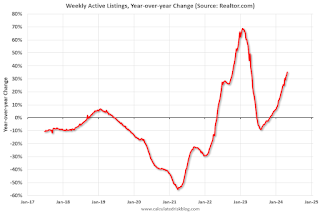 Here is a graph of the year-over-year change in inventory according to realtor.com.
Inventory was up year-over-year for the 26th consecutive week.
Realtor.com has monthly and weekly data on the existing home market. Here is their weekly report: Weekly Housing Trends View—Data for Week Ending May 4, 2024
• Active inventory increased, with for-sale homes 35.1% above year-ago levels
For the 26th straight week, there were more homes listed for sale versus the prior year, giving homebuyers more options. As mortgage rates have climbed to new 2024 highs, we could see sellers adjust their plans, since nearly three-quarters of potential sellers also plan to buy a home. However, the long buildup to listing—80% have been thinking about selling for 1 to 3 years—could mean that this year’s sellers are less deterred by market fluctuations.
• New listings—a measure of sellers putting homes up for sale—were up this week, by 3.6% from one year ago
Although the number of new listings kept rising, the rate of increase slowed considerably compared with the double-digit surges seen in recent weeks. This slowdown highlighted the extent to which sellers’ sentiments are influenced by mortgage rates.
As mortgage rates breach 7% once more, numerous home sellers might be inclined to postpone their selling endeavors. Should mortgage rates persist in their ascent, they will continue to suppress listing activities.
 Here is a graph of the year-over-year change in inventory according to realtor.com.
 Inventory was up year-over-year for the 26th consecutive week.
However, inventory is still historically very low.
New listings remain below typical pre-pandemic levels although up year-over-year.



