
 RSS Feed
 by Calculated Risk on 5/31/2022 09:11:00 AM
Tuesday, May 31, 2022
Case-Shiller: National House Price Index increased 20.6% year-over-year in March
S&P/Case-Shiller released the monthly Home Price Indices for March ("March" is a 3-month average of January, February and March prices).
This release includes prices for 20 individual cities, two composite indices (for 10 cities and 20 cities) and the monthly National index.
From S&P: S&P Corelogic Case-Shiller Index Reports Annual Home Price Gain Of 20.6% In March
The S&P CoreLogic Case-Shiller U.S. National Home Price NSA Index, covering all nine U.S. census divisions, reported a 20.6% annual gain in March, up from 20.0% in the previous month. The 10-City Composite annual increase came in at 19.5%, up from 18.7% in the previous month. The 20-City Composite posted a 21.2% year-over-year gain, up from 20.3% in the previous month.
Tampa, Phoenix, and Miami reported the highest year-over-year gains among the 20 cities in March. Tampa led the way with a 34.8% year-over-year price increase, followed by Phoenix with a 32.4% increase, and Miami with a 32.0% increase. Seventeen of the 20 cities reported higher price increases in the year ending March 2022 versus the year ending February 2022.
...
Before seasonal adjustment, the U.S. National Index posted a 2.6% month-over-month increase in March, while the 10-City and 20-City Composites posted increases of 2.8% and 3.1%, respectively
After seasonal adjustment, the U.S. National Index posted a month-over-month increase of 2.1%, and the 10-City and 20-City Composites posted increases of 2.2% and 2.4%, respectively.
In March, all 20 cities reported increases before and after seasonal adjustments.
“Those of us who have been anticipating a deceleration in the growth rate of U.S. home prices will have to wait at least a month longer,” says Craig J. Lazzara, Managing Director at S&P DJI. “The National Composite Index recorded a gain of 20.6% for the 12 months ended March 2022; the 10- and 20-City Composites rose 19.5% and 21.2%, respectively. For both National and 20-City Composites, March’s reading was the highest year-over-year price change in more than 35 years of data, with the 10-City growth rate at the 99th percentile of its own history.
“The strength of the Composite indices suggests very broad strength in the housing market, which we continue to observe. All 20 cities saw double-digit price increases for the 12 months ended in March, and price growth in 17 cities accelerated relative to February’s report. March’s price increase ranked in the top quintile of historical experience for every city, and in the top decile for 19 of them.
emphasis added
 Click on graph for larger image.
 The first graph shows the nominal seasonally adjusted Composite 10, Composite 20 and National indices (the Composite 20 was started in January 2000).
The Composite 10 index is up 2.2% in March (SA).
The Composite 20 index is up 2.4% (SA) in March.
The National index is 60% above the bubble peak (SA), and up 2.1% (SA) in March. The National index is up 117% from the post-bubble low set in February 2012 (SA).
 The second graph shows the year-over-year change in all three indices.
The Composite 10 SA is up 19.5% year-over-year. The Composite 20 SA is up 21.2% year-over-year.
The National index SA is up 20.6% year-over-year.
Price increases were above expectations. I'll have more later.
Monday, May 30, 2022
Tuesday: Case-Shiller House Prices, Chicago PMI, Dallas Fed Mfg
by Calculated Risk on 5/30/2022 09:03:00 PM
Weekend:
• Schedule for Week of May 29, 2022
Tuesday:
• At 9:00 AM ET, S&P/Case-Shiller House Price Index for March. The consensus is for a 20.0% year-over-year increase in the Comp 20 index for March.
• Also at 9:00 AM, FHFA House Price Index for March 2022. This was originally a GSE only repeat sales, however there is also an expanded index.
• At 9:45 AM, Chicago Purchasing Managers Index for May.
• At 10:00 AM, Dallas Fed Survey of Manufacturing Activity for May.
From CNBC: Pre-Market Data and Bloomberg futures S&P 500 are up 9 and DOW futures are up 12 (fair value).
Oil prices were up over the last week with WTI futures at $116.53 per barrel and Brent at $121.15 per barrel. A year ago, WTI was at $66 and Brent was at $69 - so WTI oil prices are up 75% year-over-year.
Here is a graph from Gasbuddy.com for nationwide gasoline prices. Nationally prices are at $4.59 per gallon. A year ago prices were at $3.04 per gallon, so gasoline prices are up $1.55 per gallon year-over-year.
Lawler: Large Builders Acquired Lots of Lots over the Last Year
by Calculated Risk on 5/30/2022 12:42:00 PM
Today, in the Calculated Risk Real Estate Newsletter: Lawler: Large Builders Acquired Lots of Lots over the Last Year
A brief excerpt:
Over the last year some of the nation’s largest home builders acquired an enormous number of lots – either owned outright or “controlled” via land purchase option or other contracts – over the last year in anticipation of a continuation of a strong and perhaps even over-heated economy. Here are the number of lots owned or “controlled” for the three largest home builders.There is more in the article. You can subscribe at https://calculatedrisk.substack.com/
...Obviously, the land/lot acquisition strategy of these (and other) builders over the last 15 months reflected an assumption that the exceptionally strong (frothy?) housing market over that period would continue throughout this year. If, in fact, housing demand slows considerably this year, then there could be some serious weakness in the land/lot markets.

Housing Inventory May 30th Update: Inventory UP 5.7% Week-over-week
by Calculated Risk on 5/30/2022 10:06:00 AM
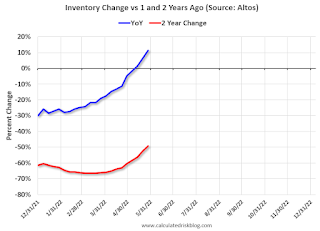
Altos reports inventory is up 11.4% year-over-year.
Inventory usually declines in the winter, and then increases in the spring. Inventory bottomed seasonally at the beginning of March 2022 and is now up 51% since then.
 Click on graph for larger image in graph gallery.
This inventory graph is courtesy of Altos Research.
As of May 27th, inventory was at 364 thousand (7-day average), compared to 344 thousand the prior week. Inventory was up 5.7% from the previous week.
Inventory is still very low. Compared to the same week in 2021, inventory is up 11.4% from 327 thousand, however compared to the same week in 2020 inventory is down 49.4% from 719 thousand. Compared to 3 years ago, inventory is down 61.6% from 948 thousand.
Inventory is still very low. Compared to the same week in 2021, inventory is up 11.4% from 327 thousand, however compared to the same week in 2020 inventory is down 49.4% from 719 thousand. Compared to 3 years ago, inventory is down 61.6% from 948 thousand.
Here are the inventory milestones I’m watching for with the Altos data:
1. The seasonal bottom (happened on March 4th for Altos) ✅
2. Inventory up year-over-year (happened on May 13th for Altos) ✅
3. Inventory up compared to two years ago (currently down 49.4% according to Altos)
4. Inventory up compared to 2019 (currently down 61.6%).
1. The seasonal bottom (happened on March 4th for Altos) ✅
2. Inventory up year-over-year (happened on May 13th for Altos) ✅
3. Inventory up compared to two years ago (currently down 49.4% according to Altos)
4. Inventory up compared to 2019 (currently down 61.6%).

Here is a graph of the inventory change year-over-year and vs two years ago (milestone 3 above).
The blue line is the year-over-year data, and the red line is compared to two years ago.
Two years ago (in 2020) inventory was declining all year, so the two-year comparison will get easier all year.
Mike Simonsen discusses this data regularly on Youtube.
Four High Frequency Indicators for the Economy
by Calculated Risk on 5/30/2022 08:40:00 AM
These indicators are mostly for travel and entertainment. It is interesting to watch these sectors recover as the pandemic subsides. Note: Apple has discontinued "Apple mobility", and restaurant traffic is mostly back to normal.
The TSA is providing daily travel numbers.
This data is as of May 29th.
 Click on graph for larger image.
This data shows the 7-day average of daily total traveler throughput from the TSA for 2019 (Light Blue), 2020 (Black), 2021 (Blue) and 2022 (Red).
The dashed line is the percent of 2019 for the seven-day average.
The 7-day average is down 9.5% from the same day in 2019 90.5% of 2019). (Dashed line)
Air travel has been moving sideways over the last three months, off about 10% from 2019.
 This data shows domestic box office for each week and the median for the years 2016 through 2019 (dashed light blue).
 Black is 2020, Blue is 2021 and Red is 2022.
The data is from BoxOfficeMojo through May 26th.
Note that the data is usually noisy week-to-week and depends on when blockbusters are released.
Movie ticket sales were at $98 million last week, down about 48% from the median for the week.
Note that the data is usually noisy week-to-week and depends on when blockbusters are released.
Movie ticket sales were at $98 million last week, down about 48% from the median for the week.
 This graph shows the seasonal pattern for the hotel occupancy rate using the four-week average.
 The red line is for 2022, black is 2020, blue is the median, and dashed light blue is for 2021. Dashed purple is 2019 (STR is comparing to a strong year for hotels).
This data is through May 21st. The occupancy rate was down 3.5% compared to the same week in 2019.
The 4-week average of the occupancy rate is at the median rate for the previous 20 years (Blue).
Notes: Y-axis doesn't start at zero to better show the seasonal change.
Notes: Y-axis doesn't start at zero to better show the seasonal change.
The 4-week average of the occupancy rate will now mostly move sideways seasonally until the summer travel season.
Here is some interesting data on New York subway usage (HT BR).
 This graph is from Todd W Schneider.
 This graph shows how much MTA traffic has recovered in each borough (Graph starts at first week in January 2020 and 100 = 2019 average).
Manhattan is at about 39% of normal.
This data is through Friday, May 27th.
He notes: "Data updates weekly from the MTA’s public turnstile data, usually on Saturday mornings".
Sunday, May 29, 2022
Energy expenditures as a percentage of PCE
by Calculated Risk on 5/29/2022 02:14:00 PM
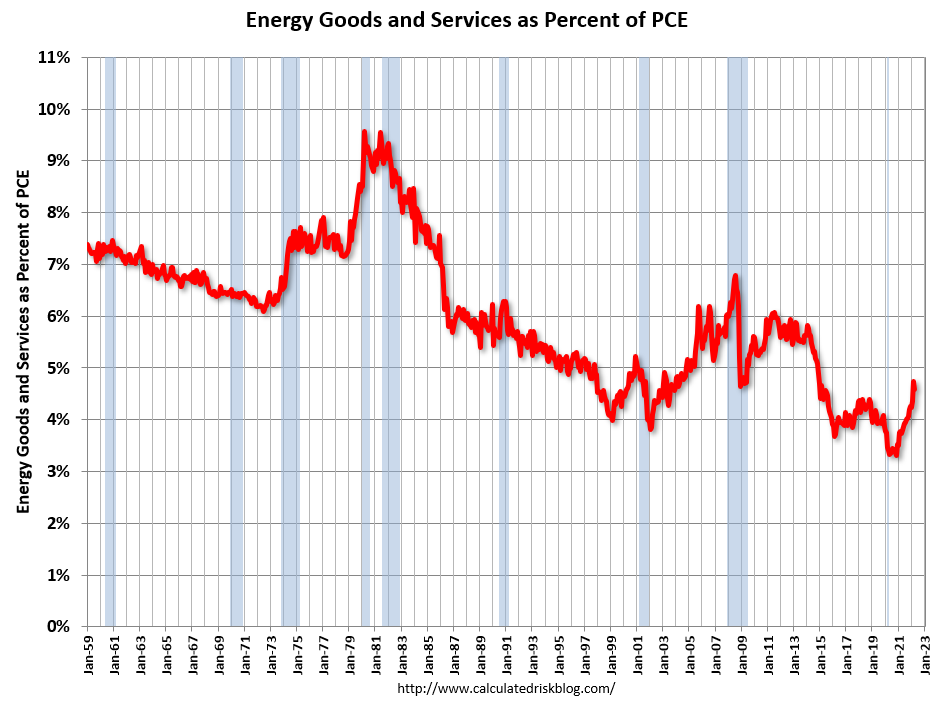
During the early stages of the pandemic, energy expenditures as a percentage of PCE hit an all-time low of 3.3% of PCE. Then energy expenditures increased to 2018 levels by the end of last year.
With the invasion of Ukraine, energy expenditures as a percentage of PCE increased further over the last few months.
Here is an update through the April 2022 PCE report.
This graph shows expenditures on energy goods and services as a percent of total personal consumption expenditures. This is one of the measures that Professor Hamilton at Econbrowser looks at to evaluate any drag on GDP from energy prices.

Click on graph for larger image.
Data source: BEA.
In general, energy expenditures as a percent of PCE has been trending down for decades. The huge spikes in energy prices during the oil crisis of 1973 and 1979 are obvious. As is the increase in energy prices during the 2001 through 2008 period.
This graph shows expenditures on energy goods and services as a percent of total personal consumption expenditures. This is one of the measures that Professor Hamilton at Econbrowser looks at to evaluate any drag on GDP from energy prices.
Click on graph for larger image.
Data source: BEA.
In general, energy expenditures as a percent of PCE has been trending down for decades. The huge spikes in energy prices during the oil crisis of 1973 and 1979 are obvious. As is the increase in energy prices during the 2001 through 2008 period.
In April 2022, energy expenditures as a percentage of PCE were at 4.6% of PCE, down slightly from the March level.
This is above the pre-pandemic level, but excluding March, this was the highest level since 2014.
Note: Professor Hamilton discusses the recent increase in energy prices here, and here is his slide deck: Sanctions, Oil Prices, and Recession. Hamilton's conclusion "oil price increase so far not enough to cause a recession"
Saturday, May 28, 2022
Real Estate Newsletter Articles this Week
by Calculated Risk on 5/28/2022 02:11:00 PM
At the Calculated Risk Real Estate Newsletter this week:
• The Household Mystery: Part II
• April New Home Sales Decline Sharply, almost 6 Months of Inventory Under Construction
• Final Look at Local Housing Markets in April
• Update: Delinquencies, Foreclosures and REO
• Realtor.com Reports Weekly Inventory Up 9% Year-over-year
This is usually published 4 to 6 times a week and provides more in-depth analysis of the housing market.
You can subscribe at https://calculatedrisk.substack.com/
Most content is available for free (and no Ads), but please subscribe!
Schedule for Week of May 29, 2022
by Calculated Risk on 5/28/2022 08:11:00 AM
The key report scheduled for this week is the May employment report.
Other key reports include the March Case-Shiller house prices, May ISM Manufacturing and Service surveys, and May Vehicle Sales.
All US markets will be closed in observance of Memorial Day.
 9:00 AM: S&P/Case-Shiller House Price Index for March.
This graph shows the year-over-year change in the seasonally adjusted National Index, Composite 10 and Composite 20 indexes through the most recent report (the Composite 20 was started in January 2000).
The consensus is for a 20.0% year-over-year increase in the Comp 20 index for March.
9:00 AM: FHFA House Price Index for March 2022. This was originally a GSE only repeat sales, however there is also an expanded index.
9:45 AM: Chicago Purchasing Managers Index for May.
10:00 AM: Dallas Fed Survey of Manufacturing Activity for May.
7:00 AM ET: The Mortgage Bankers Association (MBA) will release the results for the mortgage purchase applications index.
 10:00 AM ET: Job Openings and Labor Turnover Survey for April from the BLS.
 This graph shows job openings (yellow line), hires (purple), Layoff, Discharges and other (red column), and Quits (light blue column) from the JOLTS.
Jobs openings increased slightly in March to 11.549 million from 11.344 million in February. The number of job openings (yellow) were up 36% year-over-year.
10:00 AM: ISM Manufacturing Index for May. The consensus is for the ISM to be at 54.5, down from 55.4 in April.
10:00 AM: Construction Spending for April. The consensus is for a 0.5% increase in construction spending.
2:00 PM: the Federal Reserve Beige Book, an informal review by the Federal Reserve Banks of current economic conditions in their Districts.
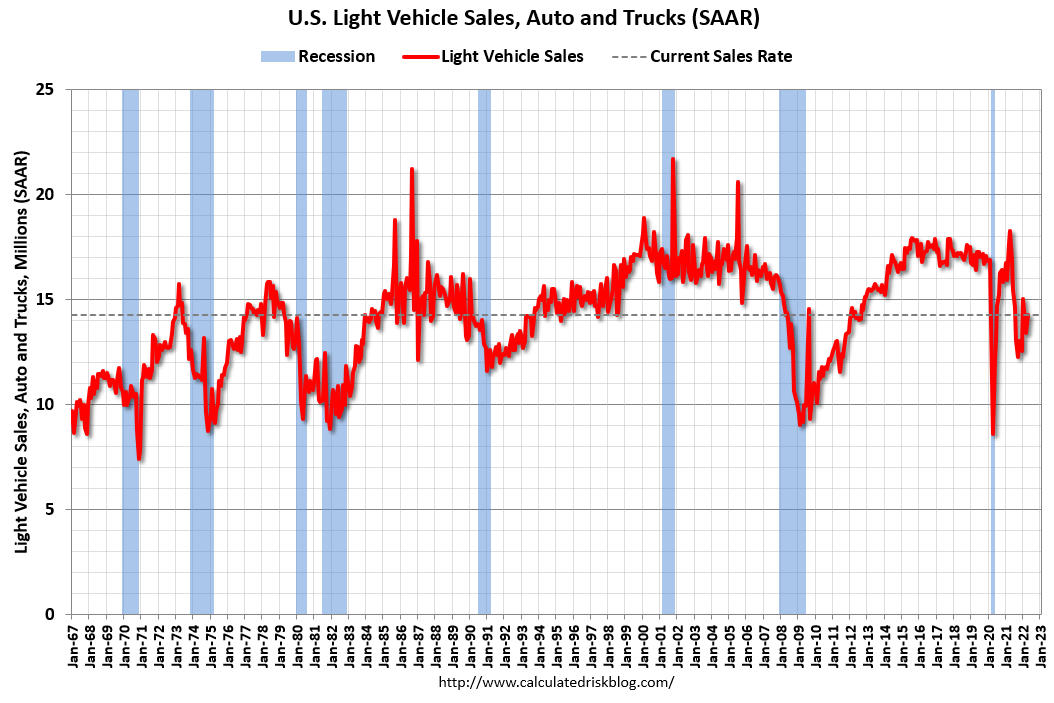 All day: Light vehicle sales for May. The consensus is for light vehicle sales to be 14.5 million SAAR in May, up from 14.3 million in April (Seasonally Adjusted Annual Rate).
Wards Auto is forecasting a decline in sales to 13.4 million SAAR.
This graph shows light vehicle sales since the BEA started keeping data in 1967. The dashed line is the sales rate for last month.
----- Thursday, June 2nd -----
8:15 AM: The ADP Employment Report for May. This report is for private payrolls only (no government). The consensus is for 280,000 payroll jobs added in May, up from 247,000 in April.
8:30 AM: The initial weekly unemployment claims report will be released. The consensus is for 210 thousand unchanged from 210 thousand last week.
----- Friday, June 3rd -----
 8:30 AM: Employment Report for May. The consensus is for 320,000 jobs added, and for the unemployment rate to decline to 3.5%.
There were 428,000 jobs added in April, and the unemployment rate was at 3.6%.
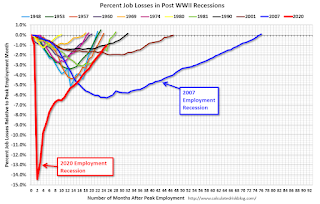
This graph shows the job losses from the start of the employment recession, in percentage terms.
The current employment recession was by far the worst recession since WWII in percentage terms. However, the current employment recession, 25 months after the onset, has recovered quicker than the previous two recessions.
10:00 AM: the ISM Services Index for May. The consensus is for a reading of 56.4, down from 57.1.
This graph shows light vehicle sales since the BEA started keeping data in 1967. The dashed line is the sales rate for last month.
8:15 AM: The ADP Employment Report for May. This report is for private payrolls only (no government). The consensus is for 280,000 payroll jobs added in May, up from 247,000 in April.
8:30 AM: The initial weekly unemployment claims report will be released. The consensus is for 210 thousand unchanged from 210 thousand last week.
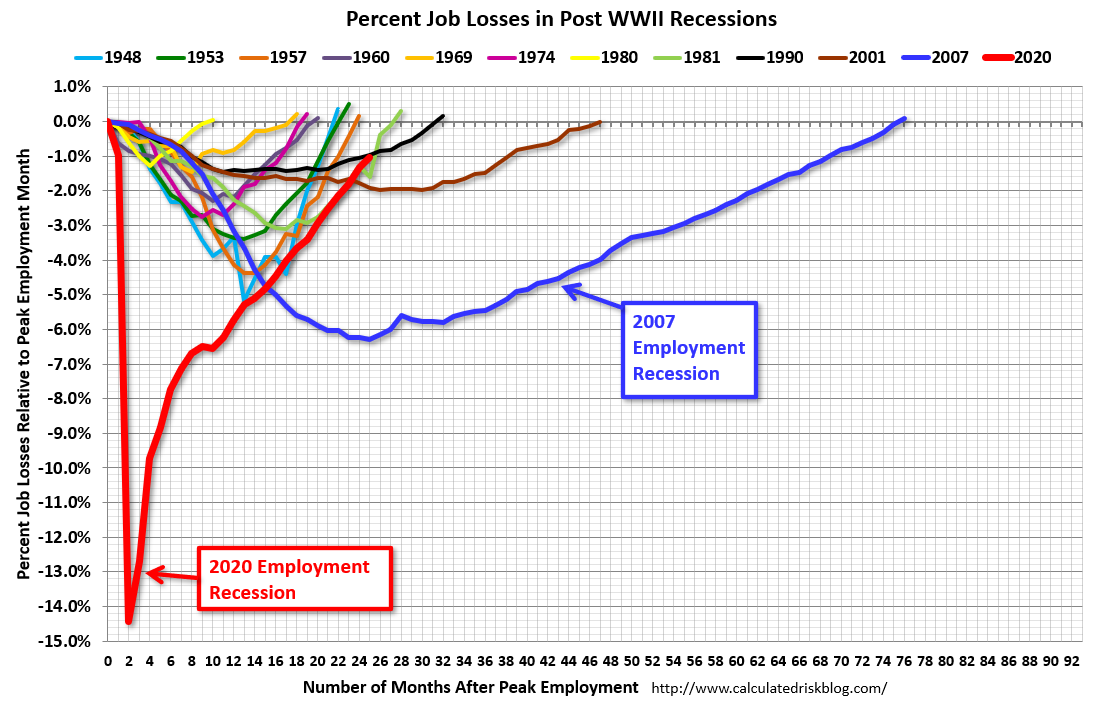 8:30 AM: Employment Report for May. The consensus is for 320,000 jobs added, and for the unemployment rate to decline to 3.5%.
There were 428,000 jobs added in April, and the unemployment rate was at 3.6%.
This graph shows the job losses from the start of the employment recession, in percentage terms.
The current employment recession was by far the worst recession since WWII in percentage terms. However, the current employment recession, 25 months after the onset, has recovered quicker than the previous two recessions.
10:00 AM: the ISM Services Index for May. The consensus is for a reading of 56.4, down from 57.1.
Friday, May 27, 2022
Q2 GDP Forecasts: Around 3.0%
by Calculated Risk on 5/27/2022 04:35:00 PM
From BofA:
We are tracking 3.0% qoq saar for 2Q GDP. Next week's trade data will be a big swing factor. [May 27 estimate]From Goldman:
emphasis added
The normalization in the trade balance was even larger than our previous assumptions, and we boosted our Q2 GDP tracking estimate by two tenths to +2.8% (qoq ar). [May 27 estimate]And from the Altanta Fed: GDPNow
The GDPNow model estimate for real GDP growth (seasonally adjusted annual rate) in the second quarter of 2022 is 1.9 percent on May 27, up from 1.8 percent on May 25. After this morning's releases from the US Bureau of Economic Analysis and the US Census Bureau, an increase in the nowcast of second-quarter real net exports was partially offset by a decrease in the nowcast of second-quarter real gross private domestic investment. [May 27 estimate]
Freddie Mac: Mortgage Serious Delinquency Rate decreased in April
by Calculated Risk on 5/27/2022 03:33:00 PM
Freddie Mac reported that the Single-Family serious delinquency rate in April was 0.85%, down from 0.92% March. Freddie's rate is down year-over-year from 2.15% in April 2021.
Freddie's serious delinquency rate peaked in February 2010 at 4.20% following the housing bubble and peaked at 3.17% in August 2020 during the pandemic.
These are mortgage loans that are "three monthly payments or more past due or in foreclosure".
 Click on graph for larger image
Mortgages in forbearance are being counted as delinquent in this monthly report but are not reported to the credit bureaus.
This is very different from the increase in delinquencies following the housing bubble. Lending standards have been fairly solid over the last decade, and most of these homeowners have equity in their homes - and they will be able to restructure their loans once (if) they are employed.
The serious delinquency rate was at 0.60% just prior to the pandemic - almost back.



