
 RSS Feed
 by Calculated Risk on 12/20/2021 02:21:00 PM
Monday, December 20, 2021
Review: Ten Economic Questions for 2021
At the end of last year, I posted Ten Economic Questions for 2021. I followed up with a brief post on each question. Here is review (we don't have all data yet, but enough). I've linked to my posts from the beginning of the year, with a brief excerpt and a few comments.
Note: Every year, I've posted a disclaimer that a recession could be caused by "An exogenous event such as a pandemic, significant military conflict, disruption of energy supplies for any reason, a major natural disaster (meteor strike, super volcano, etc), and a number of other low probability reasons" (emphasis added).
Unfortunately, 2020 saw one of those "low probability" events, and many of my predictions weren't even close. And I was wrong again on several questions in 2021 (I assumed "by mid-year people will engage in normal economic activity"). In a way, this is the point of the predictions. I don't have a crystal ball, but I think it helps to outline what I think will happen - and understand - and change my mind, when the outlook is wrong. As an example, when the pandemic hit, I switched from being mostly positive on the economy to calling a recession in early March 2020.
10) Question #10 for 2021: How much damage did the pandemic do to certain sectors?
"However, my sense is people will return to travel and entertainment activities once the pandemic ends (maybe less business travel - that would be a negative for airlines and hotels). The return might be slow at first, but people will gradually gain confidence.This has generally been correct, as the Seven High Frequency Indicators for the Economy shows. Also, certain areas of commercial real estate struggled in 2021, and business travel has been slow to return (compared to leisure travel).
So, once the pandemic subsides, my guess is certain sectors of CRE will still struggle, and possibly sectors related to business travel will be negatively impacted. "
This might be one of the most important housing questions for 2021!According to the October NAR report on existing home sales, inventory was down 12% year-over-year in November, and the months-of-supply was at 2.4 months. In 2020, inventory really declined due to a combination of potential sellers keeping their properties off the market during a pandemic, and a pickup in buying due to record low mortgage rates, a move away from multi-family rentals and strong second home buying (to escape the high-density cities). Inventory will be down again in 2021 and will probably set new record lows this Winter.
...
The bottom line is inventory will probably increase, especially in the 2nd half of 2021 (with the assumption that the pandemic will be mostly over by mid-year) - maybe back up to the 2017 - 2019 levels.
8) Question #8 for 2021: What will happen with house prices in 2021?
"My guess (based on my inventory forecast and a recovering economy) is that year-over-year price increases will probably be the strongest early in the year, and then soften somewhat towards the end of 2021. It seems likely that price appreciation will decrease from the 2020 pace, but still be in the mid-single digit range in 2021."This was way off. The CoreLogic data for October showed prices up 18.0% year-over-year. The September Case-Shiller data showed prices up 19.5% YoY. With inventory lower than expected, house prices picked up much more than expected.
7) Question #7 for 2021: How much will RI increase in 2021? How about housing starts and new home sales in 2021?
"My guess is starts will be up year-over-year in 2021 by high single digits. However, my guess is new home sales will soften in the second half of 2021 (based on my expectation of more existing home inventory), and will be up mid single digits (a decline from the sales rate over the last 5 months). It is even possible that sales will be flat to slightly down in 2021, but that will depend on inventory and the course of the pandemic."Through November, starts were up 16.3% year-over-year compared to the same period in 2019. New home sales were down 4.4% year--to-date through October. Starts were stronger than expected, but new home sales were down.
6) Question #6 for 2021: Will the Fed raise rates in 2021? What about the asset purchase program?
"There will be no rate hike in 2021, and since I'm assuming the pandemic will subside by mid-year 2021, it seems likely the Fed will taper asset purchases sometime in the second half of 2021."This was correct.
5) Question #5 for 2021: Will the core inflation rate increase in 2021? Will too much inflation be a concern in 2021?
"My guess is core PCE inflation (year-over-year) will increase in 2021 (from the current 1.4%), but I think too much inflation will NOT be a concern in 2021."According to the October Personal Income and Outlays report, the October PCE price index increased 4.1 percent year-over-year and the October PCE price index, excluding food and energy, increased 5.0 percent year-over-year. Inflation was higher than expected and is now a concern for many.
4) Question #4 for 2021: Will the overall participation rate increase to pre-pandemic levels (63.4% in February 2020) , or will it will only partially recover in 2021?
"My guess, based on the pandemic ending around mid-year, is that most of these people will return to the labor force. I don't expect that participation rate to increase to pre-pandemic levels (63.4%), but it seems reason[able that] the participation rate will increase to the mid-to-high 62s by year end."The Labor Force Participation Rate was at 61.8% in November. This remained lower than expected as many people didn't return to the labor force.
3) Question #3 for 2021: What will the unemployment rate be in December 2021?
"Depending on the estimate for the participation rate and job growth (next question), my guess is the unemployment rate will decline into the mid 5% range by December 2021 from the current 6.7%. Hopefully I'm too pessimistic."I was too pessimistic. The unemployment rates was at 4.2% in November, partially because participation remained lower than I expected.
2) Question #2 for 2021: Will all the jobs lost in 2020 return in 2021, or will job growth be sluggish?
"With 3.7 million permanent job losers - about 2.5 million more than at the beginning of 2020 - it seems unlikely the economy will add back the remaining 9 million jobs lost within a year, and also add jobs for new entrants in 2021. I think something like 6 to 8 million jobs could be added in 2021, but it will depend on ending the pandemic and appropriate fiscal policy. "As of the November employed report, the year-over-year change was +5.8 million jobs.. This was close to my guess.
1) Question #1 for 2021: How much will the economy grow in 2021?
"My guess is there are certain sectors that will be slow to recover, and some - like some sectors of commercial real estate - that will barely contribute to growth in 2021. These factors suggest real GDP growth probably in the 4.5% to 5.5% range in 2021, with some upside potential."It appears GDP growth will be close to 5.5% in 2021.
This was another difficult year. My biggest misses were on inflation, housing inventory, house prices and the unemployment rate. I was correct on the Fed, GDP growth, and close on new home sales and job growth.
Housing Inventory December 20th Update: Inventory Down 3.9% Week-over-week
by Calculated Risk on 12/20/2021 10:07:00 AM
Tracking existing home inventory is very important this year and in 2022.
Inventory usually declines sharply over the holidays - so we will likely see new record lows in the next few weeks.
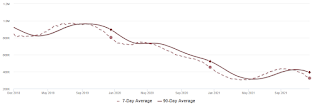
This inventory graph is courtesy of Altos Research.
As of December 17th, inventory was at 326 thousand (7-day average), compared to 454 thousand for the same week a year ago. That is a decline of 28.2%. Inventory is down 3.9% from last week.
Compared to the same week in 2019, inventory is down 59.5% from 804 thousand. A week ago, inventory was at 339 thousand, and was down 27.7% YoY.
Seasonally, inventory bottomed in April (usually inventory bottoms in January or February). Inventory last week was about 6.3% above the record low set-in early April.
Inventory peaked for the year in early September, when inventory was at 437 thousand (the peak for the year), so inventory is currently off about 25.5% from the peak for the year.
Mike Simonsen discusses this data regularly on Youtube.
Seven High Frequency Indicators for the Economy
by Calculated Risk on 12/20/2021 08:32:00 AM
These indicators are mostly for travel and entertainment. It is interesting to watch these sectors recover as the pandemic subsides.
The TSA is providing daily travel numbers.
This data is as of December 19th.
 Click on graph for larger image.
This data shows the 7-day average of daily total traveler throughput from the TSA for 2019 (Light Blue), 2020 (Blue) and 2021 (Red).
The dashed line is the percent of 2019 for the seven-day average.
The 7-day average is down 17.7% from the same day in 2019 (82.3% of 2019). (Dashed line)
Air travel had been off about 20% relative to 2019 for the last four months (with some ups and downs) - but picked up over the Thanksgiving holiday week.
The second graph shows the 7-day average of the year-over-year change in diners as tabulated by OpenTable for the US and several selected cities.
IMPORTANT: OpenTable notes: "we’ve updated the data including downloadable dataset from January 1, 2021 onward to compare seated diners from 2021 to 2019, as opposed to year over year." Thanks!
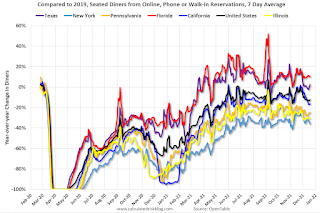 Thanks to OpenTable for providing this restaurant data:
This data is updated through December 18, 2021.
This data is "a sample of restaurants on the OpenTable network across all channels: online reservations, phone reservations, and walk-ins. For year-over-year comparisons by day, we compare to the same day of the week from the same week in the previous year."
Note that this data is for "only the restaurants that have chosen to reopen in a given market". Since some restaurants have not reopened, the actual year-over-year decline is worse than shown.
Dining is mostly moving sideways, and there has been no significant decline - yet - due to the winter wave of COVID. The 7-day average for the US is down 12% compared to 2019.
Thanks to OpenTable for providing this restaurant data:This data is updated through December 18, 2021.
This data is "a sample of restaurants on the OpenTable network across all channels: online reservations, phone reservations, and walk-ins. For year-over-year comparisons by day, we compare to the same day of the week from the same week in the previous year."
Note that this data is for "only the restaurants that have chosen to reopen in a given market". Since some restaurants have not reopened, the actual year-over-year decline is worse than shown.
Dining is mostly moving sideways, and there has been no significant decline - yet - due to the winter wave of COVID. The 7-day average for the US is down 12% compared to 2019.
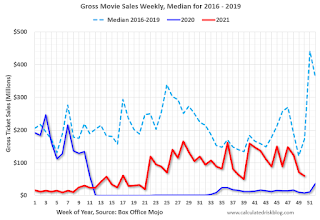 This data shows domestic box office for each week and the median for the years 2016 through 2019 (dashed light blue).
 Blue is 2020 and Red is 2021.
The data is from BoxOfficeMojo through December 16th.
Note that the data is usually noisy week-to-week and depends on when blockbusters are released.
Movie ticket sales were at $59 million last week, down about 66% from the median for the week.
Note that the data is usually noisy week-to-week and depends on when blockbusters are released.
Movie ticket sales were at $59 million last week, down about 66% from the median for the week.
The numbers next week will include the newest Spider Man.
 This graph shows the seasonal pattern for the hotel occupancy rate using the four week average.
 The red line is for 2021, black is 2020, blue is the median, dashed purple is 2019, and dashed light blue is for 2009 (the worst year on record for hotels prior to 2020).
This data is through December 11th. The occupancy rate was down 4.8% compared to the same week in 2019. Although down compared to 2019, the 4-week average of the occupancy rate is now above the median rate for the previous 20 years (Blue).
Notes: Y-axis doesn't start at zero to better show the seasonal change.
The 4-week average occupancy rate will now decline seasonally into the new year.
 This graph, based on weekly data from the U.S. Energy Information Administration (EIA), shows gasoline supplied compared to the same week of 2019.
Blue is for 2020. Red is for 2021.
As of December 10th, gasoline supplied was up 0.6% compared to the same week in 2019.
This was the 12th week this year that gasoline supplied was up compared to the same week in 2019 - so consumption is running close to 2019 levels now.
This graph is from Apple mobility. From Apple: "This data is generated by counting the number of requests made to Apple Maps for directions in select countries/regions, sub-regions, and cities." This is just a general guide - people that regularly commute probably don't ask for directions.
There is also some great data on mobility from the Dallas Fed Mobility and Engagement Index. However the index is set "relative to its weekday-specific average over January–February", and is not seasonally adjusted, so we can't tell if an increase in mobility is due to recovery or just the normal increase in the Spring and Summer.
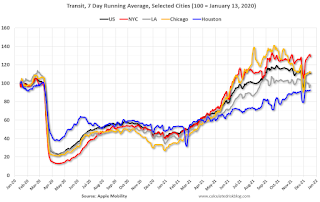 This data is through December 17th
 for the United States and several selected cities.
The graph is the running 7-day average to remove the impact of weekends.
IMPORTANT: All data is relative to January 13, 2020. This data is NOT Seasonally Adjusted. People walk and drive more when the weather is nice, so I'm just using the transit data.
According to the Apple data directions requests, public transit in the 7-day average for the US is at 111% of the January 2020 level.
The graph is the running 7-day average to remove the impact of weekends.
IMPORTANT: All data is relative to January 13, 2020. This data is NOT Seasonally Adjusted. People walk and drive more when the weather is nice, so I'm just using the transit data.
According to the Apple data directions requests, public transit in the 7-day average for the US is at 111% of the January 2020 level.
New York City is doing well by this metric, but subway usage in NYC is down significantly (next graph).
----- New York City Subway Usage -----
Here is some interesting data on New York subway usage (HT BR).
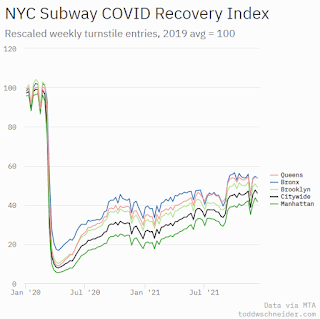 This graph is from Todd W Schneider.
Here is some interesting data on New York subway usage (HT BR).
This graph is from Todd W Schneider. This graph shows how much MTA traffic has recovered in each borough (Graph starts at first week in January 2020 and 100 = 2019 average).
Manhattan is at about 42% of normal.
This data is through Friday, December 17th.
He notes: "Data updates weekly from the MTA’s public turnstile data, usually on Saturday mornings".
Sunday, December 19, 2021
Sunday Night Futures
by Calculated Risk on 12/19/2021 06:48:00 PM
Weekend:
• Schedule for Week of December 19, 2021
Monday:
• No major economic releases scheduled.
From CNBC: Pre-Market Data and Bloomberg futures S&P 500 futures are down 12 and DOW futures are down 134 (fair value).
Oil prices were down over the last week with WTI futures at $69.18 per barrel and Brent at $72.07 per barrel. A year ago, WTI was at $49, and Brent was at $52 - so WTI oil prices are up 40% year-over-year.
Here is a graph from Gasbuddy.com for nationwide gasoline prices. Nationally prices are at $3.29 per gallon. A year ago prices were at $2.21 per gallon, so gasoline prices are up $1.08 per gallon year-over-year.
Saturday, December 18, 2021
Real Estate Newsletter Articles this Week
by Calculated Risk on 12/18/2021 02:11:00 PM
At the Calculated Risk Real Estate Newsletter this week:
• 4th Look at Local Housing Markets in November This update adds Austin, California, Des Moines, Memphis, Minneapolis, Minnesota, Rhode Island, and Sacramento.
• November Housing Starts: Most Housing Units Under Construction Since 1973 Housing Starts Increased to 1.679 million Annual Rate in November
• The Household Mystery Looking back at People per Household in the '70s
• 3rd Look at Local Housing Markets in November Looks like we will see new record low inventories this winter
This is usually published several times a week, and provides more in-depth analysis of the housing market.
The blog will continue as always!
You can subscribe at https://calculatedrisk.substack.com/ Currently all content is available for free - and some will always be free - but please subscribe!.
You can subscribe at https://calculatedrisk.substack.com/ Currently all content is available for free - and some will always be free - but please subscribe!.
Schedule for Week of December 19, 2021
by Calculated Risk on 12/18/2021 08:11:00 AM
Happy Holidays and Merry Christmas!
The key economic reports this week are New Home Sales, Existing Home Sales, the 3rd estimate of Q3 GDP, and November Personal income and outlays.
No major economic releases scheduled.
No major economic releases scheduled.
7:00 AM ET: The Mortgage Bankers Association (MBA) will release the results for the mortgage purchase applications index.
8:30 AM: Gross Domestic Product, 3rd quarter 2021 (Third estimate). The second estimate of GDP was 2.1%.
8:30 AM: Chicago Fed National Activity Index for November. This is a composite index of other data.
 10:00 AM: Existing Home Sales for November from the National Association of Realtors (NAR). The consensus is for 6.20 million SAAR, down from 6.34 million.
The graph shows existing home sales from 1994 through the report last month.
Housing economist Tom Lawler expects the NAR to report sales of 6.45 million SAAR for November.
8:30 AM: The initial weekly unemployment claims report will be released. Initial claims were 206 thousand last week.
8:30 AM: Durable Goods Orders for November.
8:30 AM: Personal Income and Outlays for November. The consensus is for a 0.2% increase in personal income, and for a 1.0% increase in personal spending.
 10:00 AM: New Home Sales for November from the Census Bureau.
 This graph shows New Home Sales since 1963. The dashed line is the sales rate for last month.
New home sales were at 745 thousand in October.
10:00 AM: University of Michigan's Consumer sentiment index (Final for December).
All US markets will be closed in observance of the Christmas Holiday.
Friday, December 17, 2021
December 17th COVID-19: Cases, Hospitalizations and Deaths Increasing
by Calculated Risk on 12/17/2021 07:24:00 PM
The CDC is the source for all data.
| COVID Metrics | ||||
|---|---|---|---|---|
| Today | Week Ago | Goal | ||
| Percent fully Vaccinated | 61.3% | --- | ≥70.0%1 | |
| Fully Vaccinated (millions) | 203.5 | --- | ≥2321 | |
| New Cases per Day3🚩 | 122,296 | 120,444 | ≤5,0002 | |
| Hospitalized3🚩 | 59,995 | 54,937 | ≤3,0002 | |
| Deaths per Day3🚩 | 1,179 | 1,090 | ≤502 | |
| 1 Minimum to achieve "herd immunity" (estimated between 70% and 85%). 2my goals to stop daily posts, 37-day average for Cases, Currently Hospitalized, and Deaths 🚩 Increasing 7-day average week-over-week for Cases, Hospitalized, and Deaths ✅ Goal met. | ||||
 Click on graph for larger image.
This graph shows the daily (columns) and 7-day average (line) of positive tests reported.
Lawler: Early Read on Existing Home Sales in November
by Calculated Risk on 12/17/2021 11:50:00 AM
From housing economist Tom Lawler:
Based on publicly-available local realtor/MLS reports released across the country through today, I project that existing home sales as estimated by the National Association of Realtors ran at a seasonally adjusted annual rate of 6.45 million in November, up 1,7% from October’s preliminary pace but down 2.1% from last November’s seasonally adjusted pace. Unadjusted sales should be little changed from a year earlier, with the SA/NSA difference reflecting this November’s higher business day count relative to last November’s.
Local realtor reports, as well as reports from national inventory trackers, suggest that the YOY % decline in the inventory of existing homes for sale last month was larger than was the case in October.
Finally, local realtor/MLS reports suggest the median existing single-family home sales price last month was up by about 13.0% from last November.
CR Note: The National Association of Realtors (NAR) is scheduled to release November existing home sales on Wednesday, December 22, 2021, at 10:00 AM ET. The consensus is for 6.20 million SAAR. Take the over.
Q4 GDP Forecasts: Up to 7%
by Calculated Risk on 12/17/2021 10:01:00 AM
From Goldman Sachs:
We boosted our Q4 GDP tracking estimate by 0.5pp to +7.0% (qoq ar), reflecting the further recovery in auto production and the sharp rise in housing starts in November. [December 16 estimate]From BofA:
emphasis added
4Q GDP tracking moved up to 6.5% qoq saar from 6.0%, reflecting the strong signal from the BAC card spending data. [December 10 estimate]And from the Altanta Fed: GDPNow
The GDPNow model estimate for real GDP growth (seasonally adjusted annual rate) in the fourth quarter of 2021 is 7.2 percent on December 16, up from 7.0 percent on December 15. [December 16 estimate]
4th Look at Local Housing Markets in November
by Calculated Risk on 12/17/2021 08:07:00 AM
Today, in the Real Estate Newsletter: 4th Look at Local Housing Markets in November
Excerpt:
This update adds Austin, California, Des Moines, Memphis, Minneapolis, Minnesota, Rhode Island, and Sacramento.
...
Here is a summary of active listings for these housing markets in November. Inventory was down 15.3% in November month-over-month (MoM) from October, and down 26.7% year-over-year (YoY).
Inventory almost always declines seasonally in November, so the MoM decline is not a surprise. Last month, these markets were down 23.4% YoY, so the YoY decline in November is larger than in October. This isn’t indicating a slowing market.
Notes for all tables:
1. New additions to table in BOLD.
2. Northwest (Seattle), North Texas (Dallas), and Santa Clara (San Jose), Jacksonville, Source: Northeast Florida Association of REALTORS®
3. Totals do not include Denver or Minneapolis (included in state totals).



