
 RSS Feed
 by Calculated Risk on 9/22/2015 10:03:00 AM
Tuesday, September 22, 2015
Richmond Fed: "Manufacturing Sector Activity Generally Softened" in September
From the Richmond Fed: Manufacturing Sector Activity Generally Softened; Average Wages Grew Moderately
Fifth District manufacturing activity slowed in September, according to the most recent survey by the Federal Reserve Bank of Richmond. Order backlogs and new orders decreased, while shipments declined. Average wages continued to increase at a moderate pace this month, however manufacturing employment grew mildly.This was another weak regional manufacturing report.
Overall, manufacturing conditions weakened in September. The composite index for manufacturing decreased to a reading of −5, following last month's reading of 0. The index for shipments remained negative, only gaining one point to end at −3. Additionally, the volume of new orders decreased this month. At an index of −12, the September indicator lost 13 points from last month's reading of 1. Manufacturing employment increased mildly this month. The indicator added two points, ending at a reading of 3.
emphasis added
FHFA House Price Index Up 0.6 Percent in July, Up 5.8 Percent YoY
by Calculated Risk on 9/22/2015 09:08:00 AM
Note: I follow several house price indexes (Case-Shiller, CoreLogic, Black Knight, Zillow, FHFA, FNC and more).
From the FHFA: FHFA House Price Index Up 0.6 Percent in July
U.S. house prices rose in July, up 0.6 percent on a seasonally adjusted basis from the previous month, according to the Federal Housing Finance Agency (FHFA) monthly House Price Index (HPI). The previously reported 0.2 percent change in June remains unchanged.
The FHFA HPI is calculated using home sales price information from mortgages sold to, or guaranteed by, Fannie Mae and Freddie Mac. From July 2014 to July 2015, house prices were up 5.8 percent. The U.S. index is 1.1 percent below its March 2007 peak and is roughly the same as the November 2006 index level.
 Click on graph for larger image.
This graph from the FHFA shows the FHFA purchase only index since 1991. The index is almost back to the March 2007 peak in nominal terms, but is well below the peak in real terms (adjusted for inflation).
Most of the other indexes are also showing the year-over-year change in the 5% range. For example, Case-Shiller was up 4.5% in June, and CoreLogic was up 6.9% in July.
Note: The July Case-Shiller index will be released next Tuesday, September 29th.
Monday, September 21, 2015
Lawler on Lennar: Net Home Orders Up by “Decent” Amount Last Quarter, Houston Weak
by Calculated Risk on 9/21/2015 07:36:00 PM
Tuesday:
• At 9:00 AM ET, FHFA House Price Index for July 2015. This was originally a GSE only repeat sales, however there is also an expanded index. The consensus is for a 0.4% month-to-month increase for this index.
• 10:00 AM, Richmond Fed Survey of Manufacturing Activity for September.
From housing economist Tom Lawler: Lennar: Net Home Orders Up by “Decent” Amount Last Quarter, Though Weakness in Houston Limits Overall Gain
Lennar Corporation reported that net home orders in the quarter ended August 31, 2015 totaled 6,495, up 10.3% from the comparable quarter of 2014. Regionally the “soft spot” in home orders was in Houston, where net orders (606) were down 12.0% from a year ago. Home deliveries last quarter totaled 6,318, up 15.8% from the comparable quarter of 2014, at an average sales price of $350,000, up 5.1% from a year earlier. The company’s order backlog at the end of August was 8,250, up 13.2% from last August, at an average order price of $366,000, up7.6% from a year ago.
On the conference call officials mentioned labor “shortages” in some areas and noted that labor costs were up about 10% over the last year. They also noted that land costs in many of its markets were up by well more than that. Officials said that the company’s “first-time buyer” share had increased from about 25% a year ago to 30%, and that the company was focusing a little more on less expensive homes, via a combination of higher density (and more attached homes), fewer amenities, and smaller size.
Lawler: Updated Table of Distressed Sales and Cash buyers for Selected Cities in August
by Calculated Risk on 9/21/2015 05:13:00 PM
Economist Tom Lawler sent me an updated table below of short sales, foreclosures and cash buyers for selected cities in August.
On distressed: Total "distressed" share is down in most of these markets. Distressed sales are up in the Mid-Atlantic due to an increase in foreclosures.
Short sales are down in all of these areas.
The All Cash Share (last two columns) is declining year-over-year. As investors pull back, the share of all cash buyers will probably continue to decline.
| Short Sales Share | Foreclosure Sales Share | Total "Distressed" Share | All Cash Share | |||||
|---|---|---|---|---|---|---|---|---|
| Jul- 2015 | Aug- 2014 | Aug- 2015 | Aug- 2014 | Aug- 2015 | Aug- 2014 | Aug- 2015 | Aug- 2014 | |
| Las Vegas | 6.2% | 11.5% | 7.0% | 8.9% | 13.2% | 20.4% | 28.2% | 32.1% |
| Phoenix | 2.7% | 3.9% | 4.3% | 6.2% | 7.0% | 10.1% | 22.6% | 25.2% |
| Sacramento | 4.3% | 6.4% | 3.8% | 5.4% | 8.0% | 11.8% | 18.8% | 20.2% |
| Minneapolis | 1.7% | 2.5% | 6.0% | 8.1% | 7.6% | 10.6% | ||
| Mid-Atlantic | 3.2% | 4.1% | 10.5% | 8.9% | 13.7% | 13.0% | 16.5% | 17.5% |
| Orlando | 3.6% | 7.2% | 21.0% | 25.7% | 24.6% | 32.9% | 35.5% | 42.2% |
| Florida SF | 3.6% | 6.0% | 16.6% | 21.2% | 20.2% | 27.3% | 33.6% | 38.6% |
| Florida C/TH | 2.3% | 4.3% | 15.3% | 19.1% | 17.6% | 23.3% | 59.7% | 64.5% |
| Bay Area CA* | 2.3% | 2.6% | 2.2% | 2.6% | 4.5% | 5.2% | 21.3% | 22.5% |
| So. California* | 3.2% | 4.2% | 3.9% | 4.3% | 7.1% | 8.5% | 21.8% | 24.9% |
| Rhode Island | 9.9% | 12.5% | ||||||
| Chicago (city) | 15.0% | 17.2% | ||||||
| Hampton Roads | 14.6% | 18.6% | ||||||
| Spokane | 10.1% | 11.1% | ||||||
| Northeast Florida | 26.2% | 32.5% | ||||||
| Toledo | 30.3% | 32.2% | ||||||
| Wichita | 22.4% | 25.7% | ||||||
| Tucson | 25.8% | 26.0% | ||||||
| Peoria | 17.3% | 21.3% | ||||||
| Georgia*** | 21.9% | 26.8% | ||||||
| Omaha | 16.9% | 18.3% | ||||||
| Pensacola | 30.6% | 32.7% | ||||||
| Richmond VA | 9.3% | 9.5% | 16.0% | 17.9% | ||||
| Memphis | 11.8% | 11.1% | ||||||
| Springfield IL** | 5.9% | 6.8% | ||||||
| *share of existing home sales, based on property records **Single Family Only ***GAMLS | ||||||||
Lawler on Existing Home Sales
by Calculated Risk on 9/21/2015 03:49:00 PM
In a report released today, the National Association of Realtors estimated that US existing home sales ran at a seasonally adjusted annual rate of 5.31 million, down 4.8% from July’s downwardly-revised (to 5.58 million from 5.59 million) pace and up 6.2% from last August’s seasonally-adjusted pace. The NAR’s estimate was way below both consensus and my estimate from early last week based on regional tracking.
Part of my “miss” was a “misread” of this August’s seasonal factors, which I had assumed would be significantly (rather than just slightly) lower than last August’s seasonal factor (related to the timing of Labor Day.)
In addition, most realtor/MLS reports released subsequent to when I issued my forecast – including many released today – came in below what I had assumed (I put out my “early read” after getting enough local realtor/MLS reports to produce a “reasonable” projection).
However, even after taking into account publicly-available reports released through today, my “regional tracking methodology” comes up with faster YOY growth in sales (on a not seasonally adjusted basis) than that shown by the NAR.
Net, my forecast for August existing home sales as measured by the National Association of Realtors was way off track, and I apologize for this.
The NAR also estimated that the inventory of existing homes for sale at the end of August was 2.29 million, up 1.3% from July’s upwardly-revised (to 2.26 million from 2.24 million) level and down 1.7% from last August. Local realtor/MLS data suggested to me that the August inventory level would be down slightly from July.
Finally, the NAR estimated that the median existing SF home sales price in August was $230,200, up 5.1% from a year earlier. This YOY increase was slightly higher than my forecast.
A Few Random Comments on August Existing Home Sales
by Calculated Risk on 9/21/2015 12:31:00 PM
I've been expecting that the seasonally adjusted pace for existing home sales would slow due to limited inventory and higher prices. Maybe this is the beginning of that slowdown.
However, it is important to remember that new home sales are more important for jobs and the economy than existing home sales. Since existing sales are existing stock, the only direct contribution to GDP is the broker's commission. There is usually some additional spending with an existing home purchase - new furniture, etc - but overall the economic impact is small compared to a new home sale.
So some slowing for existing home sales (if it continues) would not be a big deal for the economy.
Even though inventory was up a little month-to-month, Inventory is still very low (down 1.7% year-over-year in August). More inventory would probably mean smaller price increases and slightly higher sales, and less inventory means lower sales and somewhat larger price increases.
Note: I'm still hearing reports of rising inventory in some mid-to-higher priced areas. However many low priced areas still have little inventory.
Also, the NAR reported distressed sales declined a little further year-over-year:
Matching the lowest share since NAR began tracking in October 2008, distressed sales — foreclosures and short sales — remained at 7 percent in August for the second consecutive month; they were 8 percent a year ago. Five percent of August sales were foreclosures and 2 percent were short sales.The following graph shows existing home sales Not Seasonally Adjusted (NSA).
 Click on graph for larger image.
Sales NSA in August (red column) were higher than in August 2014, but below the level of August 2013 (NSA).
Earlier:
• Existing Home Sales in August: 5.31 million SAAR
Existing Home Sales in August: 5.31 million SAAR
by Calculated Risk on 9/21/2015 10:13:00 AM
From the NAR: Existing-Home Sales Stall in August, Prices Moderate
Total existing–home sales, which are completed transactions that include single–family homes, townhomes, condominiums and co–ops, fell 4.8 percent to a seasonally adjusted annual rate of 5.31 million in August from a slight downward revision of 5.58 million in July. Despite last month's decline, sales have risen year–over–year for 11 consecutive months and are 6.2 percent above a year ago (5.00 million). ...
Total housing inventory at the end of August rose 1.3 percent to 2.29 million existing homes available for sale, but is 1.7 percent lower than a year ago (2.33 million). Unsold inventory is at a 5.2–month supply at the current sales pace, up from 4.9 months in July.
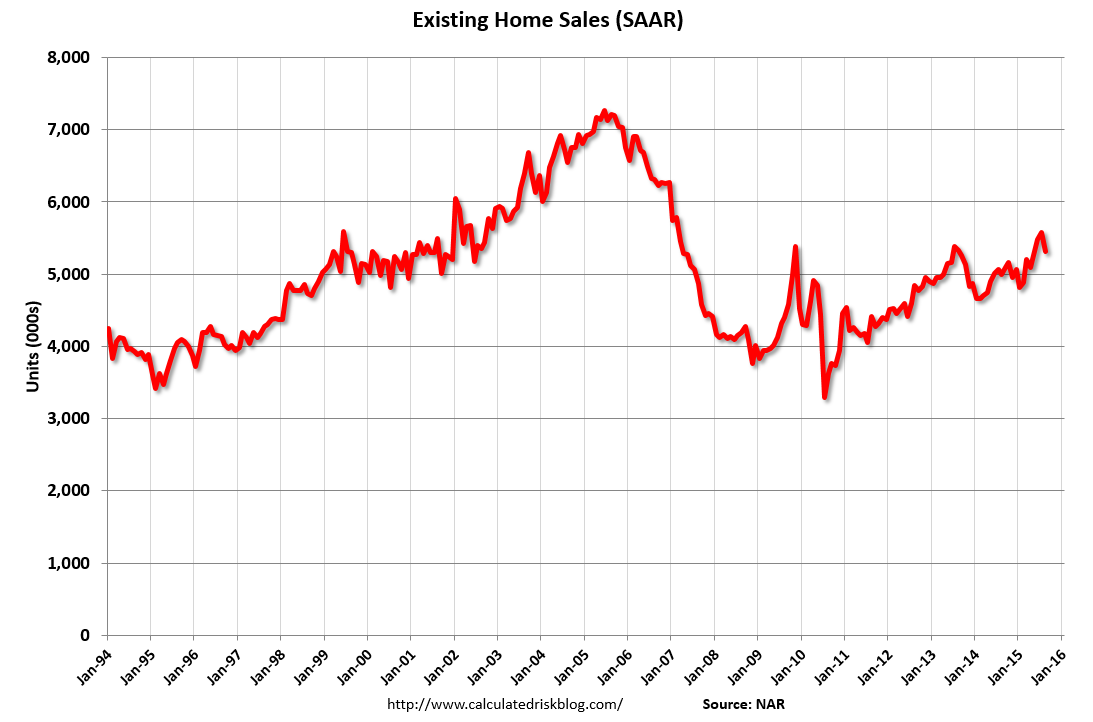 Click on graph for larger image.
This graph shows existing home sales, on a Seasonally Adjusted Annual Rate (SAAR) basis since 1993.
Sales in August (5.31 million SAAR) were 4.8% lower than last month, and were 6.2% above the August 2014 rate.
The second graph shows nationwide inventory for existing homes.
 According to the NAR, inventory increased to 2.29 million in August from 2.26 million in July. Headline inventory is not seasonally adjusted, and inventory usually decreases to the seasonal lows in December and January, and peaks in mid-to-late summer.
The third graph shows the year-over-year (YoY) change in reported existing home inventory and months-of-supply. Since inventory is not seasonally adjusted, it really helps to look at the YoY change. Note: Months-of-supply is based on the seasonally adjusted sales and not seasonally adjusted inventory.
 Inventory decreased 1.7% year-over-year in August compared to August 2014.
 Months of supply was at 5.2 months in August.
This was below expectations of sales of 5.50 million. For existing home sales, a key number is inventory - and inventory is still low. I'll have more later ...
Sunday, September 20, 2015
Monday: Existing Home Sales
by Calculated Risk on 9/20/2015 09:23:00 PM
Weekend:
• Schedule for Week of September 20, 2015
Monday:
• Existing Home Sales for August from the National Association of Realtors (NAR). The consensus is for 5.50 million SAAR, down from 5.59 million in July. Economist Tom Lawler estimates the NAR will report sales of 5.54 million SAAR.
From CNBC: Pre-Market Data and Bloomberg futures: currently S&P futures are down 3 and DOW futures are mostly unchanged (fair value).
Oil prices were down slightly over the last week with WTI futures at $44.83 per barrel and Brent at $47.53 per barrel. A year ago, WTI was at $92, and Brent was at $97 - so prices are down over 50% year-over-year.
Here is a graph from Gasbuddy.com for nationwide gasoline prices. Nationally prices are at $2.29 per gallon (down over $1.00 per gallon from a year ago).
CoStar: Commercial Real Estate prices "indices post moderate gains" in July, up 12% year-over-year
by Calculated Risk on 9/20/2015 11:59:00 AM
Here is a price index for commercial real estate that I follow.
From CoStar: CCRSI: Composite Price Indices Post Moderate Gains in July
NATIONAL COMPOSITE PRICE INDICES POST MODERATE GAINS IN JULY. Both the equal- and value-weighted national composite price indices advanced in July 2015 as a combination of strong market fundamentals, low interest rates and improving market liquidity continued to support conditions for CRE price growth. However, the pace of price growth cooled slightly from that of the previous six months ending in June 2015.
...
MODERATION IN PRICE GROWTH MOST EVIDENT AT HIGH END OF THE MARKET. The moderation in the rate of price growth was especially evident at the high end of the market where pricing has already exceeded prior peak levels. CoStar’s value-weighted U.S. Composite Index, which is influenced by high-value trades, advanced 0.3% in July 2015 compared with a 1.1% average monthly pace from January 2015 through June 2015. The value-weighted U.S. Composite Index is already more than 13% above its prerecession peak level. The equal-weighted U.S. Composite Index increased 0.9% in July 2015, down slightly from the 1.1% average monthly pace from January 2015 to June 2015. It has now advanced to within 7.5% of its prerecession peak, supported by increased investor interest beyond core properties in primary markets.
emphasis added
 Click on graph for larger image.
This graph from CoStar shows the the value-weighted U.S. Composite Index and the equal-weighted U.S. Composite Index indexes.
The value-weighted index increased 0.3% in July and is up 12.9% year-over-year.
The equal-weighted index inceased 0.9% in July and up 11.7% year-over-year.
Note: These are repeat sales indexes - like Case-Shiller for residential - but this is based on far fewer pairs.
Saturday, September 19, 2015
Fed's Williams and Bullard on Rate Hikes
by Calculated Risk on 9/19/2015 05:45:00 PM
First San Francisco Fed President John Williams explains why he is willing to be patient on rate hikes: China, Rates, and the Outlook: May the (Economic) Force Be with You
Regarding monetary policy, we’re balancing a number of considerations, some of which argue for greater patience in raising rates and others that argue for acting sooner rather than later. Our decisions reflect a careful judgment about the relative risks and merits of those factors.Second, St. Louis Fed President James Bullard President explains why he supported a rate hike: St. Louis Fed's Bullard Discusses Normalization of U.S. Monetary Policy
I’ll start with the arguments for continued patience in removing monetary accommodation. First, we are constrained by the zero lower bound in monetary policy and this creates an asymmetry in our ability to respond to changing circumstances. That is, we can’t move rates much below zero if the economy slows or inflation declines even further. By contrast, if we delay, and growth or inflation pick up quickly, we can easily raise rates in response.
This concern is exemplified by downside risks from abroad. One such risk is the financial turmoil and economic slowdown in China, which I’ll get to shortly. More generally, economic conditions and policy overseas, from China to Europe to Brazil, have contributed to a substantial increase in the dollar’s value, which has held back U.S. growth and inflation over the past year. Further bad news from abroad could add to these effects.
That brings me to inflation, which has been under our target for over three years. This is not unique to the United States—inflation is very low in most of the world. Although we can ultimately control our own inflation rate, there’s no question that globally low inflation, and the policy responses this has provoked, have contributed to put downward pressure on inflation in the U.S. Although my forecast is that inflation will bounce back, this is only a forecast and there remains the danger that it could take longer than I expect.
Those are arguments on the side of the ledger arguing for more patience. On the other side is the insight of Milton Friedman, who famously taught us that monetary policy has long and variable lags. I use a car analogy to illustrate it. If you’re headed towards a red light, you take your foot off the gas so you can get ready to stop. If you don’t, you’re going to wind up slamming on the brakes and very possibly skidding into the intersection.
In addition, an earlier start to raising rates would allow us to engineer a smoother, more gradual process of policy normalization. That would give us space to fine-tune our responses to react to economic conditions; raising rates too late would force us into the position of a steep and abrupt hike, which doesn’t leave much room for maneuver. Not to mention, it could roil financial markets and slow the economy.
In considering the monetary policy choices, it’s important to remember that we’re in a very different place now than when we first instituted extremely accommodative policy. The economy has come a long way since the dark days of late 2009, when unemployment hit its 10 percent peak. Now we’re down to 5.1 percent and we’ve added over 12 million jobs, more than three million of them last year. Even better, most of those were full-time. It’s been a tough journey back, and monetary policy has played a crucial role in healing a once-ailing economy.
In the past, I have found the arguments for greater patience to clearly outweigh those for raising rates. The labor market was still far from full strength and the risk to the recovery’s momentum was very real. As the economy closed in on full employment, the other side of the ledger started gaining greater weight and the arguments have moved into closer balance.
Looking forward, I expect that we’ll reach our maximum employment mandate in the near future and inflation will gradually move back to our 2 percent goal. In that context, it will make sense to gradually move away from the extraordinary stimulus that got us here. We already took a step in that direction when we ended QE3. And given the progress we’ve made and continue to make on our goals, I view the next appropriate step as gradually raising interest rates, most likely starting sometime later this year. Of course, that view is not immutable and will respond to economic developments over time.
emphasis added
“The case for policy normalization is quite strong, since Committee objectives have essentially been met,” he said during his presentation titled, “A Long, Long Way to Go.”Bullard is not a voting member of the FOMC this year.
However, he noted, “Even during normalization, the Fed’s highly accommodative policy will be putting upward pressure on inflation, encouraging continued improvement in labor markets, and providing the best contribution to global growth that we can provide.”
Bullard noted that the FOMC wants unemployment at its long-run level and inflation at the target rate of 2 percent. “The Committee is about as close to meeting these objectives as it has ever been in the past 50 years,” he said.
To measure the distance of the economy from the FOMC’s goals, Bullard used a simple function that depends on the distance of inflation from the target rate of inflation and on the distance of the unemployment rate from its long-run average. This version puts equal weight on inflation and unemployment and is sometimes used to evaluate various policy options, Bullard explained. ...
While the objectives for unemployment and inflation have essentially been met based on those calculations, Bullard noted that monetary policy settings remain far from normal.
...
Even once the FOMC begins to normalize, Bullard emphasized, this will still mean a very accommodative policy stance. “Policy will remain exceptionally accommodative through the medium term no matter how the Committee proceeds,” he said. “This means there will continue to be upward pressure on inflation and downward pressure on unemployment.”
I thought it was likely that the FOMC would hike rates in September, mainly because several FOMC members said they'd hike rates if the economy evolved as expected (the revisions to the projections mostly suggest a better than expected economy!).
However, I think the risks are asymmetrical (better to hike later than too soon) and there is little risk from inflation, and that argues for a little more patience.



