
 RSS Feed
 by Calculated Risk on 4/05/2014 09:15:00 AM
Saturday, April 05, 2014
Schedule for Week of April 6th
This will be a light week for economic data.
3:00 PM: Consumer Credit for February from the Federal Reserve.
7:30 AM ET: NFIB Small Business Optimism Index for March.
 10:00 AM: Job Openings and Labor Turnover Survey for February from the BLS.
 This graph shows job openings (yellow line), hires (purple), Layoff, Discharges and other (red column), and Quits (light blue column) from the JOLTS.
The number of job openings (yellow) were up 7.6% year-over-year compared to January 2013, and Quits decreased in January and were up about 3% year-over-year.
7:00 AM: The Mortgage Bankers Association (MBA) will release the results for the mortgage purchase applications index.
10:00 AM: Monthly Wholesale Trade: Sales and Inventories for February. The consensus is for a 0.5% increase in inventories.
2:00 PM: FOMC Minutes for the Meeting of March 18-19, 2014.
8:30 AM: The initial weekly unemployment claims report will be released. The consensus is for claims to decrease to 320 thousand from 326 thousand.
Early: Trulia Price Rent Monitors for March. This is the index from Trulia that uses asking house prices adjusted both for the mix of homes listed for sale and for seasonal factors.
2:00 PM ET: The Monthly Treasury Budget Statement for March.
8:30 AM: The Producer Price Index for March from the BLS. The consensus is for a 0.1% increase in prices.
9:55 AM: Reuter's/University of Michigan's Consumer sentiment index (preliminary for April). The consensus is for a reading of 81.0, up from 80.0 in March.
Friday, April 04, 2014
Public and Private Sector Payroll Jobs: Carter, Reagan, Bush, Clinton, Bush, Obama
by Calculated Risk on 4/04/2014 07:17:00 PM
By request, here is an update on an earlier post through the March employment report.
Note: I added President Carter.
Important: There are many differences between these periods. Overall employment was smaller in the '80s, so a different comparison might be to look at the percentage change. Of course the participation rate was increasing in the '80s (younger population and women joining the labor force), and the participation rate is declining now. But these graphs give an overview of employment changes.
The first graph shows the change in private sector payroll jobs from when each president took office until the end of their term(s). President George H.W. Bush only served one term, and President Obama is just starting the second year of his second term.
Mr. G.W. Bush (red) took office following the bursting of the stock market bubble, and left during the bursting of the housing bubble. Mr. Obama (blue) took office during the financial crisis and great recession. There was also a significant recession in the early '80s right after Mr. Reagan (yellow) took office.
There was a recession towards the end of President G.H.W. Bush (purple) term, and Mr Clinton (light blue) served for eight years without a recession.
 Click on graph for larger image.
The first graph is for private employment only.
The employment recovery during Mr. G.W. Bush's (red) first term was very sluggish, and private employment was down 841,000 jobs at the end of his first term. At the end of Mr. Bush's second term, private employment was collapsing, and there were net 462,000 private sector jobs lost during Mr. Bush's two terms.
Private sector employment increased slightly under President G.H.W. Bush (purple), with 1,510,000 private sector jobs added.
Private sector employment increased by 20,955,000 under President Clinton (light blue), by 14,717,000 under President Reagan (yellow), and 9,041,000 under President Carter (dashed green).
There were only 1,998,000 more private sector jobs at the end of Mr. Obama's first term. Just over one year into Mr. Obama's second term, there are now 4,690,000 more private sector jobs than when he initially took office.
 A big difference between the presidencies has been public sector employment. Note the bumps in public sector employment due to the decennial Census in 1980, 1990, 2000, and 2010.
The public sector grew during Mr. Carter's term (up 1,304,000), during Mr. Reagan's terms (up 1,414,000), during Mr. G.H.W. Bush's term (up 1,127,000), during Mr. Clinton's terms (up 1,934,000), and during Mr. G.W. Bush's terms (up 1,744,000 jobs).
However the public sector has declined significantly since Mr. Obama took office (down 738,000 jobs). These job losses have mostly been at the state and local level, but more recently at the Federal level. This has been a significant drag on overall employment.
Looking forward, I expect the economy to continue to expand for the next few years, so I don't expect a sharp decline in private employment as happened at the end of Mr. Bush's 2nd term (In 2005 and 2006 I was warning of a coming recession due to the bursting of the housing bubble).
A big question is when the public sector layoffs will end. It appears the cutbacks are mostly over at the state and local levels, but there are ongoing cutbacks at the Federal level. Right now I'm expecting some increase in public employment in 2014.
Comment on Jobs Recovery and Policy
by Calculated Risk on 4/04/2014 03:28:00 PM
The U.S. achieved a minor milestone today with the number of private sector payroll jobs finally exceeding the pre-recession peak. This raises a few of key points:
1) This doesn't include growth of the labor force and population.
2) Total employment is still below the pre-recession peak because of all the public sector layoffs (see previous post for a table of annual public sector job losses). Total employment should be above the pre-recession peak this summer.
3) Even though it took 6+ years to exceed the previous employment peak, this is actually better than most recoveries from a financial crisis. (Note: this recovery was during a period of declining participation - partially due to demographics - and that makes this milestone even better).
 From Josh Lehner today: Getting There. Financial Crises Edition.
[T]he graph compares employment loss for Carmen Reinhart and Ken Rogoff’s so-called Big 5 financial crises with the U.S. Great Depression and Great Recession. Using Reinhart and Rogoff’s great work on historical financial crises, our office previously looked into comparing the Great Recession with these historical financial crises to see how the current cycle stacked up. Overall the Great Recession was your “garden-variety, severe financial crisis” as Rogoff once said, but in terms of employment, the U.S. has actually done fairly well when compared with these other, major crises. Not good enough overall to avoid mass unemployment and lackluster growth, but in the context of historical financial crises, the U.S. employment picture is better than most.Point 3 is critically important for policy.
In 2009, many of us argued the current recovery would be sluggish because of the causes of the recession (a housing bust that led to a financial crisis). This is why I never understood why projects needed to be "shovel ready" to be included in the early 2009 stimulus package. Look at the construction job losses in the previous post, clearly infrastructure investment could have been spread out over several more years.
Unfortunately, when the stimulus was being introduced, many opponents argued the economy would recover quickly without the stimulus (obviously poor economic analysis). Even the Obama administration mostly thought the recovery would happen sooner (hence the unfortunate pivot to austerity).
Even today some policymakers don't understand what happened. As an example, from U.S. Congressman Kevin Brady (R-TX), chairman of the Joint Economic Committee: “That it took six long years for America's economy to simply return to break even for Main Street jobs is compelling proof of President Obama's disappointing economic leadership." Unfortunately that shows the "chairman of the Joint Economic Committee" is ignorant of the nature of recoveries from a financial crisis. Very sad.
What we should actually be doing is asking why the recovery was this good relative to other financial crisis. What did we do correctly? And what did we do wrong?
Wrong is easy - some of the stimulus was a clear mistake. As an example, the tax credit for business investment - when there was already too much supply - was a mistake. And research by Atif Mian and Amir Sufi suggests that "cash for clunkers" wasn't effective:
[A]lmost all of the additional purchases under the program were pulled forward from the very near future; the effect of the program on auto purchases is almost completely reversed by as early as March 2010 – only seven months after the program ended. The effect of the program on auto purchases was significantly more short-lived than previously suggested. We also find no evidence of an effect on employment, house prices, or household default rates in cities with higher exposure to the program.And of course I vigorously opposed the expensive and ineffective housing tax credit that was originally proposed by Senators Johnny Isakson (R) and Joe Lieberman (I). I opposed the tax credit early and often. The tax credit for buying new homes was especially dumb. A key problem during the housing bust was the excess supply of vacant housing units, and incentivizing people to buy new homes (and add to the supply) made no sense at all.
But clearly most of the stimulus was effective, and I think more infrastructure investment (help with construction employment) - and more aid to states (keep more teachers, police and firefighters employed) - would have been very helpful.
Luckily the track record of the Federal Reserve was better than for fiscal policy makers. Although Bernanke was slow to recognize what was happening - and he underestimated the severity of the crisis (remember "contained to subprime"?) - when he finally understood what was happening, the Fed was very effective. Bernanke's critics argued that his policies would lead to inflation (wrong) and a collapse in the dollar against other currencies (also wrong).
The key points are this recovery is better than most from a financial crisis and policymakers did many of the correct things (although they could have done better).
Construction and Government Payrolls
by Calculated Risk on 4/04/2014 01:29:00 PM
The following table shows the net payroll jobs added per year for construction and government jobs. Construction was the hardest hit sector during (and before) the recession, and construction employment is now up 532 thousand from the bottom.
Government employment is still falling (state and local employment has bottomed, but Federal employment is still declining). Combined there are about 2.3 million fewer construction and government jobs compared to before the recession started.
| Annual Change in Construction and Government Payroll jobs (000s) | ||
|---|---|---|
| Year | Construction Jobs | Government |
| 2002 | -85 | 233 |
| 2003 | 127 | -42 |
| 2004 | 290 | 147 |
| 2005 | 416 | 186 |
| 2006 | 152 | 209 |
| 2007 | -195 | 288 |
| 2008 | -789 | 180 |
| 2009 | -1047 | -74 |
| 2010 | -192 | -219 |
| 2011 | 144 | -317 |
| 2012 | 114 | -58 |
| 2013 | 156 | -34 |
| 20141 | 88 | -13 |
| 1through March 2014 | ||
 This graph shows total construction employment as reported by the BLS (not just residential).
Since construction employment bottomed in January 2011, construction payrolls have increased by 532 thousand - but there are still 1.76 million fewer construction jobs now than at the peak in 2006.
Historically there is a lag between an increase in activity and more hiring - and it appears hiring should pickup in 2014.
Comments on Employment Report
by Calculated Risk on 4/04/2014 10:19:00 AM
First, a milestone: Private payroll employment increased 192 thousand in March and private employment is now 110 thousand above the previous peak (total employment is still 437 thousand below the peak in January 2008). Of course the labor force has continued to increase over the last 6+ years, and there are still millions of workers unemployed - so the economy still has a long way to go.
Important: Although this was a slow recovery compared to most previous recessions, this was actually a relatively fast recovery compared to recessions following a severe financial crisis. It is easy to complain about policy makers, but we have to recognize that some policies actually helped ease the pain for millions of workers. There is more work to do, but no sentient being would want to return to the policies of 2001 through 2006 that caused the crisis!
There will be another milestone this summer when total non-farm employment will be above the pre-recession high (the unprecedented large number of government layoffs have held back total employment).
Overall this was a decent employment report. Hopefully job growth will be averaging over 200,000 jobs per month soon. The economy added 533 thousand jobs in Q1 this year compared to 618 thousand in Q1 2013 - not far behind last year considering the severe winter this year. I still expect stronger employment growth in 2014 than in 2013 even with the relatively poor start to the year.
Earlier: March Employment Report: 192,000 Jobs, 6.7% Unemployment Rate
Employment-Population Ratio, 25 to 54 years old
 Since the participation rate declined recently due to cyclical (recession) and demographic (aging population) reasons, an important graph is the employment-population ratio for the key working age group: 25 to 54 years old.
In the earlier period the employment-population ratio for this group was trending up as women joined the labor force. The ratio has been mostly moving sideways since the early '90s, with ups and downs related to the business cycle.
The 25 to 54 participation rate was unchanged in March at 81.2%, and the 25 to 54 employment population ratio increased to 76.7%. As the recovery continues, I expect the participation rate for this group to increase.
Percent Job Losses During Recessions

This graph shows the job losses from the start of the employment recession, in percentage terms - this time aligned at maximum job losses. At the recent pace of improvement, it appears employment will be back to pre-recession levels mid-year (Of course this doesn't include population growth).
In the earlier post, the graph showed the job losses aligned at the start of the employment recession.
Part Time for Economic Reasons
 From the BLS report:
The number of persons employed part time for economic reasons (sometimes referred to as involuntary part-time workers) was little changed at 7.4 million in March. These individuals were working part time because their hours had been cut back or because they were unable to find full-time work.This suggests significantly slack in the labor market. These workers are included in the alternate measure of labor underutilization (U-6) that increased slightly to 12.7% in March from 12.6% in February.
Unemployed over 26 Weeks
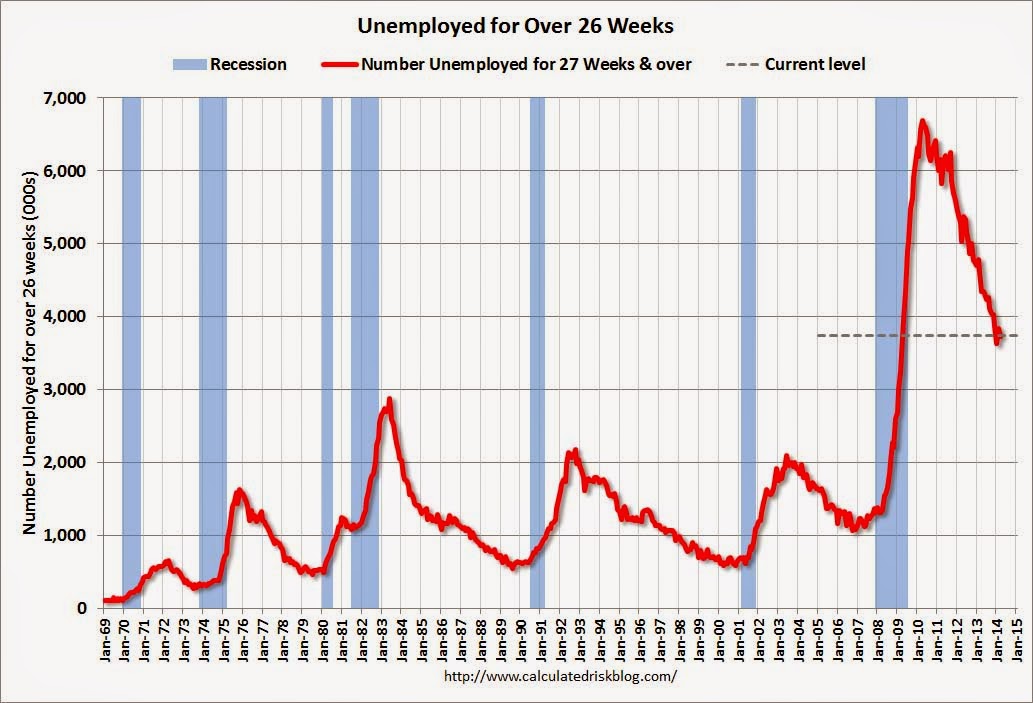 This graph shows the number of workers unemployed for 27 weeks or more.
 According to the BLS, there are 3.739 million workers who have been unemployed for more than 26 weeks and still want a job. This was down from 3.849 in February. This is trending down, but is still very high.
Long term unemployment remains one of the key labor problems in the US.
State and Local Government
 This graph shows total state and government payroll employment since January 2007. State and local governments lost jobs for four straight years. (Note: Scale doesn't start at zero to better show the change.)
 In March 2014, state and local governments added 9,000 jobs.
It appears state and local employment employment has bottomed. Of course Federal government layoffs are ongoing.
All things considered, this was a solid report. Hopefully, now that the severe weather is behind us, the pace of employment growth will pick up.
March Employment Report: 192,000 Jobs, 6.7% Unemployment Rate
by Calculated Risk on 4/04/2014 08:30:00 AM
From the BLS:
Total nonfarm payroll employment rose by 192,000 in March, and the unemployment rate was unchanged at 6.7 percent, the U.S. Bureau of Labor Statistics reported today.
...
The change in total nonfarm payroll employment for January was revised from +129,000 to +144,000, and the change for February was revised from +175,000 to +197,000. With these revisions, employment gains in January and February were 37,000 higher than previously reported.
 Click on graph for larger image.
The headline number was below expectations of 206,000 payroll jobs added.
The first graph shows the job losses from the start of the employment recession, in percentage terms, compared to previous post WWII recessions. The dotted line is ex-Census hiring.
This shows the depth of the recent employment recession - worse than any other post-war recession - and the relatively slow recovery due to the lingering effects of the housing bust and financial crisis.

Employment is 0.3% below the pre-recession peak (437 thousand fewer total jobs). Private employment is now above the pre-recession peak by 110 thousand and at a new all time high.
NOTE: The second graph is the change in payroll jobs ex-Census - meaning the impact of the decennial Census temporary hires and layoffs is removed to show the underlying payroll changes.
The third graph shows the employment population ratio and the participation rate.
The Labor Force Participation Rate was increased in March to 63.2%. This is the percentage of the working age population in the labor force.
 The participation rate is well below the 66% to 67% rate that was normal over the last 20 years, although a significant portion of the recent decline is due to demographics.
The Employment-Population ratio was increased in March at 58.9% (black line).
I'll post the 25 to 54 age group employment-population ratio graph later.
 The fourth graph shows the unemployment rate.
 The unemployment rate was unchanged in March at 6.7%.
This was a solid employment report, and including revisions, in line with expectations.
I'll have much more later ...
Thursday, April 03, 2014
Friday: Employment Report
by Calculated Risk on 4/03/2014 07:20:00 PM
From Goldman Sachs economist David Mericle:
"We forecast a 200,000 increase in nonfarm payrolls in March ... We expect that the unemployment rate declined to 6.6% ...Friday:
As growth accelerates later in 2014, we expect the trend rate of payrolls growth to rise to about 225,000 per month."
• At 8:30 AM ET the BLS will release the Employment Report for March. The consensus is for an increase of 206,000 non-farm payroll jobs in March, up from the 175,000 non-farm payroll jobs added in February.
The consensus is for the unemployment rate to decline to 6.6% in March.
 This graph shows the percentage of payroll jobs lost during post WWII recessions through February.
The economy has added 8.7 million private sector jobs since employment bottomed in February 2010 (8.0 million total jobs added including all the public sector layoffs).
There are still 129 thousand fewer private sector jobs now than when the recession started in 2007, and it is very likely that private employment now exceeds the pre-recession peak.
Employment Preview for March
by Calculated Risk on 4/03/2014 03:15:00 PM
Friday at 8:30 AM ET, the BLS will release the employment report for March. The consensus, according to Bloomberg, is for an increase of 206,000 non-farm payroll jobs in March (range of estimates between 175,000 and 275,000), and for the unemployment rate to decline to 6.6%.
Note: It is difficult to predict how much hiring will be a "bounce back" related to the severe weather in December, January and February. The economy only added an average of 129 thousand per month over the last three months, significantly below the trend of close to 200 thousand per month. We might see some upward revisions to prior months, and not all of the missing jobs will return in March, but there will probably be some hiring related to better weather.
Here is a summary of recent data:
• The ADP employment report showed an increase of 191,000 private sector payroll jobs in February. This was close to expectations of 190,000 private sector payroll jobs added. The ADP report hasn't been very useful in predicting the BLS report for any one month, but in general, this suggests employment growth close to expectations.
• The ISM manufacturing employment index declined in March to 51.1%. A historical correlation between the ISM manufacturing employment index and the BLS employment report for manufacturing, suggests that private sector BLS manufacturing payroll jobs decreased about 14,000 in March. The ADP report indicated a 5,000 increase for manufacturing jobs in March.
The ISM non-manufacturing employment index increased in March to 53.6% from 47.5% in February. A historical correlation between the ISM non-manufacturing index and the BLS employment report for non-manufacturing, suggests that private sector BLS reported payroll jobs for non-manufacturing increased 167,000 in March.
Taken together, these surveys suggest around 153,000 jobs added in March - below the consensus forecast.
• Initial weekly unemployment claims averaged close to 320,000 in March. This was down from an average of 338,000 in February. For the BLS reference week (includes the 12th of the month), initial claims were at 323,000; this was down from 330,000 during the reference week in February.
This suggests layoffs mostly in line with the consensus forecast.
• The final March Reuters / University of Michigan consumer sentiment index decreased to 80.0 from the February reading of 81.6. This is frequently coincident with changes in the labor market, but there are other factors too.
• The small business index from Intuit showed no change in small business employment in March.
• Conclusion: The ADP report was higher in March compared to the February report - and probably in line with most forecasts, the Intuit small business index showed no net hiring, and the ISM surveys suggest an increase but below the consensus. However there will probably be some bounce back from the below trend employment reports over the last three months (weather related).
There is always some randomness to the employment report - and the timing and survey methods are different than for some other reports - but my guess is the BLS report will be close to the consensus forecast of 206,000 nonfarm payrolls jobs added in March.
Reis: Mall Vacancy Rates unchanged in Q1
by Calculated Risk on 4/03/2014 01:05:00 PM
Reis reported that the vacancy rate for regional malls were unchanged at 7.9% in Q1 2014. This is down from a cycle peak of 9.4% in Q3 2011.
For Neighborhood and Community malls (strip malls), the vacancy rate was also unchanged at 10.4%. For strip malls, the vacancy rate peaked at 11.1% in Q3 2011.
Comments from Reis Senior Economist Ryan Severino:
[Strip Malls] The national vacancy rate for neighborhood and community shopping centers was unchanged during the first quarter. Though this was slightly worse than the 10 basis points decline from last quarter, it is still on par with the pace of improvement since the market began to recover roughly two years ago. The national vacancy rate remains down 70 basis points from the historical peak vacancy rate of 11.1% which was recorded over two years ago, during the third quarter of 2011. Although we continue to see improvement in both the economy and the labor market, gains are not yet sufficient to translate into more meaningful declines in the national vacancy rate.
Construction during the first quarter was the lowest since the first quarter of 2011 while net absorption was the lowest since the second quarter of 2011. Inclement weather across much of the country undoubtedly had an impact on construction during the first quarter, delaying projects. Because demand remains tied to new construction, net absorption figures were also muted this quarter. Nonetheless, construction activity remains on an upward trend as the economy recovers.
...
[Regional] Malls continue to perform better than neighborhood and community centers, but their recovery also remains challenging. Vacancy as of the first quarter was 7.9%, unchanged from the fourth quarter and down 40 basis points from the first quarter of 2013. Vacancy is also down 150 basis points from the historical high level reached during the third quarter of 2011. Asking rents grew by 0.5% in the first quarter and 1.7% during the last twelve months. This is the twelfth consecutive quarter of rent increases at the national level for regional malls.
 Click on graph for larger image.
This graph shows the strip mall vacancy rate starting in 1980 (prior to 2000 the data is annual). The regional mall data starts in 2000. Back in the '80s, there was overbuilding in the mall sector even as the vacancy rate was rising. This was due to the very loose commercial lending that led to the S&L crisis.
In the mid-'00s, mall investment picked up as mall builders followed the "roof tops" of the residential boom (more loose lending). This led to the vacancy rate moving higher even before the recession started. Then there was a sharp increase in the vacancy rate during the recession and financial crisis.
Mall vacancy data courtesy of Reis.
ISM Non-Manufacturing Index increases to 53.1 in March
by Calculated Risk on 4/03/2014 10:00:00 AM
The March ISM Non-manufacturing index was at 53.1%, up from 51.6% in February. The employment index increased in March to 53.6%, up from 47.5% in February. Note: Above 50 indicates expansion, below 50 contraction.
From the Institute for Supply Management: March 2014 Non-Manufacturing ISM Report On Business®
Economic activity in the non-manufacturing sector grew in March for the 50th consecutive month, say the nation's purchasing and supply executives in the latest Non-Manufacturing ISM® Report On Business®.
The report was issued today by Anthony Nieves, CPSM, C.P.M., CFPM, chair of the Institute for Supply Management® (ISM®) Non-Manufacturing Business Survey Committee. "The NMI® registered 53.1 percent in March, 1.5 percentage points higher than February's reading of 51.6 percent. The Non-Manufacturing Business Activity Index decreased to 53.4 percent, which is 1.2 percentage points lower than the reading of 54.6 percent reported in February, reflecting growth for the 56th consecutive month but at a slower rate. The New Orders Index registered 53.4 percent, 2.1 percentage points higher than the reading of 51.3 percent registered in February. The Employment Index increased 6.1 percentage points to 53.6 percent from the February reading of 47.5 percent and indicates substantial growth after one month of contraction. The Prices Index increased 4.6 percentage points from the February reading of 53.7 percent to 58.3 percent, indicating prices increased at a faster rate in March when compared to February. According to the NMI®, 13 non-manufacturing industries reported growth in March. Despite the affects of weather on many of the respective businesses, the majority of respondents indicate that business conditions are improving. The respondents also project better business activity and economic conditions as weather conditions continue to improve."
emphasis added
 Click on graph for larger image.
This graph shows the ISM non-manufacturing index (started in January 2008) and the ISM non-manufacturing employment diffusion index.
This was slightly below the consensus forecast of 53.5% and indicates faster expansion in March than in February.



