
 RSS Feed
 by Calculated Risk on 10/07/2010 08:41:00 AM
Thursday, October 07, 2010
Weekly Initial Unemployment Claims decrease
The DOL reports on weekly unemployment insurance claims:
In the week ending Oct. 2, the advance figure for seasonally adjusted initial claims was 445,000, a decrease of 11,000 from the previous week's revised figure of 456,000. The 4-week moving average was 455,750, a decrease of 3,000 from the previous week's revised average of 458,750.
 Click on graph for larger image in new window.
This graph shows the 4-week moving average of weekly claims since January 2000.
The dashed line on the graph is the current 4-week average. The four-week average of weekly unemployment claims decreased this week by 3,000 to 455,750.
The 4-week moving average has been moving sideways at an elevated level since last December - and that suggests a weak job market.
Reis: Mall vacancy rate declines slightly in Q3
by Calculated Risk on 10/07/2010 02:13:00 AM
 Click on graph for larger image in new window.
From Reuters: U.S. mall vacancy rate dips for first time in 3 years
The national vacancy rate for large regional malls fell to 8.8 percent in the third quarter from 9.0 percent in the second ... Asking rents were unchanged at $38.72 per square foot after declining for seven straight quarters ... At the strip malls ... vacancy was 10.9 percent.At regional malls, the record vacancy rate was 9.0% in Q2 2010 (Reis started tracking regional malls in 2000). The record vacancy rate for strip malls was in 1990 at 11.1%.
"While retail properties were offered a reprieve from massive deterioration, it is too early to say that the market has bottomed," said Victor Calanog, Reis director of research.
Many retailers have long-term leases that expire soon. The weak U.S. economy may prompt retail tenants not to renew, pushing up vacancy again, he said.
Wednesday, October 06, 2010
Roubini: 40% Chance of Double-dip Recession
by Calculated Risk on 10/06/2010 06:59:00 PM
From MarketWatch: Roubini: 40% chance of double-dip recession
There is a 40% probability of a double-dip recession, but you don't need one for the global economy to feel like it is in a deep, continuing recession, said Nouriel Roubini ... "You don't need another Lehman story, you don't need a major loss," said Roubini at an American Enterprise Institute event. "You can have death by a thousand cuts."I'm not sure how you assign precise odds (yesterday Goldman Sachs put the odds at about 25% to 30%), but I think the most likely outcome is sluggish growth. And that means the economy will remain susceptible to shocks.
And, as Roubini noted, it doesn't matter if the economy is technically in a recession - it will feel like a recession to millions of Americans as long as jobs are scarce and incomes are under pressure.
Seasonal Retail Hiring Outlook: "Dim"
by Calculated Risk on 10/06/2010 03:30:00 PM
Typically retail companies start hiring for the holiday season in October, and really increase hiring in November. Here is a graph that shows the historical net retail jobs added for October, November and December by year and a forecast for 2010.
 Click on graph for larger image in new window.
This really shows the collapse in retail hiring in 2008 and the weak recovery in 2009. This also shows how the season has changed over time - back in the '80s, retailers hired mostly in December. Now the peak month is November, and many retailers start hiring seasonal workers in October.
From Stephanie Clifford and Catherine Rampell at the NY Times: Dim Outlook for Holiday Jobs
As the economy sputters, prospects are dimming for unemployed workers who were banking on a seasonal retail job to carry them through the holidays. ...Last year - looking at the graph - retailers held back on hiring in October and waited until November (as Challenger Gray expects to happen again this year). The increase to 600,000 is significant, but still below the levels of 1992 through 2007 - except for the recession year of 2001.
The recruiting firm Challenger, Gray & Christmas, forecasts that retailers will add up to 600,000 jobs in October, November and December, compared with a net gain of 501,400 holiday jobs over the same three months in 2009.
...
Challenger Gray expects that companies may wait to hire until November or December — once they have a feel for how much consumers are willing to spend.
This hiring will be watched closely, and I suspect seasonal hiring will be stronger than in 2009, but well below the 700+ thousand jobs in 2004 through 2007.
Note: Clifford and Rampell also note that the supply chain for retailers is long - and many retailers placed orders earlier this year when the outlook seemed brighter to some (not to those paying attention!).
While retailers are just now making plans for Christmas hiring, they had to make plans for Christmas merchandise months ago, and that lag might create some inventory problems.Last year the retailers ran lean on inventory, but if this year is slow, there will be plenty of discounting.
Geithner calls for "more flexible, more market-oriented exchange rate systems"
by Calculated Risk on 10/06/2010 01:49:00 PM
From Treasury Secretary Geithner: Remarks at the Brookings Institution
[F]or the recovery to be sustainable, there must ... be a change in the pattern of global growth. For too long, many countries oriented their economies toward producing for export rather than consuming at home, counting on the United States to import many more of their goods and services than they bought of ours.This was aimed primarily at China, but also at other countries with export driven economies. Everyone can't devalue at once ...
The United States will do its part to achieve this adjustment. Private savings have increased significantly, and, as the recovery strengthens, we will bring down our fiscal deficits to a sustainable level.
But as America saves more, countries overly reliant on exports to us for their own growth will need to change their policies, or else global growth will slow and all of us will be worse off. Countries that chronically run large surpluses need to undertake policies that will boost their domestic demand.
...
That brings me to the second policy challenge: we believe it is very important to see more progress by the major emerging economies to more flexible, more market-oriented exchange rate systems. This is particularly important for those countries whose currencies are significantly undervalued.
This is a problem because when large economies with undervalued exchange rates act to keep the currency from appreciating, that encourages other countries to do the same.
This sets off a damaging dynamic, described first by my former colleague Ted Truman, as "competitive non appreciation." Over time, more and more countries face stronger pressure to lean against the market forces pushing up the value of their currencies. The collective impact of this behavior risks either causing inflation and asset bubbles in emerging economies, or else depressing consumption growth and intensifying short-term distortions in favor of exports.
This is a multilateral problem. It is unfair to countries that were already running more flexible regimes and let their currencies appreciate. And it requires a cooperative approach to solve, because emerging economies individually will be less likely to move, unless they are confident other countries would move with them.
This problem exposes once again the need for an effective multilateral mechanism to encourage economies running current account surpluses to abandon export-oriented policies, let their currencies appreciate, and strengthen domestic demand.
CoStar: Commercial Real Estate Prices decline in August
by Calculated Risk on 10/06/2010 11:35:00 AM
This is the new repeat sales index for commercial real estate. Previously I've only been using the Moodys/REAL Commercial Property Price Index (CPPI) for commercial real estate.
From CoStar: CoStar Commercial Repeat-Sale Indices
General commercial real estate and the broad-based CoStar composite index for all commercial real estate reversed the positive trend reported in last month’s findings and came in at -3.48% and -1.38% respectively for the month of August. ...
Repeat sales values for investment grade commercial property reversed their negative trend from July and moved positive again with a 3.73% climb in August. We continue to see a significant spread in cap rates and prices from the larger property in prime core markets to the property in second- and third-tier broader markets. Even with tighter financing, there appears to be plenty of institutional and REIT capital oriented to the lower-risk core markets.
For the past three months, all three indices are negative at -3.92% for the broad general index, -3.24% for investment grade and -3.92% for the composite. For the past 12 months, all three indices are down approximately 10% to 11%.
One reason for the volatility of these indices discussed here is the proportion of distress sales, which are continuing to climb in absolute levels, although as a percentage of sales they have leveled since June. This volume of distressed sales, while certainly not a tsunami, is still significant especially among lodging and multifamily properties.
emphasis added
 Click on graph for larger image in new window.
This graph from CoStar shows the indexes for investment grade, general commercial and a composite index. The investment grade index had been increasing since the beginning of the year, but the overall index is still declining.
It is important to remember that there are very few CRE transactions (compared to residential), and that there is a high percentage of distressed sales.
On the number of transactions:
The CCRSI September report is based on sales data through the end of August. In August, 559 sales pairs were recorded.
...
Distress continues to be a significant factor in the index results. Since 2007, the ratio of distressed sales to overall sales has increased from approximately 1% to approximately 23% currently. Discounts on distressed property sales (REOs and short sales) compared to non-distressed sales are running an average of 40% for multifamily, 20% for office and industrial and 17% for retail property based on 2010 data to date.
ADP: Private Employment decreases by 39,000 in September
by Calculated Risk on 10/06/2010 08:15:00 AM
ADP reports:
Private-sector employment decreased by 39,000 from August to September on a seasonally adjusted basis, according to the latest ADP National Employment Report® released today. The estimated change of employment from July to August was revised up from the previously reported decline of 10,000 to an increase of 10,000.Note: ADP is private nonfarm employment only (no government jobs).
The decline in private employment in September confirms a pause in the economic recovery already evident in other data. A deceleration of employment occurred in all the major sectors shown in The ADP Report and for all sizes of payroll.
...
Unlike the estimate of total establishment employment to be released on Friday by the Bureau of Labor Statistics (BLS), today’s ADP National Employment Report does not include the effects of federal hiring — and now firing — for the 2010 Census.
The consensus was for ADP to show an increase of about 23,000 private sector jobs in September, so this was way below consensus.
The BLS reports on Friday, and the consensus is for no change in payroll jobs in September, on a seasonally adjusted (SA) basis, with the loss of around 78,000 temporary Census 2010 jobs (+78,000 ex-Census).
MBA: Mortgage Purchase Activity increases, FHA applications increase sharply
by Calculated Risk on 10/06/2010 07:32:00 AM
The MBA reports: Sharp Jump in Purchase Activity Led by Applications for FHA Loans in Latest MBA Weekly Survey
The Refinance Index decreased 2.5 percent from the previous week. The seasonally adjusted Purchase Index increased 9.3 percent from one week earlier and is the highest Purchase Index observed in the survey since the week ending May 7, 2010.
...
“The increase in purchase activity was led by a 17.2 percent increase in FHA applications, while conventional purchase applications also increased by 3.6 percent,” said Jay Brinkmann, MBA’s Chief Economist. “This is the second straight weekly increase in purchase applications and the highest Purchase Index level since the expiration of the homebuyer tax credit program. One possible driver of last week’s big increase in FHA applications was a desire by borrowers to get applications in before new FHA requirements took effect October 4th, which included somewhat higher credit score and down payment requirements.”
...
The average contract interest rate for 30-year fixed-rate mortgages decreased to 4.25 percent from 4.38 percent, with points decreasing to 1.00 from 1.01 (including the origination fee) for 80 percent loan-to-value (LTV) ratio loans. The 30-year contract rate is the lowest recorded in the survey, with the previous low being the rate observed last week.
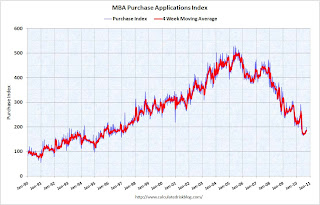 Click on graph for larger image in new window.
This graph shows the MBA Purchase Index and four week moving average since 1990.
This is the highest level of purchase activity since the end of the homebuyer tax credit, however the level is still very low - and much of the increase was driven by FHA applications that may decline next week (because of slightly tighter lending requirements).
Note that the 30 year contract rate is at another record low of 4.25%.
Tuesday, October 05, 2010
Reis: Apartment Vacancy Rates decline sharply in Q3
by Calculated Risk on 10/05/2010 11:59:00 PM
From Ilaina Jonas at Reuters: US apartment vacancy rate drops sharply in 3rd qtr
The national vacancy rate fell to 7.2 percent from 7.8 percent in the second quarter ...This is a significant decline from record vacancy rate set in Q1 at 7.9%. This decline fits with the recent survey from the NMHC that showed lower apartment vacancies.
Factoring months of free rent and other concessions landlords used to lure tenants, effective rent was up 0.6 percent to $980 per month, Reis said.
It appears the vacancy rate for large apartment buildings (and rents) bottomed early this year. This is something to watch - and indicates the excess housing inventory (that includes both vacant homes and apartments) is being absorbed.
Note: the Reis numbers are for cities. The overall vacancy rate from the Census Bureau was at a near record 10.6% in Q2 2010.
Hatzius: Two main economic scenarios "fairly bad" and "very bad"
by Calculated Risk on 10/05/2010 09:11:00 PM
This all ties together ...
Perhaps the most depressing exchange of this morning's conference -- and believe me, there were plenty to choose from -- was between Goldman Sachs's Jan Hatzius and Paul Krugman.
Hatzius, 41, said his two scenarios for the U.S. economy were “pretty bad” and “very bad.”
The economy will grow between 1 percent and 2 percent through early next year, with unemployment drifting up “to somewhere around 10 percent, maybe a little above 10 percent,” he said. ... “It’s going to take many years before you get back to anything approaching full unemployment, and 2014 is very likely too early,” said Hatzius.
We see two main scenarios for the economy over the next 6-9 months—a fairly bad one in which the economy grows at a 1½%-2% rate through the middle of next year and the unemployment rate rises moderately to 10%, and a very bad one in which the economy returns to an outright recession. There is not much probability of a significantly better outcome.
Between the two scenarios, the fairly bad one—slow growth, rising unemployment, but no outright recession—has significantly higher probability ... However, the recession scenario also has significant probability (we still think about 25%-30%).



