
 RSS Feed
 by Calculated Risk on 4/25/2010 11:45:00 AM
Sunday, April 25, 2010
Weekly Summary and a Look Ahead
The key economic stories this week will be house prices, the FOMC meeting and the “advance estimate” for Q1 GDP to be released on Friday.
On Monday the LoanPerformance house price index (for February) will probably be released. Also on Monday, the Census Bureau report on Housing Vacancies and Homeownership for Q1 will be released at 10 AM. Although noisy quarter-to-quarter, this report has been showing a declining homeownership rate. The vacancy rates for homeowners and renters have probably peaked, but both will still be near record levels.
On Tuesday the February Case-Shiller Home Price Index will be released at 9 AM by S&P. This will be confused by the recent S&P release cautioning about the seasonal adjustment. Also on Tuesday the Conference Board will release consumer confidence at 10 AM, and Fed Chairman Bernanke, budget director Peter Orszag, and others will speak at President Obama’s debt-reduction commission.
The Federal Open Market Committee (FOMC) is meeting on Tuesday and Wednesday, and the FOMC statement will be released on Wednesday at around 2:15 PM . Although there will be no change to the Fed Funds rate, or to the “extended period” language, there might be a few minor changes to the statement – perhaps a little more upbeat on the economy, maybe some discussion of eventual asset sales to appease a few hawkish members (not going to happen any time soon), and perhaps a comment on disinflation or the weak housing market.
On Thursday the closely watched initial weekly unemployment claims will be released. The consensus is for a decline to 446K this week from 456K last week. Also on Thursday (or earlier in the week) the ATA Truck Tonnage Index for March will be released.
And on Friday, the Advance Q1 GDP report will be released by the BEA at 8:30 AM. The consensus is for an annualized increase of 3.4%. Also on Friday, the Chicago Purchasing Managers Index for April, and the March Restaurant Performance index will be released. And of course the FDIC will probably be busy Friday afternoon ...
And a summary of last week:
The Census Bureau reported New Home Sales in March were at a seasonally adjusted annual rate (SAAR) of 411 thousand. This was an increase from the revised rate of 324 thousand in February (revised from 308 thousand).
 Click on graphs for larger image in new window.
The first graph shows monthly new home sales (NSA - Not Seasonally Adjusted).
Note the Red columns for 2010. In March 2010, 38 thousand new homes were sold (NSA).
The record low for March was 31 thousand in 2009.
 Months of supply declined to 6.7 in March from 8.6 in February. This is significantly below the all time record of 12.4 months of supply set in January 2009, but still higher than normal.
New home sales are counted when the contract is signed, so this pickup in activity is probably related to the tax credit. Note that that a few thousand extra sales NSA in March can make a huge difference in the SAAR.
The NAR reported: Existing-Home Sales Rise
Existing-home sales ... rose 6.8 percent to a seasonally adjusted annual rate of 5.35 million units in March.
 This graph shows existing home sales, on a Seasonally Adjusted Annual Rate (SAAR) basis since 1993.
 Sales in March 2010 (5.35 million SAAR) were 6.8% higher than last month, and were 16.1% higher than March 2009 (4.61 million SAAR).
Note: existing home sales are counted at closing, so even though contracts must be signed in April to qualify for the tax credit, buyers have until June 30th to close.
 This graph shows the year-over-year change in reported existing home inventory and months-of-supply.
The YoY inventory has been decreasing for the last 20 months. However the YoY decline is getting smaller - only 1.8% in March.
This slow decline in the inventory is especially concerning with the large reported inventory and 8.0 months of supply in March - well above normal.
 This graph shows NSA monthly existing home sales for 2005 through 2010 (see Red columns for 2010).
 Sales (NSA) in March 2010 were 19.6% higher than in March 2009, and also higher than in March 2008.
We will probably see an increase in sales in May and June - perhaps to the levels of 2006 or 2007 - because of the tax credit, however I expect to see existing home sales below last year in the 2nd half of this year.
 From the AIA: Billings Index Inches Up in March
Note: This index is a leading indicator for Commercial Real Estate (CRE) investment.
This graph shows the Architecture Billings Index since 1996. The index has remained below 50, indicating falling demand, since January 2008.
 The Department of Transportation (DOT) reported that vehicle miles driven declined year-over-year in February.
This graph shows the percent change from the same month of the previous year as reported by the DOT.
Miles driven in February 2010 were down -2.9% compared to February 2009.
The Moody’s/REAL All Property Type Aggregate Index declined 2.6% in February. This is a repeat sales measure of commercial real estate prices.
 CRE prices only go back to December 2000.
The Case-Shiller Composite 20 residential index is in blue (with Dec 2000 set to 1.0 to line up the indexes).
Commercial real estate values are now down 25.8% over the last year, and down 41.8% from the peak in August 2007.
Senate panel: Ratings agencies rolled over for Wall Street
Best wishes to all.
Morning Greece: Germany and France Talk Tough
by Calculated Risk on 4/25/2010 09:01:00 AM
From Reuters: Germany, France signal hard line with Greece (ht Jonathan)
German Finance Minister Wolfgang Schaeuble warned Greece that a tough restructuring of its economy was "unavoidable and an absolute prerequisite" if Berlin and the EU were to approve the aid Greece has requested.There will probably be some more news later today.
"The fact that neither the EU nor the German government have taken a decision (on providing aid) means the response can be positive as well as negative," Schaeuble told the Sunday edition of German daily Bild.
...
Schaeuble's French counterpart Christine Lagarde promised to hold Greece accountable for "unsuitable economic policies" ... She described the aid package as a "cocktail of indulgence and great strictness," telling the Journal du Dimanche weekly that Greece's partners would closely monitor its progress in restoring order to its creaking finances.
"We will (release the aid) according to their needs and in the case of default on repayment, we will immediately put the foot on the brake," Lagarde said.
Saturday, April 24, 2010
U.S. Trade: Wham-O Moves back to America
by Calculated Risk on 4/24/2010 09:07:00 PM
From the Daily Show ... Wham-O Moves to America
| The Daily Show With Jon Stewart | Mon - Thurs 11p / 10c | |
| Wham-O Moves to America | ||
| ||
Puerto Rico Banking News
by Calculated Risk on 4/24/2010 04:08:00 PM
From Martha Dreyer Duperray at Caribbean Business: Frank Stipes out as Westernbank chief
Westernbank President and CFO Frank Stipes ... resigned [on Friday] ... sources told caribbeanbusinesspr.com that agreement has been reached by the troubled bank to sell several branches to Banco Popular ...From the Unofficial Problem Bank List - there are three banks in Puerto Rico operating under Cease & Desist orders:
1) Westernbank Puerto Rico in Mayaguez with $11.9 billion in assets.
2) R-G Premier Bank of Puerto Rico in Hato Rey with $6.6 billion in assets.
3) Eurobank in Hato Rey with $2.6 billion in assets
All three are rumored to be out for bid. Last week the FDIC was busy in Illinois. Is this the week for Puerto Rico?
'Betting Against the American Dream'
by Calculated Risk on 4/24/2010 11:49:00 AM
An update from David Kestenbaum at Planet Money on their toxic asset: Toxie Update: Our Latest Check Arrives. Oh No.
As you know, we purchased our own toxic asset so we could watch it die.And some music ...
And she, Toxie, is dying. We just got our latest monthly check, and it's for just $72.41.
We'd been hoping for about $180, but there's been less money coming in from those 2,000-plus mortgages. All the investors in this thing are basically standing in line to get paid. We're near the back of the line, so we take the hit.
But that's not the real problem.
Toxie soon will be actually wasting away. Every month some of the houses that had been foreclosed upon, actually get sold and sold for a loss. As those losses accumulate, Toxie shrinks and eventually there's nothing left.
Our online folks just updated the graphic. Check out the "how long we have left" bar chart. It looks like next month the losses will actually eat into our Toxie, and she'll start to shrink.
I've been thinking of this like we are standing in line to get paid. We're at the back of the line, and there's this monster eating the people behind us. Next month the monster starts chewing on our heels.
Vehicle Sales: Fleet Turnover Ratio
by Calculated Risk on 4/24/2010 08:49:00 AM
Way back, during the darkest days of the recession, I wrote a couple of optimistic posts about auto sales - Vehicle Sales (Jan 2009) and Looking for the Sun (Feb 2009). By request, here is an update to the U.S. fleet turnover graph.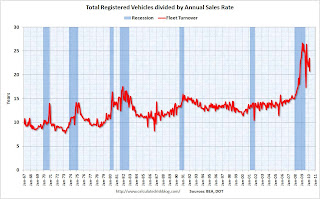 Click on graph for larger image in new window.
This graph shows the total number of registered vehicles in the U.S. divided by the sales rate through March 2010 - and gives a turnover ratio for the U.S. fleet (this doesn't tell you the age or the composition of the fleet).
The recent wild gyrations were due to the cash-for-clunkers program. Note: We are getting used to wild gyrations in economic numbers - just watch the housing numbers over the next few months!
The estimated ratio for March was just under 21 years - still very high, but well below the peak of almost 27 years. The turnover ratio will probably decline further over the next few years.
As expected some vehicles were removed from the fleet during the recession (scrappage exceeded sales), from RL Polk: Polk Finds More Vehicles Scrapped than Added to Fleet:
More than 14.8 million cars and light trucks were retired from the fleet between July 1, 2008 and September 30, 2009, compared to new registrations of slightly more than 13.6 million, resulting in an overall scrap rate of 6.1 percent. This includes thousands of units scrapped during last year’s CARS program, known as ‘Cash for Clunkers,’ and follows a trend seen by Polk over the past five years.Removing vehicles from the fleet reduces the turnover ratio, but most of the expected decline in the ratio will come from further increases in sales.
Polk also reports an increase in the average age of light vehicles on the road, up 21 percent in the past 14 years. The average age for all light vehicles during the 15-month period is 10.2 years ...
 The second graph shows light vehicle sales since the BEA started keeping data in 1967.
 Light vehicle sales were at a 11.8 million SAAR in March. To bring the turnover ratio down to more normal levels, unit sales will probably have to rise to 14 or 15 million SAAR eventually. Of course cars are lasting longer - note the general uptrend in the first graph - so the turnover ratio probably will not decline to the previous level. Also this says nothing about the composition of the fleet (perhaps smaller cars).
Friday, April 23, 2010
Unofficial Problem Bank List April 23, 2010
by Calculated Risk on 4/23/2010 11:38:00 PM
This is an unofficial list of Problem Banks compiled only from public sources.
Here is the unofficial problem bank list for April 23, 2010.
Changes and comments from surferdude808:
Bank closings dictated many changes to the Unofficial Problem Bank List this week. The failures in Illinois -- Amcore Bank, National Association ($3.8 billion), Broadway Bank ($1.2 billion), New
Century Bank ($510 million), Wheatland Bank ($437 million), Lincoln Park Savings Bank ($205 million), Peotone Bank and Trust Company ($136 million), and Citizens Bank and Trust Company of Chicago ($77 million) -- removed seven banks and $6.3 billion of assets.
Another removal this week was Paragon Bank & Trust ($107 million), a subsidiary of Capitol Bancorp (Ticker: CBC), which merged with its affiliate Michigan Commerce Bank that is also subject to a formal action. There were four additions this week including Sun National Bank, Vineland, NJ ($3.6 billion Ticker: SNBC); Great Florida Bank, Coral Gables, FL ($1.8 billion Ticker: GFLB); Central Virginia Bank, Powhatan, VA ($472 million Ticker: CVBK); and The Bank of Currituck, Moyock, NC ($197 million).
The net of these changes result in the Unofficial Problem Bank List having 694 institutions with aggregate assets of $366.1 billion. Other changes include the termination of the Prompt Corrective Action against Heritage Bank, Topeka, KS, and a name change for AmericasBank to CFG Community Bank. Next week, we look for the FDIC to release its new actions for March 2010.
Bank Failures #55 - 57: More Illinois
by Calculated Risk on 4/23/2010 08:12:00 PM
Good banks are few, far between
Even less so now
by Soylent Green is People
From the FDIC: Northbrook Bank and Trust Company, Northbrook, Illinois, Assumes All of the Deposits of Lincoln Park Savings Bank, Chicago, Illinois
As of December 31, 2009, Lincoln Park Savings Bank had approximately $199.9 million in total assets and $171.5 million in total deposits....From the FDIC: First Midwest Bank, Itasca, Illinois, Assumes All of the Deposits of Peotone Bank and Trust Company, Peotone, Illinois
The FDIC estimates that the cost to the Deposit Insurance Fund (DIF) will be $48.4 million.... Lincoln Park Savings Bank is the 55th FDIC-insured institution to fail in the nation this year, and the eighth in Illinois. The last FDIC-insured institution closed in the state was New Century Bank, Chicago, earlier today.
As of December 31, 2009, Peotone Bank and Trust Company had approximately $130.2 million in total assets and $127.0 million in total deposits. ...From the FDIC: Wheaton Bank & Trust, Wheaton, Illinois, Assumes All of the Deposits of Wheatland Bank, Naperville, Illinois
The FDIC estimates that the cost to the Deposit Insurance Fund (DIF) will be $31.7 million. ... Peotone Bank and Trust Company is the 56th FDIC-insured institution to fail in the nation this year, and the ninth in Illinois. The last FDIC-insured institution closed in the state was Lincoln Park Savings Bank, Chicago, earlier today.
As of December 31, 2009, Wheatland Bank had approximately $437.2 million in total assets and $438.5 million in total deposits. ...Seven in Illinois today ...
The FDIC estimates that the cost to the Deposit Insurance Fund (DIF) will be $133.0 million. ... Wheatland Bank is the 57th FDIC-insured institution to fail in the nation this year, and the tenth in Illinois. The last FDIC-insured institution closed in the state was Peotone Bank and Trust Company, Peotone, earlier today.
Bank Failures #51 -54: Illinois
by Calculated Risk on 4/23/2010 07:13:00 PM
Feds round up gangster-banksters
So much deja-vu
by Soylent Green is People
From the FDIC: Harris National Association, Chicago, Illinois, Assumes All Of The Deposits Of Amcore Bank, National Association, Rockford, Illinois
As of December 31, 2009, Amcore Bank, National Association had approximately $3.8 billion in total assets and $3.4 billion in total deposits....From the FDIC: MB Financial Bank, National Association, Chicago, Illinois, Assumes All Of The Deposits Of Broadway Bank, Chicago, Illinois
The FDIC estimates that the cost to the Deposit Insurance Fund (DIF) will be $220.3 million. .... Amcore Bank, National Association is the 51st FDIC-insured institution to fail in the nation this year, and the fourth in Illinois. The last FDIC-insured institution closed in the state was Bank of Illinois, Normal, on March 3, 2010.
As of December 31, 2009, Broadway Bank had approximately $1.2 billion in total assets and $1.1 billion in total deposits. ...From the FDIC: Republic Bank Of Chicago, Oak Brook, Illinois, Assumes All Of The Deposits Of Citizens Bank&Trust Company Of Chicago, Chicago, Illinois
The FDIC estimates that the cost to the Deposit Insurance Fund (DIF) will be $394.3 million. ... Broadway Bank is the 52nd FDIC-insured institution to fail in the nation this year, and the fifth in Illinois. The last FDIC-insured institution closed in the state was Amcore Bank, National Association, Rockford, earlier today.
As of December 31, 2009, Citizens Bank&Trust Company of Chicago had approximately $77.3 million in total assets and $74.5 million in total deposits....From the FDIC: MB Financial Bank, National Association, Chicago, Illinois, Assumes All Of The Deposits Of New Century Bank, Chicago, Illinois
The FDIC estimates that the cost to the Deposit Insurance Fund (DIF) will be $20.9 million. ... Citizens Bank&Trust Company of Chicago is the 53rd FDIC-insured institution to fail in the nation this year, and the sixth in Illinois. The last FDIC-insured institution closed in the state was Broadway Bank, Chicago, earlier today.
As of December 31, 2009, New Century Bank had approximately $485.6 million in total assets and $492.0 million in total deposits....
The FDIC estimates that the cost to the Deposit Insurance Fund (DIF) will be $125.3 million..... New Century Bank is the 54th FDIC-insured institution to fail in the nation this year, and the seventh in Illinois. The last FDIC-insured institution closed in the state was Citizens Bank&Trust Company of Chicago, Chicago, earlier today.
Rating Agency Testimony: "Must say yes" to Wall Street
by Calculated Risk on 4/23/2010 03:34:00 PM
From Kevin Hall at McClatchy Newspapers: Executives testify: Bond-rating agencies corrupted themselves
Testifying under oath before the Senate Permanent Subcommittee on Investigations, officials who were closely involved in giving investment-grade ratings to complex financial instruments backed by shaky U.S. mortgages described how they were pressured to give Wall Street what it wanted.The testimony is pretty amazing, but how is this being fixed?
...
Called to appear before the panel, Richard Michalek, a former Moody's vice president and senior credit officer, described the ratings process for deals that could bring more than $1 million in fees as a "must say yes" atmosphere.



