
 RSS Feed
 by Calculated Risk on 11/04/2007 12:27:00 AM
Sunday, November 04, 2007
NY Times: Rubin Likely Interim Citi Chairman
From the NY Times: Ex-Treasury Chief to Fill In as Chairman at Citigroup
Citigroup’s board is highly likely to name Robert E. Rubin ... as its interim chairman at an emergency meeting today ...Waiting for the news ...
Saturday, November 03, 2007
Mortgage Risk Perception
by Anonymous on 11/03/2007 12:12:00 PM
Good morning, everyone. I slept better than Citicorp's board did last night. But didn't we all?
Yves at naked capitalism has an interesting post up this morning on risk perception. The text is this essay, "Researchers study how people think about what is and isn't risky," at PhysOrg.com, which takes as its point of departure the question of why people live in fire-hazard areas like Disneyland. And thereabouts.
I was struck by this paragraph:
Researchers found people link perceived risk and perceived benefit to emotional evaluations of a potential hazard. If people like an activity, they judge the risks as low. If people dislike an activity, they judge the risks as high. For example, people buy houses or cars they like and find emotionally attractive, then downplay risks associated with the purchase.Without having seen the original research, I can't tell if the word "activity" here is meant literally or is simply infelicitous phrasing. My intuition, at least, is that what people like in the above examples is more usefully described as a state of being rather than an activity: people like owning nice homes and cars, not the activity of purchasing homes and cars. In fact, my intuition is that on the whole most people seriously dislike at least certain parts of the activity of purchasing such things. It is only the emotional lure of getting past the purchasing activity that keeps them going.
Anyone who has purchased a home knows that once you get past the early steps--perusing the McMansion porn in the Sunday papers, touring the open houses with a flattering, obsequious real estate agent--it gets to unpleasantries like contracts, inspections, lawyers, financing. Recreational home shopping certainly exists as a phenomenon, as any disappointed broker or home seller will tell you, but recreational home buying is certainly rare. It's just not like whipping out the Visa to snap up another pair of Nikes that you don't really need. Not even the most devoted flipper or serial homebuyer can pull that off every weekend.
I bring this up because I have contended, for some time now, that it is a mistake to see lowering of credit standards as the only real problem we've had going in the mortgage industry lately. It is the attempts to make the process of financing or refinancing a home quick and "painless" that is at the root of the problem. Certainly part of the way you make it "painless" is by relaxing credit standards; these things are related. But the important effect is that borrowers no longer feel put under a microscope (or a proctoscope, as those who borrowed mortgage money ten years or more ago are likely to describe it).
How does that change a prospective mortgagor's perception of the risk of buying a home or refinancing an existing mortgage? It doesn't seem unreasonable to conclude that making the activity less intrusive, in the borrower's subjective experience of it, means that the borrower is less likely to take seriously the written disclosures that describe the risks.
Back when the mortgage process was a great deal more "intrusive," borrowers used to complain bitterly about it. This perception of "intrusiveness" didn't arise simply in the matter of the borrower's credit and financial history; borrowers would routinely moan about lenders "interfering" in sales contracts. Why does some appraisal matter? I should be able to pay whatever I decide the property is worth. Why should the lender delve into my "side agreements" with the seller? Why should the lender be able to delay closing over incomplete items? If I don't care whether the driveway is done or the sod laid, why should the lender care?
The usual lender retort was always that you're doing all these things with someone else's money, and that you pay a lower interest rate for secured money than for unsecured money, implying that the lender has to care as much about the quality of the collateral as about the quality of the borrower. Don't like the lender's view of your collateral? Put it on the Visa; Visa doesn't care what you buy with the loan proceeds. But one of our most powerful ripostes, particularly in the case of cash-out refinances, was the old "paternalistic" standby: you are hocking the roof over your family's head! Take this seriously, will you?
Of course all of that lender "interference" and borrower complaining made for some tense, unpleasant transactions for both sides. And since no "sales oriented culture," which is what even depository mortgage lending operations became once the consultants got done with us, can stand to have unpleasantness, we began easing up on precisely those credit and collateral processing standards that drew the most complaints.
I've heard a number of folks argue that the genesis of recent wretched lending standards is the growth, over the last 20 years or so, of "affordable lending" programs, as if those efforts, led mostly by HUD and the GSEs, to put first-time homebuyers in low-down programs were the main impetus, a number of years later, for stated wage-earner programs using an AVM to offer 1-hour approval for a 95% LTV cash-out refinance on a jumbo property. There may be some truth to the idea that the success of older affordable housing programs was used as a justification for letting subsequent homebuyers and current homeowners do any stupid thing they wanted to do, but to argue that none of it would have happened if those "government" programs hadn't existed is to display one's political biases.
The fact is that those older "government" programs were the most "intrusive," "red-tape"-laden loans that have ever existed. FHA and the GSEs steadily lost market share in the purchase-money mortgage business over the last seven to ten years, as did the private mortgage insurers, even in those markets in which loan amount limits weren't an issue, and even when the rates on their products (30-year fixed) were highly competitive and attractive. "Private" programs were being developed to meet a fairly specific "need," encapsulated by the name of the famous Countrywide product, "Fast and Easy."
I think you can argue that consumers paid more attention to disclosures, spent more time reading documents, and generally proceeded with more fearfulness when things were "Slow and Difficult." It's not because they used to be smarter or we used to disclose more; in fact, just about every year the number and timing of mortgage- and RE-related disclosures has increased in the last two decades. But because the activity of getting a mortgage was painful, the seriousness with which borrowers viewed the risks of it was heightened.
This implies that more disclosure, or more vivid disclosure, is not the answer. We have to go back to a mortgage process that is, intellectually and emotionally, commensurate with its risks. This position can easily be mocked as a suggestion that we do our civic duty by providing wretched customer service. Of course you have to argue, rather than merely assert, that "good customer service" includes removing all visible traces of risk assessment from the process. Nobody is saying you should be rude when you demand those W-2s, or that you should "forget" to ask for them up front, and badger some borrower the day before closing about it. At least one of us is willing to say that that kind of half-assed "customer service" is most likely to thrive precisely in an environment in which our view of risk analysis is totally incoherent to start with.
There's a perfectly silly e-mail making the rounds, asking people to sign a petition opposing H.R. 3519, which the authors of the petition believe would outlaw yield spread premiums (money paid to a broker in exchange for a customer taking a higher rate). The unproven assertion is that all YSP is used to "pay" the borrower's closing costs via a credit, and therefore outlawing YSP would make loans more expensive to consumers. (Yes, the "closing costs" that are "paid" by the YSP include the broker's fees. This is different from the broker just taking YSP from the wholesaler in cash and not charging its compensation in the closing costs because.) It's really a lovely composition, purporting to be from "President" of mortgage company, not third-grader of Mother Khazakstan:
I need all the help I can get this morning. We have U.S. House of Representatives that are considering changing law that would eliminate the use of yield spread premiums in the mortgage place. This bill, H.R. 3915 will affect every one of us weather you are in the mortgage industry or if you are a consumer. This will allow the banks to take full control of all pricing and products available to all Americans. This would make it impossible for third party mortgage loan origination, which would reduce the number of real estate transactions for attorneys, appraisers and home inspectors. This bill would make it impossible for anyone to negotiate an interest rate with lower closing costs associated with the loan or if a borrower has credit issues may not get a loan at all.Nobody is asking what the effect on consumer perception of risk is in a situation in which not only is no cash down payment required for a purchase, no actual cash outlay for closing costs on a refi is required. It is unpleasant to cough up even a token contribution toward closing costs in actual cash. But that moment of concentration of the mind--writing a check for a thousand or two to a mortgage lender--has been eliminated from the process. It really isn't that the financial facts of this are not disclosed: the TILA disclosures do pretty clearly show the effect on APR of these "no cost" deals. But people do not perceive that "real money" is at risk when they are not asked to pay "real money" in order to close the transaction.
Back in the old days, we referred to that deposit that a property seller requires before signing a sales contract as "earnest money." As in, proof that the buyer is in earnest about going through with the transaction, as it was nonrefundable. Earnest money weeds out recreational and impulse buyers, and also forces serious buyers to pay attention to the process. (It appears to have little effect on manic speculators, but how manic do speculators get when 20% down payments are required on non-owner-occupied properties?)
Removing all the unpleasantness as well as the cash outlays from mortgage transactions, and speeding them up enough to seriously cut into the "cooling off period," is like removing earnest money from RE transactions. I seriously doubt that any study of consumer ability to read and comprehend mortgage loan disclosures is going to tell us anything useful, unless and until the researchers can find a way to approximate stakes for it: the experimental subjects need to have the emotional pull (buying the house, getting the cash) as well as the emotional push (you forfeit your privacy, your time, and a hefty check in the process). It would be enlightening to see a control group with the pull but not the push (no docs required, 1-hour approval, no cash fees). My guess is that more people can spot the difference between the APR and the "payment rate" on an Option ARM if you tell them they forfeit $1,000, payable immediately in cash, if they get the wrong answer, than if they face a monthly payment that is $5.00 higher (because the $1,000 is financed in the loan).
There really isn't anything you can do about the pull: as long as people like to own homes--this isn't an intellectual matter at this level--the pull will be there, as it will be for that big fat check you get in a cash-out. There isn't any particular reason for people not to enjoy those things. My point is that you can waive disclosure documents in front of people all day long, but if the pull is strong enough and the process is so painless that there is no countervailing pain in the activity of getting what you want, the disclosures will strike people as involving remote, rare, manageable risks if they bother to read them at all.
There is some evidence to suggest that borrowers don't actually read them, based on oral representations by interested parties that they are "just legalese": a perfect illustration of an attempt to make the homebuying or refinancing process "painless" (don't subject yourself to the unpleasantness of having to read awkwardly-written, math-heavy documents). A common sense response to this is to make the first disclosure a one-sentence form in 36-point boldface on neon orange paper that says "ANYONE SUGGESTING THAT YOU NOT READ EVERY WORD OF EVERY DOCUMENT YOU SIGN 24 HOURS PRIOR TO CLOSING IS NOT YOUR FRIEND AND IS TRYING TO MAKE MONEY OFF OF YOUR FOOLISHNESS AND IS VIOLATING FEDERAL LAW." But if you did that, you would, well, be taking the "Fast and Easy" part out of the whole transaction.
I expect, by the way, that a real-world example of this dynamic is underway around some preternaturally-waxed conference table in some climate-controlled high-rise office building in New York as we speak. The risk of all those CDOs was undoubtedly presented in the board packets, but the CEO assured the board members that it was just a bunch of "legalese."
I Love Subprime
by Calculated Risk on 11/03/2007 12:11:00 AM
A couple of ditties for you all ...
First up, a Country Western hit "I Love Subprime". (The singing starts about the 2nd chorus)
A one minute comedy piece featuring the Tan Man:
Friday, November 02, 2007
Citi CEO to Resign
by Calculated Risk on 11/02/2007 08:48:00 PM
Time for a new thread ...
From the WSJ: Citigroup CEO Plans to Resign As Losses Grow (hat tip many!)
MarketWatch version: Citi board gathering for emergency meeting
Special hat tip to Barley who broke the news:
Prince at Citi cancels speaking engagements on Sunday
Barley | 11.02.07 - 3:43 pm |
UPDATE: By popular request ... the following is from one of my original posts (in Feb 2005):
Former Fed chief Paul Volcker spoke last week at the second annual summit of the Stanford Institute for Economic Policy Research. In his keynote speech he warned that the nation is facing 'huge imbalances and risks'.
Here is a video of the speech.
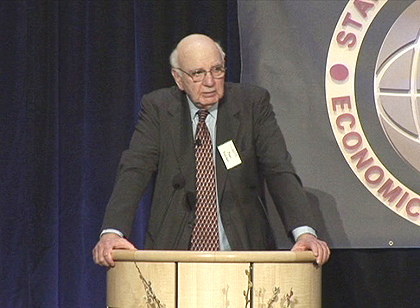
Paul Volcker, Stanford, Feb 11, 2005

A few selected excerpts:
"Altogether, the circumstances seem as dangerous and intractable as I can remember."
"Boomers are spending like there is no tomorrow."
"Homeownership has become a vehicle for borrowing and leveraging as much as a source of financial security."
"I come now to the heart of the problem, as a Nation we are consuming and investing, that is spending, about 6% more than we are producing. What holds it all together? - High consumption - high leverage - government deficits - What holds it all together is a really massive and growing flow of capital from abroad. A flow of capital that today runs to more than $2 Billion per day."
"What I'm really talking about boils down to the oldest lesson of financial policy in Central Banking: A strong sense of monetary and fiscal discipline."
Citi to Hold Emergency Board Meeting
by Calculated Risk on 11/02/2007 04:29:00 PM
From WSJ: Citi to Hold Emergency Board Meeting
Citigroup Inc. board members are expected to gather for an emergency meeting this weekend ...The music has stopped.
It wasn't immediately clear what the meeting would address, but the subject of further writedowns could come up.
S&P cuts D.R. Horton, Pulte Debt to Junk
by Calculated Risk on 11/02/2007 01:02:00 PM
From Reuters: S&P cuts D.R. Horton, Pulte debt into junk territory
Standard & Poor's ... cuts its ratings on D.R. Horton Inc and Pulte Homes Inc into junk territory, citing the vulnerability of the home builders to the deteriorating housing market and macroeconomic conditions.No surprise.
...
The outlook for both companies is negative, indicating an additional cut is likely over the next two years.
Chrysler: Long Walk on a Short Pier
by Calculated Risk on 11/02/2007 10:44:00 AM
From The Economist: Chrysler: That shrinking feeling
WHEN private equity and America’s ailing car industry meet there is only one likely outcome. On Thursday November 1st, just days after hourly workers narrowly ratified a new contract, Chrysler announced plans to drop four slow-selling models, slash overall production and trim perhaps some 12,000 hourly and salaried jobs. The job cuts amount to as much as 15% of the carmaker's total workforce.Chrysler's future is clearly uncertain, but not mentioned in the article are the $10 Billion in pier loans (bridge loans that couldn't be sold) sitting on the balance sheets of Goldman Sachs, Bear Stearns, Morgan Stanley and Citigroup. If Chrysler defaults, the pain will be significant.
...
Whether the latest round of cuts is enough to stabilise Chrysler is uncertain. Not only is its market contracting but Chrysler has also failed to score any significant hits with its recent new products other than with a four-door version of the small Wrangler SUV. If anything the carmaker will have to eliminate even more products, if sales don’t pick up. That, in turn could lead to still more job cuts in the future. And so the cycle is set to continue.
MMI: Elevated Threat
by Anonymous on 11/02/2007 09:44:00 AM
It has been a while since we measured distress level in the credit markets by a shallow survey of goofiness in the news. Since we have already noted solemnly the important news of the day--jobs report didn't smell bad--let us descend to news of the weird:
Mark to model? How about mark to flea market? "Prepare for the credit drama sequel" by stocking up on beaver pelts and glass beads.
Put on your blast goggles before you read this blinding flash of obvious: "Jump in foreclosure could hurt prices." Also, "contagion" is back.
But not to worry, it's not that contagious:
The soaring price of oil has yet to have a crippling effect on the economy, and inflation and unemployment figures remain in check, suggesting the economy is relatively healthy, despite the disastrous effects of the subprime collapse in the housing and lending arenas.I don't know; what that means either, but fallout from the quagmire of the bad bets doesn't sound good.
Bad bets on subprime mortgages have placed the financial sector in its current quagmire, not a lack of liquidity, and in the midst of sorting out the fallout from those decisions; it does not appear that Fed rate cuts are having the desired effect of propping up the flagging industry.
October Employment Report
by Calculated Risk on 11/02/2007 08:33:00 AM
From MarketWatch: October job growth strongest since May
Shaking off fears about weakness in housing and credit, the U.S. economy created 166,000 net jobs in October, the best job growth since May, the Labor Department reported Friday.Here is the BLS report. The unemployment rate was steady at 4.7%.
...
However, a separate survey of 60,000 households showed a loss of 250,000 workers, the third decline in the past four months. Economists say the payroll survey is more accurate, while acknowledging that it may not work as well when the economy is at a turning point.
 Click on graph for larger image.
Residential construction employment declined 21,500 in October, and including downward revisions to previous months, is down 221.9 thousand, or about 6.5%, from the peak in March 2006. (compare to housing starts off 30%+).
Note the scale doesn't start from zero: this is to better show the change in employment.
The initial benchmark revision shows the loss of an additional 8,000 construction jobs, but the initial report doesn't breakout residential construction.
Overall this is a stronger than expected report.
Thursday, November 01, 2007
Advance Q3 MEW Estimate
by Calculated Risk on 11/01/2007 10:00:00 PM
Based on the Q3 GDP data from the BEA, my advance estimate for Mortgage Equity Withdrawal (MEW) is approximately $520 Billion (SAAR) or 5.1% of Disposable Personal Income (DPI). This would be slightly higher than the Q2 estimates, from the Fed's Dr. Kennedy, of $494.4 Billion (SAAR), or 4.9% of Disposable Personal Income (DPI).
The actual Q3 data for MEW is released after the Flow of Funds report is available from the Fed (scheduled for December 6th for Q3).  Click on graph for larger image.
This graph compares my advance MEW estimate (as a percent of DPI) with the MEW estimate from Dr. James Kennedy at the Federal Reserve. The correlation is pretty high (0.90, R2 = 0.81) but there are differences quarter to quarter. This does suggest that MEW was at about the same level in Q3 as Q2. We will have to wait until September to know for sure.
MEW will probably decline precipitously in the Q4 2007, with a combination of tighter lending standards and falling house prices. The impact of less equity extraction on consumer spending is still being debated, but I believe a slowdown in consumption expenditures is likely.
Here are the Seasonally Adjusted Annual Rate (SAAR) Kennedy-Greenspan estimates of home equity extraction through Q2 2007, provided by James Kennedy based on the mortgage system presented in "Estimates of Home Mortgage Originations, Repayments, and Debt On One-to-Four-Family Residences," Alan Greenspan and James Kennedy, Federal Reserve Board FEDS working paper no. 2005-41. For Q2 2007, Dr. Kennedy calculated Net Equity Extraction as $494.4 Billion (SAAR), or 4.9% of Disposable Personal Income (DPI).
This graph shows the MEW results, both in billions of dollars quarterly (not annual rate), and as a percent of personal disposable income.



