
 RSS Feed
 by Calculated Risk on 12/16/2009 02:15:00 PM
Wednesday, December 16, 2009
FOMC Statement: No Change
Information received since the Federal Open Market Committee met in November suggests that economic activity has continued to pick up and that the deterioration in the labor market is abating. The housing sector has shown some signs of improvement over recent months. Household spending appears to be expanding at a moderate rate, though it remains constrained by a weak labor market, modest income growth, lower housing wealth, and tight credit. Businesses are still cutting back on fixed investment, though at a slower pace, and remain reluctant to add to payrolls; they continue to make progress in bringing inventory stocks into better alignment with sales. Financial market conditions have become more supportive of economic growth. Although economic activity is likely to remain weak for a time, the Committee anticipates that policy actions to stabilize financial markets and institutions, fiscal and monetary stimulus, and market forces will contribute to a strengthening of economic growth and a gradual return to higher levels of resource utilization in a context of price stability.Update:
With substantial resource slack likely to continue to dampen cost pressures and with longer-term inflation expectations stable, the Committee expects that inflation will remain subdued for some time.
The Committee will maintain the target range for the federal funds rate at 0 to 1/4 percent and continues to anticipate that economic conditions, including low rates of resource utilization, subdued inflation trends, and stable inflation expectations, are likely to warrant exceptionally low levels of the federal funds rate for an extended period. To provide support to mortgage lending and housing markets and to improve overall conditions in private credit markets, the Federal Reserve is in the process of purchasing $1.25 trillion of agency mortgage-backed securities and about $175 billion of agency debt. In order to promote a smooth transition in markets, the Committee is gradually slowing the pace of these purchases, and it anticipates that these transactions will be executed by the end of the first quarter of 2010. The Committee will continue to evaluate the timing and overall amounts of its purchases of securities in light of the evolving economic outlook and conditions in financial markets.
In light of ongoing improvements in the functioning of financial markets, the Committee and the Board of Governors anticipate that most of the Federal Reserve’s special liquidity facilities will expire on February 1, 2010, consistent with the Federal Reserve’s announcement of June 25, 2009. These facilities include the Asset-Backed Commercial Paper Money Market Mutual Fund Liquidity Facility, the Commercial Paper Funding Facility, the Primary Dealer Credit Facility, and the Term Securities Lending Facility. The Federal Reserve will also be working with its central bank counterparties to close its temporary liquidity swap arrangements by February 1. The Federal Reserve expects that amounts provided under the Term Auction Facility will continue to be scaled back in early 2010. The anticipated expiration dates for the Term Asset-Backed Securities Loan Facility remain set at June 30, 2010, for loans backed by new-issue commercial mortgage-backed securities and March 31, 2010, for loans backed by all other types of collateral. The Federal Reserve is prepared to modify these plans if necessary to support financial stability and economic growth.
Voting for the FOMC monetary policy action were: Ben S. Bernanke, Chairman; William C. Dudley, Vice Chairman; Elizabeth A. Duke; Charles L. Evans; Donald L. Kohn; Jeffrey M. Lacker; Dennis P. Lockhart; Daniel K. Tarullo; Kevin M. Warsh; and Janet L. Yellen.
CPI and Falling Rents
by Calculated Risk on 12/16/2009 11:11:00 AM
From the BLS report on the Consumer Price Index this morning:
The index for all items less food and energy was unchanged in November after rising 0.2 percent in October. The heavily weighted index for shelter, unchanged in October, declined 0.2 percent in November. Within the shelter group, the indexes for rent and owners' equivalent rent both declined 0.1 percent and the lodging away from home index fell 1.5 percent.Owners' equivalent rent (OER) decreased at a 1.5% annualized rate in November, and has decreased at a 1.1% annualized rate over the last three months. OER is the largest component of CPI, and helped keep core CPI unchanged in November. Median CPI from the Cleveland Fed was also unchanged.
Based on reports of falling rents - and a record high vacancy rate, OER will probably continue to fall for some time, keeping core CPI low and possibly negative next year.
Also - falling rents will push up the price-to-rent ratio, and put additional pressure on house prices.
MBA: Mortgage Purchase Applications Flat, Rates Rise
by Calculated Risk on 12/16/2009 09:49:00 AM
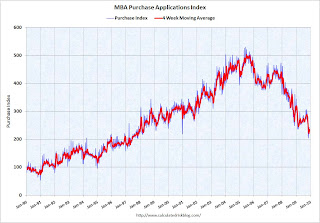
The four-week moving average of the MBA Purchase Index is near a 12 year low ...
The MBA reports: Mortgage Applications Increase in Latest MBA Weekly Survey
 Click on graph for larger image in new window.
This graph shows the MBA Purchase Index and four week moving average since 1990.
Note: In the past the MBA index was somewhat predictive of future sales - and was a favorite indicator of Alan Greenspan, but it has been questionable for some time. The increase in 2007 was due to the method used to construct the index: a combination of lender failures, and borrowers filing multiple applications pushed up the index in 2007 even though activity was actually declining. Recently there has been a substantial number of cash buyers, so the MBA index missed the strength of the recent existing home sales increase.
Although existing home sales will be very strong in November (as buyers rushed to beat the initial tax credit deadline), the indicators for residential investment have been mostly flat to weak in Q4. This includes the NAHB housing market index, housing starts, new home sales and the MBA purchase index.
Although the FOMC statement today will probably be more upbeat on the economy than in November, the statement on housing will probably have a more negative tone. Last month the FOMC said: "Activity in the housing sector has increased over recent months." That is not true now except for existing home sales that are largely irrelevant1 for residential investment and the economy.
1 Existing home sales generate some fees and commissions, but home turnover does not add to the value of the housing stock. Some people spend money on improvements and furnishings after buying a home, but this has probably been limited recently because of the types of buyers (mostly first time home buyers with minimum downpayments) and cash-flow investors. Neither group will be adding a pool or other major improvement any time soon!
The MBA reports: Mortgage Applications Increase in Latest MBA Weekly Survey
The Market Composite Index, a measure of mortgage loan application volume increased 0.3 percent on a seasonally adjusted basis from one week earlier. ...Also - most lenders are quoting mortgage rates back above 5% this week.
The Refinance Index increased 0.9 percent from the previous week and the seasonally adjusted Purchase Index decreased 0.1 percent from one week earlier.
...
The average contract interest rate for 30-year fixed-rate mortgages increased to 4.92 percent from 4.88 percent, with points decreasing to 1.08 from 1.17 (including the origination fee) for 80 percent loan-to-value (LTV) ratio loans.
 Click on graph for larger image in new window.
This graph shows the MBA Purchase Index and four week moving average since 1990.
Note: In the past the MBA index was somewhat predictive of future sales - and was a favorite indicator of Alan Greenspan, but it has been questionable for some time. The increase in 2007 was due to the method used to construct the index: a combination of lender failures, and borrowers filing multiple applications pushed up the index in 2007 even though activity was actually declining. Recently there has been a substantial number of cash buyers, so the MBA index missed the strength of the recent existing home sales increase.
Although existing home sales will be very strong in November (as buyers rushed to beat the initial tax credit deadline), the indicators for residential investment have been mostly flat to weak in Q4. This includes the NAHB housing market index, housing starts, new home sales and the MBA purchase index.
Although the FOMC statement today will probably be more upbeat on the economy than in November, the statement on housing will probably have a more negative tone. Last month the FOMC said: "Activity in the housing sector has increased over recent months." That is not true now except for existing home sales that are largely irrelevant1 for residential investment and the economy.
1 Existing home sales generate some fees and commissions, but home turnover does not add to the value of the housing stock. Some people spend money on improvements and furnishings after buying a home, but this has probably been limited recently because of the types of buyers (mostly first time home buyers with minimum downpayments) and cash-flow investors. Neither group will be adding a pool or other major improvement any time soon!
Housing Starts in November: Moving Sideways
by Calculated Risk on 12/16/2009 08:30:00 AM
 Click on graph for larger image in new window.
Total housing starts were at 574 thousand (SAAR) in November, up 8.9% from the revised October rate, and up from the all time record low in April of 479 thousand (the lowest level since the Census Bureau began tracking housing starts in 1959). Starts had rebounded to 590 thousand in June, and have moved mostly sideways for six months.
Single-family starts were at 482 thousand (SAAR) in November, up 2.1% from the revised October rate, and 35 percent above the record low in January and February (357 thousand). Just like for total starts, single-family starts have been at this level for six months.
Here is the Census Bureau report on housing Permits, Starts and Completions.
Housing Starts:This is both good news and bad news. The good news is the low level of starts means the excess housing inventory is being absorbed - a necessary step for housing (and the economy) to recover. The bad news is economic growth will probably be sluggish - and unemployment elevated - until residential investment picks up.
Privately-owned housing starts in November were at a seasonally adjusted annual rate of 574,000. This is 8.9 percent (±10.2%) above the revised October estimate of 527,000, but is 12.4 percent (±9.1%) below the November 2008 rate of 655,000.
Single-family housing starts in November were at a rate of 482,000; this is 2.1 percent (±9.2%) above the revised October figure of 472,000. The November rate for units in buildings with five units or more was 83,000.
Housing Completions:
Privately-owned housing completions in November were at a seasonally adjusted annual rate of 810,000. This is 8.7 percent (±13.7%)* above the revised October estimate of 745,000, but is 25.3 percent (±10.1%) below the November 2008 rate of 1,084,000.
Single-family housing completions in November were at a rate of 524,000; this is unchanged (±11.7%)* compared with the revised October figure. The November rate for units in buildings with five units or more was 270,000.
Tuesday, December 15, 2009
Citigroup's "Massive" Tax Break
by Calculated Risk on 12/15/2009 11:11:00 PM
The WaPo has an article about a tax break for Citigroup: U.S. gave up billions in tax money in deal for Citigroup's bailout repayment
The Internal Revenue Service on Friday issued an exception to long-standing tax rules for the benefit of Citigroup and a few other companies partially owned by the government. As a result, Citigroup will be allowed to retain billions of dollars worth of tax breaks that otherwise would decline in value when the government sells its stake to private investors.Who benefits? The value of the shares the U.S. owns should increase, but only 34% of the share price increase accrues to U.S. taxpayers The other current shareholders receive the rest. So this doesn't seem to make sense ...
While the Obama administration has said taxpayers are likely to profit from the sale of the Citigroup shares, accounting experts said the lost tax revenue could easily outstrip those profits.
...
Federal tax law lets companies reduce taxable income in a good year by the amount of losses in bad years. But the law limits the transfer of those benefits to new ownership as a way of preventing profitable companies from buying losers to avoid taxes. Under the law, the government's sale of its 34 percent stake in Citigroup, combined with the company's recent sales of stock to raise money, qualified as a change in ownership.
The IRS notice issued Friday saves Citigroup from the consequences by stipulating that the government's share sale does not count toward the definition of an ownership change.



