
 RSS Feed
 by Calculated Risk on 3/21/2006 09:42:00 AM
Tuesday, March 21, 2006
Housing: A 'Painful' Soft Landing?
Jonathan Lansner writes in the OC Register: Even a 'soft landing' for home prices can be painful [for Orange County]. A few excerpts:
The much-discussed "soft landing" – where home appreciation moderates down to historical norms, or slightly lower – may create heartburn in the business climate.On mortgage equity withdrawal:
This year, the local housing market has started off slowly. Prices are still at last August's level. And sales activity hasn't been this sluggish since 1997. Forget the doomsday predictions of a market in a downward spiral. Just imagine how difficult it could be for the economy to thrive in what some might call a normal housing market.
Everyday folks have reaped rewards in several ways. Most notable: Borrowing against the profits in their home.And on housing related employment:
For example, 72,000 Orange Countians last year took out $6.1billion worth of home-equity loans, according to DataQuick. Curiously – and a possible sign of a slowing real estate market – that's down from 88,500 equity loans worth $7.2billion in 2004.
The cold cash generated by real estate isn't the only thing that's let consumers shop until they drop. It's that perception of housing wealth that's allowed them to spend freely.
By my math, real estate of all sorts – from lending to building to brokers to swabbing the floors of office towers – employed 253,000 in the fourth quarter of 2005.See the article for a graphic on housing related employment in OC.
That's up almost 80 percent since 1995. The boom turned the real estate community, so to speak, into 17 percent of all workers employed in Orange County.
Sunday, March 19, 2006
New Home Sales and Recessions
by Calculated Risk on 3/19/2006 11:30:00 PM
This is just a reminder of the historical relationship between falling New Home Sales (units) and recessions.
Click on graph for larger image.
The white columns are economic recessions as defined by NBER.
For consumer led recessions (all but the most recent recession in 2001), New Home Sales were falling prior to the onset of the recession. It appears that New Home Sales peaked last year and it would be concerning if they fell 20% or more from the most recent peak (to below 1.05 million units). New Home Sales for February will be released on Friday and are expected to be around 1.2 million units (SA, annual rate). It is also important to note that unit volumes have not fallen very far from the peak of 2005.
This doesn't imply a cause and effect relationship, but it is something to watch. If New Home Sales can stay above 1.1 million or so that probably increases the probabilities of a soft landing (just slower growth), as opposed to a hard landing (a recession).
Weird Creative Financing
by Calculated Risk on 3/19/2006 01:50:00 PM
David Streitfeld writes in the LA Times: For Home Loan Broker, Troubles Come With Creative Refinancing
Orange County homeowners ... essentially get paid to borrow money.Here is how it worked (completely legal):
Mark Gallagher, the founder and president of Park Place Funding in Laguna Hills, uses a technique ... to cut his customers in on the action, giving them a share of the premium he earns for placing loans with high interest rates.
The homeowners receive cash on a regular basis they can use for vacations, remodeling or to pay off that expensive house faster. Not surprisingly, they love their broker.
1) Park Place would charge a higher than normal interest rate (with customer approval).
2) Park Place would charge no fees and receive a rebate of upto 5% from the lender. On a $350K loan, Park Place would receive $17.5K.
3) Park Place would give a portion of the rebate to the customer (far more than enough to cover the extra interest payments for four months).
4) Four months later, Park Place would refinance the customer again and receive another rebate (the loan balance would stay the same). They had to wait four months or refund the rebate on the previous loan.
5) The lender (frequently National City Mortgage) would sell the loans to Freddie Mac. Freddie Mac would package the loans into investment pools. As long as the pools didn't have too many loans that were repaid early, everyone was happy.
Bizarre story! I expect that other problems will be exposed as the housing market slows.
Saturday, March 18, 2006
New Homes Sales vs. Construction Employment
by Calculated Risk on 3/18/2006 10:35:00 PM
For New Home Sales, it appears the peak of the housing cycle happened last year. However construction related employment is still rising. This is not unusual.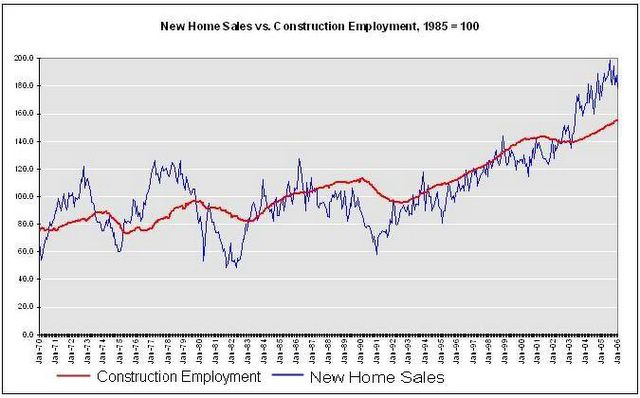
Click on graph for larger image.
The graph shows New Home Sales vs. Construction Employment since 1970.
Note that "Construction Employment" from the BLS includes all types of construction, not just residential construction.
Historically Construction Employment continued to rise for a year or more after the peak in housing transactions. Other housing related employment categories, like mortgage brokers, have already seen some layoffs - but based on historical data, construction will probably stay strong for most of 2006 unless sales fall dramatically.
Friday, March 17, 2006
UCLA: Housing Slowdown leads to "Great Uncertainty"
by Calculated Risk on 3/17/2006 06:32:00 PM
Drs. Leamer and Thornberg from UCLA's Anderson Forecast were quoted today on housing. From Contra Costa Times: Bay Area housing market cools
"We're at the peak and what happens next is a matter of great uncertainty," said Edward Leamer, director of UCLA Anderson Forecast.And from the San Francisco Chronicle: Bay Area housing market cools
... Christopher Thornberg, economist at the UCLA Anderson Forecast, predicts prices to hit a plateau later in the year, which could persist for an extended period. In addition, the downswing will have a direct impact on the construction, mortgage and real estate industries.It makes sense that a housing slowdown will impact the overall economy, but by how much remains unclear ... "a matter of great uncertainty".
"It's going to take the energy out of the economy, reducing the wealth effect and diminishing retail sales in [California], but it's not going to cause a recession," Thornberg said.



