
 RSS Feed
 by Calculated Risk on 6/03/2024 09:11:00 PM
Monday, June 03, 2024
Tuesday: Job Openings
 From Matthew Graham at Mortgage News Daily: Mortgage Rates Fully Erase Last Week's Spike
Sharp improvements in the bond market led to another nice drop in mortgage rates. The average lender is now back to the lowest levels in nearly 2 weeks, but not yet back to the recent lows seen on May 15th. [30 year fixed 7.11%]Tuesday:
emphasis added
• At 10:00 AM ET, Job Openings and Labor Turnover Survey for April from the BLS.
Vehicles Sales Increase to 15.9 million SAAR in May; Up 2.5% YoY
by Calculated Risk on 6/03/2024 06:55:00 PM
Wards Auto released their estimate of light vehicle sales for May: May U.S. Light-Vehicle Sales Continue 2024 Trend of Slow, Steady Growth (pay site).
Further confirming as a theme for 2024, growth in May largely was centered in the most affordable CUV and car segments. Other sectors during the first five months of 2024 have either recorded sporadic gains or fell into steady decline, including some, such as fullsize pickups, that are coming off lengthy periods of strong results. So far in 2024, market strength is with more affordable small and midsize CUVs and small sedans.
 Click on graph for larger image.
This graph shows light vehicle sales since 2006 from the BEA (blue) and Wards Auto's estimate for May (red).
Sales in May (15.90 million SAAR) were up 1.0% from April, and up 2.5% from May 2023.
 Sales in May were at the consensus forecast.
Freddie Mac House Price Index Increased in April; Up 6.5% Year-over-year
by Calculated Risk on 6/03/2024 01:17:00 PM
Today, in the Calculated Risk Real Estate Newsletter: Freddie Mac House Price Index Increased in April; Up 6.5% Year-over-year
A brief excerpt:
On a year-over-year basis, the National FMHPI was up 6.5% in April, down from up 6.6% YoY in March. The YoY increase peaked at 19.1% in July 2021, and for this cycle, bottomed at up 0.9% YoY in April 2023. ...
As of April, 9 states and D.C. were below their previous peaks, Seasonally Adjusted. The largest seasonally adjusted declines from the recent peak were in Idaho (-2.1%), Hawaii (-1.4%), Utah (-1.1%), and D.C. (-1.1%).
For cities (Core-based Statistical Areas, CBSA), here are the 30 cities with the largest declines from the peak, seasonally adjusted. Austin continues to be the worst performing city.

There is much more in the article.
ICE Mortgage Monitor: "Home Prices Cool for Second Straight Month in April"
by Calculated Risk on 6/03/2024 10:20:00 AM
Today, in the Real Estate Newsletter: ICE Mortgage Monitor: "Home Prices Cool for Second Straight Month in April"
Brief excerpt:
Press Release: ICE Mortgage Monitor: Home Prices Cool for Second Straight Month in April as Purchase Demand Softens, Inventory Deficits ImproveThere is much more in the article.Here is the year-over-year in house prices according to the ICE Home Price Index (HPI). The ICE HPI is a repeat sales index. Black Knight reports the median price change of the repeat sales. The index was up 5.1% year-over-year in April, down from 5.7% YoY in March.
• Home price growth cooled for the second straight month in April as elevated interest rates resulted in softer demand and improved inventory
▪ The annual home price growth rate cooled to 5.1% from a revised 5.7% in March, and as high as 6.1% back in February
▪ Unadjusted prices rose by 0.88% in the month, falling slightly below their -year same-month average for the first time this year
▪ Adjusted for seasonality, prices rose by 0.28% in the month (down from 0.45% in March), equivalent to a 3.4% seasonally adjusted annualized rate SAAR, suggesting annual home price gains will continue to ease in coming months
▪ If adjusted monthly gains continue at their current pace, annual home price growth would be below 4.25% by June and below 4% by July

Construction Spending Decreased 0.1% in April
by Calculated Risk on 6/03/2024 10:18:00 AM
From the Census Bureau reported that overall construction spending decreased:
Construction spending during April 2024 was estimated at a seasonally adjusted annual rate of $2,099.0 billion, 0.1 percent below the revised March estimate of $2,101.5 billion. The April figure is 10.0 percent (±1.5 percent) above the April 2023 estimate of $1,907.8 billion.Private and public spending decreased:
emphasis added
Spending on private construction was at a seasonally adjusted annual rate of $1,611.9 billion, 0.1 percent below the revised March estimate of $1,613.3 billion. ...
In April, the estimated seasonally adjusted annual rate of public construction spending was $487.1 billion, 0.2 percent below the revised March estimate of $488.2 billion.
 Click on graph for larger image.
This graph shows private residential and nonresidential construction spending, and public spending, since 1993. Note: nominal dollars, not inflation adjusted.
Residential (red) spending is 8.2% below the recent peak in 2022.
Non-residential (blue) spending is 1.0% below the peak two months ago.
Public construction spending is 0.2% below the peak last month.
 The second graph shows the year-over-year change in construction spending.
On a year-over-year basis, private residential construction spending is up 8.0%. Non-residential spending is up 8.3% year-over-year. Public spending is up 16.8% year-over-year.
This was below consensus expectations for 0.2% increase in spending, however, total construction spending for the previous two months was revised up.
This is probably just the start of weakness for private non-residential construction.
ISM® Manufacturing index Decreased to 48.7% in May
by Calculated Risk on 6/03/2024 10:00:00 AM
(Posted with permission). The ISM manufacturing index indicated expansion. The PMI® was at 48.7% in May, down from 49.2% in April. The employment index was at 51.1%, up from 48.6% the previous month, and the new orders index was at 45.4%, down from 49.1%.
From ISM: Manufacturing PMI® at 48.7%; May 2024 Manufacturing ISM® Report On Business®
Economic activity in the manufacturing sector contracted in May for the second consecutive month and the 18th time in the last 19 months, say the nation's supply executives in the latest Manufacturing ISM® Report On Business®.This suggests manufacturing contracted in May. This was below the consensus forecast.
The report was issued today by Timothy R. Fiore, CPSM, C.P.M., Chair of the Institute for Supply Management® (ISM®) Manufacturing Business Survey Committee:
“The Manufacturing PMI® registered 48.7 percent in May, down 0.5 percentage point from the 49.2 percent recorded in April. The overall economy continued in expansion for the 49th month after one month of contraction in April 2020. (A Manufacturing PMI® above 42.5 percent, over a period of time, generally indicates an expansion of the overall economy.) The New Orders Index remained in contraction territory, registering 45.4 percent, 3.7 percentage points lower than the 49.1 percent recorded in April. The May reading of the Production Index (50.2 percent) is 1.1 percentage points lower than April’s figure of 51.3 percent. The Prices Index registered 57 percent, down 3.9 percentage points compared to the reading of 60.9 percent in April. The Backlog of Orders Index registered 42.4 percent, down 3 percentage points compared to the 45.4 percent recorded in April. The Employment Index registered 51.1 percent, up 2.5 percentage points from April’s figure of 48.6 percent.
emphasis added
Housing June 3rd Weekly Update: Inventory up 1.7% Week-over-week, Up 38.4% Year-over-year
by Calculated Risk on 6/03/2024 08:12:00 AM
Altos reports that active single-family inventory was up 1.7% week-over-week. Inventory is now up 22.4% from the February bottom, and at the highest level since August 2020.
 Click on graph for larger image.
This inventory graph is courtesy of Altos Research.
As of May 31st, inventory was at 605 thousand (7-day average), compared to 595 thousand the prior week.
Inventory is still far below pre-pandemic levels.

The red line is for 2024. The black line is for 2019. Note that inventory is up 85% from the record low for the same week in 2021, but still well below normal levels.
Inventory was up 38.4% compared to the same week in 2023 (last week it was up 37.0%), and down 35.7% compared to the same week in 2019 (last week it was down 36.1%).
Back in June 2023, inventory was down almost 54% compared to 2019, so the gap to more normal inventory levels is slowly closing.
Mike Simonsen discusses this data regularly on Youtube.
Sunday, June 02, 2024
Monday: ISM Mfg, Construction Spending, Vehicle Sales
by Calculated Risk on 6/02/2024 06:15:00 PM
Weekend:
• Schedule for Week of June 2, 2024
Monday:
• At 10:00 AM ET, ISM Manufacturing Index for May. The consensus is for the ISM to be at 49.7, up from 49.2 in April.
• Also at 10:00 AM, Construction Spending for April. The consensus is for a 0.2% increase in construction spending.
• Late: Light vehicle sales for May. The consensus is for light vehicle sales to be 15.9 million SAAR in May, up from 15.7 million in April (Seasonally Adjusted Annual Rate).
From CNBC: Pre-Market Data and Bloomberg futures S&P 500 are up 4 and DOW futures are up 27 (fair value).
Oil prices were down over the last week with WTI futures at $76.85 per barrel and Brent at $81.00 per barrel. A year ago, WTI was at $72, and Brent was at $76 - so WTI oil prices are up about 7% year-over-year.
Here is a graph from Gasbuddy.com for nationwide gasoline prices. Nationally prices are at $3.50 per gallon. A year ago, prices were at $3.54 per gallon, so gasoline prices are down $0.04 year-over-year.
Hotels: Occupancy Rate Increased 1.6% Year-over-year
by Calculated Risk on 6/02/2024 08:21:00 AM
The U.S. hotel industry reported mixed performance results from the previous week but positive comparisons year over year, according to CoStar’s latest data through 25 May. ...The following graph shows the seasonal pattern for the hotel occupancy rate using the four-week average.
19-25 May 2024 (percentage change from comparable week in 2023):
• Occupancy: 67.7% (+1.6%)
• Average daily rate (ADR): US$160.67 (+2.3%)
• Revenue per available room (RevPAR): US$108.73 (+3.9%)
emphasis added
 Click on graph for larger image.
The red line is for 2024, blue is the median, and dashed light blue is for 2023. Dashed purple is for 2018, the record year for hotel occupancy.
The 4-week average of the occupancy rate is tracking last year, and slightly above the median rate for the period 2000 through 2023 (Blue).
Note: Y-axis doesn't start at zero to better show the seasonal change.
The 4-week average of the occupancy rate will increase seasonally when the summer travel season begins.
Saturday, June 01, 2024
Real Estate Newsletter Articles this Week: House Price Index Up 6.5% year-over-year in March
by Calculated Risk on 6/01/2024 02:11:00 PM
At the Calculated Risk Real Estate Newsletter this week:
 Click on graph for larger image.
• Case-Shiller: National House Price Index Up 6.5% year-over-year in March
• Inflation Adjusted House Prices 2.2% Below Peak
• Fannie and Freddie: Single Family Serious Delinquency Rate Decreased in April, Multi-family Increased Slightly
• Final Look at Local Housing Markets in April and a Look Ahead to May Sales
This is usually published 4 to 6 times a week and provides more in-depth analysis of the housing market.
Schedule for Week of June 2, 2024
by Calculated Risk on 6/01/2024 08:11:00 AM
The key report scheduled for this week is the May employment report.
Other key reports include the May ISM Manufacturing, Vehicle Sales and April trade balance.
10:00 AM: ISM Manufacturing Index for May. The consensus is for the ISM to be at 49.7, up from 49.2 in April.
10:00 AM: Construction Spending for April. The consensus is for a 0.2% increase in construction spending.
 Late: Light vehicle sales for May.
The consensus is for light vehicle sales to be 15.9 million SAAR in May, up from 15.7 million in April (Seasonally Adjusted Annual Rate).
This graph shows light vehicle sales since the BEA started keeping data in 1967. The dashed line is the sales rate for last month.
----- Tuesday, June 4th -----
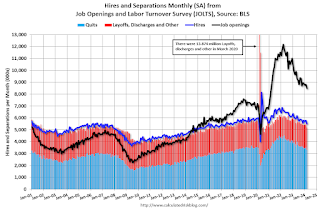 10:00 AM ET: Job Openings and Labor Turnover Survey for April from the BLS.
This graph shows job openings (black line), hires (purple), Layoff, Discharges and other (red column), and Quits (light blue column) from the JOLTS.
Jobs openings decreased in March to 8.49 million from 8.81 million in February. The number of job openings (black) were down 12% year-over-year.
----- Wednesday, June 5th -----
7:00 AM ET: The Mortgage Bankers Association (MBA) will release the results for the mortgage purchase applications index.
8:15 AM: The ADP Employment Report for May. This report is for private payrolls only (no government). The consensus is for 174,000 payroll jobs added in May, down from 192,000 in April.
10:00 AM: the ISM Services Index for May. The consensus is for a reading of 50.5, up from 59.4.
----- Thursday, June 6th -----
 8:30 AM: Trade Balance report for April from the Census Bureau.
This graph shows the U.S. trade deficit, with and without petroleum.
 10:00 AM ET: Job Openings and Labor Turnover Survey for April from the BLS.
 This graph shows job openings (black line), hires (purple), Layoff, Discharges and other (red column), and Quits (light blue column) from the JOLTS.
Jobs openings decreased in March to 8.49 million from 8.81 million in February. The number of job openings (black) were down 12% year-over-year.
7:00 AM ET: The Mortgage Bankers Association (MBA) will release the results for the mortgage purchase applications index.
8:15 AM: The ADP Employment Report for May. This report is for private payrolls only (no government). The consensus is for 174,000 payroll jobs added in May, down from 192,000 in April.
10:00 AM: the ISM Services Index for May. The consensus is for a reading of 50.5, up from 59.4.
 8:30 AM: Trade Balance report for April from the Census Bureau.
 This graph shows the U.S. trade deficit, with and without petroleum.
The blue line is the total deficit, and the black line is the petroleum surplus, and the red line is the trade deficit ex-petroleum products.
The consensus is the trade deficit to be $69.7 billion. The U.S. trade deficit was at $69.4 Billion in March.
8:30 AM: The initial weekly unemployment claims report will be released. The consensus is for 215 thousand initial claims, down from 219 thousand last week.
----- Friday, June 7th -----
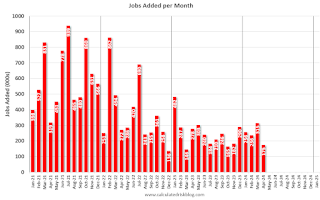 8:30 AM: Employment Report for May. The consensus is for 180,000 jobs added, and for the unemployment rate to be unchanged at 3.9%.
There were 175,000 jobs added in April, and the unemployment rate was at 3.9%.
This graph shows the jobs added per month since January 2021.
12:00 PM: Q1 Flow of Funds Accounts of the United States from the Federal Reserve.
The consensus is the trade deficit to be $69.7 billion. The U.S. trade deficit was at $69.4 Billion in March.
8:30 AM: The initial weekly unemployment claims report will be released. The consensus is for 215 thousand initial claims, down from 219 thousand last week.
 8:30 AM: Employment Report for May. The consensus is for 180,000 jobs added, and for the unemployment rate to be unchanged at 3.9%.
There were 175,000 jobs added in April, and the unemployment rate was at 3.9%.
This graph shows the jobs added per month since January 2021.
12:00 PM: Q1 Flow of Funds Accounts of the United States from the Federal Reserve.
Friday, May 31, 2024
May 31st COVID Update: Weekly Deaths at New Pandemic Low!
by Calculated Risk on 5/31/2024 07:10:00 PM
 Note: Mortgage rates are from MortgageNewsDaily.com and are for top tier scenarios.
For deaths, I'm currently using 4 weeks ago for "now", since the most recent three weeks will be revised significantly.
Note: "Effective May 1, 2024, hospitals are no longer required to report COVID-19 hospital admissions, hospital capacity, or hospital occupancy data." So I'm no longer tracking hospitalizations, however hospitalizations were at a pandemic low three weeks ago.
| COVID Metrics | ||||
|---|---|---|---|---|
| Now | Week Ago | Goal | ||
| Deaths per Week | 378 | 391 | ≤3501 | |
| 1my goals to stop weekly posts, 🚩 Increasing number weekly for Deaths ✅ Goal met. | ||||
 Click on graph for larger image.
This graph shows the weekly (columns) number of deaths reported.
Weekly deaths have declined from the recent peak of 2,561 and are now below the previous pandemic low of 491 last July.
 This appears to be a leading indicator for COVID hospitalizations and deaths.
Nationally, COVID in wastewater is now off about 90% from the holiday peak at the end of December - and also near the lows of last year - and that suggests weekly deaths will continue to decline. However, there was a pickup recently, especially in the West.
Q2 GDP Tracking: 1.8% to 2.8%
by Calculated Risk on 5/31/2024 01:01:00 PM
From BofA:
1Q GDP was revised down by three-tenths to 1.3% q/q saar, which was broadly in line with our expectations. Meanwhile, our estimate of 2Q GDP ended up unchanged at 1.8% q/q saar from a week ago. [May 31st estimate]From Goldman:
emphasis added
The consumption details in this morning’s report indicate weak spending momentum to start the quarter, and we lowered our Q2 GDP tracking estimate by 0.4pp to +2.8% (qoq ar) and our domestic final sales estimate by the same amount to +2.1%. [May 31st estimate]And from the Altanta Fed: GDPNow
The GDPNow model estimate for real GDP growth (seasonally adjusted annual rate) in the second quarter of 2024 is 2.7 percent on May 31, down from 3.5 percent on May 24. After recent releases from the US Census Bureau and the US Bureau of Economic Analysis, a decrease in the nowcast of second-quarter real personal consumption expenditures growth from 3.4 percent to 2.6 percent was partly offset by an increase in the nowcast of second-quarter real gross private domestic investment growth from 5.1 percent to 6.3 percent, while the nowcast of the contribution of the change in real net exports to second-quarter real GDP growth decreased from -0.06 percentage points to -0.60 percentage points. [May 31st estimate]
Fannie and Freddie: Single Family Serious Delinquency Rate Decreased in April, Multi-family Increased Slightly
by Calculated Risk on 5/31/2024 09:48:00 AM
Today, in the Calculated Risk Real Estate Newsletter: Fannie and Freddie: Single Family Serious Delinquency Rate Decreased in April, Multi-family Increased Slightly
Brief excerpt:
Single-family serious delinquencies decreased in April, and multi-family serious delinquencies increased slightly.
...
Freddie Mac reports that the multi-family delinquencies rate increased to 0.35% in April, up from 0.34% in March, and down from 0.44% in January.
This graph shows the Freddie multi-family serious delinquency rate since 2012. Rates were still high in 2012 following the housing bust and financial crisis.
The multi-family rate increased following the pandemic and has increased recently as rent growth has slowed, vacancy rates have increased, and borrowing rates have increased sharply. The rate surged higher in January but declined in February and March. This will be something to watch as more apartments come on the market.

There is much more in the article.
PCE Measure of Shelter Slows to 5.6% YoY in April
by Calculated Risk on 5/31/2024 08:57:00 AM
Here is a graph of the year-over-year change in shelter from the CPI report and housing from the PCE report this morning, both through April 2024.
 CPI Shelter was up 5.5% year-over-year in April, down from 5.6% in March, and down from the cycle peak of 8.2% in March 2023.
Housing (PCE) was up 5.6% YoY in April, down from 5.8% in March, and down from the cycle peak of 8.3% in April 2023.
Since asking rents are mostly flat year-over-year, these measures will continue to slow over the next year.
Since asking rents are mostly flat year-over-year, these measures will continue to slow over the next year.
 The second graph shows PCE prices, Core PCE prices and Core ex-housing over the last 6 months (annualized):
Key measures are above the Fed's target on a 6-month basis. Note: There appears to be some residual seasonality distorting PCE, especially in January.
Personal Income increased 0.3% in April; Spending increased 0.2%
by Calculated Risk on 5/31/2024 08:30:00 AM
The BEA released the Personal Income and Outlays report for April:
Personal income increased $65.3 billion (0.3 percent at a monthly rate) in April, according to estimates released today by the Bureau of Economic Analysis. Disposable personal income (DPI) —personal income less personal current taxes—increased $40.2 billion and personal consumption expenditures (PCE) increased $39.1 billion.The April PCE price index increased 2.7 percent year-over-year (YoY), unchanged from 2.7 percent YoY in March, and down from the recent peak of 7.0 percent in June 2022.
The PCE price index increased 0.3 percent. Excluding food and energy, the PCE price index increased 0.2 percent. Real DPI decreased 0.1 percent in April and real PCE decreased 0.1 percent; goods decreased 0.4 percent and services increased 0.1 percent.
emphasis added
The PCE price index, excluding food and energy, increased 2.8 percent YoY, unchanged from 2.8 percent in March, and down from the recent peak of 5.4 percent in February 2022.
The following graph shows real Personal Consumption Expenditures (PCE) through April 2024 (2017 dollars). Note that the y-axis doesn't start at zero to better show the change.
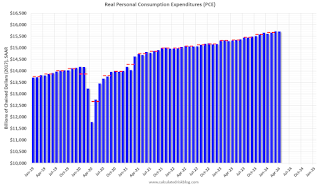 Click on graph for larger image.
The dashed red lines are the quarterly levels for real PCE.
Personal income was at expectations, and PCE was below expectations.
The following graph shows real Personal Consumption Expenditures (PCE) through April 2024 (2017 dollars). Note that the y-axis doesn't start at zero to better show the change.
 Click on graph for larger image.
The dashed red lines are the quarterly levels for real PCE.
Personal income was at expectations, and PCE was below expectations.
Inflation was at expectations.
Thursday, May 30, 2024
Friday: Personal Income and Outlays
by Calculated Risk on 5/30/2024 08:09:00 PM
 Note: Mortgage rates are from MortgageNewsDaily.com and are for top tier scenarios.
Friday:
• At 8:30 AM ET, Personal Income and Outlays, April 2024. The consensus is for a 0.3% increase in personal income, and for a 0.3% increase in personal spending. And for the Core PCE price index to increase 0.3%. PCE prices are expected to be up 2.7% YoY, and core PCE prices up 2.8% YoY.
• At 9:45 AM, Chicago Purchasing Managers Index for May.
Realtor.com Reports Active Inventory Up 36.5% YoY; Most Homes For Sale Since July 2020
by Calculated Risk on 5/30/2024 02:35:00 PM
What this means: On a weekly basis, Realtor.com reports the year-over-year change in active inventory and new listings. On a monthly basis, they report total inventory. For April, Realtor.com reported inventory was up 30.4% YoY, but still down almost 36% compared to April 2017 to 2019 levels.
Now - on a weekly basis - inventory is up 36.5% YoY.
Realtor.com has monthly and weekly data on the existing home market. Here is their weekly report: Weekly Housing Trends View—Data for Week Ending May 25, 2024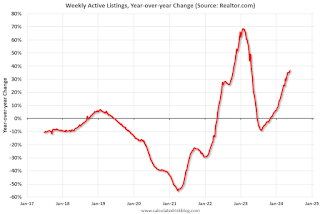 Here is a graph of the year-over-year change in inventory according to realtor.com.
Inventory was up year-over-year for the 29th consecutive week.
Realtor.com has monthly and weekly data on the existing home market. Here is their weekly report: Weekly Housing Trends View—Data for Week Ending May 25, 2024
• Active inventory increased, with for-sale homes 36.5% above year-ago levels.
For the 29th straight week, there were more homes listed for sale versus the prior year, giving homebuyers more options. This past week, the inventory of homes for sale grew by 36.5% compared with last year, and it was the highest since July 2020 in the early days of the COVID-19 Pandemic. This growth in inventory is primarily driven by housing markets in the South, which saw a 43.0% year-over-year increase in inventory in April.
• New listings–a measure of sellers putting homes up for sale–were up this week, by 3.6% from one year ago.
Seller activity continued to climb annually last week but decelerated relative to the previous week’s growth. Newly listed homes grew by 3.6% compared with a year ago, a slowdown from the 8.1% growth rate in the previous week.
 Here is a graph of the year-over-year change in inventory according to realtor.com.
 Inventory was up year-over-year for the 29th consecutive week.
However, inventory is still historically very low.
New listings remain below typical pre-pandemic levels although up year-over-year.
Final Look at Local Housing Markets in April and a Look Ahead to May Sales
by Calculated Risk on 5/30/2024 11:25:00 AM
Today, in the Calculated Risk Real Estate Newsletter: Final Look at Local Housing Markets in April and a Look Ahead to May Sales
A brief excerpt:
In April, sales in these markets were up 7.6% YoY. In March, these same markets were down 10.0% year-over-year Not Seasonally Adjusted (NSA).There is much more in the article.
Sales in most of these markets are down compared to January 2019. Sales in Grand Rapids and Nashville are up compared to 2019.
This is a year-over-year increase NSA for these markets. However, there were two more working days in April 2024 compared to April 2023, so sales Seasonally Adjusted were lower year-over-year than Not Seasonally Adjusted sales.
This was a 7.6% year-over-year decrease NSA for these markets. This is about the same as the 6.8% decline NSA reported by the NAR.
May sales will be mostly for contracts signed in March and April and mortgage rates increased slightly to an average of 6.99% in April. My early expectation is we will see a sales decrease in May on a seasonally adjusted annual rate basis (SAAR) compared to April.
Note for next month (May sales): There were the same number of working days in May 2024 compared to May 2023, so the year-over-year change in the seasonally adjusted sales will be about the same as the NSA data suggests.

NAR: Pending Home Sales Decrease 7.7% in April; Down 7.4% Year-over-year
by Calculated Risk on 5/30/2024 10:00:00 AM
From the NAR: Pending Home Sales Slumped 7.7% in April
Pending home sales in April fell 7.7%, according to the National Association of REALTORS®. All four U.S. regions registered month-over-month and year-over-year decreases.This was well below expectations. Note: Contract signings usually lead sales by about 45 to 60 days, so this would usually be for closed sales in May and June.
The Pending Home Sales Index (PHSI)* – a forward-looking indicator of home sales based on contract signings – decreased to 72.3 in April. Year over year, pending transactions were down 7.4%. An index of 100 is equal to the level of contract activity in 2001.
...
The Northeast PHSI fell 3.5% from last month to 62.9, a decline of 3.1% from April 2023. The Midwest index dropped 9.5% to 70.7 in April, down 8.7% from one year ago.
The South PHSI lowered 7.6% to 88.6 in April, dropping 8.2% from the prior year. The West index decreased 8.5% in April to 55.9, down 7.3% from April 2023.
emphasis added



