
 RSS Feed
 by Calculated Risk on 6/23/2021 01:25:00 PM
Wednesday, June 23, 2021
Black Knight: National Mortgage Delinquency Rate Increased in May
Note: At the beginning of the pandemic, the delinquency rate increased sharply (see table below). Loans in forbearance are counted as delinquent in this survey, but those loans are not reported as delinquent to the credit bureaus.
From Black Knight: Black Knight’s First Look at May 2021 Mortgage Data
• The national delinquency rate rose to 4.73% from 4.66% in April, driven largely by the three-day Memorial Day weekend foreshortening available payment windowsAccording to Black Knight's First Look report, the percent of loans delinquent increased 1.5% in May compared to April, and decreased 39% year-over-year.
• Similar occurrences are rare; the last time was in May 2004, at which time mortgage delinquencies jumped by more than 15% in a single month; this month saw a 1.5% increase
• Early-stage delinquencies (those 30 or 60 days past due) rose by 110,200 in May, while serious delinquencies (90 or more days but not yet in foreclosure) improved for the ninth consecutive month
• Despite this improvement, nearly 1.7 million first-lien mortgages remain seriously delinquent, 1.26 million more than there were prior to the pandemic
• Foreclosure inventory hit yet another new record low as both moratoriums and borrower forbearance plan participation continue to limit activity, keeping foreclosure starts near record lows as well
• Mortgage prepayments fell to their lowest level in more than a year, driven by falling refinance activity as well as purchase-related headwinds
emphasis added
The percent of loans in the foreclosure process decreased 2.5% in May and were down 26% over the last year.
Black Knight reported the U.S. mortgage delinquency rate (loans 30 or more days past due, but not in foreclosure) was 4.73% in May, up from 4.66% in April.
The percent of loans in the foreclosure process decreased in May to 0.28%, from 0.29% in April.
The number of delinquent properties, but not in foreclosure, is down 1,612,000 properties year-over-year, and the number of properties in the foreclosure process is down 52,000 properties year-over-year.
| Black Knight: Percent Loans Delinquent and in Foreclosure Process | ||||
|---|---|---|---|---|
| May 2021 | Apr 2021 | May 2020 | May 2019 | |
| Delinquent | 4.73% | 4.66% | 7.76% | 3.36% |
| In Foreclosure | 0.28% | 0.29% | 0.38% | 0.49% |
| Number of properties: | ||||
| Number of properties that are delinquent, but not in foreclosure: | 2,511,000 | 2,500,000 | 4,123,000 | 1,760,000 |
| Number of properties in foreclosure pre-sale inventory: | 148,000 | 153,000 | 200,000 | 255,000 |
| Total Properties | 2,659,000 | 2,653,000 | 4,323,000 | 2,015,000 |
A few Comments on May New Home Sales
by Calculated Risk on 6/23/2021 11:21:00 AM
New home sales for May were reported at 769,000 on a seasonally adjusted annual rate basis (SAAR). Sales for the previous three months were revised down significantly.
This was well below consensus expectations for May, but still the highest sales rate for May since 2007.
However, sales were in line with home builder comments about "limiting sales" in April and May mostly due to high material costs.
Still, sales have been strong for the last year. Clearly low mortgages rates, low existing home supply, and favorable demographics have boosted sales. A surging stock market has probably helped new home sales too.
Earlier: New Home Sales Decrease to 769,000 Annual Rate in May.
 Click on graph for larger image.
This graph shows new home sales for 2020 and 2021 by month (Seasonally Adjusted Annual Rate).
The year-over-year comparisons were easy in the first half of 2021 - especially in March and April.
However, sales will likely be down year-over-year in the 2nd half of 2021 (maybe June) - since the selling season was delayed in 2020.
And on inventory: note that completed inventory (3rd graph in previous post) is near record lows, but inventory under construction is closer to normal.
 This graph shows the months of supply by stage of construction.
The inventory of completed homes for sale was at 36 thousand in May, just above the record low of 33 thousand in April 2021. That is about 0.6 months of completed supply (just above the record low).
Earlier: New Home Sales Decrease to 769,000 Annual Rate in May.
 Click on graph for larger image.
This graph shows new home sales for 2020 and 2021 by month (Seasonally Adjusted Annual Rate).
The year-over-year comparisons were easy in the first half of 2021 - especially in March and April.
However, sales will likely be down year-over-year in the 2nd half of 2021 (maybe June) - since the selling season was delayed in 2020.
And on inventory: note that completed inventory (3rd graph in previous post) is near record lows, but inventory under construction is closer to normal.
 This graph shows the months of supply by stage of construction.
The inventory of completed homes for sale was at 36 thousand in May, just above the record low of 33 thousand in April 2021. That is about 0.6 months of completed supply (just above the record low).
The inventory of new homes under construction, and not started, is at 4.6 months - a normal level.
New Home Sales Decrease to 769,000 Annual Rate in May
by Calculated Risk on 6/23/2021 10:12:00 AM
The Census Bureau reports New Home Sales in May were at a seasonally adjusted annual rate (SAAR) of 769 thousand.
The previous three months were revised down sharply, combined.
Sales of new single‐family houses in May 2021 were at a seasonally adjusted annual rate of 769,000, according to estimates released jointly today by the U.S. Census Bureau and the Department of Housing and Urban Development. This is 5.9 percent below the revised April rate of 817,000, but is 9.2 percent above the May 2020 estimate of 704,000.
emphasis added
 Click on graph for larger image.
The first graph shows New Home Sales vs. recessions since 1963. The dashed line is the current sales rate.
This was the highest sales rate for May since 2007.
The second graph shows New Home Months of Supply.
 The months of supply increased in May to 5.1 months from 4.6 months in April.
 The all time record high was 12.1 months of supply in January 2009. The all time record low was 3.5 months, most recently in October 2020.
This is in the normal range (about 4 to 6 months supply is normal).
"The seasonally‐adjusted estimate of new houses for sale at the end of May was 330,000. This represents a supply of 5.1 months at the current sales rate."
 On inventory, according to the Census Bureau:
 "A house is considered for sale when a permit to build has been issued in permit-issuing places or work has begun on the footings or foundation in nonpermit areas and a sales contract has not been signed nor a deposit accepted."Starting in 1973 the Census Bureau broke this down into three categories: Not Started, Under Construction, and Completed.
The third graph shows the three categories of inventory starting in 1973.
The inventory of completed homes for sale is just above the record low, but the combined total of completed and under construction is close to normal.
 The last graph shows sales NSA (monthly sales, not seasonally adjusted annual rate).
In May 2021 (red column), 69 thousand new homes were sold (NSA). Last year, 64 thousand homes were sold in May.
The all time high for May was 120 thousand in 2005, and the all time low for May was 26 thousand in 2010.
This was well below expectations, and sales in the three previous months were revised down sharply, combined. I'll have more later today.
MBA: Mortgage Applications Increase in Latest Weekly Survey
by Calculated Risk on 6/23/2021 07:00:00 AM
From the MBA: Mortgage Applications Increase in Latest MBA Weekly Survey
Mortgage applications increased 2.1 percent from one week earlier, according to data from the Mortgage Bankers Association’s (MBA) Weekly Mortgage Applications Survey for the week ending June 18, 2021.
... The Refinance Index increased 3 percent from the previous week and was 9 percent lower than the same week one year ago. The seasonally adjusted Purchase Index increased 1 percent from one week earlier. The unadjusted Purchase Index decreased 1 percent compared with the previous week and was 14 percent lower than the same week one year ago.
“Mortgage rates increased last week, with the 30-year fixed rate rising to 3.18 percent – the highest level in a month. Despite the jump in rates, refinances increased for the second consecutive week, pushed higher by a 4 percent bump in conventional refinance applications,” said Joel Kan, MBA’s Associate Vice President of Economic and Industry Forecasting. “Purchase applications have regained an upward trend over the past few weeks. Activity was slightly higher for the third straight week, but remained lower than the same week a year ago. Government purchase applications drove most of last week’s increase, which also contributed to a slightly lower overall average purchase loan size.”
...
The average contract interest rate for 30-year fixed-rate mortgages with conforming loan balances ($548,250 or less) increased to 3.18 percent from 3.11 percent, with points increasing to 0.48 from 0.36 (including the origination fee) for 80 percent loan-to-value ratio (LTV) loans.
emphasis added
 Click on graph for larger image.
The first graph shows the refinance index since 1990.
With low rates, the index remains elevated, and picked up this week as rates declined.
The second graph shows the MBA mortgage purchase index
 According to the MBA, purchase activity is down 14% year-over-year unadjusted.
Note: The year ago comparisons for the unadjusted purchase index are now more difficult since purchase activity picked up in late May 2020.
Note: Red is a four-week average (blue is weekly).
Tuesday, June 22, 2021
Wednesday: New Home Sales
by Calculated Risk on 6/22/2021 09:08:00 PM
Wednesday:
• At 7:00 AM ET, The Mortgage Bankers Association (MBA) will release the results for the mortgage purchase applications index.
• At 10:00 AM, New Home Sales for May from the Census Bureau. The consensus is for 880 thousand SAAR, up from 863 thousand in April.
• During the day, The AIA's Architecture Billings Index for May (a leading indicator for commercial real estate).
June 22nd COVID-19 New Cases, Vaccinations, Hospitalizations
by Calculated Risk on 6/22/2021 07:02:00 PM
This data is from the CDC.
According to the CDC, on Vaccinations.
Total doses administered: 319,223,844, as of yesterday 318,576,441. Daily change: 0.65 million.
| COVID Metrics | ||||
|---|---|---|---|---|
| Today | Yesterday | Week Ago | Goal | |
| Percent over 18, One Dose | 65.5% | 65.4% | 64.6% | ≥70.0%1,2 |
| Fully Vaccinated (millions) | 150.4 | 150.0 | 145.8 | ≥1601 |
| New Cases per Day3,4 | 11,215 | 11,283 | 12,581 | ≤5,0002 |
| Hospitalized3 | 12,633 | 12,179 | 14,232 | ≤3,0002 |
| Deaths per Day3,4 | 300 | 273 | 310 | ≤502 |
| 1 America's Goal by July 4th, 2my goals to stop daily posts, 37 day average for Cases, Hospitalized, and Deaths 4Cases and Deaths updated Mon - Fri | ||||
KUDOS to the residents of the 16 states and D.C. that have already achieved the 70% goal: Vermont, Hawaii and Massachusetts are at 80%+, and Connecticut, New Jersey, Maine, Rhode Island, Pennsylvania, New Mexico, California, New Hampshire, Maryland, Washington, New York, Illinois, Virginia and D.C. are all over 70%.
Next up are Minnesota at 69.3%, Delaware at 69.1%, Colorado at 68.8%, Oregon at 68.8%, Wisconsin at 64.7%, Nebraska at 63.7%, and South Dakota at 63.6%.
 Click on graph for larger image.
This graph shows the daily (columns) and 7 day average (line) of positive tests reported.
This data is from the CDC.
MBA Survey: "Share of Mortgage Loans in Forbearance Decreases to 3.93%"
by Calculated Risk on 6/22/2021 04:00:00 PM
Note: This is as of June 13th.
From the MBA: Share of Mortgage Loans in Forbearance Decreases to 3.93%
The Mortgage Bankers Association’s (MBA) latest Forbearance and Call Volume Survey revealed that the total number of loans now in forbearance decreased by 11 basis points from 4.04% of servicers’ portfolio volume in the prior week to 3.93% as of June 13, 2021. According to MBA’s estimate, 2 million homeowners are in forbearance plans.
The share of Fannie Mae and Freddie Mac loans in forbearance decreased 4 basis points to 2.05%. Ginnie Mae loans in forbearance decreased 7 basis points to 5.15%, while the forbearance share for portfolio loans and private-label securities (PLS) decreased 35 basis points to 7.98%. The percentage of loans in forbearance for independent mortgage bank (IMB) servicers decreased 16 basis points to 4.05%, and the percentage of loans in forbearance for depository servicers declined 3 basis points to 4.16%.
“The share of loans in forbearance declined for the 16th straight week, with declines across almost every loan category,” said Mike Fratantoni, MBA’s Senior Vice President and Chief Economist. “New forbearance requests, at 4 basis points, remained at an extremely low level. More than 44 percent of borrowers who exited this week used a deferral plan, highlighting the importance of this option.”
Added Fratantoni, “As more homeowners reach the end of their forbearance term, we should continue to see the share in forbearance decline. The improving job market and strong housing market are providing support for those who do exit.”
emphasis added
 Click on graph for larger image.
This graph shows the percent of portfolio in forbearance by investor type over time. Most of the increase was in late March and early April 2020, and has trended down since then.
The MBA notes: "Total weekly forbearance requests as a percent of servicing portfolio volume (#) remained the same relative to the prior week at 0.04%."
Note: These deferral plans are very popular. Basically when the homeowner exits forbearance, they just go back to making their regular monthly payments, they are not charged interest on the missed payments, and the unpaid balanced is deferred until the end of the mortgage.
DOT: Vehicle Miles Driven Increased Sharply year-over-year in April
by Calculated Risk on 6/22/2021 01:00:00 PM
This will be something to watch as the economy recovers.
The Department of Transportation (DOT) reported:
Travel on all roads and streets changed by 54.6% (90.6 billion vehicle miles) for April 2021 as compared with April 2020. Travel for the month is estimated to be 256.5 billion vehicle miles.
The seasonally adjusted vehicle miles traveled for April 2021 is 248.6 billion miles, a 56.5% (89.7 billion vehicle miles) increase over April 2020. It also represents -4.7% decline (-12.3 billion vehicle miles) compared with March 2021.
Cumulative Travel for 2021 changed by ( billion vehicle miles). The cumulative estimate for the year is 947.5 billion vehicle miles of travel.
emphasis added
 Click on graph for larger image.
This graph shows the monthly total vehicle miles driven, seasonally adjusted.
Miles driven declined sharply in March 2020, and really collapsed in April 2020. After partially recovering fairly quickly, miles driven was mostly flat for 6+ months - but picked up in March, but fell back in April.
Comments on May Existing Home Sales
by Calculated Risk on 6/22/2021 10:34:00 AM
Earlier: NAR: Existing-Home Sales Decreased to 5.80 million in May
A few key points:
1) Existing home sales are getting close to pre-pandemic levels. Although seasonally adjusted (SA) sales for May were the highest since 2006, sales Not Seasonally Adjusted (NSA) in May 2021 were below the sales for May in 2017, 2018 and 2019.
Some of the increase over the previous ten months was probably related to record low mortgage rates, a move away from multi-family rentals, strong second home buying (to escape the high-density cities), a strong stock market and favorable demographics.
2) Inventory is very low, and was down 20.6% year-over-year (YoY) in May. Also, as housing economist Tom Lawler has noted, the local MLS data shows even a larger decline in active inventory (the NAR appears to include some pending sales in inventory). Lawler noted:
Months-of-supply at 2.5 months is still very low, but above the record low of 1.9 months set in December 2020 and January 2021. Inventory will be important to watch in 2021, see: Some thoughts on Housing Inventory
Also, the delay in the 2020 buying season pushed the seasonally adjusted number to very high levels over the winter. This means there are going to be some difficult comparisons in the second half of 2021!
2) Inventory is very low, and was down 20.6% year-over-year (YoY) in May. Also, as housing economist Tom Lawler has noted, the local MLS data shows even a larger decline in active inventory (the NAR appears to include some pending sales in inventory). Lawler noted:
"As I’ve noted before, the inventory measure in most publicly-released local realtor/MLS reports excludes listings with pending contracts, but that is not the case for many of the reports sent to the NAR (referred to as the “NAR Report!”), Since the middle of last Spring inventory measures excluding pending listings have fallen much more sharply than inventory measures including such listings, and this latter inventory measure understates the decline in the effective inventory of homes for sale over the last several months."
It seems likely that active inventory is down close to 50% year-over-year.
3) As usual, housing economist Tom Lawler's forecast was closer to the NAR report than the Consensus. The NAR reported 5.80 million SAAR, Lawler estimated the NAR would report 5.78 million SAAR, and the consensus was 5.72 million SAAR.
 Click on graph for larger image.
This graph shows existing home sales by month for 2020 and 2021.
The year-over-year comparison will be easy in June, and then difficult in the second half of the year.
The second graph shows existing home sales for each month, Not Seasonally Adjusted (NSA), since 2005.
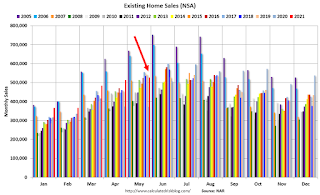 Sales NSA in May (528,000) were 41.9% above sales in May 2020 (372,000).
Although sales were up sharply from May 2020, this was below the sales NSA for May in 2017, 2018 and 2019.
 Click on graph for larger image.
This graph shows existing home sales by month for 2020 and 2021.
The year-over-year comparison will be easy in June, and then difficult in the second half of the year.
The second graph shows existing home sales for each month, Not Seasonally Adjusted (NSA), since 2005.
 Sales NSA in May (528,000) were 41.9% above sales in May 2020 (372,000).
Although sales were up sharply from May 2020, this was below the sales NSA for May in 2017, 2018 and 2019.
NAR: Existing-Home Sales Decreased to 5.80 million in May
by Calculated Risk on 6/22/2021 10:12:00 AM
From the NAR: Existing-Home Sales Experience Slight Skid of 0.9% in May
Existing-home sales decreased for a fourth straight month in May, according to the National Association of Realtors®. Only one major U.S. region recorded a month-over-month increase, while the other three regions saw sales decline. However, each of the four areas again registered double-digit year-over-year gains.
Total existing-home sales, completed transactions that include single-family homes, townhomes, condominiums and co-ops, dropped 0.9% from April to a seasonally-adjusted annual rate of 5.80 million in May. Sales in total climbed year-over-year, up 44.6% from a year ago (4.01 million in May 2020).
...
Total housing inventory at the end of May amounted to 1.23 million units, up 7.0% from April's inventory and down 20.6% from one year ago (1.55 million). Unsold inventory sits at a 2.5-month supply at the present sales pace, marginally up from April's 2.4-month supply but down from 4.6-months in May 2020.
emphasis added
 Click on graph for larger image.
This graph shows existing home sales, on a Seasonally Adjusted Annual Rate (SAAR) basis since 1993.
Sales in May (5.80 million SAAR) were down 0.9% from last month, and were 44.6% above the May 2020 sales rate.
The second graph shows nationwide inventory for existing homes.
 According to the NAR, inventory increased to 1.23 million in May from 1.15 million in April. Headline inventory is not seasonally adjusted, and inventory usually decreases to the seasonal lows in December and January, and peaks in mid-to-late summer.
The last graph shows the year-over-year (YoY) change in reported existing home inventory and months-of-supply. Since inventory is not seasonally adjusted, it really helps to look at the YoY change. Note: Months-of-supply is based on the seasonally adjusted sales and not seasonally adjusted inventory.
 Inventory was down 20.6% year-over-year in May compared to May 2020.
 Months of supply increased to 2.5 months in May from 2.4 months in April.
This was slightly above the consensus forecast. I'll have more later.



