
 RSS Feed
 by Calculated Risk on 1/07/2026 07:00:00 AM
Wednesday, January 07, 2026
MBA: Mortgage Applications Decreased Over a Two-Week Period
From the MBA: MMortgage Applications Decreased Over a Two-Week Period in Latest MBA Weekly Survey
Mortgage applications decreased 9.7 percent from two weeks earlier, according to data from the Mortgage Bankers Association’s (MBA) Weekly Mortgage Applications Survey for the week ending January 2, 2026. The results include an adjustment for the holidays.
The Market Composite Index, a measure of mortgage loan application volume, decreased 9.7 percent on a seasonally adjusted basis from two weeks earlier. On an unadjusted basis, the Index decreased 28 percent compared with two weeks ago. The holiday adjusted Refinance Index decreased 14 percent from two weeks ago and was 133 percent higher than the same week one year ago. The unadjusted Refinance Index decreased 31 percent from two weeks ago and was 108 percent higher than the same week one year ago. The seasonally adjusted Purchase Index decreased 6 percent from two weeks earlier. The unadjusted Purchase Index decreased 23 percent compared with two weeks ago and was 10 percent higher than the same week one year ago.
“Mortgage rates started the New Year with a decline to 6.25 percent, the lowest level since September 2024. Refinance applications were up 7 percent for the week but were at a slower pace than in the weeks leading up to the holidays,” said Joel Kan, MBA’s Vice President and Deputy Chief Economist. “FHA refinance applications saw a 19 percent increase, although that was a partial rebound from a drop the week before. MBA continues to expect mortgage rates to stay around current levels, with spells of refinance opportunities in the weeks when rates move lower.”
Added Kan, “Purchase applications were 10 percent higher than the same week a year ago but were down over the week following decreases in conventional and FHA applications. The average loan size was $408,700, the smallest in a year, driven by lower average loan sizes across both conventional and government loan types.”
...
The average contract interest rate for 30-year fixed-rate mortgages with conforming loan balances ($806,500 or less) decreased to 6.25 percent from 6.32 percent, with points decreasing to 0.57 from 0.59 (including the origination fee) for 80 percent loan-to-value ratio (LTV) loans.
emphasis added
 Click on graph for larger image.
The first graph shows the MBA mortgage purchase index.
According to the MBA, purchase activity is up 10% year-over-year unadjusted.
Red is a four-week average (blue is weekly).
Purchase application activity is still depressed, but solidly above the lows of 2023 and above the lowest levels during the housing bust.

The second graph shows the refinance index since 1990.
The refinance index increased from the bottom as mortgage rates declined, but is down from the recent peak in September as rates moved sideways.
Tuesday, January 06, 2026
Wednesday: ADP Employment, Job Openings, ISM Services
by Calculated Risk on 1/06/2026 08:04:00 PM
 Note: Mortgage rates are from MortgageNewsDaily.com and are for top tier scenarios.
Wednesday:
• At 7:00 AM ET, The Mortgage Bankers Association (MBA) will release the results for the mortgage purchase applications index. This will be two weeks of data.
• At 8:15 AM, The ADP Employment Report for December. This report is for private payrolls only (no government). The consensus is for 50,000, up from -32,000 jobs added in November.
• At 10:00 AM, Job Openings and Labor Turnover Survey for November from the BLS.
• At 10:00 AM, the ISM Services Index for December.
Light Vehicle Sales Increased to 16.0 Million SAAR in December
by Calculated Risk on 1/06/2026 01:21:00 PM
The BEA reported that light vehicle sales were at 16.0 million in December on a seasonally adjusted annual basis (SAAR). This was up 1.9% from the sales rate in November, and down 4.9% from December 2024.
 Click on graph for larger image.
This graph shows light vehicle sales since 2006 from the BEA (blue) through December.
Vehicle sales were over 17 million SAAR in March and April as consumers rushed to "beat the tariffs".
Then sales were depressed in May and June.
Sales were boosted in August and September due to the termination of the EV credit at the end of September.
 The second graph shows light vehicle sales since the BEA started keeping data in 1967.
Sales in Decvember were slightly above the consensus forecast.
 The second graph shows light vehicle sales since the BEA started keeping data in 1967.
Sales in Decvember were slightly above the consensus forecast.
Light vehicle sales were up 2.4% in 2025 compared to 2024.
Heavy Truck Sales Collapsed in Q4; Down 32.5% Year-over-year in December
by Calculated Risk on 1/06/2026 10:54:00 AM
This graph shows heavy truck sales since 1967 using data from the BEA. The dashed line is the December 2025 seasonally adjusted annual sales rate (SAAR) of 311 thousand.
Note: "Heavy trucks - trucks more than 14,000 pounds gross vehicle weight."
 Click on graph for larger image.
Heavy truck sales were at 311 thousand SAAR in December, down from 336 thousand in November, and down 32.5% from 461 thousand SAAR in December 2024.
Sales were down 15.3% in 2025 compared to annual sales in 2024.
Usually, heavy truck sales decline sharply prior to a recession, and sales have collapsed recently.
Asking Rents Decline Year-over-year
by Calculated Risk on 1/06/2026 10:14:00 AM
Today, in the Real Estate Newsletter: Asking Rents Decline Year-over-year
Brief excerpt:
Another monthly update on rents.There is much more in the article.
Tracking rents is important for understanding the dynamics of the housing market. Slower household formation and increased supply (more multi-family completions) has kept asking rents under pressure.
More recently, immigration policy has become a negative for rentals.
Apartment List: Asking Rent Growth -1.3% Year-over-year ...
The national median rent fell 0.8% in December, and now stands at $1,356. This closes the book on 2025, with five consecutive months of rent declines. Based on recent years, we expect another 1-2 months of rent drops before the market turns a corner in early Spring.Realtor.com: 28th Consecutive Month with Year-over-year Decline in RentsAcross the 50 largest metropolitan areas in the United States, median asking rent for 0-2 bedroom units fell for the 28th consecutive month on a year-over-year basis.

ICE: "Annual home price growth ended 2025 at just +0.7%"
by Calculated Risk on 1/06/2026 08:11:00 AM
The ICE Home Price Index (HPI) is a repeat sales index. ICE reports the median price change of the repeat sales.
From ICE (Intercontinental Exchange):
Annual home price growth ended 2025 at just +0.7% — the smallest calendar-year increase since 2011, when prices fell by 2.9%.As ICE mentioned, "regional trends ... show significant variation". The Northeast and Midwest are saw solid house price gains in 2025, whereas cities in the South and West have been leading the way in inventory increases and price declines (especially Florida and Texas).
With income growth outpacing home price gains and 30-year mortgage rates starting 2026 at 6.15%, housing affordability is at its best level in nearly four years.
At current prices and rates, purchasing an average-priced home with 20% down and a 30-year loan requires a monthly payment of $2,093 — 27.8% of median household income. That’s down from $2,256 (31.1%) at the start of 2025.
According to Andy Walden, Head of Mortgage and Housing Market Research for Intercontinental Exchange:
“Improved affordability and income growth have provided a much-needed boost to housing market dynamics, even as regional trends and property types show significant variation. The Northeast and Midwest have emerged as clear leaders, while condos continue to face headwinds in most markets.”
Drilling down into regional and property type specifics:
• Regional Standouts: New Haven, CT led all markets with an impressive 8.6% price growth, followed by Syracuse, NY (+6.8%) and Hartford, CT (+6.25%). Notably, 24 of the 25 fastest-appreciating markets were in the Northeast and Midwest.
• Price Declines: On the flip side, 35 of the 100 largest U.S. markets saw home prices decline in 2025 — up from just 10 in 2024 and marking the largest share of declines since 2011.
• Property Type Trends: Single-family homes outperformed condos, with prices rising 1.0% compared to a 1.7% decline for condos. Condos underperformed in 90% of markets nationwide.
Monday, January 05, 2026
"Mortgage Rates Holding at 2-Month Low"
by Calculated Risk on 1/05/2026 07:53:00 PM
 From Matthew Graham at Mortgage News Daily: Mortgage Rates Holding at 2-Month Low Excerpt:
Bottom line: at current levels, any day that rates spend holding steady or moving microscopically lower will technically result in the lowest rates since October 28th. It would take a more noticeable improvement to break below that floor. When and if that happens, rates will be the lowest since early 2023.[30 year fixed 6.19%]Tuesday:
emphasis added
• No major economic releases scheduled.
Update: The Housing Bubble and Mortgage Debt as a Percent of GDP
by Calculated Risk on 1/05/2026 02:51:00 PM
Today, in the Calculated Risk Real Estate Newsletter: Update: The Housing Bubble and Mortgage Debt as a Percent of GDP
A brief excerpt:
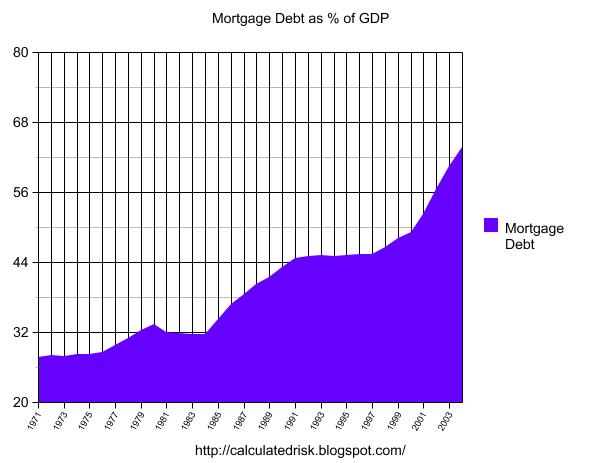
Three years ago, I wrote The Housing Bubble and Mortgage Debt as a Percent of GDP. Here is an update to a couple of graphs. The bottom line remains the same: There will not be cascading price declines in this cycle due to distressed sales.There is much more in the article.
In a 2005 post, I included a graph of household mortgage debt as a percent of GDP. Several readers asked if I could update the graph.
First, from February 2005 (21 years ago!):The following chart shows household mortgage debt as a % of GDP. Although mortgage debt has been increasing for years, the last four years have seen a tremendous increase in debt. Last year alone mortgage debt increased close to $800 Billion - almost 7% of GDP. ...And a serious problem is what happened!
Many homeowners have refinanced their homes, in essence using their homes as an ATM.
It wouldn't take a RE bust to impact the general economy. Just a slowdown in both volume (to impact employment) and in prices (to slow down borrowing) might push the general economy into recession. An actual bust, especially with all of the extensive sub-prime lending, might cause a serious problem.
ISM® Manufacturing index Decreased to 47.9% in December; "Lowest Reading of 2025"
by Calculated Risk on 1/05/2026 10:00:00 AM
(Posted with permission). The ISM manufacturing index indicated contraction. The PMI® was at 47.9% in December, down from 48.2% in November. The employment index was at 44.9%, up from 44.0% the previous month, and the new orders index was at 47.7%, up from 47.4%.
From ISM: Manufacturing PMI® at 47.9%
December 2025 ISM® Manufacturing PMI® Report
Economic activity in the manufacturing sector contracted in December for the 10th consecutive month, following a two-month expansion preceded by 26 straight months of contraction, say the nation’s supply executives in the latest ISM® Manufacturing PMI® Report.This suggests manufacturing contracted for the tenth consecutive month in December. This was below the consensus forecast, and employment was very weak and prices very strong.
The report was issued today by Susan Spence, MBA, Chair of the Institute for Supply Management® (ISM®) Manufacturing Business Survey Committee.
“The Manufacturing PMI® registered 47.9 percent in December, a 0.3-percentage point decrease compared to the reading of 48.2 percent in November and the lowest reading of 2025. The overall economy continued in expansion for the 68th month after one month of contraction in April 2020. (A Manufacturing PMI® above 42.3 percent, over a period of time, generally indicates an expansion of the overall economy.) The New Orders Index contracted for a fourth straight month in December following one month of growth; the figure of 47.7 percent is 0.3 percentage point higher than the 47.4 percent recorded in November. The December reading of the Production Index (51 percent) is 0.4 percentage point lower than November’s figure of 51.4 percent. The Prices Index remained in expansion (or ‘increasing’ territory), registering 58.5 percent, the same as November’s reading. The Backlog of Orders Index registered 45.8 percent, up 1.8 percentage points compared to the 44 percent recorded in November. The Employment Index registered 44.9 percent, up 0.9 percentage point from November’s figure of 44 percent.
emphasis added
Housing January 5th Weekly Update: Inventory Down 2.2% Week-over-week
by Calculated Risk on 1/05/2026 08:11:00 AM
Altos reports that active single-family inventory was down 2.2% week-over-week.
Note that Inventory usually bottoms seasonally in January or February.
The first graph shows the seasonal pattern for active single-family inventory since 2015.
 Click on graph for larger image.
The red line is for 2025. The black line is for 2019.
Inventory was up 13.3% compared to the same week in 2025 (last week it was up 13.1%), and down 6.0% compared to the same week in 2019 (last week it was down 11.8%).
Inventory started 2026 down almost 12% compared to 2019.
 This second inventory graph is courtesy of Altos Research.
As of January 2nd, inventory was at 720 thousand (7-day average), compared to 736 thousand the prior week.
Mike Simonsen discusses this data and much more regularly on YouTube



