RSS Feed
 by Calculated Risk on 7/24/2025 10:00:00 AM
Thursday, July 24, 2025
New Home Sales Increase to 627,000 Annual Rate in June
The Census Bureau reports New Home Sales in June were at a seasonally adjusted annual rate (SAAR) of 627 thousand.
The previous three months were revised down, combined.
Sales of new single-family houses in June 2025 were at a seasonally-adjusted annual rate of 627,000, according to estimates released jointly today by the U.S. Census Bureau and the Department of Housing and Urban Development. This is 0.6 percent above the May 2025 rate of 623,000, and is 6.6 percent below the June 2024 rate of 671,000.
emphasis added
 Click on graph for larger image.
The first graph shows New Home Sales vs. recessions since 1963. The dashed line is the current sales rate.
New home sales were below pre-pandemic levels.
The second graph shows New Home Months of Supply.
 The months of supply increased in June to 9.8 months from 9.7 months in May.
 The all-time record high was 12.2 months of supply in January 2009. The all-time record low was 3.3 months in August 2020.
This is well above the top of the normal range (about 4 to 6 months of supply is normal).
"The seasonally-adjusted estimate of new houses for sale at the end of June 2025 was 511,000. This is 1.2 percent above the May 2025 estimate of 505,000, and is 8.5 percent (±5.4 percent) above the June 2024 estimate of 471,000.Sales were below expectations of 650 thousand SAAR and sales for the three previous months were revised down, combined. I'll have more later today.
This represents a supply of 9.8 months at the current sales rate. The months' supply is 1.0 percent above the May 2025 estimate of 9.7 months, and is 16.7 percent above the June 2024 estimate of 8.4 months."
Weekly Initial Unemployment Claims Decrease to 217,000
by Calculated Risk on 7/24/2025 08:30:00 AM
The DOL reported:
In the week ending July 19, the advance figure for seasonally adjusted initial claims was 217,000, a decrease of 4,000 from the previous week's unrevised level of 221,000. The 4-week moving average was 224,500, a decrease of 5,000 from the previous week's unrevised average of 229,500.The following graph shows the 4-week moving average of weekly claims since 1971.
emphasis added
 Click on graph for larger image.
The dashed line on the graph is the current 4-week average. The four-week average of weekly unemployment claims decreased to 224,500.
The previous week was unrevised.
Weekly claims were lower than the consensus forecast.
Wednesday, July 23, 2025
Thursday: New Home Sales, Unemployment Claims
by Calculated Risk on 7/23/2025 07:53:00 PM
 Note: Mortgage rates are from MortgageNewsDaily.com and are for top tier scenarios.
Thursday:
• At 8:30 AM, The initial weekly unemployment claims report will be released. The consensus is for initial claims to increase to 230 thousand from 221 thousand last week.
• Also t 8:30 AM, Chicago Fed National Activity Index for June. This is a composite index of other data.
• At 10:00 AM, New Home Sales for June from the Census Bureau. The consensus is for 650 thousand SAAR, up from 623 thousand in May.
• At 11:00 AM, Kansas City Fed Survey of Manufacturing Activity for July.
AIA: "Architecture firm billings remain soft" in June
by Calculated Risk on 7/23/2025 06:36:00 PM
Note: This index is a leading indicator primarily for new Commercial Real Estate (CRE) investment.
From the AIA: ABI June 2025: Architecture firm billings remain soft, while inquiries increase
The AIA/Deltek Architecture Billings Index score was 46.8 for the month, indicating that the majority of architecture firms are still experiencing a decline in their billings. However, inquiries into new projects increased for the second consecutive month and grew at the strongest pace since last fall. This means that clients are starting to send out RFPs and initiate conversations with architecture firms about potential projects after a lull since mid-winter. However, these inquiries do not necessarily translate into actual projects, as the value of newly signed design contracts declined for the 16th consecutive month in June. It is unlikely that firm billings will return to positive territory until the value of new design contracts also starts to increase again.• Northeast (46.5); Midwest (45.7); South (50.6); West (45.8)
Business conditions remained generally soft across the country in June, although firms located in the South reported a very slight increase in billings for the first time since last October. Firms in all other regions experienced a decline in billings, with the pace of the decline slowing modestly. Firms of all specializations also saw billings soften further in June, although the pace of the billings decline continued to slow at firms with commercial/industrial and institutional specializations. However, conditions remained weakest at firms with a multifamily specialization, where billings declined further this month.
...
The ABI score is a leading economic indicator of construction activity, providing an approximately nine-to-twelve-month glimpse into the future of nonresidential construction spending activity. The score is derived from a monthly survey of architecture firms that measures the change in the number of services provided to clients.
emphasis added
• Sector index breakdown: commercial/industrial (47.4); institutional (49.2); multifamily residential (43.8)
 Click on graph for larger image.
This graph shows the Architecture Billings Index since 1996. The index was at 46.8 in June, down from 47.2 in May. Anything below 50 indicates a decrease in demand for architects' services.
This index has indicated contraction for 31 of the last 33 months.
Note: This includes commercial and industrial facilities like hotels and office buildings, multi-family residential, as well as schools, hospitals and other institutions.
This index usually leads CRE investment by 9 to 12 months, so this index suggests a slowdown in CRE investment throughout 2025 and into 2026.
Note: This includes commercial and industrial facilities like hotels and office buildings, multi-family residential, as well as schools, hospitals and other institutions.
This index usually leads CRE investment by 9 to 12 months, so this index suggests a slowdown in CRE investment throughout 2025 and into 2026.
Multi-family billings have been below 50 for the 35 consecutive months. This suggests we will see continued weakness in multi-family starts.
Philly Fed: State Coincident Indexes Increased in 40 States in June (3-Month Basis)
by Calculated Risk on 7/23/2025 03:01:00 PM
From the Philly Fed:
The Federal Reserve Bank of Philadelphia has released the coincident indexes for the 50 states for June 2025. Over the past three months, the indexes increased in 40 states, decreased in seven states, and remained stable in three, for a three-month diffusion index of 66. Additionally, in the past month, the indexes increased in 41 states, decreased in four states, and remained stable in five, for a one-month diffusion index of 74. For comparison purposes, the Philadelphia Fed has also developed a similar coincident index for the entire United States. The Philadelphia Fed’s U.S. index increased 0.7 percent over the past three months and 0.3 percent in June.Note: These are coincident indexes constructed from state employment data. An explanation from the Philly Fed:
emphasis added
The coincident indexes combine four state-level indicators to summarize current economic conditions in a single statistic. The four state-level variables in each coincident index are nonfarm payroll employment, average hours worked in manufacturing by production workers, the unemployment rate, and wage and salary disbursements deflated by the consumer price index (U.S. city average). The trend for each state’s index is set to the trend of its gross domestic product (GDP), so long-term growth in the state’s index matches long-term growth in its GDP.
 Click on map for larger image.
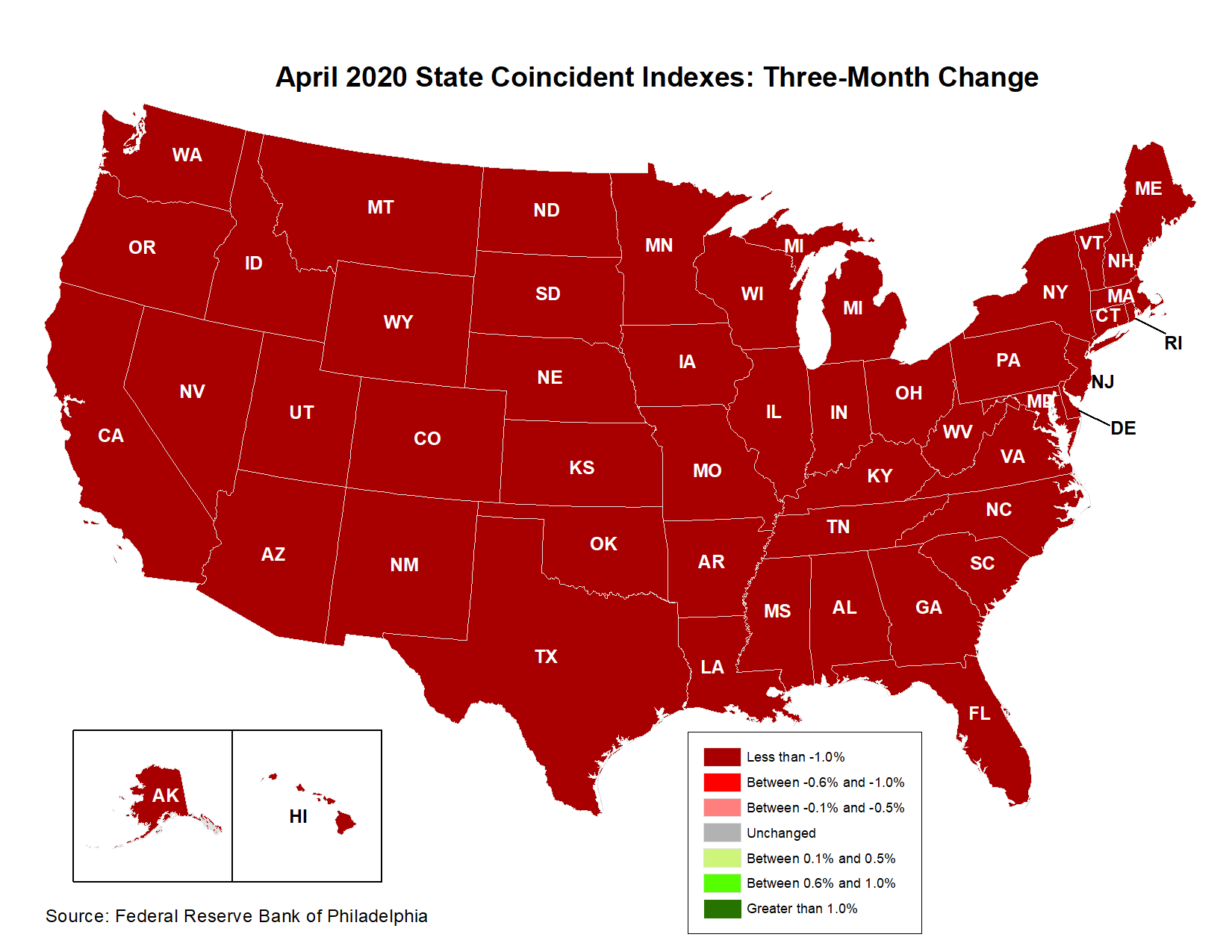
Here is a map of the three-month change in the Philly Fed state coincident indicators. This map was all red during the worst of the Pandemic and also at the worst of the Great Recession.
The map is mostly positive on a three-month basis.
Source: Philly Fed.
 And here is a graph is of the number of states with one month increasing activity according to the Philly Fed.
 This graph includes states with minor increases (the Philly Fed lists as unchanged).
In June, 44 states had increasing activity including minor increases.
In June, 44 states had increasing activity including minor increases.
Newsletter: NAR: Existing-Home Sales Decreased to 3.93 million SAAR in June; Unchanged YoY
by Calculated Risk on 7/23/2025 10:53:00 AM
Today, in the CalculatedRisk Real Estate Newsletter: NAR: Existing-Home Sales Decreased to 3.93 million SAAR in June; Unchanged YoY
Excerpt:
Sales in June (3.93 million SAAR) were down 2.7% from the previous month and were unchanged compared to the June 2024 sales rate. This was the 5th consecutive month with sales unchanged or down year-over-year. ... The sales rate was below the consensus forecast (but right at housing economist Tom Lawler’s estimate).There is much more in the article.
...
Sales Year-over-Year and Not Seasonally Adjusted (NSA)
The fourth graph shows existing home sales by month for 2024 and 2025.
Sales were unchanged year-over-year compared to June 2024. This was the 5th consecutive month with sales unchanged or down year-over-year. The next three months will also have the easy year-over-year comparisons.
...
On an NSA basis for the month of June, this was 7% below the low for housing bust for the month of June that happened in June 2008. Year-to-date, sales are down 1.5% NSA.

NAR: Existing-Home Sales Decreased to 3.93 million SAAR in June; Unchanged YoY
by Calculated Risk on 7/23/2025 10:00:00 AM
From the NAR: NAR Existing-Home Sales Report Shows 2.7% Decrease in June
Existing-home sales decreased by 2.7% in June, according to the National Association of REALTORS® Existing-Home Sales Report. ...
Month-over-month sales declined in the Northeast, Midwest and South and rose modestly in the West. Year-over-year, sales fell in the Northeast and West, while rising in the Midwest and South. ...
• 2.7% decrease in existing-home sales -- seasonally adjusted annual rate of 3.93 million in June.
• Year-over-year: No change in existing-home sales.
• 0.6% decline in unsold inventory -- 1.53 million units equal to 4.7 months' supply.
emphasis added
 Click on graph for larger image.
This graph shows existing home sales, on a Seasonally Adjusted Annual Rate (SAAR) basis since 1994.
Sales in June (3.93 million SAAR) were down 2.7% from the previous month and were unchanged compared to the June 2024 sales rate. This was the 5th consecutive month with sales unchanged or down year-over-year.
The second graph shows nationwide inventory for existing homes.
 According to the NAR, inventory decreased to 1.53 million in June from 1.54 million the previous month.
 According to the NAR, inventory decreased to 1.53 million in June from 1.54 million the previous month.
Headline inventory is not seasonally adjusted, and inventory usually decreases to the seasonal lows in December and January, and peaks in mid-to-late summer.
The last graph shows the year-over-year (YoY) change in reported existing home inventory and months-of-supply. Since inventory is not seasonally adjusted, it really helps to look at the YoY change. Note: Months-of-supply is based on the seasonally adjusted sales and not seasonally adjusted inventory.
 Inventory was up 15.9% year-over-year (blue) in June compared to June 2024.
Months of supply (red) increased to 4.7 months in June from 4.6 months the previous month.
As expected, the sales rate was below the consensus forecast. I'll have more later.
The last graph shows the year-over-year (YoY) change in reported existing home inventory and months-of-supply. Since inventory is not seasonally adjusted, it really helps to look at the YoY change. Note: Months-of-supply is based on the seasonally adjusted sales and not seasonally adjusted inventory.
 Inventory was up 15.9% year-over-year (blue) in June compared to June 2024.
 Months of supply (red) increased to 4.7 months in June from 4.6 months the previous month.
As expected, the sales rate was below the consensus forecast. I'll have more later.
MBA: Mortgage Applications Increase in Latest Weekly Survey
by Calculated Risk on 7/23/2025 07:00:00 AM
From the MBA: Mortgage Applications Increase in Latest MBA Weekly Survey
Mortgage applications increased 0.8 percent from one week earlier, according to data from the Mortgage Bankers Association’s (MBA) Weekly Mortgage Applications Survey for the week ending July 18, 2025.
The Market Composite Index, a measure of mortgage loan application volume, increased 0.8 percent on a seasonally adjusted basis from one week earlier. On an unadjusted basis, the Index increased 1 percent compared with the previous week. The Refinance Index decreased 3 percent from the previous week and was 22 percent higher than the same week one year ago. The seasonally adjusted Purchase Index increased 3 percent from one week earlier. The unadjusted Purchase Index increased 4 percent compared with the previous week and was 22 percent higher than the same week one year ago.
“The 30-year fixed mortgage rate edged higher last week to its highest level in four weeks at 6.84 percent, while rates for other loan types were mixed. Purchase applications finished the week higher, driven by conventional purchase loans, and continue to run ahead of last year’s pace,” said Joel Kan, MBA’s Vice President and Deputy Chief Economist. “After reaching $460,000 in March 2025, the purchase loan amount has fallen to its lowest level since January 2025 to $426,700. With the 30-year fixed rate still too high to benefit many borrowers, refinance applications were down almost three percent for the week.”
...
The average contract interest rate for 30-year fixed-rate mortgages with conforming loan balances ($806,500 or less) increased to 6.84 percent from 6.82 percent, with points remaining unchanged at 0.62 (including the origination fee) for 80 percent loan-to-value ratio (LTV) loans.
emphasis added
 Click on graph for larger image.
The first graph shows the MBA mortgage purchase index.
According to the MBA, purchase activity is up 22% year-over-year unadjusted.
Red is a four-week average (blue is weekly).
Purchase application activity is still depressed, but above the lows of October 2023 and slightly above the lowest levels during the housing bust.

The second graph shows the refinance index since 1990.
The refinance index decreased and remains very low.
Tuesday, July 22, 2025
Wednesday: Existing Home Sales
by Calculated Risk on 7/22/2025 07:28:00 PM
 Note: Mortgage rates are from MortgageNewsDaily.com and are for top tier scenarios.
Wednesday:
• At 7:00 AM ET, The Mortgage Bankers Association (MBA) will release the results for the mortgage purchase applications index.
• At 10:00 AM: Existing Home Sales for June from the National Association of Realtors (NAR). The consensus is for 4.00 million SAAR, down from 4.03 million last month.
• During the day: The AIA's Architecture Billings Index for June (a leading indicator for commercial and multi-family real estate).
Update: Lumber Prices Up 30% YoY
by Calculated Risk on 7/22/2025 03:11:00 PM
This is something to watch again. Here is another update on lumber prices.
SPECIAL NOTE: The CME group discontinued the Random Length Lumber Futures contract on May 16, 2023. I switched to a physically-delivered Lumber Futures contract that was started in August 2022. Unfortunately, this impacts long term price comparisons since the new contract was priced about 24% higher than the old random length contract for the period when both contracts were available.
This graph shows CME random length framing futures through August 2022 (blue), and the new physically-delivered Lumber Futures (LBR) contract starting in August 2022 (Red).
On July 22, 2025, LBR was at $669.50 per 1,000 board feet, up 30% from a year ago.
 Click on graph for larger image.
There is somewhat of a seasonal demand for lumber, and lumber prices frequently peak in the first half of the year.
The pickup in early 2018 was due to the Trump lumber tariffs in 2017. There were huge increases during the pandemic due to a combination of supply constraints and a pickup in housing starts.