
 RSS Feed
 by Calculated Risk on 1/23/2025 03:51:00 PM
Thursday, January 23, 2025
Realtor.com Reports Active Inventory Up 25.1% YoY
What this means: On a weekly basis, Realtor.com reports the year-over-year change in active inventory and new listings. On a monthly basis, they report total inventory. For December, Realtor.com reported inventory was up 22.0% YoY, but still down 15.7% compared to the 2017 to 2019 same month levels.
Now - on a weekly basis - inventory is up 25.1% YoY.
Realtor.com has monthly and weekly data on the existing home market. Here is their weekly report: Weekly Housing Trends View—Data for Week Ending January 18, 2025 Here is a graph of the year-over-year change in inventory according to realtor.com.
Inventory was up year-over-year for the 63rd consecutive week.
Realtor.com has monthly and weekly data on the existing home market. Here is their weekly report: Weekly Housing Trends View—Data for Week Ending January 18, 2025
• Active inventory increased, with for-sale homes 25.1% above year-ago levels.
For the 63rd consecutive week, the number of homes for sale has increased compared to the same time last year. However, the week’s growth was near levels seen throughout the winter, showing a narrower gap between current and previous year listings compared to last summer.
• New listings–a measure of sellers putting homes up for sale–increased 17.9%.
New listing activity can be bumpy around the holidays as homeowners turn their attention to the season’s festivities. This week brought the highest number of new listings to the market since October suggesting that sellers are ready to get into the market this year. The past two weeks have brought the most new listings so far this winter, getting the year started with a jolt of housing activity.
 Here is a graph of the year-over-year change in inventory according to realtor.com.
 Inventory was up year-over-year for the 63rd consecutive week.
New listings have jumped recently but remain below typical pre-pandemic levels.
4th Look at Local Housing Markets in December
by Calculated Risk on 1/23/2025 12:29:00 PM
Today, in the Calculated Risk Real Estate Newsletter: 4th Look at Local Housing Markets in December
A brief excerpt:
Here are a few more local markets before the NAR releases December Existing Home sales tomorrow, Friday, January 24th at 10:00 AM. This will be the 3rd consecutive month with a year-over-year increase in sales.There is much more in the article.
Watch the regional difference! Inventory is recovering quicker than sales in some areas (especially Florida and Texas), and this is pushing up months-of-supply - and could lead to some price declines in 2025.
The consensus is for 4.20 million SAAR, up from 4.15 million in November. Last year, the NAR reported sales in December 2023 at 3.88 million SAAR. Housing economist Tom Lawler expects the NAR to report sales of 4.15 million SAAR for December.
...
Here is a look at months-of-supply using NSA sales. Since this is NSA data, it is likely this will be the seasonal low for months-of-supply.
...
Several local markets - like Illinois, Miami, New Jersey and New York - will report after the NAR release.

ICE: Mortgage Delinquency Rate Increased 4% Year-over-year in December
by Calculated Risk on 1/23/2025 11:31:00 AM
• The national delinquency rate eased 2 basis points (bps) to 3.72% in December, but rose 4.0% year over year – the seventh consecutive annual increase – ending 2024 near a three-year high
• Early-stage delinquencies fell 41K (-3.6%) in the month, while serious delinquencies (loans 90+ days past due but not in active foreclosure) continued their slow climb – up 29K (+5.7%) in the month and a fifth consecutive rise year over year
• Foreclosure sales declined by 5K (-5.6%) in December, hitting their lowest level in nearly two years, while foreclosure inventory climbed 7K (+3.8%), but was down -10.7% year-over-year
• Despite rising in December on volatility around the holidays, foreclosure starts averaged 26,800 per month in 2024, down from 28,500 in 2023 and lower than any year outside the pandemic moratoria
• Prepayment activity (measured by single-month mortality or SMM) fell to 0.57% on rising interest rates, down -9.8% in the month but up 47.2% from the same time last year
emphasis added
 Click on graph for larger image.
Here is a table from ICE.
Weekly Initial Unemployment Claims Increase to 223,000
by Calculated Risk on 1/23/2025 08:30:00 AM
The DOL reported:
In the week ending January 18, the advance figure for seasonally adjusted initial claims was 223,000, an increase of 6,000 from the previous week's unrevised level of 217,000. The 4-week moving average was 213,500, an increase of 750 from the previous week's unrevised average of 212,750.The following graph shows the 4-week moving average of weekly claims since 1971.
emphasis added
 Click on graph for larger image.
The dashed line on the graph is the current 4-week average. The four-week average of weekly unemployment claims increased to 213,500.
The previous week was unrevised.
Weekly claims were below the consensus forecast.
Wednesday, January 22, 2025
Thursday: Unemployment Claims
by Calculated Risk on 1/22/2025 07:30:00 PM
 Note: Mortgage rates are from MortgageNewsDaily.com and are for top tier scenarios.
Thursday:
• At 8:30 AM ET, The initial weekly unemployment claims report will be released. The consensus is for a increase to 227 thousand from 217 thousand last week.
• At 11:00 AM, the Kansas City Fed manufacturing survey for January.
NMHC on Apartments: "Looser market conditions for the tenth consecutive quarter"
by Calculated Risk on 1/22/2025 12:16:00 PM
Today, in the CalculatedRisk Real Estate Newsletter: NMHC on Apartments: "Looser market conditions for the tenth consecutive quarter"
Excerpt:
From the NMHC: Apartment Market Experiences Loosening Conditions, Decreased Deal Flow and Less Available Financing to Start the New YearThere is much more in the article.Apartment market conditions declined in the National Multifamily Housing Council’s (NMHC’s) most recent Quarterly Survey of Apartment Market Conditions. All four indices – Market Tightness (40), Sales Volume (41), Equity Financing (48) and Debt Financing (32) – came in below the breakeven level (50), signaling less favorable conditions this quarter.This index has been an excellent leading indicator for rents and vacancy rates, and this suggests higher vacancy rates and a further weakness in asking rents. This is the tenth consecutive quarter with looser conditions than the previous quarter.
...• The Market Tightness Index came in at 40 this quarter – below the breakeven level of 50 – indicating looser market conditions for the tenth consecutive quarter. Slightly over half (52%) of respondents thought market conditions were unchanged relative to three months ago, while a third of respondents thought conditions have become looser. Fourteen percent of respondents reported tighter market conditions than three months prior.

AIA: Architecture Billings "End the year on a weak note"
by Calculated Risk on 1/22/2025 11:26:00 AM
Note: This index is a leading indicator primarily for new Commercial Real Estate (CRE) investment.
From the AIA: ABI December 2024: Business conditions end the year on a weak note
The AIA/Deltek Architecture Billings Index (ABI) score fell to 44.1 for the month as the share of firms reporting a decline in firm billings increased. Firm billings have now decreased for the majority of firms every month except two since October 2022. While not a full-fledged recession, this period of softness and uncertainty has been challenging for many firms. And prospects for future work remain soft as well. Although inquiries into new projects continued to increase at a relatively slow rate, the value of newly signed design contracts decreased further in December as clients remained hesitant to commit to new work. In one brighter spot, backlogs at firms remained steady and strong at 6.5 months in December, so many firms still have work in the pipeline for now.• Northeast (41.7); Midwest (46.4); South (47.2); West (52.2)
Despite overall softness in billings, firms located in the West reported growth for the third consecutive month in December. But business conditions remained soft for firms in all other regions, particularly at firms located in the Northeast, which were the first to report slight growth earlier in the year. Billings also declined at firms of all specializations in December, although firms with an institutional sector are on the cusp of growth and have been for several months. However, business conditions softened further for both firms with multifamily residential and commercial/industrial specializations this month, ending the year on a down note.
...
The ABI score is a leading economic indicator of construction activity, providing an approximately nine-to-twelve-month glimpse into the future of nonresidential construction spending activity. The score is derived from a monthly survey of architecture firms that measures the change in the number of services provided to clients.
emphasis added
• Sector index breakdown: commercial/industrial (44.1); institutional (49.8); multifamily residential (46.5)
 Click on graph for larger image.
This graph shows the Architecture Billings Index since 1996. The index was at 44.1 in November, down from 49.7 in November. Anything below 50 indicates a decrease in demand for architects' services.
This index has indicated contraction for 25 of the last 27 months.
Note: This includes commercial and industrial facilities like hotels and office buildings, multi-family residential, as well as schools, hospitals and other institutions.
This index usually leads CRE investment by 9 to 12 months, so this index suggests a slowdown in CRE investment in 2025.
Note: This includes commercial and industrial facilities like hotels and office buildings, multi-family residential, as well as schools, hospitals and other institutions.
This index usually leads CRE investment by 9 to 12 months, so this index suggests a slowdown in CRE investment in 2025.
In November, we saw the first positive score for multi-family since 2022. However, multi-family billings turned negative again in December and has been negative for 28 of the last 29 months. This suggests we will see further weakness in multi-family starts.
MBA: Mortgage Applications Increased in Weekly Survey
by Calculated Risk on 1/22/2025 07:00:00 AM
From the MBA: Mortgage Applications Increase in Latest MBA Weekly Survey
Mortgage applications increased 0.1 percent from one week earlier, according to data from the Mortgage Bankers Association’s (MBA) Weekly Mortgage Applications Survey for the week ending January 17, 2025.
The Market Composite Index, a measure of mortgage loan application volume, increased 0.1 percent on a seasonally adjusted basis from one week earlier. On an unadjusted basis, the Index increased 3 percent compared with the previous week. The Refinance Index decreased 3 percent from the previous week and was 42 percent higher than the same week one year ago. The seasonally adjusted Purchase Index increased 1 percent from one week earlier. The unadjusted Purchase Index increased 7 percent compared with the previous week and was 2 percent higher than the same week one year ago.
“Mortgage application volume was little changed last week, but there was a small increase in conventional purchase volume, which brought the level of total purchase volume up almost 2 percent above last year at this time,” said Mike Fratantoni, MBA’s SVP and Chief Economist. “Mortgage rates remained near 7 percent, a key psychological level, which likely continues to slow the pace of activity for both refinances and purchases. Incoming economic data are likely to keep the Federal Reserve on hold for now, while uncertainties about economic policy are likely to keep longer-term rates, including mortgage rates, steady at these levels.”
...
The average contract interest rate for 30-year fixed-rate mortgages with conforming loan balances ($766,550 or less) decreased to 7.02 percent from 7.09 percent, with points decreasing to 0.62 from 0.65 (including the origination fee) for 80 percent loan-to-value ratio (LTV) loans. The effective rate decreased from last week.
emphasis added
 Click on graph for larger image.
The first graph shows the MBA mortgage purchase index.
According to the MBA, purchase activity is up 2% year-over-year unadjusted.
Red is a four-week average (blue is weekly).
Purchase application activity is up about 30% from the lows in late October 2023 and is now 8% above the lowest levels during the housing bust.

The second graph shows the refinance index since 1990.
The refinance index is very low.
Tuesday, January 21, 2025
Wednesday: Architecture Billings Index
by Calculated Risk on 1/21/2025 07:24:00 PM
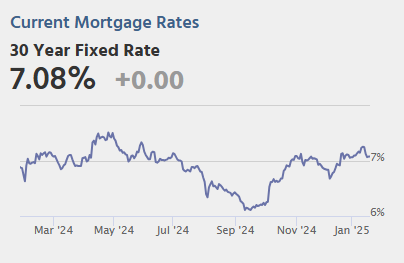 From Matthew Graham at Mortgage News Daily: Mortgage Rates Unimpacted by New Executive Orders
Bonds were thus able to hold onto the gains from last week with some additional improvement today. The average mortgage lender wasn't eager to adjust rates, however, with the top tier 30yr fixed rate remaining unchanged from last Friday. [30 year fixed 7.08%]Wednesday:
emphasis added
• At 7:00 AM ET: The Mortgage Bankers Association (MBA) will release the mortgage purchase applications index.
During the day: The AIA's Architecture Billings Index for December (a leading indicator for commercial real estate).
MBA Survey: Share of Mortgage Loans in Forbearance Decreases to 0.47% in December
by Calculated Risk on 1/21/2025 01:14:00 PM
From the MBA: Share of Mortgage Loans in Forbearance Decreases Slightly to 0.47% in December
The Mortgage Bankers Association’s (MBA) monthly Loan Monitoring Survey revealed that the total number of loans now in forbearance decreased by 3 basis points from 0.50% of servicers’ portfolio volume in the prior month to 0.47% as of December 31, 2024. According to MBA’s estimate, 235,000 homeowners are in forbearance plans. Mortgage servicers have provided forbearance to approximately 8.5 million borrowers since March 2020.
The share of Fannie Mae and Freddie Mac loans in forbearance decreased 2 basis points to 0.19% in December 2024. Ginnie Mae loans in forbearance decreased by 4 basis points to 1.07%, and the forbearance share for portfolio loans and private-label securities (PLS) decreased 2 basis points to 0.40%.
“The overall mortgage forbearance rate decreased slightly in December as some borrowers got back on track following last fall’s severe weather in the Southeast,” said Marina Walsh, CMB, MBA’s Vice President of Industry Analysis. “Even with the slight decrease, the level of forbearance is higher than it was six months ago across all loan types and the performance of servicing portfolios and loan workouts has weakened.”
Added Walsh, “At year end, almost 43% of borrowers in forbearance were there due to a natural disaster. Given the disruption and devastation caused by the California wildfires, that share will likely move higher in the months ahead, as homeowners turn to forbearance to allow time to navigate their recovery process.”
emphasis added
 Click on graph for larger image.
By reason, 54.5% of borrowers are in forbearance for reasons such as a temporary hardship caused by job loss, death, divorce, or disability. Another 42.8% are in forbearance because of a natural disaster. Less than 2.7% of borrowers are still in forbearance because of COVID-19.At the end of December, there were about 235,000 homeowners in forbearance plans.



