
 RSS Feed
 by Calculated Risk on 2/01/2021 04:00:00 PM
Monday, February 01, 2021
MBA Survey: "Share of Mortgage Loans in Forbearance Remains Unchanged at 5.38%"
Note: This is as of January 24th.
From the MBA: Share of Mortgage Loans in Forbearance Remains Unchanged at 5.38%
The Mortgage Bankers Association’s (MBA) latest Forbearance and Call Volume Survey revealed that the total number of loans now in forbearance remained unchanged relative to the prior week at 5.38% of servicers’ portfolio volume as of January 24, 2021. According to MBA’s estimate, 2.7 million homeowners are in forbearance plans.
...
“The share of loans in forbearance was unchanged in the prior week, with a gain in the portfolio/PLS loan segment offset by declines in the Ginnie Mae and GSE investor loan categories. When servicers buy out delinquent loans from Ginnie Mae pools, they are reclassified as portfolio loans, which can lead to a decrease in the Ginnie Mae forbearance share and an increase in the portfolio/PLS share,” said Mike Fratantoni, MBA’s Senior Vice President and Chief Economist. “While new forbearance requests dropped slightly, the rate of exits from forbearance was at the slowest pace since MBA began tracking exit data last summer.”
Fratantoni added, “Overall, the forbearance numbers have been little changed over the past few months. Homeowners still in forbearance are likely facing ongoing challenges with lost jobs, lost income, and other impacts from the pandemic.”
emphasis added
 Click on graph for larger image.
This graph shows the percent of portfolio in forbearance by investor type over time. Most of the increase was in late March and early April, then trended down - and has mostly moved sideways recently.
The MBA notes: "Total weekly forbearance requests as a percent of servicing portfolio volume (#) decreased relative to the prior week: from 0.07% to 0.06%."
Housing Inventory Weekly Update: At Record Lows
by Calculated Risk on 2/01/2021 12:46:00 PM
One of the key questions for 2021 is: Will inventory increase as the pandemic subsides, or will inventory decrease further in 2021?
Tracking inventory will be very important this year, and I'll be using some weekly sources.
 Click on graph for larger image in graph gallery.
This inventory graph is courtesy of Altos Research.
As of January 29th, inventory was at 367 thousand (7 day average), compared to 732 thousand the same week a year ago. That is a decline of almost 50%.
A week ago, inventory was at 380 thousand, and was down 48% YoY. Seasonally inventory should bottom by early March.
Mike Simonsen discusses this data regularly on Youtube.
Mike Simonsen discusses this data regularly on Youtube.
Construction Spending Increased 1.0% in December; 4.7% Annual Increase
by Calculated Risk on 2/01/2021 10:38:00 AM
From the Census Bureau reported that overall construction spending increased:
Construction spending during December 2020 was estimated at a seasonally adjusted annual rate of $1,490.4 billion, 1.0 percent above the revised November estimate of $1,475.6 billion. The December figure is 5.7 percent above the December 2019 estimate of $1,410.3 billion.Both private and public spending increased:
The value of construction in 2020 was $1,429.7 billion, 4.7 percent above the $1,365.1 billion spent in 2019.
emphasis added
Spending on private construction was at a seasonally adjusted annual rate of $1,137.6 billion, 1.2 percent above the revised November estimate of $1,124.4 billion. ...
In December, the estimated seasonally adjusted annual rate of public construction spending was $352.8 billion, 0.5 percent above the revised November estimate of $351.1 billion.
 Click on graph for larger image.
This graph shows private residential and nonresidential construction spending, and public spending, since 1993. Note: nominal dollars, not inflation adjusted.
Residential spending is 2% above the bubble peak (in nominal terms - not adjusted for inflation).
Non-residential spending is 8% above the previous peak in January 2008 (nominal dollars), but has been weak recently.
Public construction spending is 8% above the previous peak in March 2009, and 35% above the austerity low in February 2014.
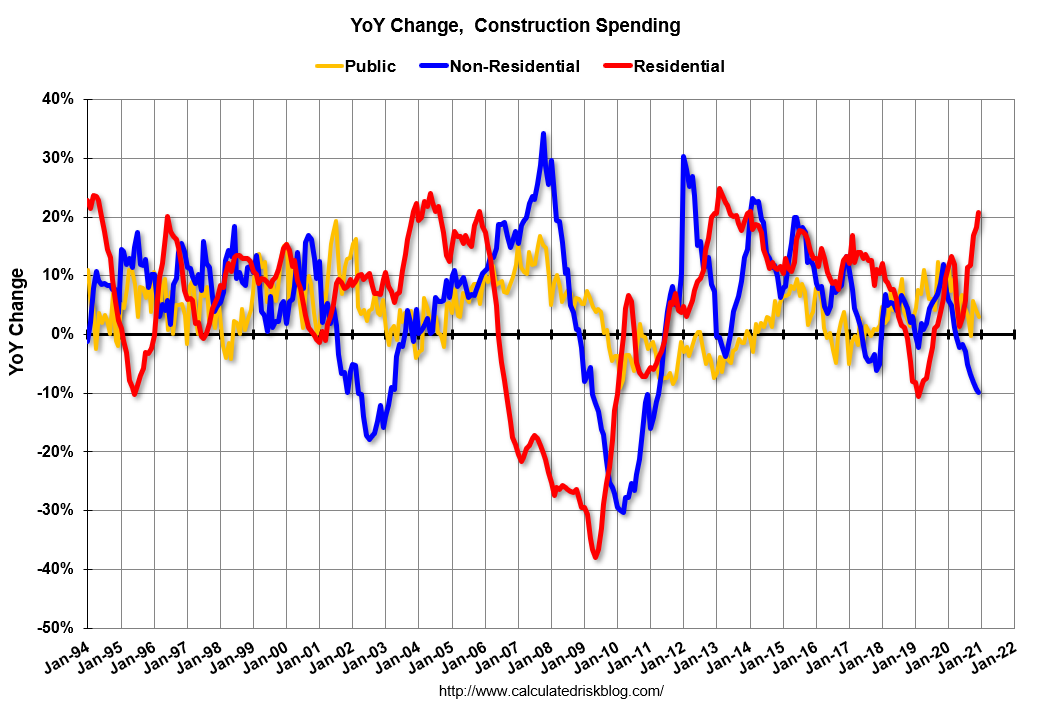 The second graph shows the year-over-year change in construction spending.
On a year-over-year basis, private residential construction spending is up 20.7%. Non-residential spending is down 9.8% year-over-year. Public spending is up 3.0% year-over-year.
Construction was considered an essential service in most areas and did not decline sharply like many other sectors, but it seems likely that non-residential, and public spending (depending on disaster relief), will be under pressure. For example, lodging is down 25% YoY, multi-retail down 21% YoY, and office down 3% YoY.
This was slightly above consensus expectations of a 0.9% increase in spending, and construction spending for the previous two months was revised up. A strong report.
ISM Manufacturing index Decreased to 58.7 in January
by Calculated Risk on 2/01/2021 10:15:00 AM
The ISM manufacturing index indicated expansion in January. The PMI was at 58.7% in January, down from 60.5% in December. The employment index was at 52.6%, up from 51.7% last month, and the new orders index was at 61.1%, down from 67.5%.
From ISM: Manufacturing PMI® at 58.7%; January 2021 Manufacturing ISM® Report On Business®
Economic activity in the manufacturing sector grew in January, with the overall economy notching an eighth consecutive month of growth, say the nation's supply executives in the latest Manufacturing ISM® Report On Business®.This was below expectations.
The report was issued today by Timothy R. Fiore, CPSM, C.P.M., Chair of the Institute for Supply Management® (ISM®) Manufacturing Business Survey Committee:
"The January Manufacturing PMI® registered 58.7 percent, down 1.8 percentage points from the seasonally adjusted December reading of 60.5 percent. This figure indicates expansion in the overall economy for the eighth month in a row after contraction in March, April, and May. The New Orders Index registered 61.1 percent, down 6.4 percentage points from the seasonally adjusted December reading of 67.5 percent. The Production Index registered 60.7 percent, a decrease of 4 percentage points compared to the seasonally adjusted December reading of 64.7 percent. The Backlog of Orders Index registered 59.7 percent, 0.6 percentage point above the December reading of 59.1 percent. The Employment Index registered 52.6 percent, 0.9 percentage point higher from the seasonally adjusted December reading of 51.7 percent. The Supplier Deliveries Index registered 68.2 percent, up 0.5 percentage point from the December figure of 67.7 percent. The Inventories Index registered 50.8 percent, 0.2 percentage point lower than the seasonally adjusted December reading of 51 percent. The Prices Index registered 82.1 percent, up 4.5 percentage points compared to the December reading of 77.6 percent. The New Export Orders Index registered 54.9 percent, a decrease of 2.6 percentage points compared to the December reading of 57.5 percent. The Imports Index registered 56.8 percent, a 2.2-percentage point increase from the December reading of 54.6 percent."
emphasis added
This suggests manufacturing expanded at a slower pace in January than in December.
Seven High Frequency Indicators for the Economy
by Calculated Risk on 2/01/2021 08:48:00 AM
These indicators are mostly for travel and entertainment. It will interesting to watch these sectors recover as the vaccine is distributed.
IMPORTANT: Be safe now - if all goes well, we could all be vaccinated by Q2 2021.
----- Airlines: Transportation Security Administration -----
The TSA is providing daily travel numbers.
 Click on graph for larger image.
This data shows the seven day average of daily total traveler throughput from the TSA for 2019-2020 (Blue) and 2020-2021 (Red).
The dashed line is the percent of last year for the seven day average.
This data is as of January 31st.
The seven day average is down 64.4% from last year (35.6% of last year). (Dashed line)
There was a slow increase from the bottom, with ups and downs due to the holidays - but TSA data has mostly moved sideways.
----- Restaurants: OpenTable -----
The second graph shows the 7 day average of the year-over-year change in diners as tabulated by OpenTable for the US and several selected cities.
 Thanks to OpenTable for providing this restaurant data:
This data is updated through January 30, 2021.
This data is "a sample of restaurants on the OpenTable network across all channels: online reservations, phone reservations, and walk-ins. For year-over-year comparisons by day, we compare to the same day of the week from the same week in the previous year."
Note that this data is for "only the restaurants that have chosen to reopen in a given market". Since some restaurants have not reopened, the actual year-over-year decline is worse than shown.
Dining picked up during the holidays. Note that dining is generally lower in the northern states - Illinois, Pennsylvania, and New York. Note that California dining is picking up now that the orders to close has been lifted.
----- Movie Tickets: Box Office Mojo -----
 This data shows domestic box office for each week (red) and the maximum and minimum for the years 2016 through 2019. Blue is 2020 and Red is 2021.
The TSA is providing daily travel numbers.
 Click on graph for larger image.
This data shows the seven day average of daily total traveler throughput from the TSA for 2019-2020 (Blue) and 2020-2021 (Red).
The dashed line is the percent of last year for the seven day average.
This data is as of January 31st.
The seven day average is down 64.4% from last year (35.6% of last year). (Dashed line)
There was a slow increase from the bottom, with ups and downs due to the holidays - but TSA data has mostly moved sideways.
The second graph shows the 7 day average of the year-over-year change in diners as tabulated by OpenTable for the US and several selected cities.
 Thanks to OpenTable for providing this restaurant data:
This data is updated through January 30, 2021.
This data is "a sample of restaurants on the OpenTable network across all channels: online reservations, phone reservations, and walk-ins. For year-over-year comparisons by day, we compare to the same day of the week from the same week in the previous year."
Note that this data is for "only the restaurants that have chosen to reopen in a given market". Since some restaurants have not reopened, the actual year-over-year decline is worse than shown.
Dining picked up during the holidays. Note that dining is generally lower in the northern states - Illinois, Pennsylvania, and New York. Note that California dining is picking up now that the orders to close has been lifted.
 This data shows domestic box office for each week (red) and the maximum and minimum for the years 2016 through 2019. Blue is 2020 and Red is 2021.
 The data is from BoxOfficeMojo through January 28th.
Note that the data is usually noisy week-to-week and depends on when blockbusters are released.
Movie ticket sales were at $9 million last week (compared to usually around $200 million per week at this time of year).
----- Hotel Occupancy: STR -----
 This graph shows the seasonal pattern for the hotel occupancy rate using the four week average.
The red line is for 2021, black is 2020, blue is the median, and dashed light blue is for 2009 (the worst year since the Great Depression for hotels - before 2020).
This data is through January 23rd. Hotel occupancy is currently down 30.6% year-over-year. Seasonally we'd expect that business travel would start to pick up in the new year, but there will probably not be much pickup early in 2021.
Notes: Y-axis doesn't start at zero to better show the seasonal change.
----- Gasoline Supplied: Energy Information Administration -----
 This graph, based on weekly data from the U.S. Energy Information Administration (EIA), shows gasoline supplied compared to the same week of 2019.
Blue is for 2020. At one point, gasoline supplied was off almost 50% YoY. Red is for 2021.
As of January 2nd, gasoline supplied was off about 18.1% (about 81.9% of the same week in 2019).
Note: People driving instead of flying might have boosted gasoline consumption.
----- Transit: Apple Mobility -----
This graph is from Apple mobility. From Apple: "This data is generated by counting the number of requests made to Apple Maps for directions in select countries/regions, sub-regions, and cities." This is just a general guide - people that regularly commute probably don't ask for directions.
There is also some great data on mobility from the Dallas Fed Mobility and Engagement Index. However the index is set "relative to its weekday-specific average over January–February", and is not seasonally adjusted, so we can't tell if an increase in mobility is due to recovery or just the normal increase in the Spring and Summer.
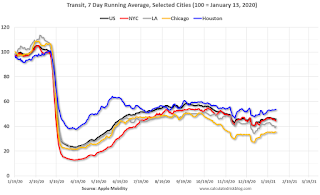 This data is through January 30th for the United States and several selected cities.
The graph is the running 7 day average to remove the impact of weekends.
IMPORTANT: All data is relative to January 13, 2020. This data is NOT Seasonally Adjusted. People walk and drive more when the weather is nice, so I'm just using the transit data.
According to the Apple data directions requests, public transit in the 7 day average for the US is at 46% of the January 2020 level. It is at 35% in Chicago, and 54% in Houston - and mostly moving sideways.
----- New York City Subway Usage -----
Here is some interesting data on New York subway usage (HT BR).
 This graph is from Todd W Schneider. This is daily data since early 2020.
This data is through Friday, January 29th.
Schneider has graphs for each borough, and links to all the data sources.
He notes: "Data updates weekly from the MTA’s public turnstile data, usually on Saturday mornings".
Note that the data is usually noisy week-to-week and depends on when blockbusters are released.
Movie ticket sales were at $9 million last week (compared to usually around $200 million per week at this time of year).
 This graph shows the seasonal pattern for the hotel occupancy rate using the four week average.
 The red line is for 2021, black is 2020, blue is the median, and dashed light blue is for 2009 (the worst year since the Great Depression for hotels - before 2020).
This data is through January 23rd. Hotel occupancy is currently down 30.6% year-over-year. Seasonally we'd expect that business travel would start to pick up in the new year, but there will probably not be much pickup early in 2021.
Notes: Y-axis doesn't start at zero to better show the seasonal change.
 This graph, based on weekly data from the U.S. Energy Information Administration (EIA), shows gasoline supplied compared to the same week of 2019.
Blue is for 2020. At one point, gasoline supplied was off almost 50% YoY. Red is for 2021.
As of January 2nd, gasoline supplied was off about 18.1% (about 81.9% of the same week in 2019).
Note: People driving instead of flying might have boosted gasoline consumption.
This graph is from Apple mobility. From Apple: "This data is generated by counting the number of requests made to Apple Maps for directions in select countries/regions, sub-regions, and cities." This is just a general guide - people that regularly commute probably don't ask for directions.
There is also some great data on mobility from the Dallas Fed Mobility and Engagement Index. However the index is set "relative to its weekday-specific average over January–February", and is not seasonally adjusted, so we can't tell if an increase in mobility is due to recovery or just the normal increase in the Spring and Summer.
 This data is through January 30th for the United States and several selected cities.
The graph is the running 7 day average to remove the impact of weekends.
IMPORTANT: All data is relative to January 13, 2020. This data is NOT Seasonally Adjusted. People walk and drive more when the weather is nice, so I'm just using the transit data.
According to the Apple data directions requests, public transit in the 7 day average for the US is at 46% of the January 2020 level. It is at 35% in Chicago, and 54% in Houston - and mostly moving sideways.
Here is some interesting data on New York subway usage (HT BR).
 This graph is from Todd W Schneider. This is daily data since early 2020.
This data is through Friday, January 29th.
Schneider has graphs for each borough, and links to all the data sources.
He notes: "Data updates weekly from the MTA’s public turnstile data, usually on Saturday mornings".
Sunday, January 31, 2021
Monday: ISM Mfg, Construction Spending
by Calculated Risk on 1/31/2021 08:01:00 PM
Weekend:
• Schedule for Week of January 31, 2021
Monday:
• At 10:00 AM ET, ISM Manufacturing Index for January. The consensus is for the ISM to be at 60.0, down from 60.7 in December.
• Also at 10:00 AM, Construction Spending for December. The consensus is for a 0.9% increase in construction spending.
• At 2:00 PM, Senior Loan Officer Opinion Survey on Bank Lending Practices for January.
From CNBC: Pre-Market Data and Bloomberg futures S&P 500 are down 20 and DOW futures are down 100 (fair value).
Oil prices were down slightly over the last week with WTI futures at $52.03 per barrel and Brent at $54.92 barrel. A year ago, WTI was at $52, and Brent was at $58 - so WTI oil prices are unchanged year-over-year.
Here is a graph from Gasbuddy.com for nationwide gasoline prices. Nationally prices are at $2.42 per gallon. A year ago prices were at $2.48 per gallon, so gasoline prices are down $0.06 per gallon year-over-year.
January 31 COVID-19 Test Results and Vaccinations; January Deadliest Month
by Calculated Risk on 1/31/2021 07:53:00 PM
Note: Bloomberg has great data on vaccinations.
"Vaccinations in the U.S. began Dec. 14 with health-care workers, and so far 31.8 million shots have been given, according to a state-by-state tally by Bloomberg and data from the Centers for Disease Control and Prevention. In the last week, an average of 1.35 million doses per day were administered."Also check out the graphs at COVID-19 Vaccine Projections The site has several interactive graphs related to US COVID vaccinations including a breakdown of how many have had one shot, and how many have had both shots.
The US is now averaging close to 2 million tests per day. Based on the experience of other countries, for adequate test-and-trace (and isolation) to reduce infections, the percent positive needs to be under 5% (probably close to 1%), so the US has far too many daily cases - and percent positive - to do effective test-and-trace.
There were 1,661,492 test results reported over the last 24 hours.
There were 118,211 positive tests.
Over 95,000 US deaths have been reported in January, surpassing December as the deadliest month. See the graph on US Daily Deaths here.
This data is from the COVID Tracking Project.
And check out COVID Act Now to see how each state is doing. (updated link to new site)
 Click on graph for larger image.
This graph shows the 7 day average of positive tests reported and daily hospitalizations.
The percent positive over the last 24 hours was 7.1%. The percent positive is calculated by dividing positive results by total tests (including pending).
It seems likely cases and hospitalizations have peaked, but are declining from a very high level.
Q4 2020 GDP Details on Residential and Commercial Real Estate
by Calculated Risk on 1/31/2021 11:15:00 AM
The BEA has released the underlying details for the Q4 advance GDP report.
The BEA reported that investment in non-residential structures increased at a 3.0% annual pace in Q4. This followed four consecutive quarterly declines (weakness started before the pandemic). On an annual basis, investment in non-residential structures was off 9.5% in 2020 from 2019.
Investment in petroleum and natural gas structures increased sharply in Q4 compared to Q3, but was still down 37% year-over-year. On an annual basis, investment in petroleum and natural gas structures was off 39% in 2020 compared to 2019.
 Click on graph for larger image.
The first graph shows investment in offices, malls and lodging as a percent of GDP.
Investment in offices decreased in Q4, and was only 6.1% year-over-year.
Investment in multimerchandise shopping structures (malls) peaked in 2007 and was down about 19% year-over-year in Q4 - and at a record low as a percent of GDP. The vacancy rate for malls is still very high, so investment will probably stay low for some time.
Lodging investment decreased in Q4, and lodging investment was down 23% year-over-year.
All three sectors - offices, malls, and hotels - are being hurt significantly by the pandemic.
 The second graph is for Residential investment components as a percent of GDP. According to the Bureau of Economic Analysis, RI includes new single family structures, multifamily structures, home improvement, Brokers’ commissions and other ownership transfer costs, and a few minor categories (dormitories, manufactured homes).
Even though investment in single family structures has increased from the bottom, single family investment is still low, and still below the bottom for previous recessions as a percent of GDP.
Investment in single family structures was $337 billion (SAAR) (about 1.6% of GDP), and up 16.2% year-over-year.
Investment in multi-family structures increased in Q4.
Investment in home improvement was at a $306 billion Seasonally Adjusted Annual Rate (SAAR) in Q3 (about 1.4% of GDP). Home improvement spending has been solid during the pandemic.
 The second graph is for Residential investment components as a percent of GDP. According to the Bureau of Economic Analysis, RI includes new single family structures, multifamily structures, home improvement, Brokers’ commissions and other ownership transfer costs, and a few minor categories (dormitories, manufactured homes).
Even though investment in single family structures has increased from the bottom, single family investment is still low, and still below the bottom for previous recessions as a percent of GDP.
Investment in single family structures was $337 billion (SAAR) (about 1.6% of GDP), and up 16.2% year-over-year.
Investment in multi-family structures increased in Q4.
Investment in home improvement was at a $306 billion Seasonally Adjusted Annual Rate (SAAR) in Q3 (about 1.4% of GDP). Home improvement spending has been solid during the pandemic.
Note that Brokers' commissions (black) increased sharply as existing home sales increased in the second half of 2020, and was up 32% year-over-year in Q4.
Saturday, January 30, 2021
January 30 COVID-19 Test Results and Vaccinations
by Calculated Risk on 1/30/2021 07:46:00 PM
The reason I'm posting COVID data is this matters for the economy. From the FOMC statement this week:
"The path of the economy will depend significantly on the course of the virus, including progress on vaccinations."It appears the 7-day average cases has peaked. Stay safe! I'm looking forward to not posting this data soon.
Note: Bloomberg has great data on vaccinations.
The US is now averaging close to 2 million tests per day. Based on the experience of other countries, for adequate test-and-trace (and isolation) to reduce infections, the percent positive needs to be under 5% (probably close to 1%), so the US has far too many daily cases - and percent positive - to do effective test-and-trace.
"Vaccinations in the U.S. began Dec. 14 with health-care workers, and so far 30.5 million shots have been given, according to a state-by-state tally by Bloomberg and data from the Centers for Disease Control and Prevention. In the last week, an average of 1.35 million doses per day were administered."Also check out the graphs at COVID-19 Vaccine Projections The site has several interactive graphs related to US COVID vaccinations including a breakdown of how many have had one shot, and how many have had both shots.
The US is now averaging close to 2 million tests per day. Based on the experience of other countries, for adequate test-and-trace (and isolation) to reduce infections, the percent positive needs to be under 5% (probably close to 1%), so the US has far too many daily cases - and percent positive - to do effective test-and-trace.
There were 2,088,902 test results reported over the last 24 hours.
There were 146,657 positive tests.
Over 93,000 US deaths have been reported so far in January, surpassing December as the deadliest month. See the graph on US Daily Deaths here.
 Click on graph for larger image.
This data is from the COVID Tracking Project.
The percent positive over the last 24 hours was 7.0% (red line is 7 day average). The percent positive is calculated by dividing positive results by total tests (including pending).
And check out COVID Act Now to see how each state is doing. (updated link to new site)
 The second graph shows the 7 day average of positive tests reported and daily hospitalizations.
It seems likely cases and hospitalizations have peaked, but are declining from a very high level.
Schedule for Week of January 31, 2021
by Calculated Risk on 1/30/2021 08:11:00 AM
The key report scheduled for this week is the January employment report.
Other key indicators include January ISM manufacturing and services surveys, the December trade deficit, and January vehicle sales.
10:00 AM: ISM Manufacturing Index for January. The consensus is for the ISM to be at 60.0, down from 60.7 in December.
10:00 AM: Construction Spending for December. The consensus is for a 0.9% increase in construction spending.
2:00 PM: Senior Loan Officer Opinion Survey on Bank Lending Practices for January.
10:00 AM: Corelogic House Price index for December.
10:00 AM: the Q4 2020 Housing Vacancies and Homeownership from the Census Bureau.
 All day: Light vehicle sales for January. The consensus is for light vehicle sales to be 16.3 million SAAR in January, unchanged from 16.3 million in December (Seasonally Adjusted Annual Rate).
This graph shows light vehicle sales since the BEA started keeping data in 1967. The dashed line is the December sales rate.
7:00 AM ET: The Mortgage Bankers Association (MBA) will release the results for the mortgage purchase applications index.
8:15 AM: The ADP Employment Report for January. This report is for private payrolls only (no government). The consensus is for 45,000 payroll jobs added in January, up from 123,000 lost in December.
10:00 AM: the ISM Services Index for January.
8:30 AM: The initial weekly unemployment claims report will be released. The consensus is for a decrease to 820 thousand from 847 thousand last week.
 8:30 AM: Employment Report for January. The consensus is for 50 thousand jobs added, and for the unemployment rate to be unchanged at 6.7%. There were 140 thousand jobs lost in December, and the unemployment rate was at 6.7%.
This graph shows the job losses from the start of the employment recession, in percentage terms.
The current employment recession was by far the worst recession since WWII in percentage terms, and the worst in terms of the unemployment rate.
 8:30 AM: Trade Balance report for December from the Census Bureau.
 This graph shows the U.S. trade deficit, with and without petroleum, through the most recent report. The blue line is the total deficit, and the black line is the petroleum deficit, and the red line is the trade deficit ex-petroleum products.
The consensus is the trade deficit to be $65.7 billion. The U.S. trade deficit was at $68.1 billion in November.



