
 RSS Feed
 by Calculated Risk on 4/03/2020 10:05:00 AM
Friday, April 03, 2020
ISM Non-Manufacturing Index decreased to 52.5% in March
The March ISM Non-manufacturing index was at 52.5%, down from 57.3% in February. The employment index decreased to 47.0%, from 55.6%. Note: Above 50 indicates expansion, below 50 contraction.
From the Institute for Supply Management: March 2020 Non-Manufacturing ISM Report On Business®
Economic activity in the non-manufacturing sector grew in March for the 122nd consecutive month, say the nation's purchasing and supply executives in the latest Non-Manufacturing ISM® Report On Business.®This is just the beginning of the down turn. The numbers will be much worse in the April report.
The report was issued today by Anthony Nieves, CPSM, C.P.M., A.P.P., CFPM, Chair of the Institute for Supply Management® (ISM®) Non-Manufacturing Business Survey Committee: “The NMI® registered 52.5 percent, 4.8 percentage points lower than the February reading of 57.3 percent. This represents continued growth in the non-manufacturing sector, at a slower rate. The Non-Manufacturing Business Activity Index decreased to 48 percent, 9.8 percentage points lower than the February reading of 57.8 percent, reflecting contraction for the first time since July 2009, when the index registered 47.2 percent. The New Orders Index registered 52.9 percent, 10.2 percentage points below the reading of 63.1 percent in February. The Employment Index decreased 8.6 percentage points to 47 percent from the February reading of 55.6 percent.
emphasis added
March Employment Report: 701,000 Jobs Lost (718,000 Lost ex-Census), 4.4% Unemployment Rate
by Calculated Risk on 4/03/2020 08:44:00 AM
From the BLS:
Total nonfarm payroll employment fell by 701,000 in March, and the unemployment rate rose to 4.4 percent, the U.S. Bureau of Labor Statistics reported today. The changes in these measures reflect the effects of the coronavirus (COVID-19) and efforts to contain it. Employment in leisure and hospitality fell by 459,000, mainly in food services and drinking places. Notable declines also occurred in health care and social assistance, professional and business services, retail trade, and construction.
...
Federal government employment rose by 18,000 in March, reflecting the hiring of 17,000 workers for the 2020 Census.
...
The change in total nonfarm payroll employment for January was revised down by 59,000 from +273,000 to +214,000, and the change for February was revised up by 2,000 from +273,000 to +275,000. With these revisions, employment gains in January and February combined were 57,000 lower than previously reported.
...
In March, average hourly earnings for all employees on private nonfarm payrolls increased by 11 cents to $28.62. Over the past 12 months, average hourly earnings have increased by 3.1 percent.
emphasis added
 Click on graph for larger image.
The first graph shows the monthly change in payroll jobs, ex-Census (meaning the impact of the decennial Census temporary hires and layoffs is removed - mostly in 2010 - to show the underlying payroll changes).
Total payrolls decreased by 718 thousand in March ex-Census (private payrolls decreased 713 thousand).
Payrolls for January and February were revised down 57 thousand combined.
 This graph shows the year-over-year change in total non-farm employment since 1968.
In March, the year-over-year change was 1.504 million jobs.
The third graph shows the employment population ratio and the participation rate.
 The Labor Force Participation Rate was decreased to 62.7% in March. This is the percentage of the working age population in the labor force. A large portion of the recent decline in the participation rate is due to demographics and long term trends.
The Employment-Population ratio decreased to 60.0% (black line).
I'll post the 25 to 54 age group employment-population ratio graph later.
 The fourth graph shows the unemployment rate.
 The unemployment rate increased in March to 4.4%.
This was well below consensus expectations of 100,000 jobs lost, and January and February were revised down by 57,000 combined.
This was a horrible employment report, and the report for April will be much worse. I'll have much more later ...
Thursday, April 02, 2020
Friday: Employment Report
by Calculated Risk on 4/02/2020 10:25:00 PM
Friday:
My March Employment Preview.
Goldman's March Payrolls preview.
Friday:
• At 8:30 AM ET, Employment Report for March. The consensus is for 100,000 jobs lost, and for the unemployment rate to increase to 3.9%.
• At 10:00 AM, the ISM non-Manufacturing Index for March. The consensus is for a reading of 48.1, down from 57.3.
April 2 Update: US COVID-19 Test Results per Day; More Testing Needed
by Calculated Risk on 4/02/2020 05:37:00 PM
The testing shortfall continues. We need someone in charge resolving any bottleneck issues - PPE, manpower, swabs, reagents - whatever the issue, someone needs to be fixing it.
Test-and-trace is a key criteria in starting to reopen the country. My current guess is test-and-trace will require around 300,000 tests per day at first since the US is far behind the curve.
Notes: Data for the previous couple of days is updated and revised, so graphs might change.
Also, I'm no longer including pending tests. So this is just test results reported daily.
There were 103,940 test results reported over the last 24 hours.
 Click on graph for larger image.
This data is from the COVID Tracking Project.
The percent positive over the last 24 hours was 26% (red line - going the wrong way).
Test. Test. Test. Protect healthcare workers first!
Goldman: March Payrolls Preview
by Calculated Risk on 4/02/2020 04:45:00 PM
A few brief excerpts from a note by Goldman Sachs economist Spencer Hill:
We estimate nonfarm payrolls declined 180k in March, below consensus of -100k.
...
We estimate the unemployment rate rose three tenths to 3.8%, with risks skewed towards a larger increase (consensus 3.8%).
…
While we look for a weaker-than-consensus report tomorrow, the March employment numbers are already fairly stale and insignificant in our view, because the April report will likely show job losses in the millions.
emphasis added
March Employment Preview
by Calculated Risk on 4/02/2020 12:22:00 PM
Important Notes:
1. The BLS reference week includes the 12th of the month. Massive COVID-19 layoffs started after the reference week (although there was a pickup in layoffs during the reference week).
2. Watch for Special Notes in the release. There could be some important announcements on how the BLS will be handling unemployment numbers and seasonal adjustments.
3. The 2020 Decennial Census was expected to increase hiring in March. This is unclear now - some of the hiring will be delayed.
On Friday at 8:30 AM ET, the BLS will release the employment report for March. The consensus is for a decrease of 100,000 non-farm payroll jobs, and for the unemployment rate to increase to 3.9%.
Last month, the BLS reported 273,000 jobs added in February (266,000 ex-Census).
Here is a summary of recent data:
• The ADP employment report showed a decrease of 27,000 private sector payroll jobs in March. This was above consensus expectations of 154,000 private sector payroll jobs lost. The ADP report hasn't been very useful in predicting the BLS report for any one month, but in general, this suggests employment growth somewhat above expectations.
• The ISM manufacturing employment index decreased in March to 43.8%. A historical correlation between the ISM manufacturing employment index and the BLS employment report for manufacturing, suggests that private sector BLS manufacturing payroll decreased around 55,000 in March. The ADP report indicated manufacturing jobs increased 6,000 in March.
The ISM non-manufacturing employment index has not been released yet.
• Initial weekly unemployment claims averaged 2.6 million in March, way up from 213,000 in February. For the BLS reference week (includes the 12th of the month), initial claims were at 282,000, up from 211,000 during the reference week the previous month.
This suggests more layoffs (during the reference week) in March than in February.
• The final March University of Michigan consumer sentiment index decreased to 89.1 from the February reading of 101.0. Sentiment is frequently coincident with changes in the labor market, but there are other factors too like gasoline prices and politics. The decline this month was related to the pandemic.
• The BofA job tracker decreased in March to 103,000, down from 144,000 in February, suggesting fewer jobs added in March. However, according to the BofA, this data is "stale".
• Weather: The weather was favorable in both January and February. It is likely some expected hiring for March was pulled forward to the previous two months, suggesting some payback in the March report. So there was some chance that the March report would have been weaker than many expected without COVID-19.
• Conclusion: If we look back at 2005, when weekly claims for the reference week jumped following hurricane Katrina (similar to what happened in March), the economy lost 35 thousand jobs. It is possible that job losses will be that small in the March report - it is also possible that losses could be well over 100K. One thing is clear, job losses in the April report will be off the chart.
Hotels: Occupancy Rate Declined 67% Year-over-year to All Time Record Low
by Calculated Risk on 4/02/2020 11:29:00 AM
From HotelNewsNow.com: STR: US hotel results for week ending 28 March
Reflecting the continued impact of the COVID-19 pandemic, the U.S. hotel industry reported significant year-over-year declines in the three key performance metrics during the week of 22-28 March 2020, according to data from STR.The following graph shows the seasonal pattern for the hotel occupancy rate using the four week average.
In comparison with the week of 24-30 March 2019, the industry recorded the following:
• Occupancy: -67.5% to 22.6%
• Average daily rate (ADR): -39.4% to US$79.92
• Revenue per available room (RevPAR): -80.3% to US$18.05
“Year-over-year declines of this magnitude will unfortunately be the ‘new normal’ until the number of new COVID-19 cases slows significantly,” said Jan Freitag, STR’s senior VP of lodging insights. “Occupancy continues to fall to unprecedented lows, with more than 75% of rooms empty around the nation last week. As projected in our U.S. forecast revision, 2020 will be the worst year on record for occupancy. We do, however, expect the industry to begin to recover once the economy reignites and travel resumes.”
emphasis added
 Click on graph for larger image.
The red line is for 2020, dash light blue is 2019, blue is the median, and black is for 2009 (the worst year probably since the Great Depression for hotels).
2020 was off to a solid start, however, COVID-19 has crushed hotel occupancy.
This is the lowest weekly occupancy on record, even considering seasonality. Note the graph is a 4-week average.
BEA: March Vehicles Sales decreased to 11.4 Million SAAR
by Calculated Risk on 4/02/2020 09:28:00 AM
The BEA released their estimate of March vehicle sales this morning. The BEA estimated light vehicle sales of 11.37 million SAAR in March 2020 (Seasonally Adjusted Annual Rate), down 32.1% from the revised February sales rate, and down 34.1% from March 2019.
Sales in February were revised down from 16.83 million SAAR to 16.73 million SAAR.
 Click on graph for larger image.
This graph shows light vehicle sales since 2006 from the BEA (blue) and an estimate for March 2020 (red).
My view - before the health crisis - was that sales would move mostly sideways at near record levels this year. Going forward, the impact of COVID-19 will be significant.
The second graph shows light vehicle sales since the BEA started keeping data in 1967.
 Note: dashed line is current estimated sales rate of 11.37 million SAAR.
Sales collapsed in the second half of March, and will really collapse in April - and will fall below the lowest point of the Great Recession of 9.0 million SAAR.
Trade Deficit decreased to $39.9 Billion in February
by Calculated Risk on 4/02/2020 09:11:00 AM
Note: This data was for February and the outbreak of COVID-19 likely impacted trade with China.
From the Department of Commerce reported:
The U.S. Census Bureau and the U.S. Bureau of Economic Analysis announced today that the goods and services deficit was $39.9 billion in February, down $5.5 billion from $45.5 billion in January, revised.
February exports were $207.5 billion, $0.8 billion less than January exports. February imports were $247.5 billion, $6.3 billion less than January imports
emphasis added
 Click on graph for larger image.
Both exports and imports decreased in January.
Exports are 26% above the pre-recession peak and down slightly compared to February 2019; imports are 7% above the pre-recession peak, and down 5% compared to February 2019.
In general, trade both imports and exports have moved more sideways or down recently.
The second graph shows the U.S. trade deficit, with and without petroleum.
 The blue line is the total deficit, and the black line is the petroleum deficit, and the red line is the trade deficit ex-petroleum products.
Note that the U.S. exported a slight net positive petroleum products in recent months.
Oil imports averaged $57.24 per barrel in February, down from $61.93 in January, and down from $57.70 in February 2019.
The trade deficit with China decreased to $16.0 billion in February, from $24.8 billion in February 2019.
Weekly Initial Unemployment Claims Increase to 6,648,000
by Calculated Risk on 4/02/2020 08:35:00 AM
The DOL reported:
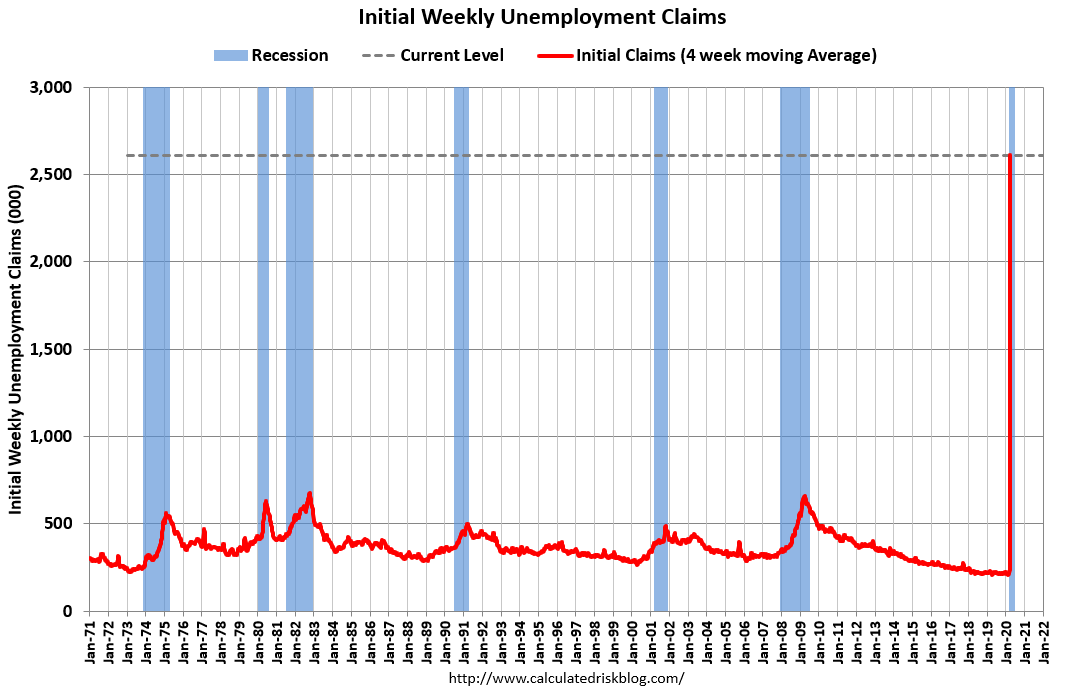
In the week ending March 28, the advance figure for seasonally adjusted initial claims was 6,648,000, an increase of 3,341,000 from the previous week's revised level. This marks the highest level of seasonally adjusted initial claims in the history of the seasonally adjusted series. The previous week's level was revised up by 24,000 from 3,283,000 to 3,307,000. The 4-week moving average was 2,612,000, an increase of 1,607,750 from the previous week's revised average. The previous week's average was revised up by 6,000 from 998,250 to 1,004,250.The previous week was revised up.
emphasis added
The following graph shows the 4-week moving average of weekly claims since 1971.
 Click on graph for larger image.
The dashed line on the graph is the current 4-week average. The four-week average of weekly unemployment claims increased to 2,612,000.
This was much higher than the consensus forecast.
The second graph shows seasonally adjust continued claims since 1967 (lags initial by one week while increasing sharply).
 At the worst of the Great Recession, continued claims peaked at 6.635 million, but then steadily declined.
Over the next few weeks, continued claims will increase rapidly to a new record high, and then will likely stay at that high level until the crisis abates.



