
 RSS Feed
 by Calculated Risk on 6/03/2016 12:31:00 PM
Friday, June 03, 2016
Trade Deficit at $37.4 Billion in April
Earlier the Department of Commerce reported:
The U.S. Census Bureau and the U.S. Bureau of Economic Analysis, through the Department of Commerce, announced today that the goods and services deficit was $37.4 billion in April, up $1.9 billion from $35.5 billion in March, revised. April exports were $182.8 billion, $2.6 billion more than March exports. April imports were $220.2 billion, $4.5 billion more than March imports.The trade deficit was smaller than the consensus forecast of $41.0 billion.
Note: There were major revisions in this report, mostly exports were revised up for the last several years.
The first graph shows the monthly U.S. exports and imports in dollars through April 2016.
 Click on graph for larger image.
Both imports and exports increased in April.
Exports are 11% above the pre-recession peak and down 5% compared to April 2015; imports are 5% below the pre-recession peak, and down 5% compared to April 2015.
The second graph shows the U.S. trade deficit, with and without petroleum.
 The blue line is the total deficit, and the black line is the petroleum deficit, and the red line is the trade deficit ex-petroleum products.
Oil imports averaged $29.48 in April, up from $27.68 in March, and down from $46.47 in April 2015. The petroleum deficit has generally been declining and is the major reason the overall deficit has declined a little since early 2012.
The trade deficit with China decreased to $24.3 billion in April, from $26.8 billion in April 2015. (Note that there were labor issues last year, and the ships were unloaded in March and April - pushing up imports from China). The deficit with China is a substantial portion of the overall deficit.
Comments: A Disappointing Employment Report
by Calculated Risk on 6/03/2016 09:41:00 AM
The headline jobs number was very disappointing, and there were downward revisions to job growth for prior months. The key negatives were few jobs added (only 38 thousand, although the Verizon strike cut the job growth by about 37 thousand), a decline in the participation rate, and a sharp increase in the number of people working part time for economic reasons.
A few positives include wage growth, a lower unemployment rate (however, for the wrong reason - a lower participation rate), and fewer long term unemployed.
Earlier: May Employment Report: 38,000 Jobs, 4.7% Unemployment Rate
In May, the year-over-year change was 2.40 million jobs.
Average Hourly Earnings
 This graph is based on “Average Hourly Earnings” from the Current Employment Statistics (CES) (aka "Establishment") monthly employment report. Note: There are also two quarterly sources for earnings data: 1) “Hourly Compensation,” from the BLS’s Productivity and Costs; and 2) the Employment Cost Index which includes wage/salary and benefit compensation.
On a monthly basis, wages increased at a 2.4% annual rate in May, and April was revised up.
The graph shows the nominal year-over-year change in "Average Hourly Earnings" for all private employees. Nominal wage growth was at 2.5% YoY in May. This series is noisy, however overall wage growth is trending up.
Note: CPI has been running under 2%, so there has been real wage growth.
Part Time for Economic Reasons
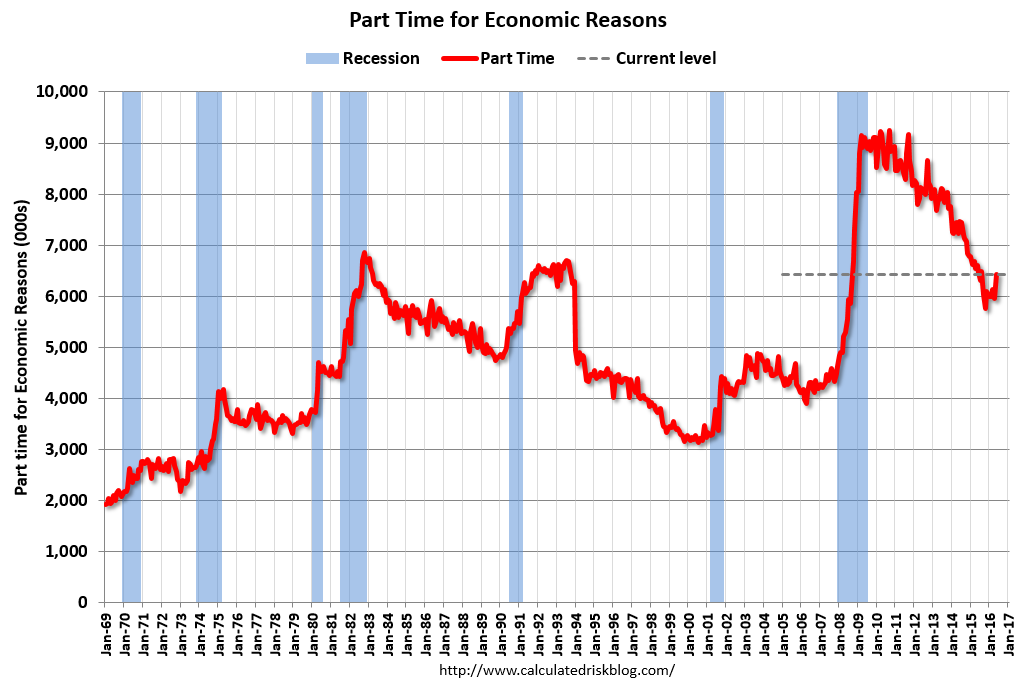 From the BLS report:
The number of persons employed part time for economic reasons (also referred to as involuntary part-time workers) increased by 468,000 to 6.4 million in May, after showing little movement since November. These individuals, who would have preferred full-time employment, were working part time because their hours had been cut back or because they were unable to find a full-time job.The number of persons working part time for economic reasons increased sharply in May. This level suggests slack still in the labor market.
These workers are included in the alternate measure of labor underutilization (U-6) that was unchanged at 9.7% in May.
Unemployed over 26 Weeks
 This graph shows the number of workers unemployed for 27 weeks or more.
 According to the BLS, there are 1.885 million workers who have been unemployed for more than 26 weeks and still want a job. This was down from 2.063 million in April, and the lowest since July 2008.
This is generally trending down, but is still high.
There are still signs of slack (as example, part time workers for economic reasons increase sharply, and elevated U-6), but there also signs the labor market is tightening (decline in long term unemployed, slight pickup in wages).
Overall this was a disappointing report.
May Employment Report: 38,000 Jobs, 4.7% Unemployment Rate
by Calculated Risk on 6/03/2016 08:43:00 AM
From the BLS:
The unemployment rate declined by 0.3 percentage point to 4.7 percent in May, and nonfarm payroll employment changed little (+38,000), the U.S. Bureau of Labor Statistics reported today. Employment increased in health care. Mining continued to lose jobs, and employment in information decreased due to a strike.
...
The change in total nonfarm payroll employment for March was revised from +208,000 to +186,000, and the change for April was revised from +160,000 to +123,000. With these revisions, employment gains in March and April combined were 59,000 less than previously reported. Over the past 3 months, job gains have averaged 116,000 per month.
...
In May, average hourly earnings for all employees on private nonfarm payrolls increased by 5 cents to $25.59, following an increase of 9 cents in April. Over the year, average hourly earnings have risen by 2.5 percent.
emphasis added
 Click on graph for larger image.
The first graph shows the monthly change in payroll jobs, ex-Census (meaning the impact of the decennial Census temporary hires and layoffs is removed - mostly in 2010 - to show the underlying payroll changes).
Total payrolls increased by 38 thousand in May (private payrolls increased 25 thousand).
Payrolls for March and April were revised down by a combined 59 thousand.
 This graph shows the year-over-year change in total non-farm employment since 1968.
In May, the year-over-year change was 2.39 million jobs. A solid gain.
The third graph shows the employment population ratio and the participation rate.
 The Labor Force Participation Rate decreased in May to 62.6%. This is the percentage of the working age population in the labor force. A large portion of the recent decline in the participation rate is due to demographics.
 The Employment-Population ratio was unchanged at 59.7% (black line).
I'll post the 25 to 54 age group employment-population ratio graph later.
 The fourth graph shows the unemployment rate.
 The unemployment rate declined in May to 4.7%.
This was way below expectations of 158,000 jobs.
I'll have much more later ...
Thursday, June 02, 2016
Friday: Jobs and Wages, Trade Deficit
by Calculated Risk on 6/02/2016 08:01:00 PM
Here is the BLS Strike Report (mentioned earlier). The report shows 35,100 Verizon workers on strike during the May reference period.
Earlier on the payroll report:
From CR: Preview of May Employment Report
And The Verizon Strike and the May Employment Report
And Goldman's May NFP Preview
"We forecast that nonfarm payroll employment increased by 165,000 in May [and] the U3 unemployment rate to decline to 4.9% [and] Average hourly earnings likely rose at a trend-like pace of 0.2% last month."Friday:
• At 8:30 AM ET, the Employment Report for May. The consensus is for an increase of 158,000 non-farm payroll jobs added in May, down from the 160,000 non-farm payroll jobs added in April. The consensus is for the unemployment rate to decline to 4.9%.
• Also at 8:30 AM, the Trade Balance report for April from the Census Bureau. The consensus is for the U.S. trade deficit to be at $41.0 billion in April from $40.4 billion in March.
• At 10:00 AM, the ISM non-Manufacturing Index for May. The consensus is for index to decrease to 55.5 from 55.7 in April.
• Also at 10:00 AM, Manufacturers' Shipments, Inventories and Orders (Factory Orders) for April. The consensus is a 2.0% increase in orders.
Preview of May Employment Report
by Calculated Risk on 6/02/2016 03:56:00 PM
On Friday at 8:30 AM ET, the BLS will release the employment report for May. The consensus, according to Bloomberg, is for an increase of 158,000 non-farm payroll jobs in May (with a range of estimates between 110,000 to 219,000, and for the unemployment rate to decline to 4.9%.
The BLS reported 160,000 jobs added in April.
Verizon Strike Note: See my previous post, but it appears the strike will reduce the NFP total by about 40,000 jobs in May. Since the strike has been settled, these jobs will be added back in June.
Here is a summary of recent data:
• The ADP employment report showed an increase of 173,000 private sector payroll jobs in May. This was close to expectations of 175,000 private sector payroll jobs added. The ADP report hasn't been very useful in predicting the BLS report for any one month, but in general, this suggests employment growth close to expectations.
• The ISM manufacturing employment index was unchanged in May at 49.2%. A historical correlation between the ISM manufacturing employment index and the BLS employment report for manufacturing, suggests that private sector BLS manufacturing payroll jobs decreased about 25,000 in May. The ADP report indicated 3,000 fewer manufacturing jobs. Note: Recently the ADP has been a better predictor for BLS reported manufacturing employment than the ISM survey.
The ISM non-manufacturing employment index for May will be released tomorrow.
• Initial weekly unemployment claims averaged 276,000 in May, up from 256,000 in April, and the lowest 4-week average since 1973. For the BLS reference week (includes the 12th of the month), initial claims were at 278,000, up from 247,000 during the reference week in April.
The increase during the reference suggests more layoffs in May as compared to April, however some of the increase is probably due to the Verizon strike.
• The final May University of Michigan consumer sentiment index increased to 94.7 from the April reading of 89.0. Sentiment is frequently coincident with changes in the labor market, but there are other factors too - like gasoline prices.
• Conclusion: Unfortunately none of the indicators above is very good at predicting the initial BLS employment report. The ADP report suggest a consensus report, and unemployment claims suggest weaker job growth.
My guess is the May report will be below the consensus forecast.
Goldman's May NFP Preview
by Calculated Risk on 6/02/2016 02:08:00 PM
A few excerpts from Goldman Sachs' May Payroll Preview by economists Zach Pandl and Elad Pashtan:
We forecast that nonfarm payroll employment increased by 165,000 in May, close to consensus expectations for a 160,000 increase. Payroll growth should be held back by a strike at Verizon Communications, which BLS figures suggest idled 35,100 workers during the survey period.
We expect the U3 unemployment rate to decline to 4.9%, although risks look tilted to the upside. Average hourly earnings likely rose at a trend-like pace of 0.2% last month, slightly below April’s 0.3% gain.
...
Verizon strike: According to the BLS Strike Report, the ongoing strike at Verizon Communications idled 35,100 workers during the payroll survey reference week (the BLS notes that this estimate could differ from the final total). The strike will affect two line items in the payroll report: specialty trade contractors (a component of the broader construction category) and telecommunications (a component of the information services category). Based on the Verizon strike in August 2011—which also affected employment in these industry groups (as well as others)—most of the impact should show up in the information services category.
The Verizon Strike and the May Employment Report
by Calculated Risk on 6/02/2016 10:56:00 AM
Approximately 40,000 Verizon workers went on strike on April 13th, and returned to work on June 1st.
What will be the impact on the May employment report?
These workers were on strike during the reference period in May and will not be counted as employed. Since the strike is over, they will be counted as employed in the June 2016 report.
To see the impact, we can look back at the Verizon strike in 2011. That strike started on Aug 6th and ended on Aug 20th. Those workers were not employed during the August reference period, and the BLS reported a loss of 48.6 thousand telecommunications workers in August 2011, and a gain of 43.0 thousand workers in September 2011 seasonally adjusted (SA).
The impact from the strike on the May employment report will be obvious in the Information Super Sector under the Telecommunications Industry. This is one of the first items I will check tomorrow morning.
If the employment report shows a loss of 40,000 telecommunications workers (SA), then it will be reasonable to add those to the headline employment number to look at the underlying trend (they will be added back in the June BLS report - and we will need to subtract those workers in June to see the underlying trend).
As an example, if the BLS reports 120,000 jobs added in May, and 40,000 telecommunication jobs lost in May, the underlying trend would be 160,000 (and the reverse in June).
Note: Some of the recent increase in the 4-week average of unemployment claims is probably related to the Verizon strike too.
Weekly Initial Unemployment Claims decrease to 267,000
by Calculated Risk on 6/02/2016 08:33:00 AM
The DOL reported:
In the week ending May 28, the advance figure for seasonally adjusted initial claims was 267,000, a decrease of 1,000 from the previous week's unrevised level of 268,000. The 4-week moving average was 276,750, a decrease of 1,750 from the previous week's unrevised average of 278,500.The previous week was unrevised.
There were no special factors impacting this week's initial claims. This marks 65 consecutive weeks of initial claims below 300,000, the longest streak since 1973.
The following graph shows the 4-week moving average of weekly claims since 1971.
 Click on graph for larger image.
The dashed line on the graph is the current 4-week average. The four-week average of weekly unemployment claims increased to 276,750.
This was at the consensus forecast. The low level of claims suggests relatively few layoffs.
ADP: Private Employment increased 173,000 in May
by Calculated Risk on 6/02/2016 08:18:00 AM
Private sector employment increased by 173,000 jobs from April to May according to the May ADP National Employment Report®. ... The report, which is derived from ADP’s actual payroll data, measures the change in total nonfarm private employment each month on a seasonally-adjusted basis.This was close to the consensus forecast for 175,000 private sector jobs added in the ADP report.
...
Goods-producing employment dropped by 1,000 jobs in May after losing a 7,000 (revised) in April. The construction industry added 13,000 jobs, in line with the previous month. Meanwhile, manufacturing lost 3,000 jobs after losing 10,000 the previous month.
Service-providing employment rose by 175,000 jobs in May, a slight increase over April’s upwardly revised 173,000. The ADP National Employment Report indicates that professional/business services contributed 43,000 jobs, up from April’s upwardly revised 38,000. Trade/transportation/utilities grew by 28,000, up a bit from the 24,000 jobs added the previous month. Financial activities added 13,000.
...
Mark Zandi, chief economist of Moody’s Analytics, said, “Job growth has moderated this spring as energy companies and manufacturers shed jobs. Retailers are also more circumspect in their hiring. Despite the recent slowdown, job growth remains strong enough to reduce underemployment.”
The BLS report for May will be released Friday, and the consensus is for 160,000 non-farm payroll jobs added in May.
Wednesday, June 01, 2016
Thursday: ADP Employment, Unemployment Claims
by Calculated Risk on 6/01/2016 09:06:00 PM
Thursday:
• At 8:15 AM ET, The ADP Employment Report for May. This report is for private payrolls only (no government). The consensus is for 175,000 payroll jobs added in May, up from 156,000 added in April.
• At 8:30 AM, The initial weekly unemployment claims report will be released. The consensus is for 267 thousand initial claims, down from 268 thousand the previous week.
From Tim Duy: Waiting For The Employment Report. A short excerpt:
Two of the last three monthly readings on the core were just above 2 percent annualized, something that will also give confidence to Fed hawks that their inflation forecast will play out (they will assume headline will head in that direction). Compared to a year ago, however, core inflation continues to languish below target.
...
The Verizon strike likely negatively impacted the headline nonfarm payrolls numbers in the May employment report, so adjust your expectations accordingly. I would pay special attention to the unemployment rate and metrics of underemployment; the Fed would be more inclined to hike rates if progress on these from resumed.
Bottom Line: Nothing here suggests to me that the Fed will soon reject their expectation of a rate hike in the "coming months."



