RSS Feed
 by Calculated Risk on 2/12/2013 10:05:00 AM
Tuesday, February 12, 2013
BLS: Job Openings "little changed" in December
From the BLS: Job Openings and Labor Turnover Summary
There were 3.6 million job openings on the last business day of December, little changed from November ...The following graph shows job openings (yellow line), hires (dark blue), Layoff, Discharges and other (red column), and Quits (light blue column) from the JOLTS.
The level of total nonfarm job openings was 2.4 million at the end of the recession in June 2009.
...
The number of quits was 2.2 million in December compared to 1.8 million at the end of the recession in June 2009.
This series started in December 2000.
Note: The difference between JOLTS hires and separations is similar to the CES (payroll survey) net jobs headline numbers. This report is for December, the most recent employment report was for January.
 Click on graph for larger image.
Notice that hires (dark blue) and total separations (red and light blue columns stacked) are pretty close each month. This is a measure of turnover. When the blue line is above the two stacked columns, the economy is adding net jobs - when it is below the columns, the economy is losing jobs.
Jobs openings decreased in December to 3.617 million, down from 3.790 million in November. The number of job openings (yellow) has generally been trending up, but openings are only up 2% year-over-year compared to December 2011.
Quits decreased slightly in December, and quits are up 7% year-over-year. These are voluntary separations. (see light blue columns at bottom of graph for trend for "quits").
Not much changes month-to-month in this report, but the trend suggests a gradually improving labor market.
NFIB: Small Business Optimism Index increases slightly in January, Still very low
by Calculated Risk on 2/12/2013 08:50:00 AM
From the National Federation of Independent Business (NFIB): Small-Business Owner Confidence Barely Budges
Small-business owner confidence continues to drag, according to the National Federation of Independent Business (NFIB) Small Business Optimism Index. The Index gained 0.9 points, rising to 88.9, failing to regain the losses caused by last month’s “fiscal cliff” scare. Expectations for improved business conditions increased by five points, but remain overwhelmingly low—negative 30 percent—the fourth lowest reading in survey history. Actual job creation and job creation plans improved nominally, but still not enough to keep up with population growth.
 Click on graph for larger image.
This graph shows the small business optimism index since 1986. The index increased to >88.9 in January from 88.0 in December.
Note: Small businesses have a larger percentage of real estate and retail related companies than the overall economy. This index remains low.
Monday, February 11, 2013
Nikkei Opens Up Sharply following Finance Ministers Price Target
by Calculated Risk on 2/11/2013 07:31:00 PM
Imagine Jack Lew (Treasury Secretary nominee) or Fed Chairman Ben Bernanke announcing a price target for the DOW or S&P500 ... that seems extremely unlikley. But in Japan ...
From MarketWatch: Japan stocks rally on yen in post-holiday return
Japan stocks surged in early Tuesday trade, as investors returned from a three-day weekend to find the yen at yet another fresh multiyear low, with the Nikkei Stock Average jumping 2.5% to 11,432.29, and the Topix up 2%.And from the Japan Times: Japan’s economic minister wants Nikkei to surge 17% to 13,000 by March
Economic and fiscal policy minister Akira Amari said Saturday the government will step up economic recovery efforts so that the benchmark Nikkei index jumps an additional 17 percent to 13,000 points by the end of March.Felix Salmon likes the idea: When the finance minister targets stock prices
“It will be important to show our mettle and see the Nikkei reach the 13,000 mark by the end of the fiscal year (March 31),” Amari said in a speech.
The Nikkei 225 stock average, which last week climbed to its highest level since September 2008, finished at 11,153.16 on Friday.
“We want to continue taking (new) steps to help stock prices rise” further, Amari stressed ...
I like this move: it shows imagination, and the upside is much bigger than the downside. The worst that can happen is that it doesn’t work, and the stock market ends up doing what the stock market would have done anyway; the best that can happen is that it helps accelerate the broad recovery that everybody in Japan is hoping for this year.CR Note: I don't think this is a good policy idea ...
What’s more, Amari is not the first policymaker to talk about targeting asset prices. Minneapolis Fed president Narayana Kocherlakota, for instance, said quite clearly in 2011 that stock prices “are really going to be a central ingredient in the recovery process”, adding:
In this kind of post financial crisis, post net worth driven recession, it makes sense to be thinking about asset value as a way to try to generate more stimulus than you do in a typical recession.In other words, don’t look to government spending for stimulus: Japan, of course, has learned that lesson the hard way. Instead, simply goose the stock market instead.
There are risks to this approach: if it works too well, you create a bubble — and when a bubble bursts, that can hurt confidence much more than a rising stock market helped it. But for the time being, the Japanese stock market still looks cheap, both on an absolute basis and in terms of its p/e ratio. Now’s no time to worry about overheating. Instead, Japan’s fiscal and monetary policymakers are working together to try to make the country as bullish and successful as possible. I’d do the same thing, if I were them.
Las Vegas Real Estate: Sales and Inventory decreased year-over-year in January
by Calculated Risk on 2/11/2013 04:13:00 PM
This is a key distressed market to follow since Las Vegas has seen the largest price decline of any of the Case-Shiller composite 20 cities.
The Greater Las Vegas Association of Realtors (GLVAR) reported (Most data via Tom Lawler):
• Residential home sales by realtors in the Las Vegas metro area totaled 2,821 in January, down 21.4% from last January’s pace
• Bank-owned properties were 12.5% of last month’s sales, down from 45.5% last January, while last month’s short-sales share were 36.2%, up from 28.1% a year ago.
• All-cash transactions were 56.2% of last month’s sales, up from 52.5% last January.
• Total listings in January totaled 17,910, down 0.9% from December and down 23.1% from a year ago. However single family home listings without offers were down over 58% from a year ago. A large number of the homes listed for sales are "short sale pending".
• Short sales are about three times foreclosures now. We've seen a shift from foreclosures to short sales in most areas (not just in areas with new foreclosure laws). Note: Some of the surge in short sales last month might have been due to sellers pushing to beat the expiration of the Mortgage Debt Relief Act of 2007, and there was a decline in January. The Act was extended as part of the fiscal deal, so the number of short sales should remain high in 2013.
• The decline in overall sales is because of fewer foreclosure sales. As the market slowly recovers, the number of distressed sales should fall and the number of conventional sales should rise.
Overall this is a slowly improving distressed market. Note: The median price was up 27.1% from a year ago, but I suggest using the repeat sales indexes because the median is impacted by the mix.
Fed's Yellen: "A Painfully Slow Recovery for America's Workers"
by Calculated Risk on 2/11/2013 01:21:00 PM
From Fed Vice Chair Janet Yellen: A Painfully Slow Recovery for America's Workers: Causes, Implications, and the Federal Reserve's Response. Some excerpts on the slow recovery:
In trying to account for why this recovery has been so weak, it is helpful to first consider several important factors that have in the past supported most economic recoveries. By this I don't mean everything that contributes to economic growth, but rather those things that typically play a key role when the U.S. economy is recovering from recession. Think of these as the tailwinds that usually promote a recovery.CR Note: The first missing tailwind is fiscal policy. Even as the Federal government provided some stimulus, state and local governments cut back significant for four consecutive years. And for the last couple of years, we've also seen austerity at the Federal level - and that will probably continue. The good news is the cutbacks at the state and local level are probably mostly over.
The first tailwind I'll mention is fiscal policy. History shows that fiscal policy often helps to support an economic recovery. Some of this fiscal stimulus is automatic, and intended to be. The income loss that individuals and businesses suffer in a recession is partly offset when their tax bills fall as well. Government spending on unemployment benefits and other safety-net programs rises in recessions, helping individuals hurt by the downturn and also supporting consumer spending and the broader economy by replacing lost income. These automatic declines in tax collections and increases in government spending are often supplemented with discretionary fiscal action--tax rate cuts, spending on infrastructure and other goods and services, and extended unemployment benefits. These discretionary fiscal policy actions are typically a plus for growth in the years just after a recession. For example, following the severe 1981-82 recession, discretionary fiscal policy contributed an average of about 1 percentage point per year to real GDP growth over the subsequent three years.
However, discretionary fiscal policy hasn't been much of a tailwind during this recovery. In the year following the end of the recession, discretionary fiscal policy at the federal, state, and local levels boosted growth at roughly the same pace as in past recoveries, as exhibit 3 indicates. But instead of contributing to growth thereafter, discretionary fiscal policy this time has actually acted to restrain the recovery. State and local governments were cutting spending and, in some cases, raising taxes for much of this period to deal with revenue shortfalls. At the federal level, policymakers have reduced purchases of goods and services, allowed stimulus-related spending to decline, and have put in place further policy actions to reduce deficits. ...
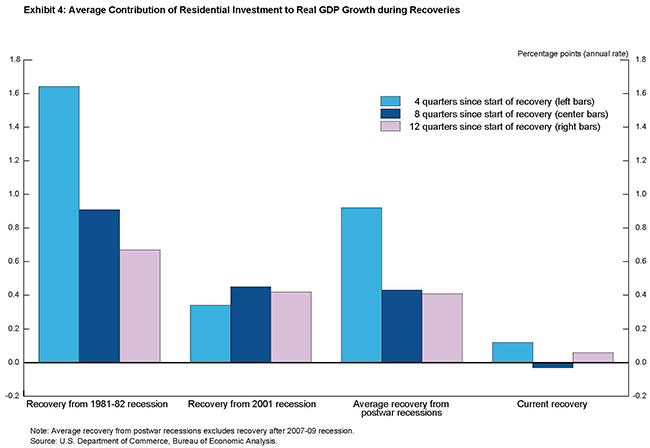
A second tailwind in most recoveries is housing. Residential investment creates jobs in construction and related industries. Before the Great Recession, housing investment added an average of 1/2 percentage point to real GDP growth in the two years after each of the previous four recessions, considerably more than its contribution to growth at other times.
During this recovery, in contrast, residential investment, on net, has contributed very little to growth since the recession ended. The reasons are easy to understand, given the central role that housing played in the Great Recession. Following an extended boom in construction driven in large part by overly loose mortgage lending standards and unrealistic expectations for future home price increases, the housing market collapsed--sales and prices plunged and mortgage credit was sharply curtailed. Tight mortgage credit conditions are continuing to make it difficult for many families to buy homes, despite record-low mortgage interest rates that have helped make housing very affordable. I'm encouraged by recent improvement in the residential sector, but the contribution of housing investment to overall economic activity remains considerably below the average seen in past recoveries, as exhibit 4 shows.
Beyond the direct effects on residential investment, the extraordinary collapse in house prices resulted in a huge loss of household wealth--at last count, net home equity is still down 40 percent, or about $5 trillion, from 2005. ...
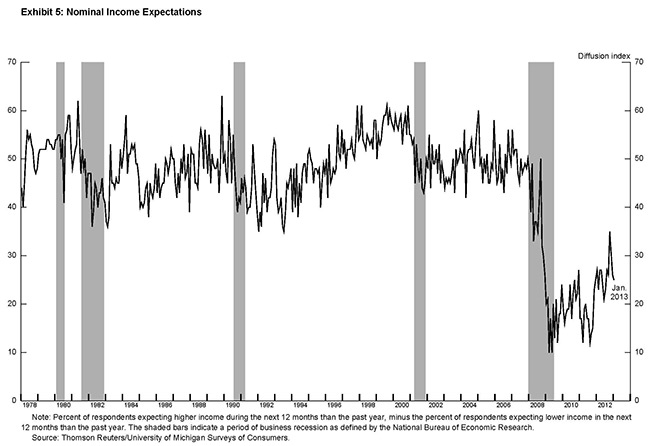
Another important tailwind in most economic recoveries is one that tends to be taken for granted--the faith most of us have, based on history and personal experience, that recessions are temporary and that the economy will soon get back to normal. Even during recessions, households' expectations for income growth tend to be reasonably stable, which provides support for overall spending. In the most recent recession, however, surveys suggest that consumers sharply revised down their prospects for future income growth and have only partially adjusted up their expectations since then (exhibit 5).
The recovery has also encountered some unusual headwinds. The fiscal and financial crisis in Europe has resulted in a euro-area recession and contributed to slower global growth. Europe's difficulties have blunted what had been strong growth in U.S. exports earlier in the recovery by sapping demand worldwide.
The next missing tailwind has been a focus of this blog: Residential investment (RI). RI has finally turned the corner and has started to contribute to the economy. Looking forward, I expect growth to improve over the next few years, although growth will be slowed by the fiscal agreement and other Federal austerity in 2013.
Sacramento January House Sales: Conventional Sales up 51% year-over-year
by Calculated Risk on 2/11/2013 09:27:00 AM
Note: I've been following the Sacramento market to look for changes in the mix of house sales in a distressed area over time (conventional, REOs, and short sales). The Sacramento Association of REALTORS® started breaking out REOs in May 2008, and short sales in June 2009.
Over the last two years there was a dramatic shift from REO to short sales, and the percentage of distressed sales declined.
Note: The percent of short sales declined in January because some sellers pushed to close in 2012 before the "Mortgage Debt Relief Act of 2007" expired. The Act was extended for one year as part of the fiscal agreement. (Usually cancelled debt is considered income, but some mortgage debt was exlcuded as part of the Act).
This data suggests continued improvement in the Sacramento market.
In January 2013, 44.5% of all resales (single family homes and condos) were distressed sales. This was down from 51.5% last month, and down from 66.6% in January 2012. This is the lowest percentage of distressed sales - and therefore the highest percentage of conventional sales - since the association started tracking the data.
The percentage of REOs stayed increased to 14.2%, and the percentage of short sales decreased to 30.3%.
Here are the statistics.
 Click on graph for larger image.
This graph shows the percent of REO sales, short sales and conventional sales.
There has been an increase in conventional sales recently, and there were twice as many short sales as REO sales in January.
Total sales were down from January 2012, but conventional sales were up 51% compared to the same month last year. This is exactly what we expect to see in an improving distressed market - flat or even declining overall sales as distressed sales decline, and conventional sales increase.
Active Listing Inventory for single family homes declined 61.1% from last January.
Cash buyers accounted for 37.4% of all sales (frequently investors), and median prices were up sharply year-over-year (the mix has changed).
This continues to move in the right direction, although the market is still in distress. A "normal" market would be mostly blue on the graph, and this market is a long way from "normal". We are seeing a similar pattern in other distressed areas, with a move to more conventional sales, and a shift from REO to short sales. This is a sign of a recovering market.
A Compendium of Tanta's Posts
by Calculated Risk on 2/11/2013 09:02:00 AM
Reader Mike kindly sent me all of the links to Tanta's posts in 2007 and 2008, and I'd like to share the updated list.
Note: Tanta was very knowledgeable about the mortgage industry - and many other topics - and she was my blogging partner in 2007 and 2008.
Here is the updated list: Compendium of Tanta's Posts
And other reading:
The Compleat UberNerd
CR writes: Sad News: Tanta Passes Away
NY Times: Doris Dungey, Prescient Finance Blogger, Dies at 47
WaPo: Doris J. Dungey; Blogger Chronicled Mortgage Crisis
Tanta: In Memoriam
Sunday, February 10, 2013
Sunday Night Futures
by Calculated Risk on 2/10/2013 09:39:00 PM
On oil prices from Jim Hamilton: Dude, where's my cheap gas?
Those who have been told that oil production is booming may be wondering why the prices of oil and gasoline are climbing again.Monday:
...[Several graphs]
It's obvious from the above price charts that it makes no economic sense to add gallons of ethane or propane to gallons of crude oil to try to summarize global oil supply. But growth of natural gas liquids has been a key factor in the reported increases in "world oil supply" over the last few years and is also a key component of recent optimistic assessments of future oil production by Leonardo Maugeri and the IEA.
There is no question that the boom in production of natural gas liquids is providing a great benefit to industrial users of ethylene. But if you're waiting for it to lower the price you pay for gasoline at the pump, you may have to wait a while longer.
• At 1:00 PM ET: Speech by Fed Vice Chair Janet Yellen, "A Painfully Slow Recovery for America's Workers: Causes, Implications, and the Federal Reserve's Response"
Weekend:
• Summary for Week Ending Feb 8th
• Schedule for Week of Feb 10th
The Nikkei is closed for National Foundation Day, and the Hang Seng and Shanghai are closed for New Year.
From CNBC: Pre-Market Data and Bloomberg futures: the S&P futures and DOW futures are up slightly.
Oil prices have been mixed recently with WTI futures down to $95.76 per barrel and Brent up to $118.88 per barrel. Gasoline prices are up almost 30 cents over the last few weeks.
Timiraos: "FHA Gets Scrutiny"
by Calculated Risk on 2/10/2013 06:29:00 PM
This is excellent article on the FHA from Nick Timiraos at the WSJ: FHA Gets Scrutiny as It Looks for a Hand
The Federal Housing Administration, a significant backer of new mortgage lending over the past five years, is facing billions of dollars in potential losses, as many loans that it guaranteed during the recession have soured. The agency's independent audit last fall showed that at its current pace, the FHA would exhaust its reserves and need $16 billion from the U.S. government to cover projected losses.The last two sentences refer to the owner financed "DAPs" or "downpayment assistance programs". I wrote extensively about DAPs during the bubble - were the owner "donated" the downpayment to the buyer through a third party "charity". The FHA tried to eliminate insuring those loans, the IRS called the programs a "scam", but Congress kept the program in place until 2008. Many of those loans went bad, significantly hurting the FHA's (and eventually taxpayers) finances. Of course the FHA also insured loans while house prices declined, and a large number of those loans defaulted too.
That would be a blow because since its creation in 1934, the agency has never required Treasury assistance. The FHA doesn't issue mortgages. Instead, it insures lenders against losses on loans that meet its standards. ...
... the FHA never relaxed its standards during the boom and didn't insure the toxic mortgages that inflated the housing bubble.
Before the bubble burst, lenders considered the FHA's standards too stringent, and in 2006 the agency's share of the home-purchase market fell below 5%. The FHA requires borrowers to prove they earn enough to make their monthly mortgage payment—thereby ruling out "liar loans." It backs mostly fixed-rate loans—meaning no teaser rates.
...
The most problematic loans are those insured from 2007-09, particularly from a program that allowed home sellers to make "gifts" of down payments to buyers through nonprofit groups. FHA officials belatedly prevailed on Congress to pull the plug on those risky lending programs in 2008.
Some of my posts on DAPs: from 2006: Housing: IRS Raps DAPs, 2007: FHA to Ban DAPs and 2008: Ding-Dong! The DAP Is Dead. And from Tanta in 2007: DAP for UberNerds. Tanta concluded:
Supporting DAPs means supporting property sellers--particularly but not limited to builders and developers--and the "entrepreneurs" who form "nonprofits" to extract fees from naive homebuyers, not to mention loan originators who pocket higher commissions, with the risk being carried by government insurance. It is, precisely, the kind of sleazy, conflict-ridden, self-serving "initiative," overtly "faith-based" or its sort-of secular equivalent "dream-based," that thrives in an environment where regulation is dismantled or unenforced and "government" is bashed with one hand and milked with the other. It is an "innovation" just like plainer, older-fashioned forms of money-laundering are "innovations." It takes a profound ideological blindness to march behind the DAP banner in the name of "helping first time homebuyers."And now we are seeing the consequences of that bad policy. DAPs aren't the only reason the FHA is facing a shortfall, but they played a key role in damaging the FHA's finances.
Gasoline Prices increase to $4 per gallon in California
by Calculated Risk on 2/10/2013 02:43:00 PM
The roller coaster ride for gasoline prices continues ...
From the Daily Democrat: Gas prices hit $4 in California
Gas prices are above or near an average of $4 a gallon statewide, and are already well over that dreaded mark in Southern California. GasBuddy.com showed gas selling for $4.01 on Thursday, while the AAA listed the state average at $3.99 -- a jump of three cents from Wednesday, 22 cents from a week ago and 37 cents from last month.Below is a graph from Gasbuddy.com for nationwide gasoline prices. Nationally prices are up over 30 cents per gallon from the low in January, and up sharply over the last two weeks.
... the record of $4.67 was reached on Oct. 9 [2012] ...
The skyrocketing prices could level off in a week or so, then ease for a few months before beginning their usual climb before Memorial Day.
"My forecast is for gasoline prices in California to level off, then go back down before Valentine's Day to an average of $3.90 per gallon," analyst Bob van der Valk said. "The good news is refineries are going to get back online in the next six weeks and gasoline prices will level off and perhaps go back down below $4 per gallon."
If you click on "show crude oil prices", the graph displays oil prices for WTI, not Brent; gasoline prices in most of the U.S. are impacted more by Brent prices.
| Orange County Historical Gas Price Charts Provided by GasBuddy.com |