RSS Feed
 by Calculated Risk on 11/14/2011 09:16:00 PM
Monday, November 14, 2011
State by state exports to Europe
From the Miami Herald: Florida’s economy faces ‘moderate’ risk from European recession
Florida would fare better than many states should Europe slip into recession, a new study [by Wells Fargo] found. ... The report makes no mention of another key concern for Florida: European tourism. The United Kingdom is Florida’s second largest source of international travelers behind Canada, with Germany holding the fifth slot behind Brazil and Mexico.Here is a map from the referenced report by economist Mark Vitner and Michael Brown at Wells Fargo. The map shows European exports as a percent of state GDP.
 Click on graph for larger image.
Utah has a very high percentage of exports to Europe - mostly silver and gold to the United Kingdom. West Virginia exports coal.
As the Miami Herald article notes, Florida will probably also be impacted by less tourism too.
However the largest potential impact is probably from financial contagion as opposed to trade and tourism. Catherine Rampell has a summary of the various channels of contagion: The Euro Zone Crisis and the U.S.: A Primer
Schedule Update: MBA's 3rd Quarter 2011 National Delinquency Survey will be released Thursday
by Calculated Risk on 11/14/2011 06:31:00 PM
An update to the weekly schedule ...
10:00 AM: Mortgage Bankers Association (MBA) 3rd Quarter 2011 National Delinquency Survey (NDS)
The following graph shows the percent of loans delinquent by days past due for Q2.
The MBA reported 8.44% of mortgage loans were delinquent at the end of Q2, seasonally adjusted, and another 4.43% were in the foreclosure process (total of 12.87%, essentially unchanged from Q1).
 Click on graph for larger image.
This graph shows the percent of loans delinquent by days past due in Q2. Based on other data, the delinquency rate probably decreased slightly in Q3.
However the key problem is the large number of seriously delinquent loans (90+ days and in the foreclosure process). And there probably was little change in those percentages in Q3.
SF Fed: Recession odds in 2012 are greater than 50% due to European Crisis
by Calculated Risk on 11/14/2011 03:37:00 PM
An economic letter from the SF Fed: Future Recession Risks: An Update(ht Rickkk)
Gathering storms across the Atlantic threaten a U.S. economy not yet recovered from the last recession. ... In the next few months, the odds of recession due to domestic factors appear reasonably contained. ... However, the curve reflecting the international odds suggests more imminent danger to the economy, although this threat is harder to calibrate using historical data and only indirectly reflects the health of the European financial system. Recession odds based on international factors peak at about 45% toward the end of 2011 ... The combination of these two recession coins, shown in the combined risks line of Figure 2, is quite disconcerting. It indicates that the odds are greater than 50% that we will experience a recession sometime early in 2012. Because the international odds of recession are more imprecisely estimated, one must be careful with a strict interpretation of this result. But the message is clear. Prudence suggests that the fragile state of the U.S. economy would not easily withstand turbulence coming across the Atlantic.Based on domestic data, I think a recession is unlikely. However the European crisis is definitely a significant downside risk to U.S. economic growth. The spillover from Europe depends on how the crisis unfolds ...
Europe: Italian and Spanish bond yields rising
by Calculated Risk on 11/14/2011 01:24:00 PM
The Italian 10 year bond yield is up to 6.7%.
And keep an eye on Spain ... The Spanish 10 year bond yield has increased to 6.1%. The Spanish 2 year yield is up to 5.0%
From Bloomberg: Merkel’s CDU Delegates at Party Gathering Support Allowing Exits From Euro
“We’re not throwing anybody out,” Finance Minister Wolfgang Schaeuble said in an interview from Leipzig with broadcaster Phoenix. “We want Greece to stay in, that everybody stays in,” he said. “But if a country can’t carry the burden or doesn’t want to carry the burden, and the Greek people have to carry a heavy load, then we have to respect the country’s decision.”Earlier today, the Greek New Democracy opposition leader Antonis Samaras was quoted as saying his party would not vote for any austerity measures, and he would not sign any letter pledging a commitment to austerity measures. If so, Greece will probably be leaving the euro sooner rather than later.
LPS: House Price Index Shows 3.8 Percent Year-Over-Year Decline in August
by Calculated Risk on 11/14/2011 09:47:00 AM
Another house price index ...
The LPS HPI is a repeat sales index that uses public disclosure by county recorders or loan origination data for purchase loans (if the sales price isn't disclosed).
From LPS: Lender Processing Services’ Home Price Index Shows 3.8 Percent Year-Over-Year Decline in U.S. Home Prices in August; Nearly 30 Percent Off Market Peak
“In August sales transactions data, we saw the national average home price decline 0.9 percent, following a decline of 0.4 percent in July. This ended a series of increases during the spring of this year; a pattern that has occurred each year since 2009. In addition, the early, partial data for September sales indicates a likely further decline of approximately 1.1 percent to come. As of the end of August, the national average home price was $205,000. This is down 3.8 percent from August last year, and down 0.4 percent from January 1, 2011.”
 Click on graph for larger image.
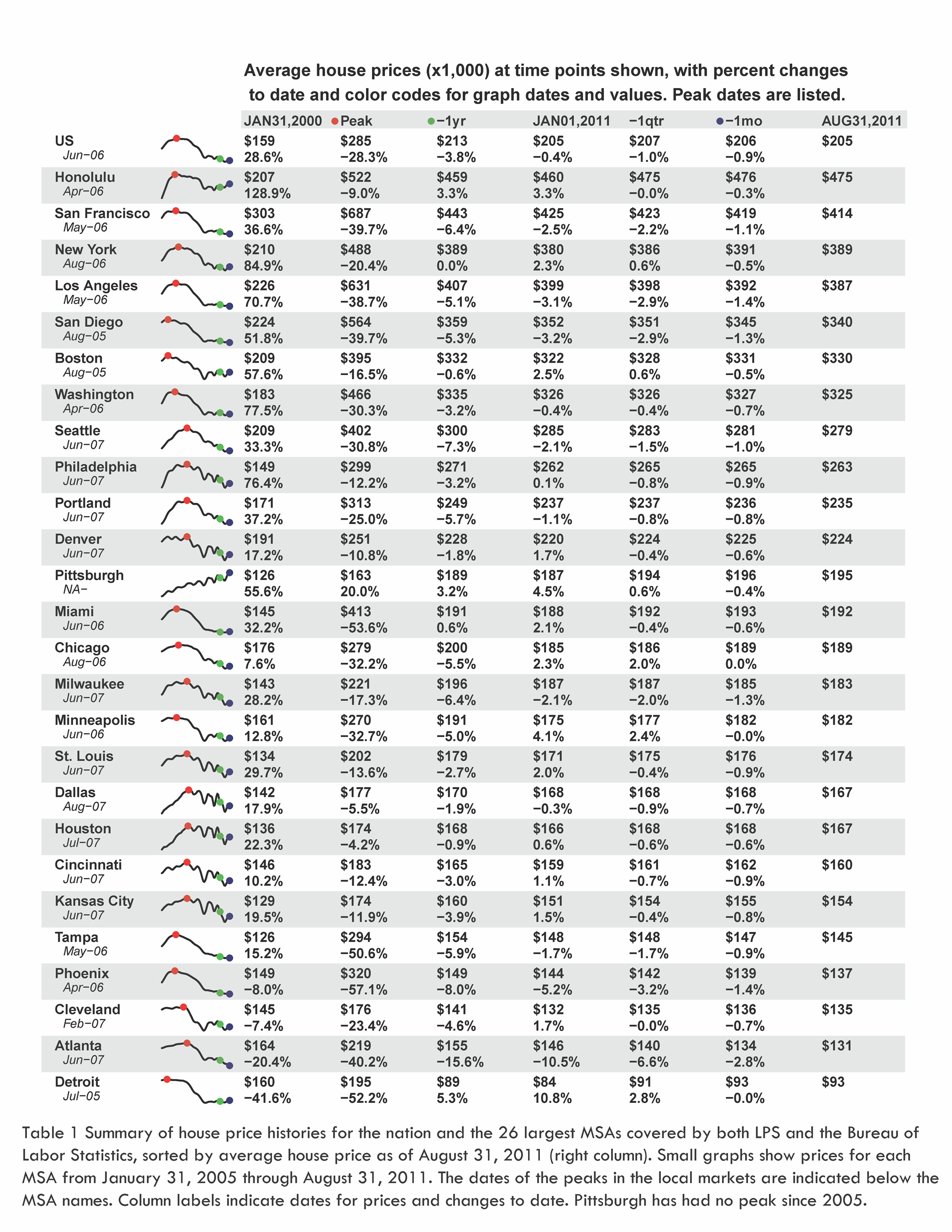
 Home prices in August continued the downward trend begun after the market peak in June 2006. The LPS HPI average national home price has declined 28.3 percent since then. The total value of U.S. housing inventory covered by the LPS HPI stood at $10.6 trillion at the peak. As of the end of August 2011, it was $7.65 trillion. During the period of most rapid price changes, from July 31, 2007, through December, 2009, prices declined $56,000 from $282,000. The average annual decline during that time was 13.8 percent.In 2005 - at the peak of the bubble - most reporting focused on NAR median house prices. However median prices can be distorted by the mix of homes sold. The most followed repeat sales price index in 2005 was the OFHEO HPI (now FHFA), but that index was only for the GSEs - and missed the worst loans. The Case-Shiller index didn't become widely followed until 2007, and now we have a number of house price indexes!
Since December 2009, prices have fallen more slowly, interrupted by brief seasonal intervals of rising prices. Since then, the LPS HPI national average home price has fallen $20,000 from $225,000. This corresponds to an average annual decline of 3.6 percent.
...
Average prices declined during August in all but three of the 26 largest MSAs in the country that both the LPS HPI and Bureau of Labor Statistics’ economic data cover: Chicago, Detroit and Minneapolis remained essentially unchanged. Changes ranged from -0.3 percent in Honolulu to -2.8 percent in Atlanta (Table 1).
It appears all of the indexes will show new post-bubble lows later this year - or early in 2012.
Europe: Italian bond auction, Merkel calls for "New Europe"
by Calculated Risk on 11/14/2011 08:44:00 AM
From the NY Times: France Keeps a Watchful Eye on Turmoil in Italy
While Italy has replaced Greece as the focus of anxiety amid Europe’s worsening debt crisis, investors are increasingly concerned about the outlook for France, whose banks are among the world’s biggest and are closely linked with their counterparts in the United States.From the WSJ: Italy Passes Bond Test — At a Cost
One crucial gauge of investor sentiment, the difference between what France pays to borrow versus what Germany pays, has doubled since the beginning of October ...
Italy cleared its first hurdle since economist Mario Monti agreed to form a caretaker government to force through tough fiscal reforms, comfortably selling €3 billion of short-dated bonds Monday ... The five-year bonds were sold at an average yield of 6.29%, up from 5.32% at the last tap in October, the Bank of Italy said. That was the most Italy had to pay for five-year funds at an auction during the euro era, but the yields were sharply below the peaks of 7.73% seen last week when the country's political crisis escalated.From the Financial Times: Eurozone crisis: live blog
The bonds got bids for 1.47 times the amount on offer, up from 1.34 times at the previous auction.
[German chancellor Angela Merkel] spelt out her determination to use the crisis to forge closer EU integration in the long-term, with “political union” as the ultimate goal.From the Athens News: Samaras will not support new measures
“It is time for a breakthrough to a new Europe,” she declared. “That means to build Europe in such a way that the euro has a future.”
It meant an end to eurozone governments financing their spending with debt – at the expense of future generations, she said. EU treaty change would be needed to embed budget discipline in the fundamental rules, including automatic sanctions for those who exceeded the limits on their debt and budget deficits.
The New Democracy leader Antonis Samaras said on Monday that his party would not vote for any new austerity measures and said the mix of policies demanded by international lenders should be changed.Without his support, Greece will probably not receive additional aid.
"We will not vote for any new measures," Samaras told a meeting of his own MPs.
He added that he would not sign any letter pledging a commitment to austerity measures, as has been demanded by EU Economic and Monetary Affairs Commissioner Olli Rehn, and that a verbal pledge should be sufficient.
Below is a table for several European bond yields (links to Bloomberg).
The Italian 10 year bond yield is up to 6.6%.
The Spanish 10 year bond yield has increased to 6.0%. The Spanish 2 year yield is up to 4.8%.
The French 10 year bond yield is at 3.4%.
| Greece | 2 Year | 5 Year | 10 Year |
| Portugal | 2 Year | 5 Year | 10 Year |
| Ireland | 2 Year | 5 Year | 10 Year |
| Spain | 2 Year | 5 Year | 10 Year |
| Italy | 2 Year | 5 Year | 10 Year |
| Belgium | 2 Year | 5 Year | 10 Year |
| France | 2 Year | 5 Year | 10 Year |
| Germany | 2 Year | 5 Year | 10 Year |
Sunday, November 13, 2011
"Animal McMansion": Another use for vacant homes
by Calculated Risk on 11/13/2011 07:09:00 PM
This morning I linked to an LA Times article about marijuana grow houses in Las Vegas ... here is another use for vacant homes:
From Patricia Leigh Brown at the NY Times: Animal McMansion: Students Trade Dorm for Suburban Luxury
While students at other colleges cram into shoebox-size dorm rooms, Ms. Alarab, a management major, and Ms. Foster, who is studying applied math, come home from midterms to chill out under the stars in a curvaceous swimming pool and an adjoining Jacuzzi behind the rapidly depreciating McMansion that they have rented for a song.Sounds like fun - and definitely better than the dumps I lived in going to college. Unfortunately these might be the nicest homes they live in for a number of years ...
Here in Merced, a city in the heart of the San Joaquin Valley and one of the country’s hardest hit by home foreclosures, the downturn in the real estate market has presented an unusual housing opportunity for thousands of college students. Facing a shortage of dorm space, they are moving into hundreds of luxurious homes in overbuilt planned communities.
Earlier:
• Schedule for Week of Nov 13th
• Summary for Week Ending Nov 11th
• Downside Risks for the U.S. economy.
Italy: Mario Monti premier-designate
by Calculated Risk on 11/13/2011 04:44:00 PM
No surprise ...
From the WSJ: Italy's Monti to Form New Government
"We need to fix Italy's financial situation and restart growth while paying particular attention to creating an equitable society," Mr. Monti said in a speech ...I wonder what Monti's proposals are to restart growth and to create a more equitable society?
Mr. Monti said he would name a cabinet quickly. Before the new administration can start operating, it needs approval from both houses of Parliament—a green light that is expected within days.
...
Though Mr. Monti's new government is likely to be approved quickly by Parliament, any honeymoon period will be short. First off are likely to be more budget cuts than those already announced by Italy last summer in order to balance its budget by 2013.
From the NY Times: Mario Monti Tapped to Lead Italy Out of Debt Crisis
[I]n a sign of political wrangling to come, the leader of Mr. Berlusconi’s People of Liberty party said that the party would support a Monti government for only as long as it could fulfill its mandate to push through measures to help reduce Italy’s $2.6 trillion public debt and increase growth to keep the country competitive. The party had been pushing for early elections, and media reports said that Mr. Monti hoped to serve until the end of the current legislature in 2013.Yesterday:
...
On Monday, Mr. Monti was expected to present a cabinet of nonpoliticians and introduce his program before Parliament, where a majority must vote confidence in his government.
• Schedule for Week of Nov 13th
• Summary for Week Ending Nov 11th
Downside Risks
by Calculated Risk on 11/13/2011 12:47:00 PM
On Friday, Goldman Sachs economists expressed concerns about two potential negative shocks for the U.S. economy:
"We are particularly concerned about two potential negative shocks— one of which has already materialized to some degree. First, a worsening of the European financial crisis would hurt the economic outlook globally. Second, our forecast assumes that the payroll tax cut is extended for another year; if that failed to happen, the fiscal drag in early 2012 would rise significantly."Goldman Sachs, November 11, 2011
These are downside risks to Goldman's forecast of about 1% GDP growth in the first half of 2012 - already a very weak forecast!
On the second point, additional fiscal stimulus might depend on the so-called "super committee" that has a November 23rd deadline. I have little confidence in the committee. Here is an update from the WaPo: Supercommittee hasn’t ‘given up hope,’ Hensarling says
“We haven’t given up hope,” Rep. Jeb Hensarling (R-Texas) said on CNN’s “State of the Union.” “But if this was easy, the president of the United States and the speaker of the House would have gotten it done themselves.”It is hard to believe that Congress would raise taxes on working Americans with a 9% unemployment rate, and in an election year - but that just might happen ...
I agree that the European financial crisis and additional fiscal tightening are the two major downside risks, but I think there are several other risks worth mentioning.
Oil and gasoline prices have remained fairly high and there is always the risk of another supply shock in the middle east. Gasoline prices are already at the highest level ever for October and November. Not a great way to start the holiday shopping season.
Another ongoing drag has been state and local government cutbacks. This year, state and local governments have cut 232,000 payroll jobs (about 23 thousand per month). This might continue in 2012 (most forecasts are for cutbacks to slow next year). The California State controller recently reported:
State Controller John Chiang today released his monthly report covering California's cash balance, receipts and disbursements in October, showing revenues came in $810.5 million below projections from the recently passed state budget.This shortfall could lead to additional cuts in California next year, and other states are probably falling short too.
"October's poor revenues capped a very disappointing first four months of the fiscal year," said Chiang. "Unless revenues and expenditures begin to track with projections, the State will face increasing cash pressure in the months ahead."
And last, but never least, the U.S. housing crisis is ongoing. House prices are now falling again, and there will be more distressed supply coming on the market - especially once the mortgage settlement is reached. It does appear the excess supply is being absorbed (based on falling vacancy rates), but there is still a long way to go.
My general forecast is for sluggish growth, but there are some significant downside risks.
Yesterday:
• Schedule for Week of Nov 13th
• Summary for Week Ending Nov 11th
Vegas goes to Pot
by Calculated Risk on 11/13/2011 09:09:00 AM
From Ashley Powers at the LA Times: In foreclosure-plagued Vegas, empty homes go to pot
The home — with four bedrooms and 61 plants — was one of the smaller alleged grow operations authorities have dismantled this year. At another home, authorities seized 878 plants worth an estimated $2.6 million.This reminds me of a classic Jim the Realtor video: High on the Hill
Las Vegas has a pot home problem. And like many of the region's maladies, it's tied to the housing slump.
...
"You can't have crime without opportunity," said William Sousa, a criminologist at the University of Nevada, Las Vegas. "And all those empty homes present an opportunity for criminal activity."
Major cultivators spend tens of thousands of dollars turning cheap homes into greenhouses.
Yesterday:
• Schedule for Week of Nov 13th
• Summary for Week Ending Nov 11th