
 RSS Feed
 by Calculated Risk on 5/15/2009 08:36:00 AM
Friday, May 15, 2009
Empire State Manufacturing Survey: Conditions worsened modestly in May
From the NY Fed: Empire State Manufacturing Survey
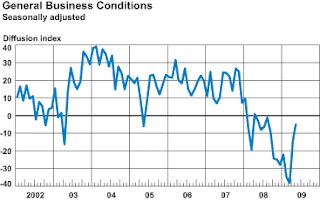
The Empire State Manufacturing Survey indicates that conditions for New York manufacturers worsened only modestly in May. Although negative, the general business conditions index rose 10 points to -4.6, its highest level since August of last year. The new orders index fell several points and remained below zero, while the shipments index inched into positive territory. The inventories index remained negative, but rose from last month’s record low. Price indexes also continued to be negative, with the prices received index falling 10 points to a record low. Employment indexes indicated further contraction in employment levels and in the average workweek.Here is the general business conditions index. Note that the data only goes back to July 2001 (chart to Jan 2002). Any reading below zero is contraction, so this index shows manufacturing is contracting - but "only modestly" in May.
NY Times Norris on Pick-a-pay Loans
by Calculated Risk on 5/15/2009 12:21:00 AM
From Floyd Norris at the NY Times: A Bank Is Survived by Its Loans
World Savings ... did not sell its loans into securitizations, so it knew it stood to lose if a loan went bad. Virtually all of the pick-a-pay loans were for less than 80 percent of the appraised value of the home, and the average was just 71 percent. World said it made loans only to those who could afford the stepped-up monthly payment after the reset, and said it did not lend to subprime borrowers.World Savings appeared to make safe loans, but they were very generous on the cap for when the loans recast. World also used the original appraised value, and there was no reappraisal provision.
...
Most banks forced the borrower to start making much larger monthly payments if the amount owed ... rose to 110 percent of the appraised value of the home when the loan was made. World ... did not force the payments up until the amount owed was 25 percent greater than the original value.
So even though the borrowers originally had substantial "skin in the game", many of the borrowers are deep underwater - and are now really renters.
Note: World was part of Golden West which was bought by Wachovia, and is now owned by Wells Fargo.
The amount owed on such loans at the end of March was $115 billion, which Wells estimates is 107 percent of the current value of the properties underlying the mortgages.At least we don't have to worry about many of these loans blowing up over the next few years!
...
Only $325 million of the loans — less than a third of 1 percent — will reset by the end of 2012.
...
Wells Fargo has written the value of the pick-a-pay portfolio down by about 20 percent, and is offering to restructure some of the loans. But many of the owners may have no reason to seek such a restructuring. ... The result may be perverse: a prolonged foreclosure crisis ...
Note: I think Norris means recast, not reset, "Reset" refers to a rate change. "Recast" refers to a payment change.
Thursday, May 14, 2009
Trucking Company to Apply for Bailout
by Calculated Risk on 5/14/2009 09:17:00 PM
After the insurers comes ...
From the WSJ: YRC to Apply for Bailout Funds
YRC Worldwide Inc., one of the nation's largest trucking companies, will seek $1 billion in federal bailout money to help relieve pension obligations, the chief executive said Thursday.Is YRC a bank holding company?
...
Chief Executive William Zollars said the company will seek the money to help cover the cost of its estimated $2 billion pension obligation over the next four years.
...
By applying to the U.S. Treasury for money under the Troubled Asset Relief Program, Mr. Zollars said he hopes to "get the conversation started" with federal authorities about reducing the company's pension obligations. He said YRC will submit an application to the Treasury Department as early as Friday.
WaPo: Treasury Approves TARP for Insurance Companies
by Calculated Risk on 5/14/2009 07:34:00 PM
Update:from the WaPo: Insurance Companies Approved for TARP Money
The Treasury today granted preliminary approval for some of the nation's largest insurance companies to receive capital infusions under the government's Troubled Assets Relief Program, Treasury spokesman Andrew Williams said.From Hartford: The Hartford Receives Preliminary Approval For $3.4 Billion Participation In Treasury's Capital Purchase Program (ht jb)
Recipients are Hartford, Prudential, Allstate, Ameriprise, Lincoln National and Principal Financial Group, Williams said.
The Hartford Financial Services Group, Inc. (NYSE: HIG - News) announced today that the United States Treasury Department has provided preliminary approval for the company to participate in Treasury’s Capital Purchase Program (CPP) in the amount of $3.4 billion.
NY Times Economics Reporter: "My Personal Credit Crisis"
by Calculated Risk on 5/14/2009 05:44:00 PM
From Edmund Andrews at the NY Times: My Personal Credit Crisis
If there was anybody who should have avoided the mortgage catastrophe, it was I. As an economics reporter for The New York Times, I have been the paper’s chief eyes and ears on the Federal Reserve for the past six years. I watched Alan Greenspan and his successor, Ben S. Bernanke, at close range. I wrote several early-warning articles in 2004 about the spike in go-go mortgages. Before that, I had a hand in covering the Asian financial crisis of 1997, the Russia meltdown in 1998 and the dot-com collapse in 2000. I know a lot about the curveballs that the economy can throw at us.Both Tanta and I linked to articles by Andrews over the years, and I'm amazed by this story ...
But in 2004, I joined millions of otherwise-sane Americans in what we now know was a catastrophic binge on overpriced real estate and reckless mortgages. Nobody duped or hypnotized me. Like so many others — borrowers, lenders and the Wall Street dealmakers behind them — I just thought I could beat the odds.I won't spoil the story, but it should be obvious the number don't work...
...
Patty [his new wife] discovered a small but stately brick home in a leafy, kid-filled neighborhood in Silver Spring, Md. We sent in an offer of $460,000 and one day later got our answer: the sellers accepted.
...
The only problem was money. Having separated from my wife of 21 years, who had physical custody of our sons, I was handing over $4,000 a month in alimony and child-support payments. That left me with take-home pay of $2,777, barely enough to make ends meet in a one-bedroom rental apartment. Patty had yet to even look for a job. At any other time in history, the idea of someone like me borrowing more than $400,000 would have seemed insane.
But this was unlike any other time in history.
An Interview with Charlie Munger
by Calculated Risk on 5/14/2009 03:53:00 PM
Stanford Law Professor Joseph Grundfest interviews Charlie Munger, vice chairman of Berkshire Hathaway: Legal Matters
Munger makes a number of interesting comments (I believe many of you will find the interview interesting). Here are a few excerpts ...
On accounting:
Grundfest: As we look at the current situation, how much of the responsibility would you lay at the feet of the accounting profession?And on derivatives:
Munger: I would argue that a majority of the horrors we face would not have happened if the accounting profession developed and enforced better accounting. They are way too liberal in providing the kind of accounting the financial promoters want. They’ve sold out, and they do not even realize that they’ve sold out.
Grundfest: Would you give an example of a particular accounting practice you find problematic?
Munger: Take derivative trading with mark-to-market accounting, which degenerates into mark-to-model. Two firms make a big derivative trade and the accountants on both sides show a large profit from the same trade.
Grundfest: And they can’t both be right. But both of them are following the rules.
Munger: Yes, and nobody is even bothered by the folly. It violates the most elemental principles of common sense.
Grundfest: You and your partner, Warren Buffett, have for years warned about the dangers of the modern derivatives markets, particularly credit derivatives, and about interest rate swaps, currency swaps, and equity swaps.There is much more.
Munger: Interest rate swaps have enormous dangers given their size and the accounting that has been allowed. But credit default derivatives took that danger to new levels of excess—from something that was already gross and wrong. In the ’20s we had the “bucket shop.” The term bucket shop was a term of derision, because it described a gambling parlor. The bucket shop didn’t buy any securities. It just enabled people to make bets against the house and the house furnished little statements of how the bets came out. It was like the off-track betting system.
Grundfest: Until the house lost its money and suddenly disappeared. Or the house made its money and suddenly disappeared.
Munger: That is right. Derivatives trading, with no central clearing, brought back the bucket shop, because you could make bets without having any interest in the basic security, and people did make such bets in the billions and billions of dollars. Some of the most admired people in finance — including Alan Greenspan — argued that derivatives trading, substituting for the old bucket shop, was a great contribution to modern economic civilization. There’s another word for this: bonkers. It is not a credit to academic economics that Greenspan’s view was so common.
Zillow: High Percentage of Homeowners Waiting for a Market Turnaround
by Calculated Risk on 5/14/2009 02:23:00 PM
Press Release: Homeowner Confidence Shrinks; Most Americans Now Believe Their Home's Value Has Declined (ht broward, Jonathan)
The following table gives an idea of the number of homeowners waiting for a market turnaround to sell. Since about 6% of owner occupied properties turnover per year, this is a substantial shadow inventory. Click on table for larger image in new window.
On shadow inventory:
As for selling activity, it's clear a significant number of potential sellers are holding back due to the current market. When asked about future plans to sell, 31 percent of homeowners said they would be at least "somewhat likely" to put their homes on the market in the next 12 months if they saw signs of a real estate market turnaround.Here is the full report: Q1 2009 Homeowner Confidence Survey Results
...
"Also interesting is the information we have for the first time this quarter on the levels of 'shadow inventory' - homes that people would like to sell but that aren't currently on the market, and thus aren't captured in the official number of homes on the market. With almost a third of homeowners poised to jump into the market at the first sign of stabilization, this could create a steady stream of new inventory adding to already record-high inventory levels, thus keeping downward pressure on home prices." [said Dr. Stan Humphries, Zillow's vice president of data and analytics].
Hotel Recession Reaches 18 months, RevPAR off 22.4%
by Calculated Risk on 5/14/2009 01:36:00 PM
From HotelNewsNow: Hotel industry enters 18th month of recession
Economic research firm e-forecasting.com in conjunction with Smith Travel Research announced that following a decline of 3.7 percent in March, HIP went down 1.1 percent in April. HIP, the Hotel Industry's Pulse index, is a composite indicator that gauges business activity in the U.S. hotel industry in real-time. The latest decrease brought the index to a reading of 84.2.See article for graph of HPI.
...
“With April’s reading of HIP, the hotel industry is creeping up to the weak performance of the industry during the recession in 1981-1982, which lasted 20 months. Even still, there is some promise in April’s reading as it appears the decline may have hit a bottom, looking at the six-month growth rate and monthly decline,” noted Evangelos Simos, chief economist of e-forecasting.com.
Also from HotelNewsNow.com: STR reports US hotel performance for week ending 9 May 2009
In year-over-year measurements, the industry’s occupancy fell 14.0 percent to end the week at 53.6 percent. Average daily rate dropped 9.8 percent to finish the week at US$97.58. Revenue per available room for the week decreased 22.4 percent to finish at US$52.32.
 Click on graph for larger image in new window.
This graph shows the YoY change in the occupancy rate (3 week trailing average).
The three week average is off 12.1% from the same period in 2008. The comparable week off 14.0%.
The average daily rate is down 9.8%, so RevPAR is off 22.4% from the same week last year.
BankUnited Deadline Extended
by Calculated Risk on 5/14/2009 12:44:00 PM
From Dow Jones: BankUnited Auction Extended As Thrift Scrambles For Capital
The auction to find a new buyer for struggling BankUnited Financial Corp. (BKUNA) has been extended until next week, according to a person familiar with the matter.Pitches to the FDIC? Kind of says it all ...
Bidders were originally asked to submit their pitches to the Federal Deposit Insurance Corporation by noon Thursday. However, that deadline has been extended to next Tuesday, the person said.
Update from Bloomberg: BankUnited Bidders Said to Seek Receivership Before Purchase
Bidders for BankUnited Financial Corp. are asking federal regulators to put the company into receivership before selling its assets, a step that could wipe out shareholders, people familiar with the matter said.
Potential buyers, including a private-equity group led by former North Fork Bancorp Chief Executive Officer John Kanas, have expressed an interest in purchasing the Coral Gables, Florida-based lender out of receivership ... The bidding deadline was pushed to May 19 from today ...
MBA: Commercial/Multifamily Mortgage Loan Originations Decline in Q1
by Calculated Risk on 5/14/2009 10:19:00 AM
 Click on graph for larger image.
This graph shows the Mortgage Bankers Association Commercial/Multifamily Mortgage Originations index since 2001.
A couple of points:
Here is the press release from the Mortgage Bankers Association (MBA): MBA Survey Shows Continued Slowdown of Commercial/Multifamily Mortgage Lending in First Quarter 2009
Commercial and multifamily mortgage loan originations continued to drop in the first quarter of 2009, according to the Mortgage Bankers Association’s (MBA) Quarterly Survey of Commercial/Multifamily Mortgage Bankers Originations. First quarter originations were 70 percent lower than during the same period last year and 26 percent lower than during the fourth quarter of 2008. The year-over-year decrease was seen across all investor groups and most property types.There are more details in the quarterly report.
“In the first quarter of 2009 we saw the effects of the continued recession coupled with little demand from borrowers and a constrained supply from lenders as a result of the credit crunch,” said Jamie Woodwell, Vice President of Commercial Real Estate Research at the Mortgage Bankers Association. ...
Decreases in total commercial/multifamily mortgage originations continued to be led by a drop in commercial mortgage-backed security (CMBS) conduit loans.



