
 RSS Feed
 by Calculated Risk on 9/26/2005 12:03:00 AM
Monday, September 26, 2005
This and that ...
My most recent post is up on Angry Bear: Housing: Buy or Rent?
The inherent problem with the buy vs. rent calculation is estimating the future value of the house. As long as prices are going to continue to appreciate, it doesn't matter what you pay for the house. But when appreciation stops; price matters!
A couple of posts I recommend:
Dr. Duy's Fed Watch: Dejá Not A great series on trying to read the FED's mind.
"I continue to think that Greenspan & Co. are sending increasingly not-so-subtle messages that the days of low interest rates and easy policy are at their end. This is a message for Congress and the Administration, not just the financial markets. Indeed, something unexpected may be happening – a concerted effort to end any sense of a Greenspan-put in the markets or the economy as a whole. It will undoubtedly be interesting to watch this chapter in Fed history play out."Responding to supply shocks Dr. Hamilton cautions about future FED Funds increases, at least until the full impact of Katrina can be assessed.
UPDATE: Two more on the FED:
Macroblog: Funds Rate Probabilities: Keep On Truckin' *AT Least One More Time)
And Dr. Polley asks some questions: Differing opinions on the Fed
I'll throw out these questions to the blogosphere: What are the dangers of a pause in the rate hikes? What are the chances that the market would misinterpret it and see it as a signal that the Fed is done raising rates or that they see recession on the horizon? If you were on the FOMC, what would you do between now and the end of the year to minimize that risk? Do you think that these risks would cause the Fed not to want to pause at all, but treat "measured pace" as meaning 25 b.p. per meeting until they feel they're at the neutral funds rate? Would that be good policy?Best to all.
Saturday, September 24, 2005
Rita: Oil Refinery Impact
by Calculated Risk on 9/24/2005 02:31:00 PM
UPDATE: Status added to some refineries (see list).
The AP reports: Feds Optimistic That Houston Refineries OK
Federal officials were "cautiously optimistic" Saturday that one of the largest concentrations of Texas refineries near Houston escaped serious damage as Hurricane Rita veered farther to the east.As mentioned in the article, the biggest concern is for the refineries in the Port Arthur-Beaumont and Lake Charles areas. These include:
But the Energy Department said it was too soon to assess the impact of the storm on a cluster of refineries in the Port Arthur-Beaumont area that caught the direct impact of the hurricane as it came ashore.
Based on computer modeling and initial reports, department spokesman Craig Stevens said, "We're cautiously optimistic about (the Houston) ... region" and "that the petroleum supply will be OK."
"But we really need to look at the Port Arthur region and other areas directly impacted. ... It may still be two or three days before we get a sense of the actual picture," he said.
| CRUDE OIL | |||
| THROUGHPUT | |||
| COMPANY | LOCATION | CAPACITY (B/D) | STATUS |
| FAR EASTERN TEXAS | 1,013,500 (Total) | ||
| ExxonMobil | Beaumont, Tex. | 348,500 | |
| Valero | Port Arthur, Tex. | 250,000 | 4 feet water, 2 to 4 weeks |
| Motiva | Port Arthur, Tex. | 235,000 | flooded with 4-5 feet water, no date |
| Total | Port Arthur, Tex. | 180,000 | |
| WESTERN LOUISIANA | 593,300 (Total) | ||
| Citgo | Lake Charles, La. | 324,300 | minor damage reported |
| ConocoPhillips | Westlake, La. | 239,000 | |
| Calcasieu | Lake Charles, La. | 30,000 |
Four refineries remain shut down from Katrina: three in New Orleans and the Chevron refinery in Pascagolua, Mississsippi.
Four refineries (ChevronTexaco, located in Pascagoula, MS; ConocoPhillips, located in Belle Chasse, LA; ExxonMobil, located in Chalmette, LA; and Murphy Oil, located in Meraux, LA) remain shut down, and expectations are that these refineries, which represent about 5 percent of total U.S. refining capacity, could be shut down for an extended period.For production, the Minerals Mining Service reports that 100% of GOM oil production is shut-in:
Today’s shut-in oil production is 1,500,898 BOPD. This shut-in oil production is equivalent to 100% of the daily oil production in the GOM, which is currently approximately 1.5 million BOPD.The immediate concern is the loss of refining capacity. For the short term, the loss of oil production is not critical (see Dr. Hamilton's Economic effects of Rita)
Today’s shut-in gas production is 7.488 BCFPD. This shut-in gas production is equivalent to 74.88% of the daily gas production in the GOM, which is currently approximately 10 BCFPD.
Friday, September 23, 2005
NYTimes: Is It Better to Buy or Rent?
by Calculated Risk on 9/23/2005 07:44:00 PM
The NYTimes has an article comparing buying and renting in New York and San Francisco: Is It Better to Buy or Rent?
"... renting might deserve another look right now. After five years in which rents have barely budged while house prices in New York, Washington, Los Angeles and elsewhere have doubled, renting has become a surprisingly smart option for many people who never would have considered it before.Check the graphics on the left of the article. The New York house, selling for
...
Add it all up - which The New York Times did, in an analysis of the major costs and benefits of owning and renting, including tax breaks - and owning a home today is more expensive than renting in much of the Northeast, Florida and California. Only if prices rise well above their already lofty levels will home ownership turn out to be the good deal that it is widely assumed to be."
The analysis was very generous to buyers. They assume the homebuyers receive the entire benefit of the interest and property tax deduction. The article correctly points out this may not be true:
"Don't be buying a house because you think you're saving on the taxes," said Frank Borges LLosa, owner of FranklyRealty.com, a brokerage in Arlington, Va. "You'll save even more by not buying and renting."The article also points out some of the extra benefits of ownership, like stability and being able to choose the "color of their living room walls", but there advantages to renting too - like being able to move easier.
Mr. LLosa added: "I'm not saying not to buy. I'm saying don't buy just for the tax reasons."
Many homeowners also do not receive the full deductions from home ownership. In the Northeast and California, homeowners now have so many deductions that some must pay the alternative minimum tax. This tax effectively wipes out part of their property-tax deduction, further cutting into the benefits of home ownership.
Other homeowners do not itemize their deductions or, if they do so, end up with total deductions only a little larger than the standard deduction that the government offers to all taxpayers, even renters.
"A lot of people hugely overvalue the mortgage deduction," said Dean Baker, co-director of the Center for Economic and Policy Research, a liberal group in Washington, "because they compare it to no deduction instead of comparing it to the standard deduction."
If I was moving to a new bubble area, I would definitely rent.
Housing: Mortgage Applications Still Steady
by Calculated Risk on 9/23/2005 01:00:00 AM
The Mortgage Bankers Association (MBA) reports: Mortgage Applications Steady During Holiday Shortened Week
The Mortgage Bankers Association (MBA) today released its Weekly Mortgage Applications Survey for the week ending September 16. The Market Composite Index — a measure of mortgage loan application volume – was 772.2, an increase of 1.5 percent on a seasonally adjusted basis from 760.6 one week earlier. On an unadjusted basis, the Index increased 11.9 percent compared with the previous week and was up 12.0 percent compared with the same week one year earlier.What I found puzzling is that refinance activity is still strong, even though rates have been flat or rising for some time:
The refinance share of mortgage activity increased to 45.6 percent of total applications from 42.9 percent the previous week. The adjustable-rate mortgage (ARM) share of activity increased to 29.8 percent of total applications from 28.2 percent the previous week.It appears homeowners are still pulling equity out of their houses. Also, given the narrow spread between products, I'm surprised at the volume of ARMs.
Thursday, September 22, 2005
UK Chief Scientist: This IS Global Warming
by Calculated Risk on 9/22/2005 10:59:00 PM
The Independent reports: This IS global warming, says environmental chief
Super-powerful hurricanes now hitting the United States are the "smoking gun" of global warming, one of Britain's leading scientists believes.There is no question that warmer waters lead to more intense hurricanes. From NOAA: Global Warming and Hurricanes
The growing violence of storms such as Katrina, which wrecked New Orleans, and Rita, now threatening Texas, is very probably caused by climate change, said Sir John Lawton, chairman of the Royal Commission on Environmental Pollution. Hurricanes were getting more intense, just as computer models predicted they would, because of the rising temperature of the sea, he said. "The increased intensity of these kinds of extreme storms is very likely to be due to global warming."
"...we cannot say at present whether more or fewer hurricane will occur in the future with global warming, the hurricanes that do occur near the end of the 21st century are expected to be stronger and have significantly more intense rainfall than under present day climate conditions."And there is no question that waters are getting warmer; a fact that is not in dispute. The only question has been if man is contributing to the warming trend. And the overwhelming scientific evidence is that man's activities are a major factor in the warming trend. From the American Association of the Advancement of Science annual meeting: Scientists on AAAS Panel Warn That Ocean Warming Is Having Dramatic Impact
Strong new evidence shows that ocean temperatures are rising because of human activity, and the impact on people and ecosystems worldwide could be severe, scientists on a AAAS panel warned Thursday.The FT also quoted the AAAS report: "‘Global warming real’ say new studies"
The evidence-based on computer models and observations in the field-is so strong that it should put to an end any debate about whether human-caused global warming is a real phenomenon, said Tim Barnett, a research marine physicist in the Climate Research Division at Scripps Institution of Oceanography at the University of California-San Diego.
"The temperature-driven impact that these models predict over the next 30-40 years is severe, not only for the Western United States, but for China and Peru," Barnett said.
"Other parts of the world will face similar problems," he added in an unpublished paper released to reporters. The climate models "suggest that these scenarios have a high enough probability of actually happening that they need to be taken seriously by decision makers...if it is not already too late."
They found that the "warming signals" in the oceans could only have been produced by the build-up of man-made carbon dioxide in the atmosphere. Non-human factors would have produced quite different effects.And on the "debate", Sir John Lawton commented:
Tim Barnett, the Scripps project leader, said previous attempts to show that human activities caused global warming had looked for evidence in the atmosphere. "But the atmosphere is the worst place to look for a global warming signal," he said. "Ninety per cent of the energy from global warming has gone into the oceans and the oceans show its fingerprint much better than the atmosphere."
"There are a group of people in various parts of the world ... who simply don't want to accept human activities can change climate and are changing the climate."The scientific debate is over. It is time for action.
"I'd liken them to the people who denied that smoking causes lung cancer."
Bank CEO: "losses up the gazoo"
by Calculated Risk on 9/22/2005 01:37:00 PM
SNL Financial reports:
Golden West CEO concerned about underwriting of competitors amid talk of housing bubble Golden West Financial Corp. Chairman and Co-CEO Herbert Sandler attempted to hammer home to investors that the company focuses on quality in underwriting mortgages, as opposed to some who just focus on generating volume, a practice that concerns the executive.And NBC follows up with this article: No down payment? No sweat
"Are we concerned about what we see happening in the field? Are we concerned about throwing around the so-called 1% payment rate on the option ARMs, attracting people who are not really qualified for loans? Yes, I'm scared to death about that," Sandler said at the Banc of America Securities 35th Annual Investment Conference. "We leave volume on the table because we give the correct appraisal [on properties]."
...
the executive pointed to the dramatic increase in the secondary market over the last year, with a number of players focusing on volume. And the executive believes that companies engaging in such a practice will face problems when interest rates eventually increase and home prices flatten or decline.
Sandler added that in some markets such as Las Vegas, Orange County, Calif., and Southern Florida — where housing prices escalate as investors purchase homes and look to make a quick profit by flipping the property — housing prices could drop dramatically.
"You're are going to see losses up the gazoo on those loans and you've got to be very careful about lending you do in any lending you do in those geographic areas," Sandler said.
Push-the-envelope loans and low interest rates have taken housing to extraordinary levels in price and homeownership rates. And as lenders found more creative ways for people to buy, the higher prices attracted speculators.Blunt talk on a serious problem.
Many warn this volatile combination could end in a prolonged period of stagnant or falling home values. That could bring more foreclosures and bankruptcies and undermine an economy relying heavily on housing.
...
Chris Thornberg, a senior economist with the UCLA Anderson Forecast, argues that the dramatic rise in what he calls "ultra-high-risk" mortgage financing is a sign of a "distended market."
"What happens when you run out of people who could even qualify to buy a house with an interest-only, (zero-down), variable-rate mortgage?" Thornberg asked. "The answer is ... there are no more shills to enter the bottom of this pyramid and, therefore, the pyramid scheme will have collapsed into itself. We are in the midst of the biggest bubble we've ever seen."
Rita and Oil
by Calculated Risk on 9/22/2005 12:43:00 PM
Radar: Houston / Galveston and Lake Charles, LA
Map from: Weather Underground
The US already has a significant portion of oil and gas production shut-in due to Katrina. UPDATE: Another report on Rita/Katrina Production Shut-In
Today’s shut-in oil production is 1,379,000 BOPD. This shut-in oil production is equivalent to 91.93% of the daily oil production in the GOM, which is currently approximately 1.5 million BOPD.
Today’s shut-in gas production is 6.594 BCFPD. This shut-in gas production is equivalent to 65.95% of the daily gas production in the GOM, which is currently approximately 10 BCFPD.
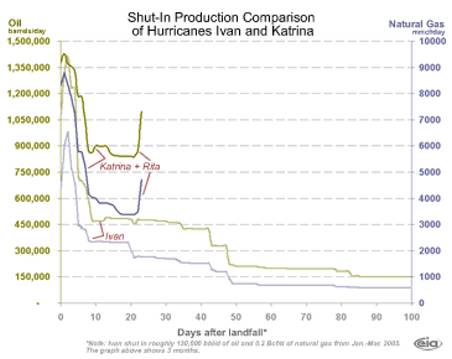
Click on graph for larger image.
The graph from the EIA's Daily Report adds Rita to the comparison of the recovery from Katrina to Ivan last year.
Here is an interactive map showing the oil rigs in Rita's path.
My thoughts are with the residents of the Gulf Coast. Best to all.
Wednesday, September 21, 2005
Mortgage Debt Increases $231.1 Billion in Q2
by Calculated Risk on 9/21/2005 01:21:00 PM
The FED Flow of Funds report was released today. It shows household mortgage debt increased $231.1 Billion in the 2nd quarter. The last 6 quarters (billions increase in household mortgages):
q1 2004: $198.8
q2 2004: $201.9
q3 2004: $283.9
q4 2004: $208.8
q1 2005: $178.7
q2 2005: $231.1
More to come.
"Oil Industry Wary of Rita"
by Calculated Risk on 9/21/2005 01:04:00 AM
NHC at 2AM EST announces that Rita is officially the FIFTH MAJOR hurricane of the season. Meanwhile the NHC is now forecasting that Rita might be Category 4 at landfall and that "strengthening into a category 5 hurricane is a distinct possibility."
My thoughts are with the residents of south Texas.
The Austin Statesman reports: Oil industry wary of Rita
The U.S. energy industry, already staggered by Hurricane Katrina, is bracing for another punch this weekend as Hurricane Rita heads for oil- and gas-producing areas along the Texas and Louisiana coasts.On a more positive note: Houston-area refineries say they're prepared
A second hit could raise the chances for a recession, some analysts fear.
...
The Gulf of Mexico is home to about a quarter of the country's oil and natural gas production, with Houston hosting the key refining center. Hurricane Rita could hurt in two ways.
First, it could dramatically slow the recovery of production and refining operations devastated three weeks ago by Katrina in the New Orleans area. Second, it could shut down yet more refineries, pipelines and offshore platforms around Houston.
"You got a right cross with Katrina and now a left hook with Rita," said Agbeli Ameko, a partner with First Enercast Financial Inc., a Denver-based energy forecasting firm. "That's worse than getting hit twice in the same spot."
...
The 19 refineries operating along the Texas and western Louisiana coasts can process nearly 4.5 million barrels of oil a day, representing more than a quarter of all domestic capacity.
Analysts are hopeful that Rita's impact will be shorter lived than Katrina's because the Texas refineries are on higher ground than those in the New Orleans area.
I think the real one-two punch to the economy is energy prices and housing.

Tuesday, September 20, 2005
Refineries: In the Line of Fire
by Calculated Risk on 9/20/2005 04:20:00 PM
Dow Jones provides this list of refineries potentially in Rita's Path:
| CRUDE OIL | ||
| THROUGHPUT | ||
| COMPANY | LOCATION | CAPACITY (B/D) |
| HOUSTON AREA | 2,292,000 (Total) | |
| ExxonMobil | Baytown, Tex. | 557,000 |
| BP | Texas City | 437,000 |
| Deer Park | Deer Park, Tex. | 340,000 |
| Lyondell Citgo | Houston | 270,000 |
| ConocoPhillps | Old Ocean, Tex. | 216,000 |
| Valero | Texas City | 210,000 |
| Astra | Pasadena, Tex. | 100,000 |
| Valero | Houston | 90,000 |
| Marathon | Texas City | 72,000 |
| CORPUS CHRISTI | 586,000 (Total) | |
| Flint Hills | Corpus Christi | 288,000 |
| Citgo | Corpus Christi | 156,000 |
| Valero | Corpus Christi | 142,000 |
| FAR EASTERN TEXAS | 1,013,500 (Total) | |
| ExxonMobil | Beaumont, Tex. | 348,500 |
| Valero | Port Arthur, Tex. | 250,000 |
| Motiva | Port Arthur, Tex. | 235,000 |
| Total | Port Arthur, Tex. | 180,000 |
| WESTERN LOUISIANA | 593,300 (Total) | |
| Citgo | Lake Charles, La. | 324,300 |
| ConocoPhillips | Westlake, La. | 239,000 |
| Calcasieu | Lake Charles, La. | 30,000 |
| TOTAL | 4,484,800 | |
| US TOTAL | 17,133,000 |



