
 RSS Feed
 by Calculated Risk on 9/23/2005 01:00:00 AM
Friday, September 23, 2005
Housing: Mortgage Applications Still Steady
The Mortgage Bankers Association (MBA) reports: Mortgage Applications Steady During Holiday Shortened Week
The Mortgage Bankers Association (MBA) today released its Weekly Mortgage Applications Survey for the week ending September 16. The Market Composite Index — a measure of mortgage loan application volume – was 772.2, an increase of 1.5 percent on a seasonally adjusted basis from 760.6 one week earlier. On an unadjusted basis, the Index increased 11.9 percent compared with the previous week and was up 12.0 percent compared with the same week one year earlier.What I found puzzling is that refinance activity is still strong, even though rates have been flat or rising for some time:
The refinance share of mortgage activity increased to 45.6 percent of total applications from 42.9 percent the previous week. The adjustable-rate mortgage (ARM) share of activity increased to 29.8 percent of total applications from 28.2 percent the previous week.It appears homeowners are still pulling equity out of their houses. Also, given the narrow spread between products, I'm surprised at the volume of ARMs.
Thursday, September 22, 2005
UK Chief Scientist: This IS Global Warming
by Calculated Risk on 9/22/2005 10:59:00 PM
The Independent reports: This IS global warming, says environmental chief
Super-powerful hurricanes now hitting the United States are the "smoking gun" of global warming, one of Britain's leading scientists believes.There is no question that warmer waters lead to more intense hurricanes. From NOAA: Global Warming and Hurricanes
The growing violence of storms such as Katrina, which wrecked New Orleans, and Rita, now threatening Texas, is very probably caused by climate change, said Sir John Lawton, chairman of the Royal Commission on Environmental Pollution. Hurricanes were getting more intense, just as computer models predicted they would, because of the rising temperature of the sea, he said. "The increased intensity of these kinds of extreme storms is very likely to be due to global warming."
"...we cannot say at present whether more or fewer hurricane will occur in the future with global warming, the hurricanes that do occur near the end of the 21st century are expected to be stronger and have significantly more intense rainfall than under present day climate conditions."And there is no question that waters are getting warmer; a fact that is not in dispute. The only question has been if man is contributing to the warming trend. And the overwhelming scientific evidence is that man's activities are a major factor in the warming trend. From the American Association of the Advancement of Science annual meeting: Scientists on AAAS Panel Warn That Ocean Warming Is Having Dramatic Impact
Strong new evidence shows that ocean temperatures are rising because of human activity, and the impact on people and ecosystems worldwide could be severe, scientists on a AAAS panel warned Thursday.The FT also quoted the AAAS report: "‘Global warming real’ say new studies"
The evidence-based on computer models and observations in the field-is so strong that it should put to an end any debate about whether human-caused global warming is a real phenomenon, said Tim Barnett, a research marine physicist in the Climate Research Division at Scripps Institution of Oceanography at the University of California-San Diego.
"The temperature-driven impact that these models predict over the next 30-40 years is severe, not only for the Western United States, but for China and Peru," Barnett said.
"Other parts of the world will face similar problems," he added in an unpublished paper released to reporters. The climate models "suggest that these scenarios have a high enough probability of actually happening that they need to be taken seriously by decision makers...if it is not already too late."
They found that the "warming signals" in the oceans could only have been produced by the build-up of man-made carbon dioxide in the atmosphere. Non-human factors would have produced quite different effects.And on the "debate", Sir John Lawton commented:
Tim Barnett, the Scripps project leader, said previous attempts to show that human activities caused global warming had looked for evidence in the atmosphere. "But the atmosphere is the worst place to look for a global warming signal," he said. "Ninety per cent of the energy from global warming has gone into the oceans and the oceans show its fingerprint much better than the atmosphere."
"There are a group of people in various parts of the world ... who simply don't want to accept human activities can change climate and are changing the climate."The scientific debate is over. It is time for action.
"I'd liken them to the people who denied that smoking causes lung cancer."
Bank CEO: "losses up the gazoo"
by Calculated Risk on 9/22/2005 01:37:00 PM
SNL Financial reports:
Golden West CEO concerned about underwriting of competitors amid talk of housing bubble Golden West Financial Corp. Chairman and Co-CEO Herbert Sandler attempted to hammer home to investors that the company focuses on quality in underwriting mortgages, as opposed to some who just focus on generating volume, a practice that concerns the executive.And NBC follows up with this article: No down payment? No sweat
"Are we concerned about what we see happening in the field? Are we concerned about throwing around the so-called 1% payment rate on the option ARMs, attracting people who are not really qualified for loans? Yes, I'm scared to death about that," Sandler said at the Banc of America Securities 35th Annual Investment Conference. "We leave volume on the table because we give the correct appraisal [on properties]."
...
the executive pointed to the dramatic increase in the secondary market over the last year, with a number of players focusing on volume. And the executive believes that companies engaging in such a practice will face problems when interest rates eventually increase and home prices flatten or decline.
Sandler added that in some markets such as Las Vegas, Orange County, Calif., and Southern Florida — where housing prices escalate as investors purchase homes and look to make a quick profit by flipping the property — housing prices could drop dramatically.
"You're are going to see losses up the gazoo on those loans and you've got to be very careful about lending you do in any lending you do in those geographic areas," Sandler said.
Push-the-envelope loans and low interest rates have taken housing to extraordinary levels in price and homeownership rates. And as lenders found more creative ways for people to buy, the higher prices attracted speculators.Blunt talk on a serious problem.
Many warn this volatile combination could end in a prolonged period of stagnant or falling home values. That could bring more foreclosures and bankruptcies and undermine an economy relying heavily on housing.
...
Chris Thornberg, a senior economist with the UCLA Anderson Forecast, argues that the dramatic rise in what he calls "ultra-high-risk" mortgage financing is a sign of a "distended market."
"What happens when you run out of people who could even qualify to buy a house with an interest-only, (zero-down), variable-rate mortgage?" Thornberg asked. "The answer is ... there are no more shills to enter the bottom of this pyramid and, therefore, the pyramid scheme will have collapsed into itself. We are in the midst of the biggest bubble we've ever seen."
Rita and Oil
by Calculated Risk on 9/22/2005 12:43:00 PM
Radar: Houston / Galveston and Lake Charles, LA
Map from: Weather Underground
The US already has a significant portion of oil and gas production shut-in due to Katrina. UPDATE: Another report on Rita/Katrina Production Shut-In
Today’s shut-in oil production is 1,379,000 BOPD. This shut-in oil production is equivalent to 91.93% of the daily oil production in the GOM, which is currently approximately 1.5 million BOPD.
Today’s shut-in gas production is 6.594 BCFPD. This shut-in gas production is equivalent to 65.95% of the daily gas production in the GOM, which is currently approximately 10 BCFPD.
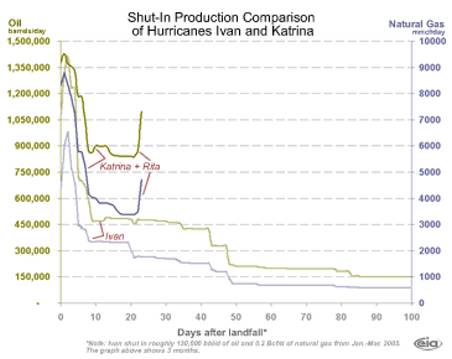
Click on graph for larger image.
The graph from the EIA's Daily Report adds Rita to the comparison of the recovery from Katrina to Ivan last year.
Here is an interactive map showing the oil rigs in Rita's path.
My thoughts are with the residents of the Gulf Coast. Best to all.
Wednesday, September 21, 2005
Mortgage Debt Increases $231.1 Billion in Q2
by Calculated Risk on 9/21/2005 01:21:00 PM
The FED Flow of Funds report was released today. It shows household mortgage debt increased $231.1 Billion in the 2nd quarter. The last 6 quarters (billions increase in household mortgages):
q1 2004: $198.8
q2 2004: $201.9
q3 2004: $283.9
q4 2004: $208.8
q1 2005: $178.7
q2 2005: $231.1
More to come.
"Oil Industry Wary of Rita"
by Calculated Risk on 9/21/2005 01:04:00 AM
NHC at 2AM EST announces that Rita is officially the FIFTH MAJOR hurricane of the season. Meanwhile the NHC is now forecasting that Rita might be Category 4 at landfall and that "strengthening into a category 5 hurricane is a distinct possibility."
My thoughts are with the residents of south Texas.
The Austin Statesman reports: Oil industry wary of Rita
The U.S. energy industry, already staggered by Hurricane Katrina, is bracing for another punch this weekend as Hurricane Rita heads for oil- and gas-producing areas along the Texas and Louisiana coasts.On a more positive note: Houston-area refineries say they're prepared
A second hit could raise the chances for a recession, some analysts fear.
...
The Gulf of Mexico is home to about a quarter of the country's oil and natural gas production, with Houston hosting the key refining center. Hurricane Rita could hurt in two ways.
First, it could dramatically slow the recovery of production and refining operations devastated three weeks ago by Katrina in the New Orleans area. Second, it could shut down yet more refineries, pipelines and offshore platforms around Houston.
"You got a right cross with Katrina and now a left hook with Rita," said Agbeli Ameko, a partner with First Enercast Financial Inc., a Denver-based energy forecasting firm. "That's worse than getting hit twice in the same spot."
...
The 19 refineries operating along the Texas and western Louisiana coasts can process nearly 4.5 million barrels of oil a day, representing more than a quarter of all domestic capacity.
Analysts are hopeful that Rita's impact will be shorter lived than Katrina's because the Texas refineries are on higher ground than those in the New Orleans area.
I think the real one-two punch to the economy is energy prices and housing.

Tuesday, September 20, 2005
Refineries: In the Line of Fire
by Calculated Risk on 9/20/2005 04:20:00 PM
Dow Jones provides this list of refineries potentially in Rita's Path:
| CRUDE OIL | ||
| THROUGHPUT | ||
| COMPANY | LOCATION | CAPACITY (B/D) |
| HOUSTON AREA | 2,292,000 (Total) | |
| ExxonMobil | Baytown, Tex. | 557,000 |
| BP | Texas City | 437,000 |
| Deer Park | Deer Park, Tex. | 340,000 |
| Lyondell Citgo | Houston | 270,000 |
| ConocoPhillps | Old Ocean, Tex. | 216,000 |
| Valero | Texas City | 210,000 |
| Astra | Pasadena, Tex. | 100,000 |
| Valero | Houston | 90,000 |
| Marathon | Texas City | 72,000 |
| CORPUS CHRISTI | 586,000 (Total) | |
| Flint Hills | Corpus Christi | 288,000 |
| Citgo | Corpus Christi | 156,000 |
| Valero | Corpus Christi | 142,000 |
| FAR EASTERN TEXAS | 1,013,500 (Total) | |
| ExxonMobil | Beaumont, Tex. | 348,500 |
| Valero | Port Arthur, Tex. | 250,000 |
| Motiva | Port Arthur, Tex. | 235,000 |
| Total | Port Arthur, Tex. | 180,000 |
| WESTERN LOUISIANA | 593,300 (Total) | |
| Citgo | Lake Charles, La. | 324,300 |
| ConocoPhillips | Westlake, La. | 239,000 |
| Calcasieu | Lake Charles, La. | 30,000 |
| TOTAL | 4,484,800 | |
| US TOTAL | 17,133,000 |
More "No Bubble" Talk
by Calculated Risk on 9/20/2005 03:26:00 PM
The media is picking up the recent No Bubble paper: Assessing High House Prices: Bubbles, Fundamentals, and Misperceptions
From the SFGate: Bubble won't burst, Study finds Bay Area housing prices in line with economic growth:
The recent, rapid price increases stem not from a speculative frenzy but from basic economic factors, including low interest rates, strong income growth and abnormally low prices in the mid-1990s, said researchers at Columbia University and the University of Pennsylvania's Wharton School.Over in the UK the BoE is arguing there is no bubble. From Reuters: Possible no housing market bubble-BoE's Nickell
"The bubble fears are over people paying money for housing today because they're expecting unreasonable (price increases)," said Todd Sinai, associate professor of real estate at the Wharton School. "Our calculation says that if people are expecting something reasonable, house prices today are justified -- and they are in San Francisco."
The housing market, which rose 123 percent between early 1999 and the middle of last year, may well not have been in a bubble, Bank of England policymaker Stephen Nickell said on Tuesday.The paper is not worth reading, but I suppose I'll write a review (JS did a nice job in earlier comments).
Nickell said a fall in long-term real interest rates from about 4 percent in the mid-1990s to around 2 percent by 2000 was one factor that has likely driven a substantial rise in the equilibrium house price to earnings ratio since the mid-1990s.
"Of course, there is a good deal of uncertainty here, but it is clear that it may be legitimately argued that there has been no housing bubble whatever," Nickell told an academic audience.
Nickell also said that low inflation, the rise in two-salary households and increased levels of job security and rapid prospective earnings growth may also make it more sensible for households to borrow more now than they have in the past.
Rita Resources
by Calculated Risk on 9/20/2005 02:19:00 AM
Here are some excellent sites:
National Hurricane Center
U.S. Navy Storm Site
Weather Underground Note: See Jeff Master's blog.
Click on photo for larger image.
Rita nears the Keys. From the NHC Satellite Floater one.
Key West Radar and Miami Radar.
The Oil Drum: They are discussing the possible impact on oil and gas production.
I'm sure there are many more excellent sites. For most hurricanes the fear is greater than the actual damage. Hopefully that will be true with Rita. Unfortunately Katrina lived up to the hype.
From an economic perspective, Rita is a huge concern since so much oil and gas production is already shut-in. Another serious disruption of the GOM facilities could cause a significant price spike for oil, natural gas, gasoline and heating oil this winter.
For tomorrow, the concern is about the Florida Keys.
Monday, September 19, 2005
NAHB: Housing Market Index Falls Again
by Calculated Risk on 9/19/2005 04:05:00 PM
The National Association of Homebuilders reports: Home Builder Optimism Edges Down Further In September
Home builder optimism in the market for new single-family homes remains in a positive zone this month, albeit with some further erosion from the cyclical high in June, according to the National Association of Home Builders/Wells Fargo Housing Market Index (HMI), released today.Weird. NAHB President Wilson blames it on Katrina and then NAHB economist Seiders admits Katrina is not a factor - yet.
"Many builders appear to be taking on a more cautious attitude because of uncertainties in the economy and this post-Katrina environment, particularly with regard to sales expectations in the near term," observed Dave Wilson, NAHB president and a custom home builder from Ketchum, Idaho.
The overall HMI declined two points in September to a score of 65, which is the lowest it has been since July of 2003 when it also hit 65. This was the third consecutive month of declines since June’s 72 reading.
"As expected, the housing market is beginning to show signs of cooling and builders are reacting to that," agreed NAHB Chief Economist David Seiders. "While the HMI survey was taken immediately following Hurricane Katrina in early September, a combination of factors are likely in play, and Katrina impacts are only one part of the equation. In fact, the current HMI does not include responses from Katrina-hit areas, which typically account for about 2 percent of survey responses."
Here are the components. UPDATE: Note that "Traffic of Prospective Buyers" has gone negative.



