
 RSS Feed
 by Calculated Risk on 9/01/2005 10:53:00 AM
Thursday, September 01, 2005
OFHEO: Huge House Price Increase
UPDATE: Kash looks at the numbers: House Prices
The Office of Federal Housing Oversight (OFHEO) reports:
LARGEST U.S. HOUSE PRICE INCREASES IN MORE THAN 25 YEARSMore to come.
OFHEO House Price Index Shows Annual Rise of 13.4 Percent
WASHINGTON, D.C. – Average U.S. home prices increased 13.43 percent from the second quarter of 2004 through the second quarter of 2005. Appreciation for the most recent quarter was 3.20 percent, or an annualized rate of 12.8 percent. The new data represent the largest four-quarter increase since the second quarter of 1979. The figures were released today by OFHEO Acting Director Stephen A. Blumenthal, as part of the House Price Index (HPI), a quarterly report analyzing housing price appreciation trends.
"There is no evidence here of prices topping out," said OFHEO Chief Economist Patrick Lawler. "On the contrary, house price inflation continues to accelerate, as some areas that have experienced relatively slow appreciation are picking up steam."
House prices grew considerably faster over the past year than did prices of non-housing goods and services reflected in the Consumer Price Index. House prices rose 13.4 percent, while prices of other goods and services rose only 3.1 percent.
Wednesday, August 31, 2005
Recession Coming?
by Calculated Risk on 8/31/2005 06:12:00 PM
Even before the devastation of hurricane Katrina, the US economy was apparently headed for a significant slowdown and possible recession. According to a survey of CFOs completed on August 28th (before Katrina): Housing, Fuel Are Top CFO Concerns
In the four years of the survey, this is the first time that CFOs with growing pessimism outnumbered CFOs with growing optimism. Indeed, the level of optimism is down sharply from last quarter's 40 percent and is strikingly lower than last year's 72 percent.Emphasis added. And the most recent numbers have not looked good:
"This is the greatest increase in pessimism that we have seen," says Don Durfee, research editor of CFO magazine. "We’ve found that this optimism index predicts future economic growth quite well. In a situation like this, where the growth in pessimism outweighs the growth in optimism, we expect to see a slowdown in economic growth."
Macroblog: Not The Most Bullish Day For Economic News
The Big Picture: PMI, GDP stink up the joint
And here is how Briefing.com described the Chicago PMI report (with chart):
- An unbelievable plunge to 49.2 in August Chicago PMI index (-14.3 pts).
Key Factors - Record sized plunge leaves index in a contractionary sub 50 level -- the first since April '03 after reaching a 17 yr high in March.
- New orders (30% weight) plunged an astounding 23 points to 46.5 -- presumably off the highs in oil prices.
- Production fell to 56.2 from a nose bleed 70.5 in July as it followed orders.
- Employment fell in line to 51.7, March stood at a high 66.
- Prices paid rose to just 62.9 and doesn't reflect the pricing fear we are assuming caused the orders plunge.
So Katrina impacted an already fragile US economy. Dr. Hamilton notes this while discussing the energy related economic impact of Katrina: Day 2:
... this event did not arrive out of the blue. Instead, it came in an environment in which there was already considerable anxiety about gas prices and sound basis for worrying about a possible recession even if Katrina had done no harm.And Kash makes a similar observation - "I’ve been a bit worried about which way animal spirits were heading in the US" before Katrina struck - he writes on Katrina and Psychology over on Angry Bear:
Could this be enough to tip the whole economic cart over? I'm not certain that it will. But it would seem foolish to deny the very real possibility that it could.
Now add Katrina. ... I think that the current situation contains the seeds for such a shift in sentiment. My personal odds for a recession in 2006 have just gone up, thanks to Katrina.UPDATE: Dr. Polley adds: Katrina and the probability of recession
"I am reluctant to speculate too much too soon about a recession. It's just too early. But all in all, the economics corner of the blogosphere has been (as evidenced by the links here) very reasoned in its assessment of the situation. My take is closest to Hamilton's. It would indeed be foolish to underestimate the possibility that this could be the straw that breaks the camel's back.OTOH, the Ten Year bond has rallied and the yield has dropped from 4.4% to just under 4.1% over the last few weeks. This will probably lead to lower mortgage rates and could possibly boost equity extraction and support the housing market. Tomorrow the OFHEO House Price Index will be released and I believe it will show stunning widespread gains in house prices and that might help with confidence. But I think the housing boom is almost over, even with slightly lower mortgage rates.
...
Of course, that doesn't mean a recession is inevitable. ... I think it is safe to say, however, that this is a very critical moment for the economy. It could swing either way. If we pass this hurdle, I think it bodes well for the future of the recovery."
Flooding as seen from Space
by Calculated Risk on 8/31/2005 03:37:00 PM
After and before photos of the New Orleans area:
Click on photo from larger image.
August 30, 2005.
Photo from NASA Earth Observatory.
August 27, 2005.
Relief and General Information
by Calculated Risk on 8/31/2005 10:44:00 AM
From The Big Picture: Katrina/New Orleans Disaster Relief Aid
From Movie Guy in comments: Many information links (scroll down - 3 different posts)
Bartlett: Housing Balloon or Bubble?
by Calculated Risk on 8/31/2005 01:11:00 AM
Bruce Barlett writes in the Washington Times:
Over the weekend, Federal Reserve Chairman Alan Greenspan warned housing boom speculators should be very careful. What goes up fast can come down just as fast.Bartlett then reviews many of the riskier loans available these days. He concludes:
A key underpinning of the housing price surge is the lenders' belief risks have fallen. They therefore became more willing to lend on terms they would not have extended in the past. This made available mortgages to previously unqualified borrowers and bigger mortgages to those with good credit.
Though he is no alarmist, Mr. Greenspan warned Friday that if lenders should perceive greater risk, rates could rise and borrowing qualifications tighten quickly. "Newly abundant liquidity can readily disappear," he noted.I suggest reading the entire commentary.
Access to mortgages will become much more limited, people will have less money to pay for housing, and this must bring prices down. A mild downturn could thereby become a collapse, with consequences throughout the economy.
Tuesday, August 30, 2005
Damage: "Swimming in Crude, No Gasoline"
by Calculated Risk on 8/30/2005 07:49:00 PM
CBS MarketWatch exaggerates - a little:
"Americans could be swimming in crude, but wouldn't have a drop of gasoline to run their cars."UPDATE: Series of Port Fourchon photos

Wholesale prices of gasoline are already over $3.00 per gallon on the Gulf Coast:
Wholesale gasoline prices on the Gulf Coast broke $3 a gallon on Tuesday -- far higher than prices at most U.S. pumps -- as major refineries remained shut after Hurricane Katrina, trading sources said.There have been some relatively positive damage reports (also CBSMarketWatch):
This could spell a huge spike in retail prices for drivers throughout the United States in the coming days and in particular those in the Southeast, where prices are typically the lowest in the country.
...
"Retail prices are going to vary among regions but for all practical purposes $3 is a floor," said private oil analyst Jim Ritterbusch.
The spike could spread across other regions of the United States due to the shutdown of two fuel pipelines from the Gulf Coast to the Northeast, including the massive Colonial Pipeline.
"This tightness of supply in the Gulf Coast is going to spread," said Ritterbusch, of Galena, Illinois. He said the shutdown of a major fuel pipeline from the Gulf Coast to the Northeast could push prices up in other regions.
"This thing has tentacles that are going to stretch all over the place," Ritterbusch said.
The vital Louisiana Offshore Oil Port, the only U.S. port that can handle supertankers, apparently escaped major damage, the manager of the port told Dow Jones NewsWires.Also: BP says US Gulf oil rigs intact after Hurricane Katrina. But its the refineries that are critical in the short term. Of the 9 major refineries in the area, only Exxon Mobil's Baton Rouge facility is operational. And, as reported earlier, Valero expect to be out of operation for 1 to 2 weeks. Damage reports are expected tomorrow for some of the other refineries.
The major onshore port at Port Fourchon, also escaped major damage, according to Dow Jones NewsWires. The port is the base for oil service operations for oil rigs in the Gulf.
However, the channel leading to the port may have suffered severe silting from the storm surge. Dredging the channel could take weeks or longer. There could be a "very large impact to the energy supply," if the port can't reopen, port manager Ted Falgout told CNBC.
The Henry Hub, the junction of several pipelines in central Louisiana that serves as the pricing point for natural gas, reopened Monday afternoon. The condition of pipelines leading to the Henry Hub from the coast is not known.
The Economist: Katrina Could Tip US / World into Recession
by Calculated Risk on 8/30/2005 04:04:00 PM
The Economist ponders the impact of Katrina: The damage that Katrina could still wreak:
Besides its devastating cost in lives, Katrina could push the American economy—maybe even the world economy—into recession ...
Nor will the effects of Hurricane Katrina be limited to the Gulf Coast and the offices of a few agitated insurers. Analysts are busy rewriting their forecasts of America’s fourth-quarter GDP growth to take into account the expected economic repercussions of the devastation. The affected area’s ports move a large fraction of the nation’s imports—including critical oil and gas supplies—as well as roughly half its exports of agricultural commodities like corn and soyabeans. ...
Chief among the worries is the oil industry. The Gulf of Mexico provides about a tenth of all the crude oil consumed in America; and almost half of the petrol produced in the country comes from refineries in the states along the gulf's shores. Oil companies are busy assessing how much damage was done to drilling rigs, refineries and port facilities ... This is bad news considering that refineries have been running flat out in recent months to keep up with high demand. ... while much of the recent oil-price increase was demand-driven, and thus expected to have relatively benign economic effects, any outages owing to Katrina could cause a supply shock—meaning the kind of sudden, negative effects that battered the world economy in the 1970s.
As a rule of thumb, every $10 sustained increase in the price of a barrel of oil is estimated to result in a loss of something like half a percentage point of GDP. ... Some economists are worried that if there are extensive shutdowns of oil and gas production, this could push the economy to the brink of recession.
That is bad news abroad ... particularly ... Asia ... are already dangerously dependent on robust American demand for their exports. Those countries are also being hit by higher oil prices. Indonesia’s central bank was forced to tighten the money supply sharply on Tuesday ... While rich countries are much less dependent on oil than they used to be, thanks to increases in fuel efficiency and a shift from manufacturing to services, middle-income countries are still big energy guzzlers: India and South Korea use more oil per dollar of GDP today than they did in the 1970s.
Europe’s recovery could also be choked off in its infancy by the steady upward march of prices for petrol and heating oil. That would weaken another of Asian exporters’ main markets and leave the global economy little refuge if American demand were to stutter. If Katrina has damaged America’s capacity to pump and refine oil, forcing Americans to shop abroad for more fuel to feed their gluttonous appetites, it could be a long cold winter for everyone.
Monday, August 29, 2005
Katrina: Refinery Map
by Calculated Risk on 8/29/2005 11:46:00 PM
UPDATE3: Chevron says won't know full storm damage until Wednesday SAN FRANCISCO (AFX) --
Chevron Corp. said Tuesday it will not know the extent of hurricane damage to its Gulf of Mexico oil and gas facilities until Wednesday. A Houston-based spokesman for the nation's second-biggest oil company said their aircraft were currently making initial damage assessments of offshore rigs and onshore facilities, including the 325,000 barrel-per-day Pascagoula refinery in Mississippi, which the company evacuated ahead of Katrina. Pascagoula is one of the biggest refineries along the Gulf Coast. Chevron evacuated 2,100 offshore employees and contract workers and shut its New Orleans office ahead of the hurricane. The company declined to say how much oil and gas output was shut by the stormUpdate: Here is a much better map. Thanks to Dr. Hamilton. (My Original Map removed)
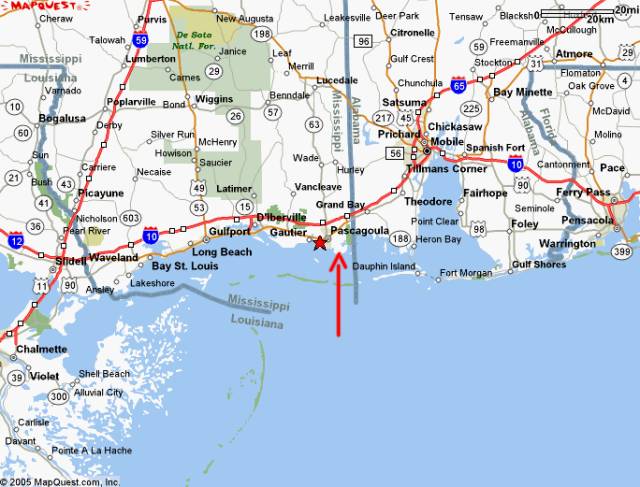
Click on graph for larger image.
This map shows the location (arrow) of Chevron's Pascagoula facility. This is not on the Louisiana only map linked above.
UPDATE: "Exxon Mobil Refining & Supply Co.'s Baton Rouge, La. refinery - had not been affected by the storm or had resumed normal operations by late Monday."
| Number | Facility | Production 1000s bbl/day |
| 1 | Valero's St. Charles | 260 |
| 2 | Exxon Mobil Corp.'s Baton Rouge | 494 |
| 3 | Motiva's Convent | 255 |
| 3 | Motiva's Norco | 242 |
| 3 | Marathon's Garyville | 245 |
| 4 | ConocoPhillips' Belle Chasse | 247 |
| 4 | Murphy Oil Corp.'s Meraux | 125 |
| 4 | Chalmette Refining | 187 |
| 5 | Chevron's Pascagoula | 325 |
SOURCE.
Valero is the only facility to report:
Valero sees re-opening refinery in Louisiana in 1-2 weeks (VLO) By Carla Mozee
SAN FRANCISCO (MarketWatch) -- Valero Energy Corp. (VLO) said Monday evening that it expects to re-open its St. Charles refinery in Louisiana in one to two weeks. The company said that the refinery is now without power and that it may take two to three days for it to return. It also said that there is 3 feet of flood water in two units and that it may have to repair pumps, electric motors and electrical switchgear. Valero also sees minor damage to its cooling towers. The company said that no major damage is apparent and there's no evidence of spills or leaks.
Katrina: Oil and Gas
by Calculated Risk on 8/29/2005 06:57:00 PM
Luckily hurricane Katrina weakened before it came onshore and the "worst case" scenario was avoided, however there still appears to be severe damage and widespread devastation. My thoughts are with the victims of this massive storm.
Early estimates are that Katrina will be one of the most expensive hurricanes to ever hit the US. Although the damage is major, the economic impact on the United States will be from any significant damage to the oil infrastructure on the Gulf Coast. It will take some time to assess the damage to refineries, and oil and gas production facilities. We are starting to see stories like this:
Valero sees re-opening refinery in Louisiana in 1-2 weeks (VLO) By Carla MozeeAnd some good news on Natural Gas: Henry Hub reopens for delivery
SAN FRANCISCO (MarketWatch) -- Valero Energy Corp. (VLO) said Monday evening that it expects to re-open its St. Charles refinery in Louisiana in one to two weeks. The company said that the refinery is now without power and that it may take two to three days for it to return. It also said that there is 3 feet of flood water in two units and that it may have to repair pumps, electric motors and electrical switchgear. Valero also sees minor damage to its cooling towers. The company said that no major damage is apparent and there's no evidence of spills or leaks.
A potential crisis in the natural-gas markets was apparently averted Monday after the company operating the Henry Hub gas gathering facility said it avoided major damage from Hurricane Katrina and reopened the site for delivery and receipt.But a couple of cautionary comments from this story:
"After Ivan hit, the initial word was that it wasn't that bad." [said Bob Slaughter, president of the National Petrochemical and Refiners Association].
"Our goal is to get back up as soon as possible, but do it safely. It took almost a year to get back up to full production after Hurricane Ivan," [said Tony Lentini, spokesman for Apache Corp].Oil, natural gas and gasoline futures all soared as Katrina appeared to be the storm of the century, and settled back when the damage was less severe than initially feared. Still, from Friday's closing prices, oil is up 2%, gasoline 8% and Natural Gas 18%. On Friday, I pointed out that oil inventories were solid (see Dr. Hamilton's Supply factors in the 2005 oil price surge), but gasoline stocks were tight.

Click on graph for larger image.
This graph is from the DOE.
We will not know the extent of the damage to refineries for several days, but the US can expect a price spike at the pumps on top of already record gasoline prices. One prediction:
"One analyst said pump prices nationwide would likely average more than $2.75 a gallon by week's end — up from $2.61 a gallon last week"
 Meanwhile crude stocks are robust and well above the average range. Plus the White House has suggested that oil could be released from the Strategic Petroleum Reserve if needed.
It is difficult to make any predictions, especially with stories of oil rigs adrift. But with above average oil stocks, it appears there will be no short term crude oil supply issues.
Gasoline is a different story. And there might be concerns about adequate heating oil supplies too.





