
 RSS Feed
 by Calculated Risk on 11/30/2023 08:34:00 PM
Thursday, November 30, 2023
Friday: ISM Mfg, Construction Spending, Fed Chair Powell, Vehicle Sales
 Note: Mortgage rates are from MortgageNewsDaily.com and are for top tier scenarios.
Friday:
• At 10:00 AM ET, ISM Manufacturing Index for November. The consensus is for 47.7%, up from 46.7%.
• Also at 10:00 AM, Construction Spending for October. The consensus is for 0.4% increase in spending.
• At 11:00 AM, Discussion, Fed Chair Jerome Powell, Conversation with Spelman College President Helene Gayle, At a Fireside Chat at Spelman College, Atlanta, Ga.
• All day, Light vehicle sales for November. The consensus is for 15.5 million SAAR in November, unchanged from the BEA estimate of 15.5 million SAAR in October (Seasonally Adjusted Annual Rate).
Las Vegas October 2023: Visitor Traffic Down Slightly YoY; Convention Traffic Up 2%
by Calculated Risk on 11/30/2023 04:07:00 PM
From the Las Vegas Visitor Authority: October 2023 Las Vegas Visitor Statistics
Demand for sports, entertainment and conventions combined to lift room rates to record levels in October as the destination hosted more than 3.6M visitors. Complementing the signature shows and residencies of the destination were other headliner acts including P!NK, the When We Were Young music festival and Ed Sheeran, along with the Fall NASCAR race and two NFL Raider home games.
Convention attendance for the month was up 2.0% YoY, supported by various returning and rotating tradeshows as well as the TwitchCon gamers event (30k attendees) that was held in Las Vegas for the first time.
Overall hotel occupancy matched last October at 87.7% as Weekend occupancy came in at 94.2% (+0.2 pts YoY), and Midweek occupancy reached 85.4% (up 0.3 pts), and ADR and RevPAR set records at $233 and $204 respectively, beating the prior monthly record tallies from March 2023
 Click on graph for larger image.
 The first graph shows visitor traffic for 2019 (Black), 2020 (light blue), 2021 (purple), 2022 (orange), and 2023 (red).
Visitor traffic was down 0.2% compared to last October.
Visitor traffic was down 1.0% compared to the same month in 2019.
Note: There was almost no convention traffic from April 2020 through May 2021.
The second graph shows convention traffic.

Convention traffic was up 2.0% compared to October 2022, and up 21.9% compared to October 2019.
Note: There was almost no convention traffic from April 2020 through May 2021.
Realtor.com Reports Active Inventory UP 1.8% YoY; New Listings up 8.9% YoY
by Calculated Risk on 11/30/2023 02:31:00 PM
Realtor.com has monthly and weekly data on the existing home market. Here is their weekly report: Weekly Housing Trends View — Data Week Ending Nov 25, 2023
• Active inventory increased slightly, with for-sale homes 1.8% above year ago levels.
Active listings exceeded last year’s levels again this week, growing by a slightly higher rate than previous week (+1.8% year-over-year vs +1.5%). However, active inventory has now fallen below its peak of 758,000 listings two weeks ago, to 741,000 this past week.
• New listings–a measure of sellers putting homes up for sale–were up this week, by 8.9% from one year ago.
New listings registered lower than prior year levels from mid-2022 through roughly 5 weeks ago, as the mortgage rate lock-in effect froze homeowners with low-rate existing mortgages in place. More recently the trend has reversed as new listings during the week outpaced the same week in the previous year by 8.9%, the largest increase since summer 2021. With the number of homes for sale already limited, a pick up in new listings is a welcome change to recent inventory woes. However, the pace of new listings is still 16.9% below typical pre-pandemic levels.
 Here is a graph of the year-over-year change in inventory according to realtor.com.
 Inventory was up year-over-year for the 2rd consecutive week following 20 consecutive weeks with a YoY decrease in inventory.
Inventory is still historically very low.
New listings really collapsed a year ago, so the YoY comparison for new listings is easier now - and although new listings also remain about 17% below "typical pre-pandemic levels", new listings are now up YoY.
Freddie Mac House Price Index Increased in October to New High; Up 6.0% Year-over-year
by Calculated Risk on 11/30/2023 11:01:00 AM
Today, in the Calculated Risk Real Estate Newsletter: Freddie Mac House Price Index Increased in October to New High; Up 6.0% Year-over-year
A brief excerpt:
On a year-over-year basis, the National FMHPI was up 6.0% in October, from up 5.1% YoY in September. The YoY increase peaked at 19.1% in July 2021, and for this cycle, bottomed at up 0.9% in April 2023. ...There is much more in the article. You can subscribe at https://calculatedrisk.substack.com/
As of October, 7 states and D.C. were below their previous peaks, Seasonally Adjusted. The largest seasonally adjusted declines from the recent peak were in Idaho (-4.5%), Utah (-2.7%), D.C. (-2.0%), and Nevada (-1.6%).
For cities (Core-based Statistical Areas, CBSA), here are the 30 cities with the largest declines from the peak, seasonally adjusted. Austin continues to be the worst performing city.
...
I’ll have an update on the House Price Battle Royale: Low Inventory vs Affordability soon.

NAR: Pending Home Sales Decrease 1.5% in October; Down 8.5% Year-over-year; Lowest Number of Record
by Calculated Risk on 11/30/2023 10:00:00 AM
From the NAR: Pending Home Sales Fell 1.5% in October
Pending home sales dropped 1.5% in October, according to the National Association of REALTORS®. The Northeast posted a monthly gain in transactions while the Midwest, South and West all recorded losses. All four U.S. regions noted year-over-year declines in transactions.This was below expectations. Note: Contract signings usually lead sales by about 45 to 60 days, so this would usually be for closed sales in November and December.
The Pending Home Sales Index (PHSI)* – a forward-looking indicator of home sales based on contract signings – dropped 1.5% to 71.4 in October, the lowest number since the index was originated in 2001. Year over year, pending transactions declined 8.5%. An index of 100 is equal to the level of contract activity in 2001.
...
The Northeast PHSI jumped 2.7% from last month to 64.8, although representing a loss of 6.5% from October 2022. The Midwest index contracted 0.4% to 73.8 in October, down 10.3% from one year ago.
The South PHSI decreased 1.9% to 85.6 in October, declining 7.1% from the prior year. The West index fell 6.0% in October to 51.8, dipping 10.8% from October 2022.
emphasis added
PCE Measure of Shelter Slows to 6.9% YoY in October
by Calculated Risk on 11/30/2023 09:03:00 AM
Here is a graph of the year-over-year change in shelter from the CPI report and housing from the PCE report this morning, both through October 2023.
 CPI Shelter was up 6.7% year-over-year in October, down from 7.1% in September, and down from the cycle peak of 8.2% in March 2023.
Housing (PCE) was up 6.9% YoY in October, down from 7.2% in September, and down from the cycle peak of 8.3% in April 2023.
Since asking rents are slightly negative year-over-year, these measures will continue to slow over coming months.
Since asking rents are slightly negative year-over-year, these measures will continue to slow over coming months.
Weekly Initial Unemployment Claims Increase to 218,000
by Calculated Risk on 11/30/2023 08:43:00 AM
The DOL reported:
In the week ending November 25, the advance figure for seasonally adjusted initial claims was 218,000, an increase of 7,000 from the previous week's revised level. The previous week's level was revised up by 2,000 from 209,000 to 211,000. The 4-week moving average was 220,000, a decrease of 500 from the previous week's revised average. The previous week's average was revised up by 500 from 220,000 to 220,500.The following graph shows the 4-week moving average of weekly claims since 1971.
emphasis added
 Click on graph for larger image.
The dashed line on the graph is the current 4-week average. The four-week average of weekly unemployment claims decreased to 220,000.
The previous week was revised up.
Weekly claims were at the consensus forecast.
Personal Income increased 0.2% in October; Spending increased 0.2%
by Calculated Risk on 11/30/2023 08:38:00 AM
The BEA released the Personal Income and Outlays report for October:
Personal income increased $57.1 billion (0.2 percent at a monthly rate) in October, according to estimates released today by the Bureau of Economic Analysis. Disposable personal income (DPI), personal income less personal current taxes, increased $63.4 billion (0.3 percent) and personal consumption expenditures (PCE) increased $41.2 billion (0.2 percent).The October PCE price index increased 3.0 percent year-over-year (YoY), down from 3.4 percent YoY in September, and down from the recent peak of 7.0 percent in June 2022.
The PCE price index increased less than 0.1 percent. Excluding food and energy, the PCE price index increased 0.2 percent. Real DPI increased 0.3 percent in October and real PCE increased 0.2 percent; goods increased 0.1 percent and services increased 0.2 percent.
emphasis added
The PCE price index, excluding food and energy, increased 3.5 percent YoY, up from 3.7 percent in September, and down from the recent peak of 5.4 percent in February 2022.
The following graph shows real Personal Consumption Expenditures (PCE) through October 2023 (2012 dollars). Note that the y-axis doesn't start at zero to better show the change.
 Click on graph for larger image.
The dashed red lines are the quarterly levels for real PCE.
Personal income and PCE were at expectations.
The following graph shows real Personal Consumption Expenditures (PCE) through October 2023 (2012 dollars). Note that the y-axis doesn't start at zero to better show the change.
 Click on graph for larger image.
The dashed red lines are the quarterly levels for real PCE.
Personal income and PCE were at expectations.
Inflation was slightly below expectations.
Wednesday, November 29, 2023
Thursday: Unemployment Claims, Personal Income and Outlays, Pending Home Sales
by Calculated Risk on 11/29/2023 08:30:00 PM
 Note: Mortgage rates are from MortgageNewsDaily.com and are for top tier scenarios.
Thursday:
• At 8:30 AM ET, The initial weekly unemployment claims report will be released. The consensus is for an increase to 218 thousand from 209 thousand last week.
• Also at 8:30 AM, Personal Income and Outlays, October 2023. The consensus is for a 0.2% increase in personal income, and for a 0.2% increase in personal spending. And for the Core PCE price index to increase 0.2%. PCE prices are expected to be up 3.1% YoY, and core PCE prices up 3.5% YoY.
• At 9:45 AM, Chicago Purchasing Managers Index for November.
• At 10:00 AM, Pending Home Sales Index for October. The consensus is for a 0.6% decrease in the index.
Fannie and Freddie Serious Delinquencies in October: Single Family Declined, Multi-Family Increased
by Calculated Risk on 11/29/2023 04:54:00 PM
Today, in the Calculated Risk Real Estate Newsletter: Fannie and Freddie Serious Delinquencies in October: Single Family Declined, Multi-Family Increased
Brief excerpt:
Single-family serious delinquencies continued to decline in October, however, multi-family serious delinquencies increased.You can subscribe at https://calculatedrisk.substack.com/.
...
Freddie Mac reports that multi-family delinquencies increased to 0.26% in October, up from 0.15% in October 2022.
This graph shows the Freddie multi-family serious delinquency rate since 2012. Rates were still high in 2012 following the housing bust and financial crisis.
The multi-family rate increased following the pandemic and has increased recently as rent growth has slowed, vacancy rates have increased, and interest rates have increased sharply. This will be something to watch as rents soften, and more apartments come on the market.

Fed's Beige Book: "Economic activity slowed since the previous report"
by Calculated Risk on 11/29/2023 02:00:00 PM
Fed's Beige Book "This report was prepared at the Federal Reserve Bank of Atlanta based on information collected on or before November 17, 2023."
On balance, economic activity slowed since the previous report, with four Districts reporting modest growth, two indicating conditions were flat to slightly down, and six noting slight declines in activity. Retail sales, including autos, remained mixed; sales of discretionary items and durable goods, like furniture and appliances, declined, on average, as consumers showed more price sensitivity. Travel and tourism activity was generally healthy. Demand for transportation services was sluggish. Manufacturing activity was mixed, and manufacturers' outlooks weakened. Demand for business loans decreased slightly, particularly real estate loans. Consumer credit remained fairly healthy, but some banks noted a slight uptick in consumer delinquencies. Agriculture conditions were steady to slightly up as farmers reported higher selling prices; yields were mixed. Commercial real estate activity continued to slow; the office segment remained weak and multifamily activity softened. Several Districts noted a slight decrease in residential sales and higher inventories of available homes. The economic outlook for the next six to twelve months diminished over the reporting period.
Demand for labor continued to ease, as most Districts reported flat to modest increases in overall employment. The majority of Districts reported that more applicants were available, and several noted that retention improved as well.
emphasis added
Final Look at Local Housing Markets in October
by Calculated Risk on 11/29/2023 10:31:00 AM
Today, in the Calculated Risk Real Estate Newsletter: Final Look at Local Housing Markets in September
A brief excerpt:
NOTE: Starting next month, I’ll add some comparisons to 2019 data (pre-pandemic)!There is much more in the article. You can subscribe at https://calculatedrisk.substack.com/
Each month I track closed sales, new listings and active inventory in a sample of local markets around the country (over 40 local housing markets) in the US to get an early sense of changes in the housing market. In addition, we can look for regional differences.
After the National Association of Realtors® (NAR) releases the monthly existing home sales report, I pick up additional local market data that is reported after the NAR (and I’m adding more markets). This is the final look at local markets in September.
The big story for September was that existing home sales hit a new cycle low. Also new listings were down YoY, but less than over the Summer.
This table shows the YoY change in new listings since the start of 2023. The smaller decline is due to a combination of new listings collapsing in the 2nd half of 2022, and new listings holding up more than normal seasonally (but still historically very low).
...
More local data coming in November for activity in October!

Q3 GDP Growth Revised up to 5.2% Annual Rate
by Calculated Risk on 11/29/2023 08:30:00 AM
From the BEA: Gross Domestic Product (Second Estimate) Corporate Profits (Preliminary Estimate) Third Quarter 2023
Real gross domestic product (GDP) increased at an annual rate of 5.2 percent in the third quarter of 2023, according to the "second" estimate released by the Bureau of Economic Analysis. In the second quarter, real GDP increased 2.1 percent.Here is a Comparison of Second and Advance Estimates. PCE growth was revised down from 4.0% to 3.4%. Residential investment was revised up from 3.9% to 6.2%.
The GDP estimate released today is based on more complete source data than were available for the "advance" estimate issued last month. In the advance estimate, the increase in real GDP was 4.9 percent. The update primarily reflected upward revisions to nonresidential fixed investment and state and local government spending that were partly offset by a downward revision to consumer spending. Imports, which are a subtraction in the calculation of GDP, were revised down (refer to "Updates to GDP").
The increase in real GDP reflected increases in consumer spending, private inventory investment, exports, state and local government spending, federal government spending, residential fixed investment, and nonresidential fixed investment. Imports increased.
emphasis added
MBA: Mortgage Applications Increased in Weekly Survey
by Calculated Risk on 11/29/2023 07:00:00 AM
From the MBA: Mortgage Applications Increase in Latest MBA Weekly Survey
— Mortgage applications increased 0.3 percent from one week earlier, according to data from the Mortgage Bankers Association’s (MBA) Weekly Mortgage Applications Survey for the week ending November 24, 2023. This week’s results include an adjustment for the observance of the Thanksgiving holiday.
The Market Composite Index, a measure of mortgage loan application volume, increased 0.3 percent on a seasonally adjusted basis from one week earlier. On an unadjusted basis, the Index decreased 33 percent compared with the previous week. The Refinance Index decreased 9 percent from the previous week and was 1 percent higher than the same week one year ago. The seasonally adjusted Purchase Index increased 5 percent from one week earlier. The unadjusted Purchase Index decreased 31 percent compared with the previous week and was 19 percent lower than the same week one year ago.
“Mortgage rates decreased for the fourth time in five weeks, with the 30-year fixed rate dipping to 7.37 percent, the lowest level in 10 weeks. There was a slight increase in applications overall, driven by a five percent increase in purchase applications, but refinance applications decreased over the week,” said Joel Kan, MBA’s Vice President and Deputy Chief Economist. “Rates have declined more than 50 basis points over the past six weeks, which has helped to spur a small increase in purchase applications, but activity last week was still around 20 percent lower than a year ago. The purchase market remains depressed because of the ongoing, low supply of existing homes on the market. Similarly, refinance activity will likely be muted for some time, even with the recent decline in rates, as many borrowers locked in much lower rates in 2020 and 2021.”
...
The average contract interest rate for 30-year fixed-rate mortgages with conforming loan balances ($726,200 or less) decreased to 7.37 percent from 7.41 percent, with points increasing to 0.64 from 0.62 (including the origination fee) for 80 percent loan-to-value ratio (LTV) loans.
emphasis added
 Click on graph for larger image.
The first graph shows the MBA mortgage purchase index.
According to the MBA, purchase activity is down 19% year-over-year unadjusted.
Red is a four-week average (blue is weekly).
Purchase activity has increased for four consecutive weeks but remains at a very low level.

The second graph shows the refinance index since 1990.
With higher mortgage rates, the refinance index declined sharply in 2022 - and has mostly flat lined at a low level since then.
Tuesday, November 28, 2023
Wednesday: GDP, Beige Book
by Calculated Risk on 11/28/2023 07:43:00 PM
 Note: Mortgage rates are from MortgageNewsDaily.com and are for top tier scenarios.
Wednesday:
• At 7:00 AM ET, The Mortgage Bankers Association (MBA) will release the results for the mortgage purchase applications index.
• At 8:30 AM, Gross Domestic Product (Second Estimate) and Corporate Profits (Preliminary), 3rd Quarter 2023. The consensus is that real GDP increased 5.0% annualized in Q3, up from the advance estimate of 4.9% in Q3.
• At 2:00 PM, the Federal Reserve Beige Book, an informal review by the Federal Reserve Banks of current economic conditions in their Districts.
FHFA Announces Baseline Conforming Loan Limit Will Increase to $766,550
by Calculated Risk on 11/28/2023 12:21:00 PM
High-Cost Areas increase to $1,149,825.
Here is the official announcement from the FHFA: FHFA Announces Conforming Loan Limit Values for 2024
The Federal Housing Finance Agency (FHFA) today announced the conforming loan limit values (CLLs) for mortgages Fannie Mae and Freddie Mac (the Enterprises) will acquire in 2024. In most of the United States, the 2024 CLL value for one-unit properties will be $766,550, an increase of $40,350 from 2023.
...
The new ceiling loan limit for one-unit properties will be $1,149,825, which is 150 percent of $766,550.
emphasis added
Comments on September Case-Shiller and FHFA House Prices
by Calculated Risk on 11/28/2023 09:49:00 AM
Today, in the Calculated Risk Real Estate Newsletter: Case-Shiller: National House Price Index Up 3.9% year-over-year in September; New all-time High
Excerpt:
S&P/Case-Shiller released the monthly Home Price Indices for September ("September" is a 3-month average of July, August and September closing prices). September closing prices include some contracts signed in May, so there is a significant lag to this data. Here is a graph of the month-over-month (MoM) change in the Case-Shiller National Index Seasonally Adjusted (SA).
The MoM increase in the seasonally adjusted Case-Shiller National Index was at 0.65%. This was the eighth consecutive MoM increase following seven straight MoM decreases.
On a seasonally adjusted basis, prices increased in all 20 Case-Shiller cities on a month-to-month basis. Seasonally adjusted, San Francisco has fallen 8.6% from the recent peak, Seattle is down 6.7% from the peak, Las Vegas is down 5.1%, and Phoenix is down 5.0%.

There is much more in the article. You can subscribe at https://calculatedrisk.substack.com/
Case-Shiller: National House Price Index Up 3.9% year-over-year in September; New all-time High
by Calculated Risk on 11/28/2023 09:00:00 AM
S&P/Case-Shiller released the monthly Home Price Indices for September ("September" is a 3-month average of July, August and September closing prices).
This release includes prices for 20 individual cities, two composite indices (for 10 cities and 20 cities) and the monthly National index.
From S&P S&P CoreLogic Case-Shiller Index Continued to Trend Upward in September
The S&P CoreLogic Case-Shiller U.S. National Home Price NSA Index, covering all nine U.S. census divisions, reported a 3.9% annual change in September, up from a 2.5% change in the previous month. The 10-City Composite showed an increase of 4.8%, up from a 3.0% increase in the previous month. The 20-City Composite posted a year-over-year increase of 3.9%, up from a 2.1% increase in the previous month. Detroit surpassed Chicago, reporting the highest year-over-year gain among the 20 cities with an 6.7% increase in September, followed by San Diego with a 6.5% increase. Three of the 20 cities reported lower prices in September versus a year ago.
...
Before seasonal adjustment, the U.S. National Index,10-City and 20-City Composites, all posted 0.3% month-over-month increases in September, while the 10-City and 20-City composites posted 0.3% and 0.2% increases, respectively.
After seasonal adjustment, the U.S. National Index, the 10-City and 20-City Composites each posted month-over-month increases of 0.7%.
“U.S. home prices continued their rally in September 2023,” says Craig J. Lazzara, Managing Director at S&P DJI. “Our National Composite rose by 0.3% in September, marking eight consecutive monthly gains since prices bottomed in January 2023. The Composite now stands 3.9% above its year-ago level and 6.6% above its January level. Our 10- and 20-City Composites both rose in September, and likewise currently exceed their year-ago and January levels.
“We’ve commented before on the breadth of the housing market’s strength, which continued to be impressive. On a seasonally adjusted basis, all 20 cities showed price increases in September; before seasonal adjustments, 15 rose. Prices in 17 of the cities are higher than they were in September 2022. Notably, the National Composite, the 10-City Composite, and 10 individual cities (Atlanta, Boston, Charlotte, Chicago, Cleveland, Detroit, Miami, New York, Tampa, and Washington) stand at their all-time highs."
 Click on graph for larger image.
 The first graph shows the nominal seasonally adjusted Composite 10, Composite 20 and National indices (the Composite 20 was started in January 2000).
The Composite 10 index is up 0.7% in September (SA) and is at a new all-time high.
The Composite 20 index is up 0.7% (SA) in September and is also at a new all-time high.
The National index is up 0.7% (SA) in September and is also at a new all-time high.
 The second graph shows the year-over-year change in all three indices.
The Composite 10 SA is up 4.8% year-over-year. The Composite 20 SA is up 3.9% year-over-year.
The National index SA is up 3.9% year-over-year.
Annual price changes were close to expectations. I'll have more later.
Monday, November 27, 2023
Tuesday: Case-Shiller House Prices
by Calculated Risk on 11/27/2023 07:06:00 PM
 From Matthew Graham at Mortgage News Daily: Mortgage Rates Undo Any Potential Damage From Last Friday
n other words, the bond market pointed to a moderate jump in rates on Friday. There was a good chance the jump was an artificial byproduct of Thanksgiving week, but there was no way to be sure until today.Tuesday:
Now we're sure. Bonds quickly moved back in line with Wednesday's levels and the average mortgage lender did the same. That's good news considering last Wednesday's mortgage rates were right in line with the lowest levels of the past 2 months. [30 year fixed 7.32%]
emphasis added
• At 9:00 AM ET, S&P/Case-Shiller House Price Index for September. The National index was up 2.6% YoY in August and is expected to increase further in September.
• At 9:00 AM, FHFA House Price Index for September. This was originally a GSE only repeat sales, however there is also an expanded index. The 2023 Conforming loan limits will also be announced.
• At 10:00 AM, Richmond Fed Survey of Manufacturing Activity for November. This is the last of the regional Fed manufacturing surveys for November.
TSA: Airline Travel Above 2019 Levels
by Calculated Risk on 11/27/2023 02:32:00 PM
The TSA is providing daily travel numbers.
This data is as of November 26th.
 Click on graph for larger image.
This data shows the 7-day average of daily total traveler throughput from the TSA (Blue).
The red line is the percent of 2019 for the seven-day average.
The 7-day average is above the level for the same week in 2019 (104% of 2019). (red line) The 7-day average has been above 2019
Air travel - as a percent of 2019 - is tracking above pre-pandemic levels.
New Home Sales decrease to 679,000 Annual Rate in October; Median New Home Price is Down 18% from the Peak
by Calculated Risk on 11/27/2023 10:44:00 AM
Today, in the Calculated Risk Real Estate Newsletter: New Home Sales decrease to 679,000 Annual Rate in October
Brief excerpt:
The Census Bureau reports New Home Sales in October were at a seasonally adjusted annual rate (SAAR) of 679 thousand. The previous three months were revised down.You can subscribe at https://calculatedrisk.substack.com/.
...
The next graph shows new home sales for 2022 and 2023 by month (Seasonally Adjusted Annual Rate). Sales in October 2023 were up 17.7% from October 2022. Year-to-date sales are up 4.6% compared to the same period in 2022.
As expected, new home sales were up solidly year-over-year in October, and there will be more sales in 2023 than in 2022.

New Home Sales decrease to 679,000 Annual Rate in October
by Calculated Risk on 11/27/2023 10:00:00 AM
The Census Bureau reports New Home Sales in October were at a seasonally adjusted annual rate (SAAR) of 679 thousand.
The previous three months were revised down.
Sales of new single‐family houses in October 2023 were at a seasonally adjusted annual rate of 679,000, according to estimates released jointly today by the U.S. Census Bureau and the Department of Housing and Urban Development. This is 5.6 percent below the revised September rate of 719,000, but is 17.7 percent above the October 2022 estimate of 577,000.
emphasis added
 Click on graph for larger image.
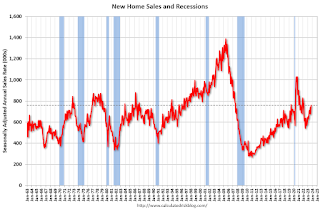
The first graph shows New Home Sales vs. recessions since 1963. The dashed line is the current sales rate.
New home sales are close to pre-pandemic levels.
The second graph shows New Home Months of Supply.
 The months of supply increased in October to 7.8 months from 7.2 months in September.
 The all-time record high was 12.2 months of supply in January 2009. The all-time record low was 3.3 months in August 2020.
This is above the top of the normal range (about 4 to 6 months of supply is normal).
"The seasonally‐adjusted estimate of new houses for sale at the end of October was 439,000. This represents a supply of 7.8 months at the current sales rate."Sales were well below expectations of 730 thousand SAAR, and sales for the three previous months were revised down. I'll have more later today.
Housing November 27th Weekly Update: Inventory Down Week-over-week, Up Slightly Year-over-year
by Calculated Risk on 11/27/2023 08:11:00 AM
Altos reports that active single-family inventory was down 0.7% week-over-week and is now up 0.2% year-over-year. Inventory will decrease seasonally for next several weeks (for the Holidays).
 Click on graph for larger image.
This inventory graph is courtesy of Altos Research.
As of November 24th, inventory was at 566 thousand (7-day average), compared to 570 thousand the prior week.
Year-to-date, inventory is up 15.3%.

The red line is for 2023. The black line is for 2019. Note that inventory is up from the record low for the same week in 2021, but below last year and still well below normal levels.
Inventory was up 0.2% compared to the same week in 2022 (last week it was up 0.1%), and down 35.1% compared to the same week in 2019 (last week down 35.7%).
Inventory is now solidly above the same week in 2020 levels (dark blue line).
Mike Simonsen discusses this data regularly on Youtube.
Sunday, November 26, 2023
Monday: New Home Sales
by Calculated Risk on 11/26/2023 06:49:00 PM
Weekend:
• Schedule for Week of November 26, 2023
Monday:
• At 10:00 AM ET, New Home Sales for October from the Census Bureau. The consensus is for 730 thousand SAAR, down from 759 thousand in September.
• At 10:30 AM, Dallas Fed Survey of Manufacturing Activity for November.
From CNBC: Pre-Market Data and Bloomberg futures S&P 500 futures are down 8 and DOW futures are down 32 (fair value).
Oil prices were down over the last week with WTI futures at $75.54 per barrel and Brent at $80.58 per barrel. A year ago, WTI was at $76, and Brent was at $83 - so WTI oil prices were down slightly year-over-year.
Here is a graph from Gasbuddy.com for nationwide gasoline prices. Nationally prices are at $3.21 per gallon. A year ago, prices were at $3.54 per gallon, so gasoline prices are down $0.33 year-over-year.
2024 Conforming Loan Limits Will be Released on Tuesday
by Calculated Risk on 11/26/2023 09:31:00 AM
Although Case-Shiller usually receives more attention, the FHFA index will be a focus on Tuesday - since the quarterly FHFA Expanded-Data Indexes (Estimated using Enterprise, FHA, and Real Property County Recorder Data Licensed from DataQuick for sales below the annual loan limit ceiling) is used to set the Fannie and Freddie conforming loan limits (CLL), and the FHA insured limit.
For 2023, the CLL for one-unit properties was set at $726,200, and for high cost areas the ceiling loan limit for one-unit properties was $1,089,300.
Based on the monthly FHFA index, the CLL will probably increase around 6% for 2024 to around $770,000, and to $1,155,000 for high cost areas.
Saturday, November 25, 2023
Real Estate Newsletter Articles this Week: Existing-Home Sales Decreased to 3.79 million SAAR in October; New Cycle Low
by Calculated Risk on 11/25/2023 02:11:00 PM
At the Calculated Risk Real Estate Newsletter this week:
• NAR: Existing-Home Sales Decreased to 3.79 million SAAR in October; New Cycle Low
• Lawler on Existing Home Sales, Population Projections and Household Slowdown
• 4th Look at Local Housing Markets in October
This is usually published 4 to 6 times a week and provides more in-depth analysis of the housing market.
You can subscribe at https://calculatedrisk.substack.com/
Schedule for Week of November 26, 2023
by Calculated Risk on 11/25/2023 08:11:00 AM
The key reports this week include the 2nd estimate of Q3 GDP and October New Home Sales.
Other key indicators include the September Case-Shiller and FHFA house price indexes, October Personal Income & Outlays (and PCE), the November ISM manufacturing index, and November vehicle sales.
----- Monday, November 27th -----
 10:00 AM: New Home Sales for October from the Census Bureau.
This graph shows New Home Sales since 1963. The dashed line is the sales rate for last month.
The consensus is for 730 thousand SAAR, down from 759 thousand in September.
10:30 AM: Dallas Fed Survey of Manufacturing Activity for November.
----- Tuesday, November 28th -----
 9:00 AM ET: S&P/Case-Shiller House Price Index for September.
This graph shows graph shows the Year over year change in the seasonally adjusted National Index, Composite 10 and Composite 20 indexes through the most recent report (the Composite 20 was started in January 2000).
The National index was up 2.6% YoY in August and is expected to increase further in September.
9:00 AM: FHFA House Price Index for September. This was originally a GSE only repeat sales, however there is also an expanded index. The 2023 Conforming loan limits will also be announced.
10:00 AM: Richmond Fed Survey of Manufacturing Activity for November. This is the last of the regional Fed manufacturing surveys for November.
----- Wednesday, November 29th -----
7:00 AM ET: The Mortgage Bankers Association (MBA) will release the results for the mortgage purchase applications index.
8:30 AM: Gross Domestic Product (Second Estimate) and Corporate Profits (Preliminary), 3rd Quarter 2023. The consensus is that real GDP increased 5.0% annualized in Q3, up from the advance estimate of 4.9% in Q3.
2:00 PM: the Federal Reserve Beige Book, an informal review by the Federal Reserve Banks of current economic conditions in their Districts.
----- Thursday, November 30th -----
8:30 AM: The initial weekly unemployment claims report will be released. Initial claims were at 209 thousand last week.
8:30 AM: Personal Income and Outlays, October 2023. The consensus is for a 0.2% increase in personal income, and for a 0.2% increase in personal spending. And for the Core PCE price index to increase 0.2%. PCE prices are expected to be up 3.1% YoY, and core PCE prices up 3.5% YoY.
9:45 AM: Chicago Purchasing Managers Index for November.
10:00 AM: Pending Home Sales Index for October. The consensus is for a 0.6% decrease in the index.
----- Friday, December 1st -----
10:00 AM: ISM Manufacturing Index for November. The consensus is for 47.7%, up from 46.7%.
10:00 AM: Construction Spending for October. The consensus is for 0.4% increase in spending.
11:00 AM: Discussion, Fed Chair Jerome Powell, Conversation with Spelman College President Helene Gayle, At a Fireside Chat at Spelman College, Atlanta, Ga.
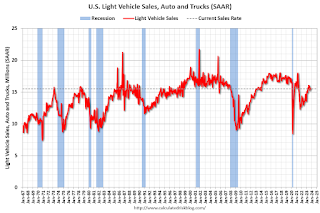 All day: Light vehicle sales for November.
The consensus is for 15.5 million SAAR in November, unchanged from the BEA estimate of 15.5 million SAAR in October (Seasonally Adjusted Annual Rate).
This graph shows light vehicle sales since the BEA started keeping data in 1967. The dashed line is the current sales rate.
 10:00 AM: New Home Sales for October from the Census Bureau.
 This graph shows New Home Sales since 1963. The dashed line is the sales rate for last month.
The consensus is for 730 thousand SAAR, down from 759 thousand in September.
10:30 AM: Dallas Fed Survey of Manufacturing Activity for November.
 9:00 AM ET: S&P/Case-Shiller House Price Index for September.
This graph shows graph shows the Year over year change in the seasonally adjusted National Index, Composite 10 and Composite 20 indexes through the most recent report (the Composite 20 was started in January 2000).
The National index was up 2.6% YoY in August and is expected to increase further in September.
9:00 AM: FHFA House Price Index for September. This was originally a GSE only repeat sales, however there is also an expanded index. The 2023 Conforming loan limits will also be announced.
10:00 AM: Richmond Fed Survey of Manufacturing Activity for November. This is the last of the regional Fed manufacturing surveys for November.
7:00 AM ET: The Mortgage Bankers Association (MBA) will release the results for the mortgage purchase applications index.
8:30 AM: Gross Domestic Product (Second Estimate) and Corporate Profits (Preliminary), 3rd Quarter 2023. The consensus is that real GDP increased 5.0% annualized in Q3, up from the advance estimate of 4.9% in Q3.
2:00 PM: the Federal Reserve Beige Book, an informal review by the Federal Reserve Banks of current economic conditions in their Districts.
8:30 AM: The initial weekly unemployment claims report will be released. Initial claims were at 209 thousand last week.
8:30 AM: Personal Income and Outlays, October 2023. The consensus is for a 0.2% increase in personal income, and for a 0.2% increase in personal spending. And for the Core PCE price index to increase 0.2%. PCE prices are expected to be up 3.1% YoY, and core PCE prices up 3.5% YoY.
9:45 AM: Chicago Purchasing Managers Index for November.
10:00 AM: Pending Home Sales Index for October. The consensus is for a 0.6% decrease in the index.
10:00 AM: ISM Manufacturing Index for November. The consensus is for 47.7%, up from 46.7%.
10:00 AM: Construction Spending for October. The consensus is for 0.4% increase in spending.
11:00 AM: Discussion, Fed Chair Jerome Powell, Conversation with Spelman College President Helene Gayle, At a Fireside Chat at Spelman College, Atlanta, Ga.
 All day: Light vehicle sales for November.
The consensus is for 15.5 million SAAR in November, unchanged from the BEA estimate of 15.5 million SAAR in October (Seasonally Adjusted Annual Rate).
This graph shows light vehicle sales since the BEA started keeping data in 1967. The dashed line is the current sales rate.
Friday, November 24, 2023
Hotels: Occupancy Rate Decreased 0.6% Year-over-year
by Calculated Risk on 11/24/2023 03:25:00 PM
U.S. hotel performance showed mixed year-over-year comparisons, according to CoStar’s latest data through 18 November. ...The following graph shows the seasonal pattern for the hotel occupancy rate using the four-week average.
12-18 November 2023 (percentage change from comparable week in 2022):
• Occupancy: 62.4% (-0.6%)
• Average daily rate (ADR): US$156.47 (+7.0%)
• Revenue per available room (RevPAR): US$97.61 (+6.3%)
emphasis added
 Click on graph for larger image.
The red line is for 2023, black is 2020, blue is the median, and dashed light blue is for 2022. Dashed purple is for 2018, the record year for hotel occupancy.
The 4-week average of the occupancy rate is tracking close to last year, and above the median rate for the period 2000 through 2022 (Blue).
Note: Y-axis doesn't start at zero to better show the seasonal change.
The 4-week average of the occupancy rate will decline seasonally for the next couple of months.
Realtor.com Reports Active Inventory UP 1.5% YoY; New Listings up 5.0% YoY
by Calculated Risk on 11/24/2023 12:31:00 PM
Realtor.com has monthly and weekly data on the existing home market. Here is their weekly report: Weekly Housing Trends View — Data Week Ending Nov 18, 2023
• Active inventory increased slightly, with for-sale homes 1.5% above year ago levels. Active listings exceeded last year’s levels again this week, falling in line with last week’s trend.
• New listings–a measure of sellers putting homes up for sale–were up this week, by 5.0% from one year ago. New listings registered lower than prior year levels from mid-2022 through roughly 4 weeks ago, as the mortgage rate lock-in effect freezes homeowners with low-rate existing mortgages in place. Over the last three weeks, however, the trend has reversed and new listings during this week outpaced the same week in the previous year by 5.0%.
 Here is a graph of the year-over-year change in inventory according to realtor.com.
 Inventory was up year-over-year for the 2nd consecutive week following 20 consecutive weeks with a YoY decrease in inventory.
Inventory is still historically very low.
New listings really collapsed a year ago, so the YoY comparison for new listings is easier now - and although new listings also remain historically very low, new listings are now up YoY.
Q4 GDP Tracking: Around 2%
by Calculated Risk on 11/24/2023 10:40:00 AM
From BofA:
Overall, this reduced our 4Q US GDP tracking estimate down a tenth to 1.4% q/q saar from our official forecast of 1.5% q/q saar. Also, 3Q GDP remains unchanged from our last weekly publication at 5.2% q/q saar. [Nov 22nd estimate]From Goldman:
emphasis added
The inventory details of the durable goods report were firmer than our previous assumptions, and we boosted our Q4 GDP tracking estimate by one tenth to +2.0% (qoq ar). Our Q4 domestic final sales estimate also stands at +2.0%. [Nov 22nd estimate]And from the Altanta Fed: GDPNow
The GDPNow model estimate for real GDP growth (seasonally adjusted annual rate) in the fourth quarter of 2023 is 2.1 percent on November 22, up from 2.0 percent on November 17. After recent releases from the US Census Bureau and the National Association of Realtors, the nowcast of fourth-quarter real gross private domestic investment growth increased from -1.8 percent to -1.1 percent. [Nov 22nd estimate]
Thursday, November 23, 2023
Five Economic Reasons to be Thankful
by Calculated Risk on 11/23/2023 08:47:00 AM
Here are five economic reasons to be thankful this Thanksgiving. (Hat Tip to Neil Irwin who started doing this years ago)
1) The Unemployment Rate is Below 4%
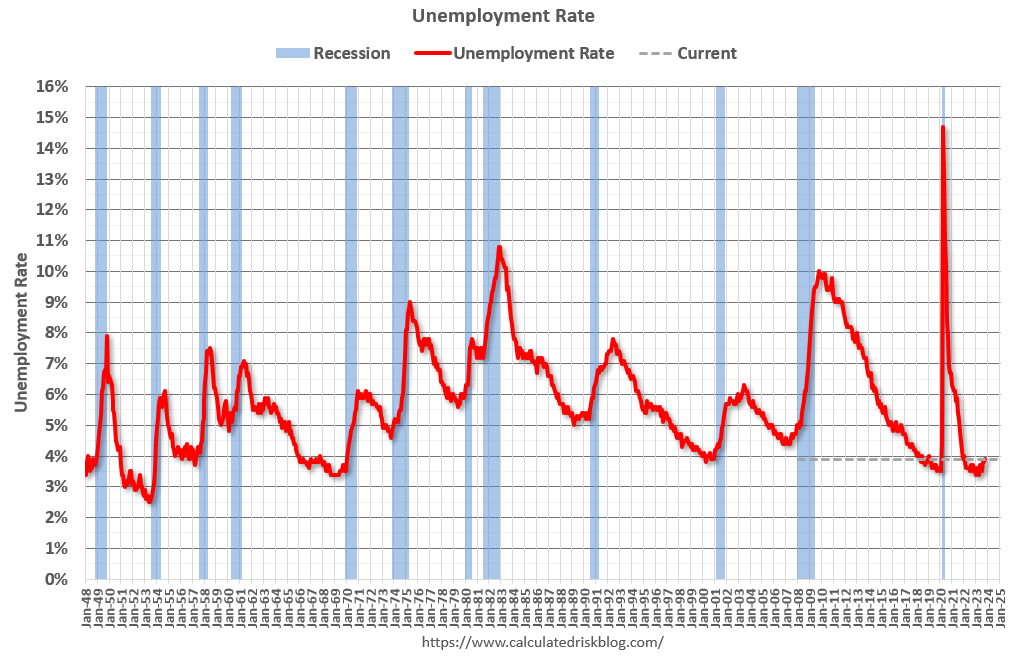 The unemployment rate was at 3.9% in October. The unemployment rate is down from 14.7% in April 2020 (the highest since the Great Depression).
The unemployment rate is up from 3.7% a year ago (October 2022).
This was up from 3.4% in April 2023 - and that matched the lowest unemployment rate since 1969!
2) Low unemployment claims.
 This graph shows the 4-week moving average of weekly claims since 1971.
2) Low unemployment claims.
 This graph shows the 4-week moving average of weekly claims since 1971.
Weekly claims were at 209,000 last week.
The dashed line on the graph is the current 4-week average.
The dashed line on the graph is the current 4-week average.
Even though weekly claims have bounced around a little recently, the 4-week average is close to the lowest level in 50 years.
3) Inflation is Decreasing
 This graph shows the year-over-year change in three measures of inflation since 1970: CPI, Core CPI, and Core CPI ex-shelter.
3) Inflation is Decreasing
 This graph shows the year-over-year change in three measures of inflation since 1970: CPI, Core CPI, and Core CPI ex-shelter.
 CPI was up 3.2% YoY in October, down from the recent peak of 8.9%.
Core CPI was up 4.0% YoY, and Core CPI ex-shelter was up 2.0% YoY in October.
Overall inflation is moving back to the Fed's 2% target.
4) Mortgage Delinquency Rate Near the Lowest Level since at least 1979

Overall inflation is moving back to the Fed's 2% target.
4) Mortgage Delinquency Rate Near the Lowest Level since at least 1979

This graph, based on data from the MBA through Q3 2023, shows the percent of loans delinquent by days past due. Even though delinquencies increased in Q3, mortgage delinquencies were near the lowest level since the MBA survey started in 1979.
Note: The sharp increase in 2020 in the 90-day bucket was due to loans in forbearance (included as delinquent, but not reported to the credit bureaus).
The percent of loans in the foreclosure process decreased year-over-year in Q3 even with the end of the foreclosure moratoriums and are historically low.
5) Household Debt burdens at Low Levels
 This graph, based on data from the Federal Reserve, shows the Total Debt Service Ratio (DSR), and the DSR for mortgages (blue) and consumer debt (yellow).
The Household debt service ratio was at 13.2% in 2007 and has fallen to under 10% now., and the DSR for mortgages (blue) are near the lowest level for the last 35 years.
This data suggests aggregate household cash flow is in a solid position.
This data suggests aggregate household cash flow is in a solid position.
Happy Thanksgiving to All!
Wednesday, November 22, 2023
Black Knight: Mortgage Delinquency Rate Decreased in October
by Calculated Risk on 11/22/2023 02:35:00 PM
From ICE / Black Knight: ICE First Look at Mortgage Performance: Foreclosure starts rose in October, despite serious delinquencies returning to 17-year lows
• The national delinquency rate fell 3 basis points (bps) to 3.26% in October, marking a 9 bps (-2.8%) improvement from the same time last year
• Serious delinquencies (90+ days past due) fell to 447K, once again hitting their lowest levels since 2006
• Loans 30-days late also declined, marking the first such improvement in five months
• Despite the improvement in delinquencies, foreclosure starts rose to 33K in October, hitting their highest levels in 18 months – while the number of foreclosure sales (completions) remained relatively flat
• Active foreclosure inventory inched up 3K to 217K, but remains more than 25% below prepandemic levels
• While foreclosure starts rose in October, near term risk remains muted, with serious delinquencies historically low and more than 70% of such loans protected from foreclosure by loss mitigation efforts
• Prepay activity (measured as single-month mortality) dwindled to just 0.43% under continued seasonal pressure, despite interest rates easing somewhat from the prior month
| Black Knight: Percent Loans Delinquent and in Foreclosure Process | ||||
|---|---|---|---|---|
| October 2023 | September 2023 | |||
| Delinquent | 3.26% | 3.29% | ||
| In Foreclosure | 0.41% | 0.40% | ||
| Number of properties: | ||||
| Number of properties that are delinquent, but not in foreclosure: | 1,734,000 | 1,749,000 | ||
| Number of properties in foreclosure pre-sale inventory: | 217,000 | 214,000 | ||
| Total Properties | 1,951,000 | 1,963,000 | ||
November Vehicle Sales Forecast: 15.8 million SAAR, Up 11% YoY
by Calculated Risk on 11/22/2023 01:30:00 PM
From WardsAuto: November U.S. Light-Vehicle Sales to Improve on Past Three Months (pay content). Brief excerpt:
The recent falloff in the SAAR from summer highs could mean more consumers are reaching price fatigue. It also could be that some of the stronger selling segments – especially fullsize trucks – of the past two-plus years are closer than other segments to meeting the pent-up demand built up since the inventory drain caused by the semiconductor shortage began in early 2021. Of course, there also has been a rise in distractions over that period, locally and internationally.
emphasis added
 Click on graph for larger image.
This graph shows actual sales from the BEA (Blue), and Wards forecast for November (Red).
On a seasonally adjusted annual rate basis, the Wards forecast of 15.8 million SAAR, would be up 2% from last month, and up 11% from a year ago.
Vehicle sales are usually a transmission mechanism for Federal Open Market Committee (FOMC) policy, although far behind housing. This time vehicle sales were more suppressed by supply chain issues.
Lawler on Existing Home Sales, Population Projections and Household Slowdown
by Calculated Risk on 11/22/2023 09:34:00 AM
Today, in the CalculatedRisk Real Estate Newsletter: Lawler on Existing Home Sales, Population Projections and Household Slowdown
Excerpt:
Census’ new long-term US population projections released last Friday were massively lower than the previous long-term projection released in 2017. In a report earlier this week I highlighted the how the projected components of population change (births, deaths, and net international migration) differed in the two forecasts. Today I’m going to highlight a few “issues” with the latest projections over the next few years.There is much more in the article. You can subscribe at https://calculatedrisk.substack.com/ Please subscribe!
First, the “projected” components of change from July 1, 2022, to June 30, 2023, differ significantly from likely components of change based on existing information.
For deaths, the latest projection shows deaths from July 1, 2022, to June 30, 2023, of 2,861,510, a whopping 298,232 lower than CDC provisional data for that period show (this latter number will be revised upward slightly). In looking at deaths by age, mortality rates are “too low” in the latest long-term projection for almost all age groups, but especially for young to middle-aged adults.
For net international migration (NIM), the latest projection shows NIM from July 1, 2022, to June 30, 2023, of 853,220, or a sizeable 157,703 below the estimated NIM from July 1, 2021, to June 30, 2022, in the Vintage 2022 population estimates. Yet the admittedly limited data available on immigration trends suggest the NIM INCREASED from 2022 to 2023, and my best estimate in that NIM from July 1, 2022, to June 30, 2022, was about 1,200,000 – 346,780 higher than the assumption in the latest long-term population projection.
Finally, births in the latest long-term population projection from July 1, 2022, to June 30, 2023, are 18,788 below provisional CDC data for this period.

Weekly Initial Unemployment Claims Decrease to 209,000
by Calculated Risk on 11/22/2023 08:30:00 AM
The DOL reported:
In the week ending November 18, the advance figure for seasonally adjusted initial claims was 209,000, a decrease of 24,000 from the previous week's revised level. The previous week's level was revised up by 2,000 from 231,000 to 233,000. The 4-week moving average was 220,000, a decrease of 750 from the previous week's revised average. The previous week's average was revised up by 500 from 220,250 to 220,750.The following graph shows the 4-week moving average of weekly claims since 1971.
emphasis added
Click on graph for larger image.The dashed line on the graph is the current 4-week average. The four-week average of weekly unemployment claims decreased to 220,000.
The previous week was revised up.
Weekly claims were much lower than the consensus forecast.
MBA: Mortgage Applications Increased in Weekly Survey
by Calculated Risk on 11/22/2023 07:00:00 AM
From the MBA: Mortgage Applications Increase in Latest MBA Weekly Survey
Mortgage applications increased 3.0 percent from one week earlier, according to data from the Mortgage Bankers Association’s (MBA) Weekly Mortgage Applications Survey for the week ending November 17, 2023.
The Market Composite Index, a measure of mortgage loan application volume, increased 3.0 percent on a seasonally adjusted basis from one week earlier. On an unadjusted basis, the Index decreased 0.1 percent compared with the previous week. The Refinance Index increased 2 percent from the previous week and was 4 percent lower than the same week one year ago. The seasonally adjusted Purchase Index increased 4 percent from one week earlier. The unadjusted Purchase Index decreased 1 percent compared with the previous week and was 20 percent lower than the same week one year ago.
“U.S. bond yields continued to move lower as incoming data signaled a softer economy and more signs of cooling inflation. Most mortgage rates in our survey decreased, with the 30-year fixed mortgage rate decreasing to 7.41 percent, the lowest rate in two months,” said Joel Kan, MBA’s Vice President and Deputy Chief Economist. “Mortgage applications increased to their highest level in six weeks, but remain at very low levels. Purchase applications were up almost four percent over the week, on a seasonally adjusted basis, as both conventional and government purchase loans saw increases. The average loan size on a purchase application was $403,600, the lowest since January 2023. This is consistent with other sources of home sales data showing a gradually increasing first-time homebuyer share.”
Added Kan, “Refinance applications increased 1.6 percent last week, but the level of refinances continues to be well below historical averages, given that most borrowers already have a rate well below current market rates.”
...
The average contract interest rate for 30-year fixed-rate mortgages with conforming loan balances ($726,200 or less) decreased to 7.41 percent from 7.61 percent, with points decreasing to 0.62 from 0.67 (including the origination fee) for 80 percent loan-to-value ratio (LTV) loans.
emphasis added
 Click on graph for larger image.
The first graph shows the MBA mortgage purchase index.
According to the MBA, purchase activity is down 20% year-over-year unadjusted.
Red is a four-week average (blue is weekly). Other than the previous five weeks, the purchase index was at the lowest level since 1995.

The second graph shows the refinance index since 1990.
With higher mortgage rates, the refinance index declined sharply in 2022 - and has mostly flat lined at a low level since then.
Tuesday, November 21, 2023
Wednesday: Unemployment Claims, Durable Goods
by Calculated Risk on 11/21/2023 08:38:00 PM
 Note: Mortgage rates are from MortgageNewsDaily.com and are for top tier scenarios.
Wednesday:
• At 7:00 AM ET, The Mortgage Bankers Association (MBA) will release the results for the mortgage purchase applications index.
• At 8:30 AM, The initial weekly unemployment claims report will be released. The consensus is for 229 thousand initial claims, down from 231 thousand last week.
• Also at 8:30 AM, Durable Goods Orders for October from the Census Bureau. The consensus is for a 3.0% decrease in durable goods orders.
• At 10:00 AM, University of Michigan's Consumer sentiment index (Final for November).
FOMC Minutes: "All participants agreed that the Committee was in a position to proceed carefully"
by Calculated Risk on 11/21/2023 02:00:00 PM
From the Fed: Minutes of the Federal Open Market Committee, October 31–November 1, 2023. Excerpt:
Participants noted that real GDP had expanded at an unexpectedly strong pace in the third quarter, boosted by a surge in consumer spending. Nevertheless, participants judged that aggregate demand and aggregate supply continued to come into better balance, as a result of the current restrictive stance of monetary policy and the continued normalization of aggregate supply conditions. Participants assessed that while labor market conditions remained tight, they had eased since earlier in the year, partly as a result of recent increases in labor supply. Participants judged that the current stance of monetary policy was restrictive and was putting downward pressure on economic activity and inflation. In addition, they noted that financial conditions had tightened significantly in recent months. Participants noted that inflation had moderated over the past year but stressed that current inflation remained unacceptably high and well above the Committee's longer-run goal of 2 percent. They also stressed that further evidence would be required for them to be confident that inflation was clearly on a path to the Committee's 2 percent objective. Participants continued to view a period of below-potential growth in real GDP and some further softening in labor market conditions as likely to be needed to reduce inflation pressures sufficiently to return inflation to 2 percent over time.
...
In discussing the policy outlook, participants continued to judge that it was critical that the stance of monetary policy be kept sufficiently restrictive to return inflation to the Committee's 2 percent objective over time. All participants agreed that the Committee was in a position to proceed carefully and that policy decisions at every meeting would continue to be based on the totality of incoming information and its implications for the economic outlook as well as the balance of risks. Participants noted that further tightening of monetary policy would be appropriate if incoming information indicated that progress toward the Committee's inflation objective was insufficient. Participants expected that the data arriving in coming months would help clarify the extent to which the disinflation process was continuing, aggregate demand was moderating in the face of tighter financial and credit conditions, and labor markets were reaching a better balance between demand and supply. Participants noted the importance of continuing to communicate clearly about the Committee's data-dependent approach and its firm commitment to bring inflation down to 2 percent.
All participants judged that it would be appropriate for policy to remain at a restrictive stance for some time until inflation is clearly moving down sustainably toward the Committee's objective. Participants also observed that the continuing process of reducing the size of the Federal Reserve's balance sheet was an important part of the overall approach to achieving their macroeconomic objectives. A few participants noted that the process of balance sheet runoff could continue for some time, even after the Committee begins to reduce the target range for the federal funds rate. Several participants commented on the recent decline in the use of the ON RRP facility, noting that the use of the facility had been responsive to market conditions.
emphasis added
NAR: Existing-Home Sales Decreased to 3.79 million SAAR in October; New Cycle Low, Months-of-Supply Close to 2019 Levels
by Calculated Risk on 11/21/2023 10:54:00 AM
Today, in the CalculatedRisk Real Estate Newsletter: NAR: Existing-Home Sales Decreased to 3.79 million SAAR in October; New Cycle Low
Excerpt:
Sales Year-over-Year and Not Seasonally Adjusted (NSA)There is much more in the article. You can subscribe at https://calculatedrisk.substack.com/ Please subscribe!
The fourth graph shows existing home sales by month for 2022 and 2023.
Sales declined 14.6% year-over-year compared to October 2022. This was the twenty-sixth consecutive month with sales down year-over-year. This was a new cycle low, below the 3.95 million SAAR in September 2023.

NAR: Existing-Home Sales Decreased to 3.79 million SAAR in October
by Calculated Risk on 11/21/2023 10:00:00 AM
From the NAR: Existing-Home Sales Receded 4.1% in October
Existing-home sales dropped in October, according to the National Association of REALTORS®. Among the four major U.S. regions, sales slid in the Northeast, South and West but were unchanged in the Midwest. All four regions experienced year-over-year sales declines.
Total existing-home sales – completed transactions that include single-family homes, townhomes, condominiums and co-ops – fell 4.1% from September to a seasonally adjusted annual rate of 3.79 million in October. Year-over-year, sales tumbled 14.6% (down from 4.44 million in October 2022).
...
Total housing inventory registered at the end of October was 1.15 million units, up 1.8% from September but down 5.7% from one year ago (1.22 million). Unsold inventory sits at a 3.6-month supply at the current sales pace, up from 3.4 months in September and 3.3 months in October 2022.
emphasis added
 Click on graph for larger image.
This graph shows existing home sales, on a Seasonally Adjusted Annual Rate (SAAR) basis since 1994.
Sales in October (3.79 million SAAR) were down 4.1% from the previous month and were 14.6% below the October 2022 sales rate.
The second graph shows nationwide inventory for existing homes.
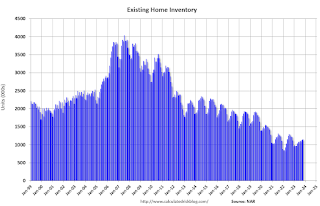 According to the NAR, inventory increased to 1.15 million in October from 1.13 million the previous month.
 According to the NAR, inventory increased to 1.15 million in October from 1.13 million the previous month.
Headline inventory is not seasonally adjusted, and inventory usually decreases to the seasonal lows in December and January, and peaks in mid-to-late summer.
The last graph shows the year-over-year (YoY) change in reported existing home inventory and months-of-supply. Since inventory is not seasonally adjusted, it really helps to look at the YoY change. Note: Months-of-supply is based on the seasonally adjusted sales and not seasonally adjusted inventory.
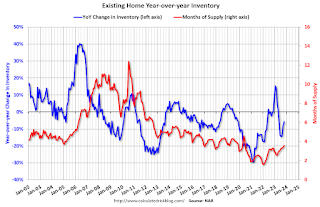 Inventory was down 5.7% year-over-year (blue) in October compared to October 2022.
Months of supply (red) increased to 3.6 months in October from 3.4 months the previous month.
This was below the consensus forecast. I'll have more later.
The last graph shows the year-over-year (YoY) change in reported existing home inventory and months-of-supply. Since inventory is not seasonally adjusted, it really helps to look at the YoY change. Note: Months-of-supply is based on the seasonally adjusted sales and not seasonally adjusted inventory.
 Inventory was down 5.7% year-over-year (blue) in October compared to October 2022.
 Months of supply (red) increased to 3.6 months in October from 3.4 months the previous month.
This was below the consensus forecast. I'll have more later.
Monday, November 20, 2023
Tuesday: Existing Home Sales, FOMC Minutes
by Calculated Risk on 11/20/2023 07:08:00 PM
 From Matthew Graham at Mortgage News Daily: Boring Day For Mortgage Rates, But That's a Good Thing
Mortgage rates moved down to the lowest levels in roughly 2 months last week. ... "Low" is relative, of course. Before September, today's rates would have been depressingly high, but they represent significant progress from October's multi-decade highs of over 8% for conventional 30yr fixed rates. For the same scenario, today's rates are down 5/8ths of a percent from those peaks. [30 year fixed 7.38%]Tuesday:
emphasis added
• At 8:30 AM ET, Chicago Fed National Activity Index for October. This is a composite index of other data.
• At 10:00 AM, Existing Home Sales for October from the National Association of Realtors (NAR). The consensus is for 3.93 million SAAR, down from 3.96 million in September.
• At 2:00 PM, FOMC Minutes, Meeting of October 31-November 1
MBA Survey: "Share of Mortgage Loans in Forbearance Decreases to 0.29% in October"
by Calculated Risk on 11/20/2023 04:37:00 PM
From the MBA: Share of Mortgage Loans in Forbearance Decreases to 0.29% in October
The Mortgage Bankers Association’s (MBA) monthly Loan Monitoring Survey revealed that the total number of loans now in forbearance decreased by 2 basis points from 0.31% of servicers’ portfolio volume in the prior month to 0.29% as of October 31, 2023. According to MBA’s estimate, 145,000 homeowners are in forbearance plans. Mortgage servicers have provided forbearance to approximately 8 million borrowers since March 2020.
In October 2023, the share of Fannie Mae and Freddie Mac loans in forbearance remained flat at 0.18%. Ginnie Mae loans in forbearance decreased 5 basis points to 0.52%, and the forbearance share for portfolio loans and private-label securities (PLS) decreased 3 basis points to 0.32%.
“For the first time since MBA began tracking the reasons for forbearance in October 2022, temporary hardships such as job loss, death, and divorce represent a larger share of loans in forbearance by reason than a COVID-19 hardship,” said Marina Walsh, CMB, MBA’s Vice President of Industry Analysis. “This upward trend will continue, as Fannie Mae and Freddie Mac sunset the use of COVID-19 as a reason for delinquency starting in November 2023,[1] and FHA’s COVID-19 forbearance period ends at the end of November 2023[2].”
Added Walsh, “Forbearance is still an option for many distressed homeowners, but in most cases, the requirements to obtain a forbearance will not be as streamlined as they were during the pandemic.”
emphasis added
 Click on graph for larger image.
This graph shows the reasons for forbearance: COVID-19, Naturnal Disaster, other Temporary Hardship.
From the MBA:
• By reason, 45.4% of borrowers are in forbearance for reasons such as a temporary hardship caused by job loss, death, divorce, or disability; while 43.3% of borrowers are in forbearance because of COVID-19. Another 11.3% are in forbearance because of a natural disaster.At the end of October, there were about 145,000 homeowners in forbearance plans.



