
 RSS Feed
 by Calculated Risk on 3/17/2009 04:12:00 PM
Tuesday, March 17, 2009
Stock Market Update
Another up day with the NASDAQ up over 4%, and the S&P up 3.2%. The S&P 500 is now up 15% from the closing lows. Here are a couple of graphs:
The first graph is from Doug Short of dshort.com (financial planner): "Four Bad Bears".
Note that the Great Depression crash is based on the DOW; the three others are for the S&P 500.
The second graph shows the S&P 500 since 1990. 
The dashed line is the closing price today.
This puts the 15% rally into perspective - the S&P is still off more than 50% from the 2007 high.
Thornburg Mortgage may file bankruptcy
by Calculated Risk on 3/17/2009 03:40:00 PM
From Reuters: Thornburg Mortgage may file Chapter 11 bankruptcy
Thornburg Mortgage ... a large and troubled provider of "jumbo" mortgage loans, on Tuesday said it may file for Chapter 11 bankruptcy protection.We're all subprime now!
...
A bankruptcy filing would make Thornburg one of the largest U.S. mortgage providers to seek protection from creditors since the housing slump began ...
Thornburg has specialized in making mortgages larger than $417,000 to borrowers with good credit ...
Last March, Thornburg arranged a $1.35 billion bailout from the distressed debt investor MatlinPatterson Global Advisors LLC and other investors to stay out of bankruptcy.
According to a Tuesday regulatory filing, MatlinPatterson surrendered all of its Thornburg common stock -- 120.8 million shares -- on March 12 and 16 without any compensation. ...
DataQuick: SoCal Home Sales Up, Foreclosure Resales 56.4% of Market
by Calculated Risk on 3/17/2009 01:18:00 PM
Note: I ignore the median price data because it is skewed by the mix of homes sold. A repeat sales index like Case-Shiller is a better indicator of price changes.
From DataQuick: Southland home sales outpace last year again; median price steady
Southland home sales stayed above year-ago levels for the eighth consecutive month in February ... Market activity was dominated by bargain-hunting in affordable neighborhoods while buying and selling in more expensive established areas remained largely on hold ...Sales are up because of foreclosure resales in less expensive neighborhoods. Meanwhile, sales in "more expensive established areas" have slowed to a trickle. This build up in supply will eventually lead to more price declines in the expensive areas ...
A total of 15,231 new and resale homes sold in Los Angeles, Riverside, San Diego, Ventura, San Bernardino and Orange counties last month. That was essentially unchanged from 15,227 for January, and up 41.3 percent from 10,777 for February 2008, according to MDA DataQuick of San Diego.
...
Regionwide, foreclosure resales accounted for 56.4 percent of February’s resales activity, which was the same as the revised January figure and up from 36.2 percent in February 2008.
Credit Crisis Indicators
by Calculated Risk on 3/17/2009 10:58:00 AM
Here is a quick look at a few credit indicators:
First, the British Bankers' Association reported that the three-month dollar Libor rates were fixed at 1.30%, down from 1.31% on Monday. This has been a slight improvement over the last week. Click on table for larger image in new window.
The first graph shows the spread between 30 year Moody's Aaa and Baa rated bonds and the 30 year treasury.
There has been some increase in the spread the last few weeks, but the spread is still way below the recent peak. The spreads are still very high, even for higher rated paper, but especially for lower rated paper.
The Moody's data is from the St. Louis Fed:
Moody's tries to include bonds with remaining maturities as close as possible to 30 years. Moody's drops bonds if the remaining life falls below 20 years, if the bond is susceptible to redemption, or if the rating changes.
 There has been improvement in the A2P2 spread. This has declined to 0.84. This is far below the record (for this cycle) of 5.86 after Thanksgiving, but still above the normal spread.
This is the spread between high and low quality 30 day nonfinancial commercial paper.
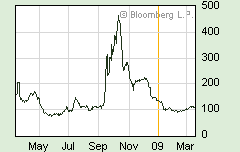 | Meanwhile the TED spread has decreased a little over the last week, and is now at 107.5. This is the difference between the interbank rate for three month loans and the three month Treasury. The peak was 463 on Oct 10th and a normal spread is around 50 bps. |
 This graph shows the at the Merrill Lynch Corporate Master Index OAS (Option adjusted spread) for the last 2 years.
This is a broad index of investment grade corporate debt:
The Merrill Lynch US Corporate Index tracks the performance of US dollar denominated investment grade corporate debt publicly issued in the US domestic market.The recent surge in this index was a cause for alarm, but the index appears to have stabilized over the last week.
All of these indicators are still too high, but at least none of them are increasing this week.
Housing Starts Rebound
by Calculated Risk on 3/17/2009 08:30:00 AM
 Click on graph for larger image in new window.
Total housing starts were at 583 thousand (SAAR) in February, well off the record low of 477 thousand in January (the lowest level since the Census Bureau began tracking housing starts in 1959).
Single-family starts were at 357 thousand in February; just above the record low in January (353 thousand).
Permits for single-family units increased in February to 373 thousand, suggesting single-family starts could increase in March.
Here is the Census Bureau report on housing Permits, Starts and Completions.
Building permits increased slightly:
Privately-owned housing units authorized by building permits in February were at a seasonally adjusted annual rate of 547,000. This is 3.0 percent (±3.5%)* above the revised January rate of 531,000, but is 44.2 percent (±1.2%) below the revised February 2008 estimate of 981,000.On housing starts:
Single-family authorizations in February were at a rate of 373,000; this is 11.0 percent (±2.1%) above the January figure of 336,000.
Privately-owned housing starts in February were at a seasonally adjusted annual rate of 583,000. This is 22.2 percent (±13.8%) above the revised January estimate of 477,000, but is 47.3 percent (±5.3%) below the revised February2008 rate of 1,107,000.And on completions:
Single-family housing starts in February were at a rate of 357,000; this is 1.1 percent (±11.0%)* above the January figure of 353,000.
Privately-owned housing completions in February were at a seasonally adjusted annual rate of 785,000. This is 2.3 percent (±14.8%)* above the revised January estimate of 767,000, but is 37.3 percent (±7.7%) below the revised February 2008 rate of 1,251,000.Note that single-family completions are still significantly higher than single-family starts. This is important because residential construction employment tends to follow completions, and completions will probably decline further.
Single-family housing completions in February were at a rate of 505,000; this is 8.2 percent (±11.8%)* below the January figure of 550,000.
One month does not make a trend - and the graph shows this is just a slight increase in total starts (and single family starts are basically flat with the record low). However I do expect housing starts to bottom sometime in 2009.



