
 RSS Feed
 by Calculated Risk on 11/29/2007 05:35:00 PM
Thursday, November 29, 2007
Florida REO: Priced Below 2002 New Home Price
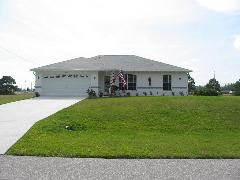 The asking price for this foreclosed property in Florida is below the price the home sold for new in 2002. (hat tip John)
Here are the details:
Feb 15, 2002: $122,300 (New)
Mar 15, 2006: $259,600
Oct 23, 2007: Foreclosed.
Current Asking Price: $99,900
There are probably some special circumstances with this house, but ... yikes! According to the public tax records, the larger house on the 2nd lot away sold for $185,300 new in 2004, and for $370,000 in 2006.
This raises some interesting questions: How far have prices really fallen?
How will the neighbors react when they discover their homes are worth far less than they paid in recent years?
As OFHEO noted today:
Declines in home prices will increase the frequency with which homeowners find themselves with no equity and thus may be motivated to “walk away” from the property and the mortgage.No kidding - this has to be depressing for the neighbors. Note: I rarely mention Florida, but this is worth noting.
Florida Freezes Fund Withdrawals
by Calculated Risk on 11/29/2007 04:16:00 PM
UPDATE: This Bloomberg Special Report has more info: Florida Suspends Withdrawals From Investment Pool (hat tip Andrew)
The pool had $3 billion of withdrawals today alone, putting assets at $15 billion, said Coleman Stipanovich, executive director of the State Board of Administration. The board manages the pool along with other short-term investments and the state's $137 billion pension fund.Original post from the WSJ: Florida Moves to Halt Run on Fund
``If we don't do something quickly, we're not going to have an investment pool,'' said Stipanovich at the meeting in the state capitol in Tallahassee. The fund was the largest of its kind, managing $27 billion before this month's withdrawals.
Local governments including Orange County and Pompano Beach that use the pool like a money-market fund asked for their money back after the State Board of Administration disclosed in a report earlier this month that holdings in the fund were lowered to below investment grade.
...
The pool has invested $2 billion in structured investment vehicles and other subprime-tainted debt, state records show. About 20 percent of the pool is in asset-backed commercial paper, Stipanovich said at the meeting today.
``There is no liquidity out there, there are no bids'' for those securities, he said.
Florida halted withdrawals from a $15 billion local-government fund Thursday after concerns over losses ... prompted investors to pull roughly $10 billion out of the fund in recent weeks.
The State Board of Administration met Thursday and voted to immediately freeze withdrawals ...
The decision shows how far this year's ... credit crisis has spread. Florida's Local Government Investment Pool, which had more than $27 billion in assets at the end of September, is a money-market fund that's supposed to invest in ultrasafe assets to provide participants with a secure place to stash spare cash. But even these types of funds have been hit by the widening crunch.
House Prices and Foreclosures
by Calculated Risk on 11/29/2007 02:34:00 PM
OFHEO provides a discussion of foreclosures and house prices in the Q3 House Price Index report.
The causal relationship between home prices and foreclosures is two-directional: high foreclosure activity can both cause and be caused by home price declines. Home price declines can cause foreclosures by decreasing the equity homeowners have in their properties. Mortgagors are much more likely to default on their loans if the current value of their property falls below the outstanding loan balance (i.e., their equity is zero or less). Declines in home prices will increase the frequency with which homeowners find themselves with no equity and thus may be motivated to “walk away” from the property and the mortgage.Historically foreclosure activity peaks when prices bottom. The following graph shows this relationship for California.
Home foreclosures contribute to weakening prices by introducing additional supply to the inventory of unsold homes. Compounding this influence is the fact that the sellers of foreclosed homes, frequently creditors, may be strongly averse to holding onto the property for an extended period of time. As a result, they may be willing to sell for lower prices than resident homeowners.
 Click on graph for larger image.
In the '90s, as prices fell in California, foreclosure activity (using Notice of Defaults NODs) increased. Prices bottomed in 1996, as foreclosure activity peaked.
Now imagine what will happen over the next few years as house prices fall. Foreclosure activity is already at record levels (2007 estimated on graph). Yet, as prices fall, foreclosure activity will probably continue to increase - the activity will be literally off the chart!
Back to OFHEO:
The upshot of the interrelatedness of foreclosures and house price changes is that the empirical evidence should reveal sharp differences in measured appreciation for states and cities with higher foreclosure rates. ...

Figure 1 plots recent appreciation rates and foreclosure filings by state since the third quarter of 2006. The bars reflect the relative intensity of foreclosure activity for states, where intensity is defined as the ratio of statewide foreclosure filings to the number of households. The blue squares show house price appreciation between the third quarters of 2006 and 2007. OFHEO’s “purchase-only” price index, which is constructed exclusively with sales price data, is used to estimate price changes.OFEHO's conclusion on house prices and foreclosure:
The graph clearly depicts the negative correlation over the latest year. With few exceptions, states with the lowest appreciation (i.e., greatest depreciation) tended to have the most foreclosure filings. For instance, Nevada had by far the greatest relative foreclosure activity and, at the same time, showed the third largest price decline. By contrast, states with relatively few foreclosure filings, including the Dakotas and Vermont, had relatively strong price growth of between 5 and 6 percent.
In conclusion, it should be recognized that house prices are very hard to track in housing market downturns. Empirical evidence has consistently shown that homeowners are hesitant to sell their homes for losses, often leaving their homes on the market for long periods awaiting the “right” price. Price declines may appear muted, as inventories of for-sale properties grow sharply and the properties that do sell may not fully reflect price declines that have occurred. In this environment, if the inventory of unsold properties is relatively large in high-foreclosure areas, then it may take some time for the association between foreclosures and price trends to reveal itself within cities. The best empirical estimates will only become available after the market normalizes and excess inventory has been sold.Translation: There are large price declines coming.
MGIC Tightens Alt-A
by Anonymous on 11/29/2007 12:45:00 PM
AP, via our Clyde:
MILWAUKEE (AP) -- The nation's leading mortgage insurer, MGIC Investment Corp., says it will raise prices and limit its coverage of loans made without proof of income to try to rein in growing losses. . . .You know, I actually believe that MGIC always thought stated income for wage earners was silly.
One of the bigger changes proposed announced Wednesday will limit the insurance MGIC offers people who have Alt-A loans, which generally require only limited verification of income.
MGIC will insure these loans only for people who are self-employed, the original market for them, Culver said. They have been used more recently by people who wanted to borrow more than they could really afford, resulting in losses for MGIC and other mortgage insurers, he said.
"We always thought it was silly, a wage earner who could show you a paycheck would pay a higher interest rate not to show you their paycheck," he said.
The company will raise prices on Alt-A loans, other loans worth 95 percent of a home's value and certain loans for people with low credit scores or small down payments. More specifics will be announced next week, Culver said.
What is missing here is the explanation for why they went ahead and insured something this "silly."
ETrade Sells Portfolio for 27 cents on the Dollar
by Calculated Risk on 11/29/2007 12:43:00 PM
From MarketWatch: CEO leaves as E-Trade gets $2.55 billion from Citadel
The subprime crisis claimed a new scalp Thursday, as E-Trade's CEO Mitch Caplan said he was stepping down as part of a deal that has private equity firm Citadel injecting $2.55 billion into the troubled firm.That is about 27 cents on the dollar for the ABS portfolio.
Under the deal, Citadel will end up with about a 20% stake in E-Trade after acquiring its $3 billion asset backed securities portfolio for $800 million and making other investments.



