
 RSS Feed
 by Calculated Risk on 2/13/2007 03:00:00 PM
Tuesday, February 13, 2007
Home Mortgages and the Trade Deficit
"Interestingly, the change in U.S. home mortgage debt over the past half-century correlates significantly with our current account deficit. To be sure, correlation is not causation, and there have been many influences on both mortgage debt and the current account."The Census Bureau reported "today that total December exports of $125.5 billion and imports of $186.7 billion resulted in a goods and services deficit of $61.2 billion."
Alan Greenspan, Feb, 2005
 Click on graph for larger image.
The red line is the trade deficit excluding petroleum products. (Blue is the total deficit, and black is the petroleum deficit).
Looking at the trade balance, excluding petroleum products, the deficit has been fairly stable since the second half of 2005.
Brad Setser reviews the 2006 trade data and points out several key stories:
The first is that US exports grew quite strongly in 2006. ... The second is that the pace of non-oil import growth slowed. ... The third is that higher oil prices do lead even the US to cut back on its use of oil. ... The fourth big story -- one that is somewhat controversial for reasons that elude me -- is that exchange rate adjustment works.Another possible key story is the relationship between the trade deficit and mortgage debt. As Greenspan noted, "correlation is not causation", but it is possible that a slowdown in the U.S. housing market has also led to a reverse in the U.S. trade deficit. This could have significant implications going forward.
Perhaps we have seen a Virtuous Cycle as depicted in the following diagram:
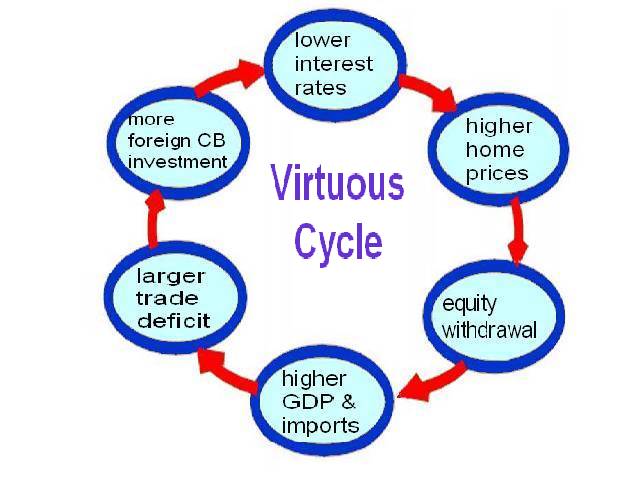 Starting from the top: There is no question that lower interest rates led to an increase in housing prices. And those higher housing prices led to an ever increasing equity withdrawal by homeowners - until very recently (See Kennedy-Greenspan MEW graph). Based on research by Greespan, it appears a large percentage of this equity withdrawal has flowed to consumption (maybe 50%), increasing both GDP and imports over the last few years. Then, to finance the current account deficit, foreign Central Banks (CBs) have been investing heavily in dollar denominated securities. Some analysts have suggested that these investments have lowered interest rates by between 40 bps and 200 bps.
 The result: a Virtuous Cycle with higher housing prices leading to more borrowing and more consumption, leading to lower interest rates, followed by higher housing prices.
The following diagram depicts the possible unwinding of the current cycle.
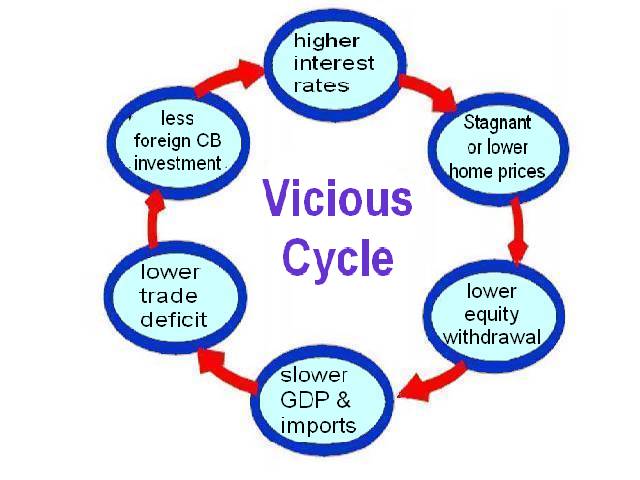
As housing cools down (prices do not need to collapse), this will lead to lower equity withdrawal. In turn this will lead to a slow down in GDP growth and lower imports.
Lower imports might lead to a lower trade deficit, depending on the strength of exports. This could lead to less foreign CB investment in dollar denominated assets. And this could lead to higher interest rates followed by lower housing prices and the cycle repeats.
This is why I'm predicting a decline in the trade deficit, and an increase in long rates.
Dr. Setser doesn't see the trade deficit decreasing in 2007.
"Here though I am a bit of a holdout. I am not convinced that it makes sense to project out current trends -- at least not the current y/y growth rates.Of course I'm looking at the trade deficit from a housing centric view, and I realize that view might be too narrow.
The monthly trends seem to me to suggest a slowdown in the pace of export growth (look at the first graph in the BEA data release). Conversely, there are some tenative signs that non-oil import growth is picking up a bit (December imports were $134b, up from $131-132b in October/ November). My personal view is that the trade deficit is more likely to stabilize at roughly its current level than to shrink."
"It happened overnight."
by Calculated Risk on 2/13/2007 11:45:00 AM
"When you throw out the words 'foreclosure,' 'short sale,' 'repo,' the buyer thinks it's a deal. It's still very early, but I'm convinced that's where the market is going."David Streitfeld writes in the LA Times on Inland Empire housing: It's their default position
Home Center President Jason Bosch
During the four-year boom that ended last summer, Home Center expanded from 15 agents to 80 in three offices. The roster of agents has since sunk to 52, only about half of whom are active.There are some amazing quotes in the article:
"The rest are looking for side jobs at McDonald's," said Home Center President Jason Bosch. "It happened overnight."
"To make a living, you had to push a product you didn't believe in," said Aimee Quigley, a Home Center mortgage broker. "It was like being a defense attorney where you know your client did it, but you have to say he didn't."
Quigley says she tried to emphasize how quickly these loans would adjust, causing payments to balloon, but the message rarely got through.
"Nine out of ten times when these loans closed, we would sit there and say, 'How long can they hold it together?'"
ResMae Files for Bankruptcy
by Calculated Risk on 2/13/2007 11:34:00 AM
From Bloomberg: ResMae Files for Bankruptcy, Will Sell Assets to Credit Suisse
ResMae Mortgage Corp., a U.S. home lender to people with bad credit, said it filed for bankruptcy protection and agreed to sell some of its assets to Switzerland's Credit Suisse Group.
...
Subprime loans in the U.S. mortgage industry fell 3.8 percent last year to $640 billion, according to Inside B&C Lending. ResMae made $7.7 billion in loans last year, up 11 percent from 2005, placing it 21st among U.S. subprime lenders, the newsletter reported.
Monday, February 12, 2007
Fremont Lending Changes
by Calculated Risk on 2/12/2007 02:30:00 PM
An email from Fremont Investment & Loan:
Sent: Monday, February 12, 2007 1:54 PM
Subject: PLEASE READ - IMPORTANT PROGRAM CHANGES at FREMONT
Importance: High
Due to general negative Industry sentiment, due to recent articles in the media, and the ripple effect to the secondary market, Fremont has made the difficult decision to speed up some changes that were set to take place later in the year. PLS READ BELOW.
2nd MORTGAGES ELIMINATED effective TODAY!!!!!
Any Prequals out there that are 80/20 or combo loans, pls contact me by email asap for new pricing, with an outside second if available from IBC or other lender, or as a 100% or straight one loan
AA CUT BACKS AND HUGE CHANGES – any files that have been priced on the AA program need to be looked at ASAP, pls email me and attach a copy of the prequal with 1003 and Credit
Note: Fremont is typically at the forefront when making changes to programs, I would urge you to expect our competitors to be making similar changes in the next few weeks. Fremont ’s goal is to be here for the long term, thankfully we are self funded with tons of capital and reserves….We will be here to close your loans.
Thank you for your patience and understanding in these tough times in the industry.
More Details will be communicated later today ... I apologize for the barrage of emails, but I wanted to make sure that everyone is aware of what is going on ...
Thank you.
Fremont Investment & Loan
The Yield Curve Matters to Banks
by Calculated Risk on 2/12/2007 12:33:00 PM
"It's very difficult to make money or make a lot of money."From the WaPo: Interest On Deposits Pressures Area Banks
Provident Bankshares chairman and chief executive Gary N. Geisel
Higher interest rates for bank depositors are stressing local and regional banks.
Caught in a squeeze, the banks generally are reporting declining profits. Some are considering cutting staff or closing branches. Others have been propping up earnings per share by buying back their own stock.
...
To compete, some banks "have been loosening up their credit standards and offering lower rates to borrowers," even lower than the prime rates they traditionally charged their best business customers, said Avi Barak, who analyzes banks in the Mid-Atlantic region for the investment firm Sandler O'Neill & Partners.
Meanwhile, there are signs that the ability of borrowers to repay existing loans has been weakening, Barak said.
In a survey of 17 regional banks by Sandler O'Neill, nonperforming assets -- foreclosed property and loans on which borrowers have failed to make payments -- increased 23.2 percent in 2006.



