
 RSS Feed
 by Calculated Risk on 3/09/2006 12:01:00 AM
Thursday, March 09, 2006
January US Trade Deficit: $68.5 Billion
UPDATE: Brad Setser's comments are interesting: Mike Mandel, Ricardo Hausmann and Federico Sturzenegger better be right (January trade data)
The U.S. Census Bureau and the U.S. Bureau of Economic Analysis reports that the U.S. trade deficit for January was $68.5 Billion. 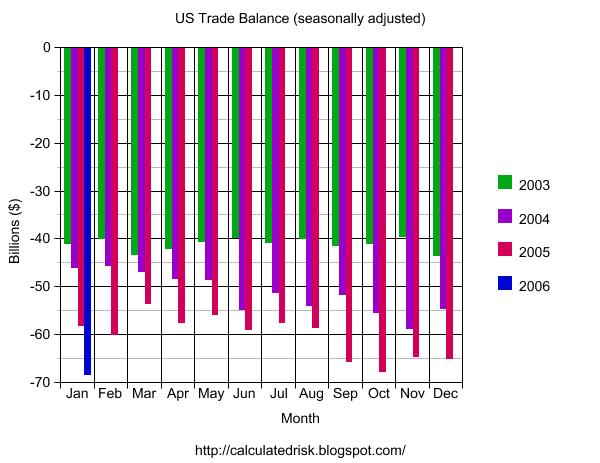
Click on graph for larger image.
The U.S. Census Bureau and the U.S. Bureau of Economic Analysis, through the Department of Commerce, announced today that total January exports of $114.4 billion and imports of $182.9 billion resulted in a goods and services deficit of $68.5 billion, $3.4 billion more than the $65.1 billion in December, revised.More to come.
January exports were $2.8 billion more than December exports of $111.6 billion. January imports were $6.2 billion more than December imports of $176.6 billion.
Wednesday, March 08, 2006
Slowing housing won't sink spending: Poole
by Calculated Risk on 3/08/2006 02:59:00 PM
From Reuters: Slowing housing won't sink spending: Poole
The U.S. housing sector may already be cooling but it should maintain its lofty level and not undermine the economic expansion, St. Louis Federal Reserve Bank President William Poole said on Wednesday.Those are the big questions: Will housing activity "stabilize" or keep falling? And what will be the impact on jobs and the US economy?
"My hunch ... is that housing activity will stabilize and remain at a high level this year," Poole told the St. Louis Regional Chamber and Growth Association over breakfast.
Poole, who is not a voting member of the FOMC this year, said rising inventories of unsold U.S. houses signaled a slowdown may already be underway.I disagree with Poole's comments. I think the substantial mortgage equity withdrawal (MEW) in recent years contributed significantly to GDP growth, and declining MEW will be a significant drag for the next few years.
Some economists have forecast a downturn in the housing sector will sap consumer spending, which has been driving U.S. growth since a shallow recession in 2001.
They argue that homeowners have extracted equity from now more valuable homes to support spending despite, weak income growth in recent years. But Poole dismissed this concern.
"The marginal contribution to the pace of consumer spending stemming from the wealth effect -- that is, from households extracting a portion of their home equity to spend on goods and services -- is not likely to be a significant concern."
"The reason is that other economy-wide developments, especially income and employment growth, typically exert a much greater influence on the consumer's pocketbook and spending habits than does the state of the housing industry,' he said.
MBA: Mortgage Application Volume Holds Steady
by Calculated Risk on 3/08/2006 10:00:00 AM
The Mortgage Bankers Association (MBA) reports that mortgage application volume was steady for the week ending March 3rd. 
Click on graph for larger image.
The Market Composite Index — a measure of mortgage loan application volume was 575.6 – an increase of 0.7 percent on a seasonally adjusted basis from 571.5 one week earlier. On an unadjusted basis, the Index increased 12.9 percent compared with the previous week, but was down 17.8 percent compared with the same week one year earlier.Mortgage rates increased:
The seasonally-adjusted Purchase Index decreased by 0.4 percent to 399.0 from 400.8 the previous week, whereas the Refinance Index increased by 2.6 percent to 1614.4 from 1573.5 one week earlier.
The average contract interest rate for 30-year fixed-rate mortgages increased to 6.31 percent from 6.18 percent ...Change in mortgage applications from one year ago (from Dow Jones):
The average contract interest rate for one-year ARMs increased to 5.69 percent from 5.64 percent ...
| Total | -17.8% |
| Purchase | -11.8% |
| Refi | -25.8% |
| Fixed-Rate | -14.6% |
| ARM | -25.0% |
Purchase activity is still fairly high though off from the peaks of 2005. Mortgage rates are increasing again, and will be increase again this week with the Ten Year note yield rising to 4.7%.
Tuesday, March 07, 2006
Krugman's Intro to Keynes's General Theory
by Calculated Risk on 3/07/2006 09:33:00 PM
Dr. DeLong excerpts Krugman's Intro to Keynes's General Theory
"... Keynes was no socialist - he came to save capitalism, not to bury it. And there’s a sense in which The General Theory was... a conservative book.... Keynes wrote during a time of mass unemployment, of waste and suffering on an incredible scale. A reasonable man might well have concluded that capitalism had failed, and that only... the nationalization of the means of production - could restore economic sanity.... Keynes argued that these failures had surprisingly narrow, technical causes... because Keynes saw the causes of mass unemployment as narrow and technical, he argued that the problem’s solution could also be narrow and technical: the system needed a new alternator, but there was no need to replace the whole car. In particular, “no obvious case is made out for a system of State Socialism which would embrace most of the economic life of the community.”... Keynes argued that much less intrusive government policies could ensure adequate effective demand, allowing the market economy to go on as before.There is much more at Dr. DeLong's blog.
Still, there is a sense in which free-market fundamentalists are right to hate Keynes. If your doctrine says that free markets, left to their own devices, produce the best of all possible worlds, and that government intervention in the economy always makes things worse, Keynes is your enemy. And he is an especially dangerous enemy because his ideas have been vindicated so thoroughly by experience.
Stripped down, the conclusions of The General Theory might be expressed as four bullet points:
1) Economies can and often do suffer from an overall lack of demand, which leads to involuntary unemployment
2) The economy’s automatic tendency to correct shortfalls in demand, if it exists at all, operates slowly and painfully
3) Government policies to increase demand, by contrast, can reduce unemployment quickly
4) Sometimes increasing the money supply won’t be enough to persuade the private sector to spend more, and government spending must step into the breach
To a modern practitioner of economic policy, none of this - except, possibly, the last point - sounds startling or even especially controversial. But these ideas weren’t just radical when Keynes proposed them; they were very nearly unthinkable. And the great achievement of The General Theory was precisely to make them thinkable....
I've read Keynes' General Theory of Employment, Interest and Money twice. It is a tough read, but well worth the effort.
Monday, March 06, 2006
Financial Times: A chart for Japanese monetary policy
by Calculated Risk on 3/06/2006 07:54:00 PM
The Financial Times is free this week.
From A chart for Japanese monetary policy By Takatoshi Ito
Toshihiko Fukui, governor of the Bank of Japan, has been sending a signal through speeches and testimony ... that the time is ripe for ending quantitative easing (QE).
...
The BoJ considers that the self-imposed conditions for an exit from QE – positive inflation, reflected in the consumer price index ... as an actual rate ... and as a forecast – have been satisfied.
It is widely expected that the BoJ will abolish QE in April, if not as early as this week. The drive for an early termination seems to have received strong encouragement after the government’s announcement on March 3 that the inflation rate for January 2006 (compared with January 2005) was 0.5 per cent.
Last autumn, when Mr Fukui and other BoJ policy board members hinted at the exit from QE, the government sent a strong signal not to do it hastily. But in the past few weeks, Heizo Takenaka, the interior minister, Hidenao Nakagawa, chairman of the LDP policy research council, and Junichiro Koizumi, the prime minister, have all changed their tone, suggesting they may not oppose the abolition of QE.
Although terminating QE in the near term seems to have become a foregone conclusion, it is not clear why the BoJ is in such a hurry, given that the level of inflation – 0.5 per cent – is still very low. The core inflation rate, excluding energy prices as well as food, is a still more modest 0.1 per cent.
Deflation risks remain, if energy prices stop rising or if the US economy slows down later this year. ... As the end of QE nears, a future path and guidelines for monetary policy are needed.
...
Inflation targeting is a popular framework for answering these questions. It is now practised by a majority of central banks among advanced countries.
...
Adopting inflation targeting will ensure independence, which will be essential when the BoJ contemplates raising the interest rate in cases where the government opposes the move. As the policy interest rate starts to become positive, medium-term and long-term interest rates will rise.
...
As Mr Fukui leads the termination of QE, he should set out the direction of future monetary policy definitively, with a numerical range. By defining the BoJ’s commitment and accountability, the path forward will be cleared.



