
 RSS Feed
 by Calculated Risk on 2/14/2006 01:20:00 PM
Tuesday, February 14, 2006
Retail Sales Strong
Bloomberg reports: Retail Sales May Spur Faster Expansion
Retailers rang up their biggest sales gains since May 2004 last month, more than doubling forecasts and helping the U.S. economy snap back from its worst quarter in three years.I'm not really surprised. The weather has been nice and mortgage activity is still robust. With the recent increases in the Ten Year yield, I expect mortgage rates to increase this week. It will be interesting to see if higher rates slow mortgage activity (the MBA report is due tomorrow).
The 2.3 percent rise came as the warmest January in more than a century encouraged Americans to buy more cars and redeem holiday gift cards. The gain followed a 0.4 percent increase in December, the Commerce Department said today in Washington. Excluding autos, sales rose 2.2 percent, the most in six years.
The fifth straight increase in sales reflects the higher wages U.S. workers are enjoying as the economy adds more jobs and unemployment declines. Treasury notes fell on speculation the economic rebound will give Federal Reserve Chairman Ben Bernanke more reason to raise interest rates next month.
"We're definitely going to see a very strong first quarter," said Brian Bethune, an economist at Global Insight Inc., a forecasting firm in Lexington, Massachusetts. "It looked like consumers were hibernating in December, and all they needed was an excuse to go on a spending spree. The weather provided that."
Economists expected sales to rise 0.9 percent, after an originally reported 0.7 percent gain in December, according to the median of 71 forecasts in a Bloomberg News survey. The rise exceeded the highest estimate of 1.5 percent.
"There's no question it's exaggerated by the record mild temperatures in January," said Jim O'Sullivan, a senior economist at UBS Securities LLC in Stamford, Connecticut. "We expect some payback" for February, he said.
And it looks like rates are even going higher. Based on the FED funds futures, the market is now expecting at least two more rate hikes (See Macroblog: Betting On Ben, Market Version)
For more on retail, see Kash's Consumption: Full Steam Ahead
Monday, February 13, 2006
Good Luck Sasha!
by Calculated Risk on 2/13/2006 08:40:00 PM

Sasha practices in Torino. / Photo by Kevork Djansezian
Schedule:
Tuesday, Feb. 21, Ladies short program, 7 p.m. (Italy time), (2 p.m. ET)
Thursday, February 23, Ladies free skate, 7 p.m. (Italy time) (2 p.m. ET)
Photo from the current People Magazine: Ready to Ice the Competition
Credit: Patrik Giardino
Please pardon this off topic post (see Nationals). Hopefully this will be the first of a few off topic posts during the Olympics as I cheer for Sasha.
Good luck Sasha! Have fun!

KB Home: "May Moderate Revenue Guidance"
by Calculated Risk on 2/13/2006 02:18:00 PM
In last Friday's 10-K filing with the SEC, KB Home (KBH) summarized their outlook:
There are signs ... that consumer demand in the United States for residential housing at current prices is softening. For example, the U.S. Census Bureau reported that single-family housing starts in December 2005 were approximately 12% lower than in November 2005 and approximately 8% lower than in December 2004. The Bureau also reported that the median sales price for new homes fell approximately 3% in December 2005 relative to the median sales price in December 2004.Emphasis added.
Our results to date in fiscal year 2006 reflect these broader market trends. In the first two months of the year, we have experienced an increase in home order cancellations and a decline in net orders for new homes when compared to the same period last year.
It is too early in our prime selling season (February through June) to forecast whether our experience in the first two months of the year will continue. Historically, demand for new homes in the United States has been strong during periods of economic expansion and growth in employment, and we continue to believe that the state of the U.S. economy is the single most important long-term indicator of our future financial performance.
If the current trends do not improve, we may be required to moderate our revenue guidance for fiscal year 2006. At the same time, we do not anticipate changing our diluted earnings per share guidance for fiscal year 2006.
Sunday, February 12, 2006
Housing Slowdown Threatens Inland Empire's Economy
by Calculated Risk on 2/12/2006 03:15:00 PM
UPDATE: Please see my Angry Bear post: Krugman: Debt and Denial
The Press Enterprise reports: A drop in real estate prices could have far-reaching effects, economists warn.
Inland Southern California's surging real estate prices have done more than create hefty equities for hundreds of thousands of homeowners.
They've also kept thousands of people working.
But if prices start to drop in Riverside and San Bernardino counties, and homes stay on the market for five months instead of five days, it hurts more than just sellers. It also leads to less work for the people who build new homes and to those who help sell, finance and insure them.
If those jobs slow, economists question which, if any, industries of the region's economy have enough strength to pick up the slack.
Several economists who watch the two counties did not hesitate when asked to name a potential landmine for the economy in 2006.
"Real estate is a big concern, and we're going to have to watch it carefully," said Chapman University economist Esmael Adibi.
...
"The markets are starting to cool, and everyone says we may be sliding down the backside of a hill," said UCLA economist Christopher Thornberg.
He said there's a "substantial risk" in the second half of the year when he expects home prices to drop. He was one of the first economists to suggest that a slowdown in the market could bring on conditions seen in a recession.
The Inland area relied heavily on housing-related jobs in 2005.
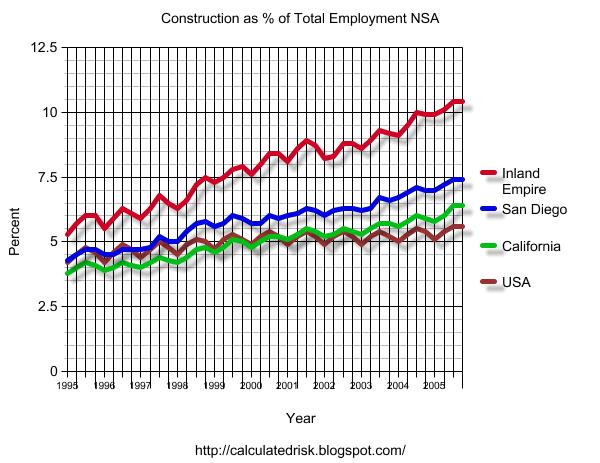
Click on graph for larger image.
This graph is from my Angry Bear post last November: Construction Employment in the Inland Empire
As the housing market slows areas like California's Inland Empire that have been heavily dependent on Real Estate related employment will suffer the most.
Friday, February 10, 2006
More on Yield Curve
by Calculated Risk on 2/10/2006 02:50:00 PM
Here is a graph comparing the the yield curve for one year ago (Feb, 2005), six months ago (Aug, 2005), and yesterday. The data is from the US Treasury. (thanks to Doctorwho for link).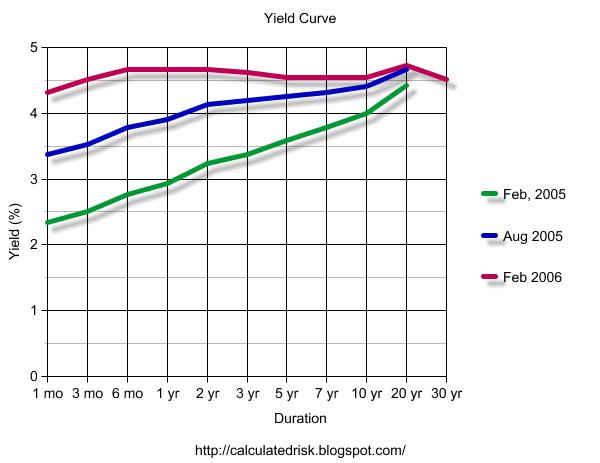
Click on graph for larger image.
The yield curve has definitely flattened out with a small inversion in the 6 months to 3 year time frame.
For some perspective, and a long term graph, see Dr. Kash's Interest Rate Update. To add to Kash's graph, the current spread between the 10 year yield and 6 month yield is -0.12.
For more long term graphs, see Dr. Hamilton's Inverted yield curve edges closer also from last November.



