
 RSS Feed
 by Calculated Risk on 1/09/2006 02:06:00 AM
Monday, January 09, 2006
The End of Defined Benefit Plans
First, my post on Angry Bear, Stiglitz and Bilmes: The Real Cost of Iraq War
The NY Times reports: More Companies Ending Promises for Retirement
The death knell for the traditional company pension has been tolling for some time now. Companies in ailing industries like steel, airlines and auto parts have thrown themselves into bankruptcy and turned over their ruined pension plans to the federal government.This will put the burden on the employee and from my experience, the employees that will probably need the benefits the most, will contribute the least (as a percentage of income), and invest poorly.
Now, with the recent announcements of pension freezes by some of the cream of corporate America - Verizon, Lockheed Martin, Motorola and, just last week, I.B.M. - the bell is tolling even louder. Even strong, stable companies with the means to operate a pension plan are facing longer worker lifespans, looming regulatory and accounting changes and, most important, heightened global competition. Some are deciding they either cannot, or will not, keep making the decades-long promises that a pension plan involves.
...the pension freeze is the latest sign that today's workers are, to a much greater extent, on their own. Companies now emphasize 401(k) plans, which leave workers responsible for ensuring that they have adequate funds for retirement and expose them to the vagaries of the financial markets.
When I was a trustee for a 401(k) plan, I saw the following behavior repeated many times: Less sophisticated investors would tend to be overly conservative putting most of their money in money market funds. Then they would occasionally invest in whatever went up in the most recent quarters. If they had a losing quarter, they would scurry back to the money market fund. Their overall results were poor.
This will leave Social Security Insurance as the only defined benefit portion of an individual's retirement income - an insurance policy for life's vagaries.
Friday, January 06, 2006
What will the Fed do?
by Calculated Risk on 1/06/2006 08:19:00 PM
Here is another Fed Watch from Dr. Duy: A Little Something for Everyone. Duy mostly looks at the employment report, but he also writes:
Wall Street's stamp of approval implies a wide expectation of "one and done" for this tightening cycle. That's not quite my interpretation, although I can't blame traders for looking for good news after a dreary December. Instead, I left the minutes with the sense that another rate hike at the end of the month is in the bag, but beyond that, future changes in policy are not automatic but instead data dependent. That is decidedly not the same thing as "done."Barring some drastic change in the data, I think two more rate hikes are "in the bag" and we will see 4.75% at the March meeting.
As a note: Dr. Duy's Fed Watch is a regular column on Economist's View. For weekly updates on market expectations for the Fed Funds rate, see Dr. Altig's Macroblog.
The reason I think the Fed will raise rates at least two more times is because: 1)the data will probably be inconclusive and 2) Dr. Bernanke has been heavily criticized (I think unfairly) for being an inflation dove based on this speech: Deflation: Making Sure "It" Doesn't Happen Here and, therefore, if the Fed pauses at Bernanke's first meeting in March that would inflame the criticism. So I believe Bernanke will lean towards one more hike to prove his inflation fighting credentials.

Click on graph for larger image.
Using the Cleveland Fed Median CPI, this graph shows the real Fed Funds rate by quarter for the last five years - the period of emergency interest rates.
I think the Fed would like to see inflation below 2% - median CPI was 2.6% annualized last month and 2.4% over the last 12 months. To achieve their goal, the Fed will probably have to raise the real Fed rate to 2% to 2.5% and that puts the nominal Fed Funds rate at 4.75% or even 5%.
After the January hike, the key data will be the various measures of inflation. If inflation is subsiding, then the Fed might stop. If its close, I expect another hike in March.
When will the Fed cut rates?
I've written several times that I expect a rate cut later this year. The reason I expect a cut is because of the impact of a housing slowdown. If there is no housing slowdown, as predicted by Wells Fargo, then I doubt we will see a rate cut in 2006. If there is a slowdown, I expect two things: 1) Mortgage equity withdrawal to decrease significantly and impact consumer spending (like what happened in England) and 2) housing related employment to fall.
The Fed doesn't like to change directions too quickly. Looking at the Fed's recent history:
Rates peaked at 6.5% on May 16, 2000 and the first rate cut was almost 9 months later, in January 2001.And speaking of England, the Bank of England repo rate peaked in August 2004 at 4.75% and the BOE cut the rate to 4.5% one year later.
Rates peaked at 6% on Feb 1, 1995 and the first cut was 5 months later in July.
So, if housing slows down, I expect a rate cut in late 2006.
Wells Fargo forecasts 6.5% 2006 SoCal House Appreciation
by Calculated Risk on 1/06/2006 04:43:00 PM
Wells Fargo is forecasting 6.5% house price appreciation in Southern California for 2006 compared to their estimate of 14.3% in 2005.
An internal forecast from a Wells Fargo Senior Economist:
| Wells Fargo Forecast | 2005(est) | 2006(f) |
| Median Existing Home Price | $489K | $521K |
| Percent Change in Prices | 14.3% | 6.5% |
| Housing Starts | 101.3K | 103.4K |
| Single Family Starts | 72.4K | 74.3K |
| Multifamily Starts | 28.8K | 29.K |
Christopher Thornberg, senior economist with the UCLA Forecast, expects housing construction to drop by 25 percent next year, resulting in significant job loss for the construction industry.Two very different views.
Employment Report
by Calculated Risk on 1/06/2006 02:37:00 PM
The BLS reported:
"Total nonfarm payroll employment increased by 108,000 in December, and the unemployment rate was little changed at 4.9 percent"Kash calls the report "disappointing" and pgl looks at the labor force participation rate and the employment-population ratio.
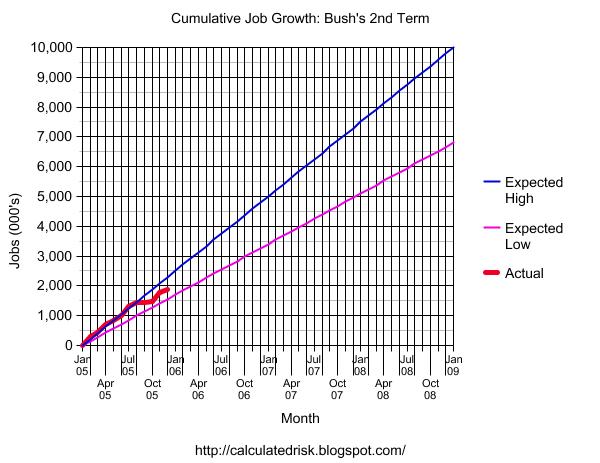
Click on graph for larger image.
Although the December report might be disappointing, the number of jobs created in 2005 seems solid.
A major concern going forward is the impact of a housing slowdown. Housing was once again a key driver for employment gains in 2005; construction alone added almost 250K jobs. Since construction usually accounts for around 5% of total employment, I would have expected around 100K construction jobs given the total employment growth.
The good news is the economy has been adding jobs at around the expected rate. The bad news is the economy is probably still too "housing centric".
Thursday, January 05, 2006
Mortgage Spread
by Calculated Risk on 1/05/2006 04:59:00 PM
The spread between the yields of a 30 year fixed mortgage (as reported by the MBA) and the Ten Year Treasury note has widened steadily over the past year.
Click on graph for larger image.
If the current spread was 145 bps, as in early 2005, the rate on a 30 year mortgage would be about 5.7% today.
Instead, the rate on a 30 year fixed mortgage is 6.15%.
That is a substantial increase in the spread and I'm guessing it indicates investors have become increasingly wary of mortgage backed securities.



