
 RSS Feed
 by Calculated Risk on 12/28/2005 10:49:00 AM
Wednesday, December 28, 2005
MBA: Mortgage Activity Declines
The Mortgage Bankers Association (MBA) reports: Mortgage Application Activity Slows Preceding Holiday Weekend
The Market Composite Index - a measure of mortgage loan application volume was 554.1 -- a decrease of 6.8 percent on a seasonally adjusted basis from 594.6 one week earlier. A holiday adjustment was included in the seasonally adjusted numbers to help account for the reduced application activity prior to the holiday weekend. On an unadjusted basis, the Index decreased 17.0 percent compared with the previous week and was up 3.1 percent compared with the same week one year earlier.Rates were steady:
The seasonally-adjusted Purchase Index decreased by 4.5 percent to 432.9 from 453.1 the previous week whereas the Refinance Index decreased by 11.2 percent to 1259.1 from 1418.1 one week earlier.
The average contract interest rate for 30-year fixed-rate mortgages decreased to 6.21 percent from 6.22 percent on week earlier ...Activity is falling, but still reasonably strong. These reports will be more informative after the holidays.
The average contract interest rate for one-year ARMs decreased to 5.36 percent from 5.41 percent one week earlier...
Tuesday, December 27, 2005
Looking Back: 2005 Top Economic Stories
by Calculated Risk on 12/27/2005 01:09:00 AM
Looking back, I think these were the Top Five economic stories of 2005:
5) Social Security
Social Security is the story of what didn't happen.
Drs. Mark Thoma, Brad DeLong, Paul Krugman, Andrew Samwick and my friends at Angry Bear all contributed to my understanding of this issue.
4) Interest Rates
The Federal Reserve raised the Fed Funds Rate eight times in 2005; steadily increasing the rate at a measured pace (25 bps) after each Federal Reserve meeting. The Fed Funds rate started the year at 2.25% and finished at 4.25%.
The eight increases might be a big story in and of itself, except the even bigger story was Greenspan's "conundrum" with long rates. The Ten Year Treasury Note started the year yielding 4.22% and closed last week yielding 4.38%.
Amazing.
Looking ahead: It appears the yield curve will officially invert after the next Fed Meeting (Jan 31, 2006 - Greenspan's last meeting).
For more on the Fed, I suggest reading Dr. Tim Duy and Dr. William Polley.
3) Energy Prices
Another huge story was energy prices. Even though prices have dropped recently, oil and gasoline prices are substantially higher than last year. According to the DOE, at the end of 2004, the weighted average price was $32.07 per barrel (all grades) and $51.58 last week. That is a 61% increase in the price of crude oil.
For Energy issues, see Dr. James Hamilton.
2) Trade Deficit
The trade deficit continued to increase in 2005. For the Jan through Oct period, the US trade deficit was $598 Billion, up from $504 Billion for the comparable period in 2005. The US is heading for a $720+ Billion trade deficit for 2005, or close to 6% of GDP.
For more, see Dr. Brad Setser and Dr. Menzie Chinn.
And the biggest story of the year ...
1) The Housing Bubble
I've written extensively about housing on this blog and at Angry Bear. For daily updates, I've linked to several sites on the right under "Housing Sites".
I'll write a "looking forward" to 2006 post later this week. Note: Iraq and Katrina were also huge stories in 2005 from an economic perspective, as were hurricanes in general and global warming. Iraq is a huge story from many perspectives, but I am trying to stick to macroeconomics.
Best to all. Happy New Year!
Friday, December 23, 2005
November New Home Sales: 1.245 Million Annual Rate
by Calculated Risk on 12/23/2005 10:11:00 AM
According to the Census Bureau report, New Home Sales in November were at a seasonally adjusted annual rate of 1.245 million vs. market expectations of 1.30 million. October's record sales were revised down slightly to 1.404 million from 1.424 million.
Click on Graph for larger image.
NOTE: The graph starts at 700 thousand units per month to better show monthly variation.
The Not Seasonally Adjusted monthly rate was 85,000 New Homes sold, down from a revised 110,000 in October.
On a year over year basis, November 2005 sales were 1% higher than November 2004.
The median and average sales prices are trending down.
The median sales price of new houses sold in November 2005 was $225,200; the average sales price was $283,300.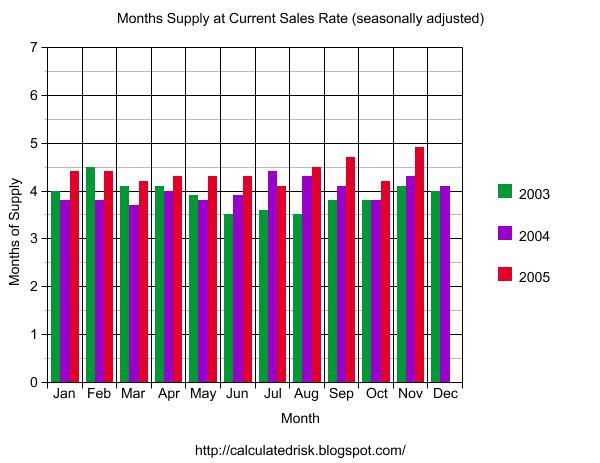
The seasonally adjusted estimate of new houses for sale at the end of November was 503,000. This represents a supply of 4.9 months at the current sales rate.
The 503,000 units of inventory is the all time record for new houses for sale. On a months of supply basis, inventory is above the level of recent years.
This report is still reasonably strong.
Thursday, December 22, 2005
West Coast Ports: November Imports Mixed, Exports Up
by Calculated Risk on 12/22/2005 03:01:00 PM
The Ports of Long Beach and Los Angeles reported mixed import traffic for October.
Import traffic at the Port of Long Beach increased 2.0% compared to October. A total of 305 thousand loaded cargo containers came into the Port of Long Beach, compared to 299 thousand in October. The record is 313 thousand set in August 2005.
The Port of Los Angeles import traffic decreased 11% in November. Imports were 325.1 thousand containers, off from the record set in October for the Port of Los Angeles of 368.5 thousand containers.
For Long Beach, outbound traffic was up 3.6% to 107 thousand containers. At Los Angeles, outbound traffic was flat at 98 thousand containers.
The quantity of containers says nothing about the content value, but provides a rough guide on imports from China and the rest of Asia. Given these numbers, I expect imports from Asia to be about the same in November as in October.
Wednesday, December 21, 2005
Martin Wolf Podcast: The surprises of the past year
by Calculated Risk on 12/21/2005 09:05:00 PM
From the Financial Times, Martin Wolf discusses the world economy:
Wolf's discussion starts a little slow, reciting a number of growth statistics, however the second half of the podcast regarding global imbalances is interesting.



