
 RSS Feed
 by Calculated Risk on 11/21/2005 01:12:00 AM
Monday, November 21, 2005
WSJ on Housing: What's Behind the Boom
From the WSJ: What's Behind the Boom James Haggerty of the WSJ looks at the future for the housing market:
Almost everyone agrees that prices can't keep rising this fast much longer. The debate now is whether the boom will lead to a soft landing, with gentler price increases, or to a long, painful bust, in which prices fall considerably in some places before buyers regain confidence.If you are looking for an answer to the hard or soft landing question, Mr. Haggerty doesn't provide it. But he does provide an overview of ten factors impacting housing - from limited space in certain areas to risky loans to homeowners using their homes as a "piggy bank".
However the current boom ends, longer-term forces are reshaping the housing industry. Here is a look at some of them.
Haggerty does offer this chart to show that housing might not be overvalued (at the median):

If that 2nd chart is supposed to be comforting, I'm not sure why. Not only is "affordability" dropping rapidly, but the index is at levels not seen since the last housing bust in the early '90s!
Sunday, November 20, 2005
Real Estate Employment
by Calculated Risk on 11/20/2005 09:32:00 PM
My weekly post on Angry Bear: Construction Employment in the Inland Empire
Added from Dr. Thoma - A funny photo: The Consumption Boom
And in a related story from Reuters: Californians gamble on career in real estate
Real estate bubble or not, more and more Californians are betting on a future in selling homes.
Realtor hopefuls are arriving every day -- a troubling trend for veterans, say economists who note that there soon will not be enough homes for sale to support all the newcomers.
Nearly 2 percent of adults in California hold a license to sell residential property in the state, where $30,000 commissions on million-dollar homes have become commonplace.
...
"Some of these agents will be flushed out" of the industry, said economist Stuart Gabriel, director of the Lusk Center for Real Estate at the University of Southern California.
"It's difficult to imagine that there will be an adequate volume of home sales" that would sustain the new arrivals, he said.
Since the beginning of 2004, statewide sales activity among existing single-family homes has risen 2 percent, according to the California Association of Realtors. But during the same period, the population of agents grew 26 percent.
...
"There's a precarious situation out there right now," he said, citing frustration among novices who find themselves regularly outfoxed by more seasoned realtors.
Rohrbach added that if sales slow even moderately, "it's going to be more and more difficult for them to be earning a living wage."
Saturday, November 19, 2005
Housing and Employment
by Calculated Risk on 11/19/2005 08:34:00 PM
Four articles on Housing and Employment.
From the NY Times: As the McMansions Go, So Goes Job Growth
THERE'S a growing consensus that the housing market is cooling off. ... ... in recent years, housing, real estate and the related industries have become a huge factor in another crucial economic area: employment growth.And now from the LA Times on California: State Posts Tepid Job Growth
After the brief and shallow recession of 2001, the resilient United States economy stubbornly failed to create payroll jobs at the rate of past recoveries. ... amid the gloom, the real estate sector shouldered the burden of job creation.
Asha Bangalore, an economist at Northern Trust in Chicago, tallied figures from the Bureau of Labor Statistics for sectors like construction, building material and garden supply stores. She found that from November 2001 to October 2005, housing and real estate accounted for a whopping 36 percent of private-sector payroll job growth. "In four years, 2.3 million private-sector jobs were created in the U.S., and 836,000 were related to the housing sector," she said.
...virtually all the labor associated with housing - the roofers, the investment bankers who securitize mortgages into bonds, the clerks at Home Depot - is based in the United States.
As a result of the boom, the economy is more concentrated on housing than ever before. "Residential investment as a share of gross domestic product is at the highest level in 50 years," said Jan Hatzius, senior economist at Goldman, Sachs.
Mark Zandi, chief economist at Economy.com, notes that real-estate-related industries accounted for 9.7 percent of total domestic employment in the second quarter of 2005, up from 9.0 percent in the fourth quarter of 2001. And in areas with the hottest markets, housing plays an even more important role. In California, 13.4 percent of jobs in the second quarter of 2005 were housing-related, versus 12.3 percent in the fourth quarter of 2001. In Las Vegas, the figure rose to 14.6 percent from 12.9 percent; in Panama City, Fla., it rose to 15.4 percent from 11.7 percent.
So what should we expect, now that housing appears to be cooling off?
... "Housing and the job markets are joined at the hip," Mr. Zandi said. "And if housing cools, so too will hiring and the job market more broadly, particularly in the more juiced-up housing markets."
If housing prices are flat in 2006 and residential investment falls 5 percent, there could be a direct loss of a few hundred thousand jobs related to real estate, Mr. Hatzius said. And the indirect effects will certainly be larger, Mr. Zandi said: "Housing is going to go from being a key contributor to the job engine to being a significant drag on job growth."
But there's some good news. Ms. Bangalore notes that while housing's contribution to job growth has declined in recent months, "other sectors are picking up the slack."
Can [California] weather a softening housing market?And in Orange County, California, from the OC Register: O.C. Unemployment up as job growth slows
The real estate sector, including construction, mortgage finance and home sales, has been the state's single largest engine of job growth. Construction added 63,400 jobs in the last year, nearly double the 32,400 jobs added by the next-strongest category,
leisure and hospitality.
But amid rising mortgage rates, home price increases are stalling and sales activity is slowing. Homes are staying on the market longer, as sellers find it harder to get their asking prices. These factors could result in slowing job gains or even job losses like those that hit Orange-based Ameriquest Mortgage Co., which said Thursday it would cut 10% of its workforce nationwide.
Construction employment in the county fell by 1,100 in October to 98,300 ... Financial activities, which include real estate, posted a slight increase of 100 jobs in October, but the number was unchanged from a year earlier at 132,500.And finally, the Ameriquest announcement: Ameriquest parent cuts jobs
"We expected construction and financial activities to show gradual slowness in terms of job growth, and that's kicking in," said Esmael Adibi, an economist with Chapman University's A. Gary Anderson Center for Economic Research.
...
The figures released Friday don't reflect two big layoffs by Orange County companies this week.
On Thursday, ACC Capital Corp., the Orange-based parent of Ameriquest Mortgage, laid off 1,500 people nationwide. On Wednesday, Anaheim's Automotive Caliper Exchangeshut down, putting 300 people out of work. The impact of those layoffs should show up in November employment figures that EDD will release next month.
ACC Capital Holdings, the Orange-based parent of Ameriquest Mortgage Corp., said Thursday that it is laying off about 10 percent of its staff, or about 1,500 people nationwide.
"The mortgage industry is entering a challenging phase of rising interest rates," ACC Capital said in a statement. "In response to these changing market conditions, the ACC Capital Holdings family of companies is reducing its current workforce by
approximately 10 percent. In cyclical industries such as mortgage lending, periodic workforce reductions are not uncommon."
Friday, November 18, 2005
Thoughts on Housing Starts
by Calculated Risk on 11/18/2005 07:12:00 PM
Much has been made about the Seasonally Adjusted October drop in housing starts and permits reported yesterday. As an example, Reuters reported:
"A sharp drop in U.S. housing starts and permits for new building in October pointed to some cooling in the red-hot real estate market...".And the Indianopolis Star headline screamed:
"Housing starts plunge in October"But did starts really "plunge"?
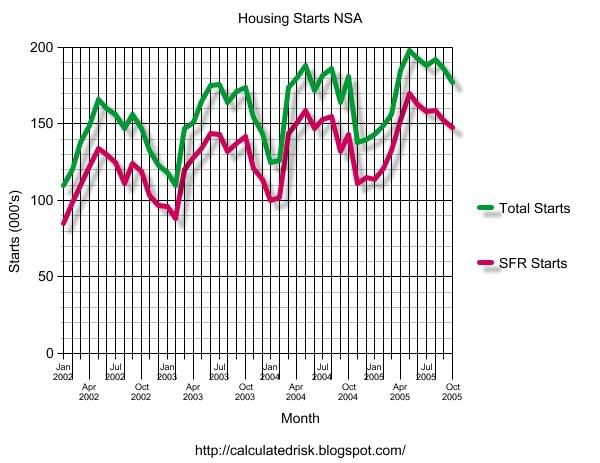
Click on graph for larger image.
This graph shows the NSA housing starts for the last four years. Every year housing starts decline in the fall, yet the October housing starts are still near the peak summer pace for 2004. That is hardly a plunge.
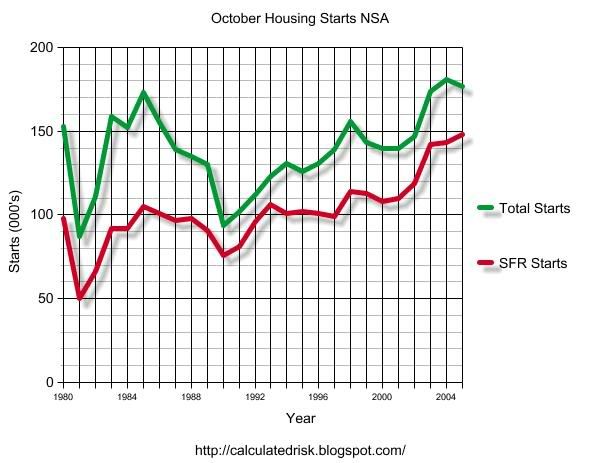
The second graph shows October housing starts since 1980.
Total starts in Oct, 2005 showed a small decline from Oct, 2004. But for one unit structures (SFR), 2005 was an all time record for October starts.
Hardly a plunge.
With rising inventories and rising interest rates, it is understandable that analysts are looking for confirmation that the housing market has slowed substantially. This isn't it.
Besides, permits and housing starts are historically lagging indicators for a housing slowdown. In addition to rising inventories, I believe the more timely indicators are falling mortgage applications and declining sales.
ARMs Coming Due
by Calculated Risk on 11/18/2005 05:47:00 PM
CNN reports: Homeowners with ARMs face big bill jump
The Mortgage Bankers Association estimates that some $330 billion worth of ARMs will adjust in 2006 and $1 trillion worth will reset by the end of 2007.For more details on adjusting ARMs, see this NY Times article from June: The Trillion-Dollar Bet
Since the average ARM loan is about $300,000, according to Freddie Mac, a trillion dollars probably represents more than 3 million homeowners who will face bigger bills in the next two years.
If you took out an 3/1 ARM for $300,000 back in late 2002, your initial interest rate was probably around 5 percent and your monthly payment has been about $1,610.
...
Your new payment: $1,995 a month -- a difference of $385, or more than $4,600 a year.



