
 RSS Feed
 by Calculated Risk on 10/24/2005 10:47:00 AM
Monday, October 24, 2005
WSJ: Bush To Name Greenspan Successor Monday Afternoon
UPDATE3: Also see Dr. Thoma's comments.
Dr. Hamilton praises Bernanke:
He absolutely has a first-rate mind, just as sharp as they come. And he'll need all the gray matter that can be mustered in his new job, I fear, to figure out how to respond to simultaneous threats of recession, inflation, global imbalances, and systemic financial risk.The WSJ Econoblog quotes several economists / bloggers: Taking Bernanke's Measure
UPDATE2: Bernanke.
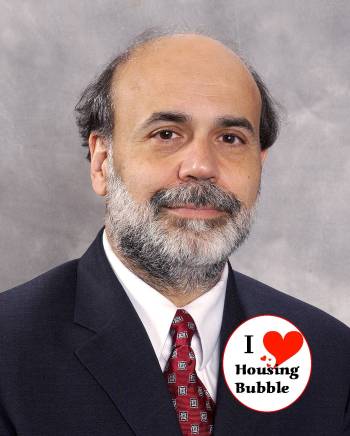
Dr. Delong says "a very good choice".
Dr. Kash Mansori (Angry Bear) writes:
"a pretty good choice .... (Full disclosure: he was one of my professors in grad school, so I accept the possibility that I might be biased on this.) Bernanke is a superb macroeconomist, a nice guy, and, despite his current position as chair of the CEA (a position that has historically been filled by highly respected academics with only minor partisan leanings), he is not a sharply partisan or ideological person."Barry Ritholtz writes:
"Ben Bernanke is a safe, strong choice, sure to be liked by both the Bond and Equity markets."
Original Post:
Dow Jones News Service reports that Bush To Name Greenspan Successor Monday Afternoon. Reuters reports: Bush said eyeing Greenspan successor
President George W. Bush was believed poised on Monday to announce who he wants to replace Federal Reserve Chairman Alan Greenspan, according to sources familiar with the situation.
White House officials had no comment, but other sources said Bush was believed to be ready to make his announcement. The markets were awash in rumors that an announcement was coming.
Greenspan's 18-year tenure at the Fed runs out on January 31. Although he could stay longer if a successor is not in place, the Fed chief has signaled he prefers to leave on time.
Three potential candidates are regularly mentioned for the Fed chairman job: Glenn Hubbard, a past adviser to Bush; Harvard economist Martin Feldstein; and Fed governor-turned White House adviser Ben Bernanke.
Other potential contenders include former Bush economic aide and ex-Federal Reserve Governor Lawrence Lindsey; Fed Governor Donald Kohn; Fed Vice Chairman Roger Ferguson; and ex-Dallas Fed President Robert McTeer.
Most of the candidates are Republicans. But Kohn is a political independent and Ferguson a moderate Democrat.
Sunday, October 23, 2005
Housing, Wilma and Fitzgerald
by Calculated Risk on 10/23/2005 10:50:00 PM
My most recent post is up on Angry Bear: This Week's Housing Data.
Also see David Jackson's first hand account: Washington, DC Area Update
The big stories of the week will probably be Wilma and the Fitzgerald announcement. Wilma is now a dangerous Category 3 hurricane:
Map from: Weather Underground
Radar Key West.
And some thoughts on the Fitzgerald investigation: Not to personify the markets too much, but there is an old adage: Wall Street is not Republican or Democrat, it is Capitalist!
And market participants hate uncertainty. Once the Fitzgerald announcement is made, uncertainty will be removed and the market will probably rally short term. This is true if there are no indictments, or just a handful of aides are indicted. Most people on Wall Street don't care about Libby or Rove.
If a large number of people are indicted or Fitzgerald harpoons the Great White Whale (Cheney), then all bets are off. However I think this is an unlikely scenario.
Best to all.

UK: Profit Warnings
by Calculated Risk on 10/23/2005 12:55:00 PM
The London Times reports: Profit warnings worst since 9/11
PROFIT WARNINGS by British companies hit their highest level last month since the September 11 attacks on America four years agoAnd Reuters adds: Slowdown in housing precipitates consumer pullback; debt correction ahead?
...
So far this year there have been 370 profit warnings by quoted companies, up from 261 in the first nine months of last year.
"With profit warnings averaging 92 a quarter in the past 12 months, businesses are clearly finding it difficult to forecast in the current environment," said Andrew Wollaston, an Ernst & Young partner. "Though the economy is weaker than a year ago, this continued high level of warnings is a real concern."
The increase in profit warnings is blamed on rising costs, particularly for energy, and weaker-than-expected demand.
A UK housing market slowdown and subsequent curbs in consumer spending have precipitated companies' woes, E&Y's London head of corporate restructuring, Andrew Wollaston, said.The downward cycle continues (thanks to Joshua for the Times story).
"The last three or four years there's been a credit boom, and now people are paying off debt."
Friday, October 21, 2005
Foreign Policy: An interview with Stephen Roach
by Calculated Risk on 10/21/2005 05:47:00 PM
Foreign Policy asks Morgan Stanley Chief Economist Stephen S. Roach: What Awaits the Next Alan Greenspan?
FP: If you had to give the current U.S. economy a grade, what would it be?Roach is too generous. The biggest problem is that the US is not seriously addressing the 'unprecedented imbalances', and there appears to be no leadership even arguing to take the first step towards more fiscal discipline. For the consumer, they have been using their homes as ATMs, and even if prices just stabilize, the ATM will dry up.
SR: I’d give it a gentleman’s C. On the surface, GDP is good, inflation is low, and so is the unemployment rate. Beneath the surface, we have unprecedented imbalances in terms of low national savings. Two of the three pieces of national savings—the consumer piece and the government piece—are in the red. We have a record balance-of-payments deficit. We have record levels of household-sector indebtedness, and [a record number] of consumers living beyond their means. Superficially, it looks ok. Beneath the surface, it looks disconcerting.
FP: What’s the likelihood of a U.S. recession?See the interview for more.
SR: I put a 40 percent chance on a recession next year, which is high.
[Rising energy prices] are a big concern because they are hitting a consumer that has been stretched in an unprecedented fashion. The consumer savings rate right now is negative 1 percent, the lowest it’s been since 1933, which was not a terrific year. [During] the last 3 energy shocks—mid 70s, late 70s and early 90s—the same savings rate averaged 8 percent. We had a cushion that we could use to fund higher energy expenses. There is no cushion today. Consumption is going to get hit hard unless there’s immediate relief on energy product prices such as natural gas and gasoline, and home heating oil.
Special Counsel Fitzgerald Launches Website
by Calculated Risk on 10/21/2005 03:21:00 PM
The US Department of Justice Special Prosecutor Patrick J. Fitzgerald has launched a new website today: Office of Special Counsel
"I would strongly caution ... against reading anything into it substantive, one way or the other," [Fitzgerald spokesman Randall Samborn]said. "It's really a long overdue effort to get something on the Internet to answer a lot of questions that we get . . . and to put up some of the documents that we have had ongoing and continued interest in having the public be able to access."Source: Fitzgerald Launches Web Site
I am not aware of any economic research correlating government scandals with changes in economic activity. My guess is the economic impact of a major scandal is probably minimal. After Watergate the economy went into recession, but most major scandals, like Teapot Dome, Iran-Contra or the Monica affair had no clear economic impact.



