
 RSS Feed
 by Calculated Risk on 8/25/2005 06:52:00 PM
Thursday, August 25, 2005
Floyd Norris: "The real key to a housing bubble"
Floyd Norris, chief financial correspondent of The New York Times, has an interesting take on the housing market:
If housing prices fall, will mortgages cushion the downfall, or make it worse? Put another way, will more overstretched homeowners be forced to sell?Mr. Norris reviews previous housing slowdowns and contrasts housing, bought with mortgages, to stock, bought on margin. I recommend reading his comments.
At issue is whether financial innovations that have made it easier for Americans to buy homes have also made the system less stable and more vulnerable to shocks that could drive many of them from their homes, having lost all they invested in them.
The interesting and somewhat novel observation is that Mr. Norris believes we can tell, when housing starts to slow down, if it is an ordinary housing slowdown or a possible disaster by whether or not transaction volumes decline significantly for existing home sales.
But if and when a fall comes, watch the volume of home sales, particularly of existing homes. Back in 1978, almost four million sales of such homes were counted by the National Association of Realtors. By 1982, amid recession and rising interest rates, the figure was under two million.I've been expecting volumes to drop significantly (what Mr. Norris suggests is normal). Of course the "limited damage" would be a slow down in GDP growth or a mild recession.
...
If [then number of transactions] falls rapidly, that will be an indication that not much has changed, and the damage is likely to be limited.
But if sales volume stays high, that could indicate that the mortgage innovations are hurting. Then we could see rising numbers of foreclosures as homeowners discover they cannot sell their homes for what they owe but also cannot pay their suddenly higher monthly mortgage bills.
If volumes stay high while prices drop, Mr. Norris argues we are in for tough times.
Krugman: Housing Bubble will Burst
by Calculated Risk on 8/25/2005 02:46:00 PM
Reuters quotes Dr. Krugman:
"I'll give you a forecast which might very well be wrong, but I think it will burst in the spring of next year," he said at a derivatives conference in Brazil's winter resort of Campos do Jordao.I think it will be sooner rather than later.
"I would be surprised if it doesn't burst in the next three years," he added.
Krugman said skyrocketing U.S. housing prices were supported by large -- and somewhat "odd" -- capital inflows from emerging market countries, such as China, which has accumulated huge holdings of U.S. Treasury debt, helping keep long-term interest rates abnormally low.
"Americans pay for their houses with money they borrowed from the Chinese," he said.
...
An expected decline in U.S. housing investment would be part of an economic adjustment process which could include the weakening of the dollar, higher U.S. exports and the reduction of current account deficits in the world's largest economy, Krugman said.
"This is how we would like to see it happening -- smoothly -- but there are many moving parts and they're unlikely to move at the same time," he said. "So it's not going to happen unpainfully."
Wednesday, August 24, 2005
Housing Thoughts ...
by Calculated Risk on 8/24/2005 11:25:00 PM
Dr. Duy adds some interesting thoughts today: Another Look at Housing.
Like many others, Dr. Setser, Gen'l Glut, Paul Volcker to name a few, Dr. Duy expresses some concerns:
I was unsettled by the combination of weak durable goods numbers, strong housing numbers, and this morning’s Wall Street Journal piece regarding global capital flows into the US housing market. Like many, I see the need for an eventual rebalancing – a shifting away from consumption and housing and toward investment – of growth in the years ahead.Dr. Duy than adds some excellent analysis and graphs. I believe the graph showing the relationship between the CA (Current Account, mostly trade deficit) and housing starts is very interesting. Dr. Duy concludes:
All in all, it suggests to me that international factors – specifically, the willingness of foreign investors to place their capital into the US – have a significant place in explaining the consumption binge/CA deficit/low interest rate issue.The entire post is well worth reading.
...
Of course, the international angle only increases the difficulty of the Fed’s job – the willingness of foreign capital to flow into the US could mean the Fed will end up strangling the non-housing sectors of the economy to keep overall inflation expectations in line.
And on today's numbers, I plotted the New Home Sales for July for the last 30 years (annual rate, seasonally adjusted).
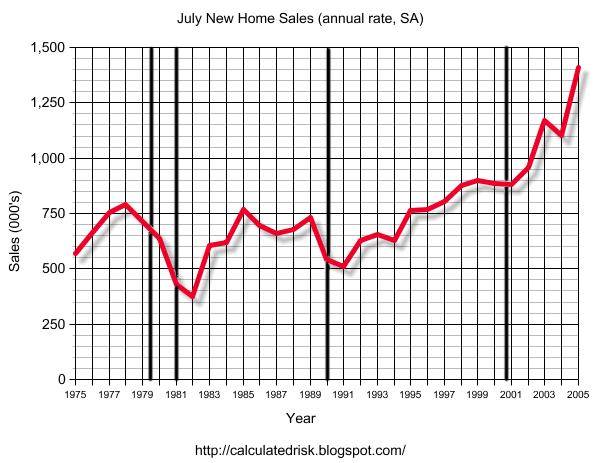
Click on graph for larger image.
The vertical lines indicate the start of a recession.
With the increasing Existing Homes inventory and this very strong New Home Sales report for July, more and more I think this looks like a blow off top for housing. I probably could have written that last year too, but I didn't see the widespread speculation (especially speculation with riskier financing).
I believe there is a relationship between housing, trade and interest rates, and when that starts to unwind, we may see a vicious cycle on the downside.
Tuesday, August 23, 2005
July New Home Sales: 1.41 Million
by Calculated Risk on 8/23/2005 08:10:00 PM
According to a Census Bureau report, New Home Sales in July were at a seasonally adjusted annual rate of 1.41 million vs. market expectations of 1.35 million. June sales were revised down to 1.324 million from 1.374 million.
Click on Graph for larger image.
NOTE: The graph starts at 700 thousand units per month to better show monthly variation.
Sales of new one-family houses in July 2005 were at a seasonally adjusted annual rate of 1,410,000, according to estimates released jointly today by the U.S. Census Bureau and the Department of Housing and Urban Development.
The Not Seasonally Adjusted monthly rate was 120,000 New Homes sold, up from a revised 117,000 in June.
The median sales price of new houses sold in July 2005 was $203,800; the average sales price was $275,000.
The average sales price rebounded slightly and the median price is the lowest since 2003.
The seasonally adjusted estimate of new houses for sale at the end of July was 460,000. This represents a supply of 4.0 months at the current sales rate.
The seasonally adjusted supply of New Homes was 4.0 months, about normal for the last few years.
July was a record for sales, but recently the trend has been for downward revisions and July will probably be revised down. Even though inventories are at a record high, with the strong sales, the months of inventory is normal for the last few years.
Median prices continue to fall and are now at 2003 levels.
Shiller Defines a Bubble and Probable Ending
by Calculated Risk on 8/23/2005 07:41:00 PM
Here are some excerpts from a FoxNews interview with Yale Economist Robert Shiller said:
Shiller admits he doesn’t have a short, simple definition and then goes on to say that defining a bubble "is similar to the way psychiatrists define a mental illness, that is, it involves a list of symptoms."And Shiller expects the end to be ugly:
Indeed, to hear Shiller describe a financial bubble it sounds like a disease. "It’s a social contagion," he says, "An epidemic whose mode of transmission is word of mouth. It’s emotional. People keep hearing about price increases. There’s a tinge of envy about other people who have done well, which brings more and more people into the market. This, in turn, pushes prices up." In other words, it's a self-fulfilling prophecy.
... the most important issue is not whether or when the bubble will burst, but what the "end" will it look like. Shiller confesses he has no idea. He says a lot depends on the other factors or "symptoms" in the mix.
In the extreme scenario, buyers start to default on adjustable-rate mortgages and trigger a financial crisis in the banking sector. Real estate prices nosedive as properties are abandoned. If this is compounded by significantly higher oil prices, "it could change the psychology," says Shiller. "Consumer confidence plummets and people pull back on spending." This causes a downward economic spiral and leads to recession.
In the "soft landing" version, real estate prices simply remain flat for years, much as they did after the boom in the 1970s, until they’re back in line with inflation. "This is what people are counting on happening," says Shiller. He considers this outcome unlikely "because the signs of a bubble are stronger."
Though he admits there are so many variables it’s impossible to forecast it precisely, Shiller says he senses that the housing bubble is "more likely to turn out badly."



