RSS Feed
 by Calculated Risk on 8/22/2025 02:21:00 PM
Friday, August 22, 2025
Philly Fed: State Coincident Indexes Increased in 41 States in July (3-Month Basis)
From the Philly Fed:
The Federal Reserve Bank of Philadelphia has released the coincident indexes for the 50 states for July 2025. Over the past three months, the indexes increased in 41 states, decreased in eight states, and remained stable in one, for a three-month diffusion index of 66. Additionally, in the past month, the indexes increased in 38 states, decreased in five states, and remained stable in seven, for a one-month diffusion index of 66. For comparison purposes, the Philadelphia Fed has also developed a similar coincident index for the entire United States. The Philadelphia Fed’s U.S. index increased 0.5 percent over the past three months and 0.1 percent in July.Note: These are coincident indexes constructed from state employment data. An explanation from the Philly Fed:
emphasis added
The coincident indexes combine four state-level indicators to summarize current economic conditions in a single statistic. The four state-level variables in each coincident index are nonfarm payroll employment, average hours worked in manufacturing by production workers, the unemployment rate, and wage and salary disbursements deflated by the consumer price index (U.S. city average). The trend for each state’s index is set to the trend of its gross domestic product (GDP), so long-term growth in the state’s index matches long-term growth in its GDP.
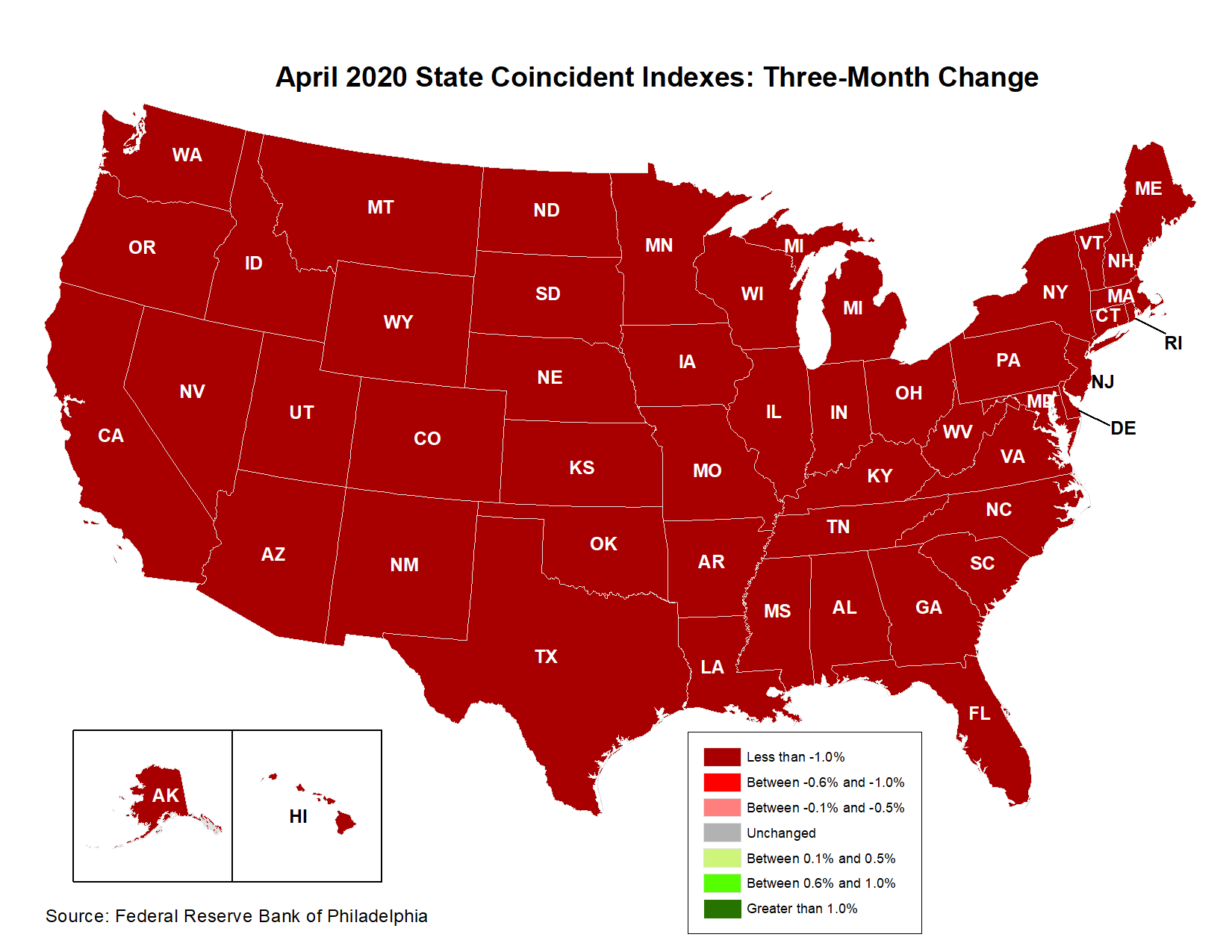
 Click on map for larger image.
Here is a map of the three-month change in the Philly Fed state coincident indicators. This map was all red during the worst of the Pandemic and also at the worst of the Great Recession.
The map is mostly positive on a three-month basis.
Source: Philly Fed.
 And here is a graph is of the number of states with one month increasing activity according to the Philly Fed.
 This graph includes states with minor increases (the Philly Fed lists as unchanged).
In July, 39 states had increasing activity including minor increases.
In July, 39 states had increasing activity including minor increases.
Q3 GDP Tracking
by Calculated Risk on 8/22/2025 12:24:00 PM
From Goldman:
We boosted our Q3 GDP tracking estimate by 0.1pp to +1.5% (quarter-over-quarter annualized). Our Q3 domestic final sales estimate stands at +0.3%. We left our past-quarter GDP tracking estimate unchanged at +3.1%. [August 21st estimate]And from the Atlanta Fed: GDPNow

The GDPNow model estimate for real GDP growth (seasonally adjusted annual rate) in the third quarter of 2025 is 2.3 percent on August 19, down from 2.5 percent on August 15. After this morning’s housing starts release from the US Census Bureau, the nowcast of third-quarter real residential investment growth decreased from 1.1 percent to -5.9 percent. [August 19th estimate]
Fed Chair Powell: "The shifting balance of risks may warrant adjusting our policy stance"
by Calculated Risk on 8/22/2025 10:00:00 AM
From Fed Chair Powell at Jackson Hole: Monetary Policy and the Fed’s Framework Review. Excerpts:
When I appeared at this podium one year ago, the economy was at an inflection point. Our policy rate had stood at 5-1/4 to 5-1/2 percent for more than a year. That restrictive policy stance was appropriate to help bring down inflation and to foster a sustainable balance between aggregate demand and supply. Inflation had moved much closer to our objective, and the labor market had cooled from its formerly overheated state. Upside risks to inflation had diminished. But the unemployment rate had increased by almost a full percentage point, a development that historically has not occurred outside of recessions.1 Over the subsequent three Federal Open Market Committee (FOMC) meetings, we recalibrated our policy stance, setting the stage for the labor market to remain in balance near maximum employment over the past year.
This year, the economy has faced new challenges. Significantly higher tariffs across our trading partners are remaking the global trading system. Tighter immigration policy has led to an abrupt slowdown in labor force growth. Over the longer run, changes in tax, spending, and regulatory policies may also have important implications for economic growth and productivity. There is significant uncertainty about where all of these polices will eventually settle and what their lasting effects on the economy will be.
Changes in trade and immigration policies are affecting both demand and supply. In this environment, distinguishing cyclical developments from trend, or structural, developments is difficult. This distinction is critical because monetary policy can work to stabilize cyclical fluctuations but can do little to alter structural changes.
The labor market is a case in point. The July employment report released earlier this month showed that payroll job growth slowed to an average pace of only 35,000 per month over the past three months, down from 168,000 per month during 2024 (figure 2).2 This slowdown is much larger than assessed just a month ago, as the earlier figures for May and June were revised down substantially.3 But it does not appear that the slowdown in job growth has opened up a large margin of slack in the labor market—an outcome we want to avoid. The unemployment rate, while edging up in July, stands at a historically low level of 4.2 percent and has been broadly stable over the past year. Other indicators of labor market conditions are also little changed or have softened only modestly, including quits, layoffs, the ratio of vacancies to unemployment, and nominal wage growth. Labor supply has softened in line with demand, sharply lowering the "breakeven" rate of job creation needed to hold the unemployment rate constant. Indeed, labor force growth has slowed considerably this year with the sharp falloff in immigration, and the labor force participation rate has edged down in recent months.
Overall, while the labor market appears to be in balance, it is a curious kind of balance that results from a marked slowing in both the supply of and demand for workers. This unusual situation suggests that downside risks to employment are rising. And if those risks materialize, they can do so quickly in the form of sharply higher layoffs and rising unemployment.
At the same time, GDP growth has slowed notably in the first half of this year to a pace of 1.2 percent, roughly half the 2.5 percent pace in 2024 (figure 3). The decline in growth has largely reflected a slowdown in consumer spending. As with the labor market, some of the slowing in GDP likely reflects slower growth of supply or potential output.
Turning to inflation, higher tariffs have begun to push up prices in some categories of goods. Estimates based on the latest available data indicate that total PCE prices rose 2.6 percent over the 12 months ending in July. Excluding the volatile food and energy categories, core PCE prices rose 2.9 percent, above their level a year ago. Within core, prices of goods increased 1.1 percent over the past 12 months, a notable shift from the modest decline seen over the course of 2024. In contrast, housing services inflation remains on a downward trend, and nonhousing services inflation is still running at a level a bit above what has been historically consistent with 2 percent inflation (figure 4).
The effects of tariffs on consumer prices are now clearly visible. We expect those effects to accumulate over coming months, with high uncertainty about timing and amounts. The question that matters for monetary policy is whether these price increases are likely to materially raise the risk of an ongoing inflation problem. A reasonable base case is that the effects will be relatively short lived—a one-time shift in the price level. Of course, "one-time" does not mean "all at once." It will continue to take time for tariff increases to work their way through supply chains and distribution networks. Moreover, tariff rates continue to evolve, potentially prolonging the adjustment process.
It is also possible, however, that the upward pressure on prices from tariffs could spur a more lasting inflation dynamic, and that is a risk to be assessed and managed. One possibility is that workers, who see their real incomes decline because of higher prices, demand and get higher wages from employers, setting off adverse wage–price dynamics. Given that the labor market is not particularly tight and faces increasing downside risks, that outcome does not seem likely.
Another possibility is that inflation expectations could move up, dragging actual inflation with them. Inflation has been above our target for more than four years and remains a prominent concern for households and businesses. Measures of longer-term inflation expectations, however, as reflected in market- and survey-based measures, appear to remain well anchored and consistent with our longer-run inflation objective of 2 percent.
Of course, we cannot take the stability of inflation expectations for granted. Come what may, we will not allow a one-time increase in the price level to become an ongoing inflation problem.
Putting the pieces together, what are the implications for monetary policy? In the near term, risks to inflation are tilted to the upside, and risks to employment to the downside—a challenging situation. When our goals are in tension like this, our framework calls for us to balance both sides of our dual mandate. Our policy rate is now 100 basis points closer to neutral than it was a year ago, and the stability of the unemployment rate and other labor market measures allows us to proceed carefully as we consider changes to our policy stance. Nonetheless, with policy in restrictive territory, the baseline outlook and the shifting balance of risks may warrant adjusting our policy stance.
Monetary policy is not on a preset course. FOMC members will make these decisions, based solely on their assessment of the data and its implications for the economic outlook and the balance of risks. We will never deviate from that approach.
Realtor.com Reports Median listing price was flat year over year
by Calculated Risk on 8/22/2025 08:29:00 AM
What this means: On a weekly basis, Realtor.com reports the year-over-year change in active inventory and new listings. On a monthly basis, they report total inventory. For July, Realtor.com reported inventory was up 24.8% YoY, but still down 13.4% compared to the 2017 to 2019 same month levels.
Here is their weekly report: Weekly Housing Trends: Latest Data as of Aug. 16
• Active inventory climbed 20.9% year over year
The number of homes active on the market climbed 20.9% year over year, easing slightly compared with the previous week for the ninth consecutive week. Nevertheless, last week was the 93rd consecutive week of annual gains in inventory. There were roughly 1.1 million homes for sale last week, marking the 16th week in a row over the million-listing threshold. Active inventory is growing significantly faster than new listings, an indication that more homes are sitting on the market for longer.
• New listings—a measure of sellers putting homes up for sale—rose 4.9% year over year
New listings rose 4.9% last week compared with the same period last year, a lower rate compared with the previous week, as the number of new listings remains below the spring and early summer norm. Homeowners are showing less urgency to list, as rising inventory and cautious buyer activity continue to temper the market.
• The median listing price was flat year over year
The median list price was flat compared with the same week in 2024. The median list price per square foot, which accounts for changes in home size, rose 0.1% year over year, extending its nearly two-year growth streak, though this represents the slowest growth rate over that period.
Thursday, August 21, 2025
Friday: Fed Chair Powell Speech at Jackson Hole
by Calculated Risk on 8/21/2025 08:12:00 PM
 Note: Mortgage rates are from MortgageNewsDaily.com and are for top tier scenarios.
Friday:
• At 10:00 AM ET, Speech, Fed Chair Jerome Powell, Economic Outlook and Framework Review, At the 2025 Jackson Hole Economic Policy Symposium, Moran, Wyoming
Hotels: Occupancy Rate Decreased 0.9% Year-over-year; Weak Summer
by Calculated Risk on 8/21/2025 02:11:00 PM
The U.S. hotel industry reported mostly negative year-over-year comparisons, according to CoStar’s latest data through 16 August. ...The following graph shows the seasonal pattern for the hotel occupancy rate using the four-week average.
10-16 August 2025 (percentage change from comparable week in 2024):
• Occupancy: 66.3% (-0.9%)
• Average daily rate (ADR): US$157.51 (+0.4%)
• Revenue per available room (RevPAR): US$104.50 (-0.5%)
emphasis added
 Click on graph for larger image.
The red line is for 2025, blue is the median, and dashed light blue is for 2024. Dashed purple is for 2018, the record year for hotel occupancy.
The 4-week average of the occupancy rate is tracking behind last year and the median rate for the period 2000 through 2024 (Blue).
Note: Y-axis doesn't start at zero to better show the seasonal change.
The 4-week average will decrease seasonally until the Fall travel period.
On a year-to-date basis, the only worse years for occupancy over the last 25 years were pandemic or recession years.
Newsletter: NAR: Existing-Home Sales Increased to 4.01 million SAAR in July; Up 0.8% YoY
by Calculated Risk on 8/21/2025 10:50:00 AM
Today, in the CalculatedRisk Real Estate Newsletter: NAR: Existing-Home Sales Increased to 4.01 million SAAR in July; Up 0.8% YoY
Excerpt:
On prices, the NAR reported:There is much more in the article.• $422,400: Median existing-home price for all housing types, up 0.2% from one year ago ($421,400) – the 25th consecutive month of year-over-year price increases.Median prices are distorted by the mix (repeat sales indexes like Case-Shiller and FHFA are probably better for measuring prices).
The YoY change in the median price peaked at 25.2% for this cycle in May 2021 and bottomed at -3.0% in May 2023. Prices are now up 0.2% YoY.
On a month-over-month basis, median prices decreased 2.4% from the peak in June. This is more than the normal seasonal decrease in the median price for July. Typically, the NAR median price increases in the Spring, and tends to peak seasonally in the June report. The median price will likely decline until early 2026.
The median price tends to lead the Case-Shiller index, and this suggests a lower YoY increase in the Case-Shiller index as in May over the next couple of months.

NAR: Existing-Home Sales Increased to 4.01 million SAAR in July
by Calculated Risk on 8/21/2025 10:00:00 AM
From the NAR: NAR Existing-Home Sales Report Shows 2.0% Increase in July
Existing-home sales increased by 2.0% in July, according to the National Association of REALTORS® Existing-Home Sales Report. ...
Month-over-month sales increased in the Northeast, South, and West, and fell in the Midwest. Year-over-year, sales rose in the South, Northeast, and Midwest, and fell in the West. ...
• 2.0% increase in existing-home sales – seasonally adjusted annual rate of 4.01 million in July.
• Year-over-year: 0.8% increase in existing-home sales
• 0.6% increase in unsold inventory – 1.55 million units equal to 4.6 months' supply.
emphasis added
 Click on graph for larger image.
This graph shows existing home sales, on a Seasonally Adjusted Annual Rate (SAAR) basis since 1994.
Sales in July (4.01 million SAAR) were up 2.0% from the previous month and were up 0.8% compared to the July 2024 sales rate.
The second graph shows nationwide inventory for existing homes.
 According to the NAR, inventory increased to 1.55 million in July from 1.54 million the previous month.
 According to the NAR, inventory increased to 1.55 million in July from 1.54 million the previous month.
Headline inventory is not seasonally adjusted, and inventory usually decreases to the seasonal lows in December and January, and peaks in mid-to-late summer.
The last graph shows the year-over-year (YoY) change in reported existing home inventory and months-of-supply. Since inventory is not seasonally adjusted, it really helps to look at the YoY change. Note: Months-of-supply is based on the seasonally adjusted sales and not seasonally adjusted inventory.
 Inventory was up 15.7% year-over-year (blue) in July compared to July 2024.
Months of supply (red) decreased to 4.6 months in July from 4.7 months the previous month.
I'll have more later.
The last graph shows the year-over-year (YoY) change in reported existing home inventory and months-of-supply. Since inventory is not seasonally adjusted, it really helps to look at the YoY change. Note: Months-of-supply is based on the seasonally adjusted sales and not seasonally adjusted inventory.
 Inventory was up 15.7% year-over-year (blue) in July compared to July 2024.
 Months of supply (red) decreased to 4.6 months in July from 4.7 months the previous month.
I'll have more later.
Weekly Initial Unemployment Claims Increase to 235,000
by Calculated Risk on 8/21/2025 08:30:00 AM
The DOL reported:
In the week ending August 16, the advance figure for seasonally adjusted initial claims was 235,000, an increase of 11,000 from the previous week's unrevised level of 224,000. The 4-week moving average was 226,250, an increase of 4,500 from the previous week's unrevised average of 221,750.The following graph shows the 4-week moving average of weekly claims since 1971.
emphasis added
 Click on graph for larger image.
The dashed line on the graph is the current 4-week average. The four-week average of weekly unemployment claims increased to 226,250.
The previous week was unrevised.
Weekly claims were above the consensus forecast.
Wednesday, August 20, 2025
Thursday: Unemployment Claims, Existing Home Sales
by Calculated Risk on 8/20/2025 07:40:00 PM
 Note: Mortgage rates are from MortgageNewsDaily.com and are for top tier scenarios.
Thursday:
• At 8:30 AM ET, The initial weekly unemployment claims report will be released. The consensus is for initial claims to increase to 226 thousand from 224 thousand last week.
• At 10:00 AM, Existing Home Sales for July from the National Association of Realtors (NAR). The consensus is for 3.92 million SAAR, down from 3.93 million last month. Housing economist Tom Lawler expects the NAR to report sales of 3.92 million SAAR for July.
FOMC Minutes: "Committee might face difficult tradeoffs" regarding Unemployment and Inflation
by Calculated Risk on 8/20/2025 02:00:00 PM
This is a little stale since this meeting was before the July employment report.
From the Fed: Minutes of the Federal Open Market Committee, July 29–30, 2025. Excerpt:
n their discussion of inflation, many participants observed that overall inflation remained somewhat above the Committee's 2 percent longer-run goal. Participants noted that tariff effects were becoming more apparent in the data, as indicated by recent increases in goods price inflation, while services price inflation had continued to slow. A couple of participants suggested that tariff effects were masking the underlying trend of inflation and, setting aside the tariff effects, inflation was close to target.
With regard to the outlook for inflation, participants generally expected inflation to increase in the near term. ...
In their evaluation of the risks and uncertainties associated with the economic outlook, participants judged that uncertainty about the economic outlook remained elevated, though several participants remarked that there had been some reduction in uncertainty regarding fiscal policy, immigration policy, or tariff policy. Participants generally pointed to risks to both sides of the Committee's dual mandate, emphasizing upside risk to inflation and downside risk to employment. A majority of participants judged the upside risk to inflation as the greater of these two risks, while several participants viewed the two risks as roughly balanced, and a couple of participants considered downside risk to employment the more salient risk. Regarding upside risks to inflation, participants pointed to the uncertain effects of tariffs and the possibility of inflation expectations becoming unanchored. In addition to tariff-induced risks, potential downside risks to employment mentioned by participants included a possible tightening of financial conditions due to a rise in risk premiums, a more substantial deterioration in the housing market, and the risk that the increased use of AI in the workplace may lower employment.
In their discussion of financial stability, participants who commented noted vulnerabilities to the financial system that they assessed warranted monitoring. ...
In discussing risk-management considerations that could bear on the outlook for monetary policy, participants generally agreed that the upside risk to inflation and the downside risk to employment remained elevated. Participants noted that, if this year's higher tariffs were to generate a larger-than-expected or a more-persistent-than-anticipated increase in inflation, or if medium- or longer-term inflation expectations were to increase notably, then it would be appropriate to maintain a more restrictive stance of monetary policy than would otherwise be the case, especially if labor market conditions remained solid. By contrast, if labor market conditions were to weaken materially or if inflation were to come down further and inflation expectations remained well anchored, then it would be appropriate to establish a less restrictive stance of monetary policy than would otherwise be the case. Participants noted that the Committee might face difficult tradeoffs if elevated inflation proved to be more persistent while the outlook for the labor market weakened.
emphasis added
AIA: "Business at architecture firms remains soft" in July
by Calculated Risk on 8/20/2025 11:34:00 AM
Note: This index is a leading indicator primarily for new Commercial Real Estate (CRE) investment including multi-family residential.
From the AIA: ABI July 2025: Business at architecture firms remains soft
The AIA/Deltek Architecture Billings Index (ABI) score for the month was below 50 for 31 out of the last 34 months, with a score of 46.2, as a majority of firms are still seeing declining billings. There are signs of hope ahead, as inquiries into new work grew slowly but steadily this month, following a brief three-month pause earlier this year. However, the value of newly signed design contracts at firms declined again in July, as firms continue to struggle to convert inquiries into contracts for new projects. This has been an issue for nearly as long as billings have been declining and reflects how soft business has been at many firms over the last two and a half years.• Northeast (47.8); Midwest (45.1); South (47.5); West (46.4)
Billings continued to decline at firms in all regions of the country in July. Although conditions in the South looked like they were improving earlier this summer, the share of firms reporting a decline in billings increased this month. Billings remained softest at firms located in the Midwest for the third consecutive month. Business conditions continued to improve at firms with a commercial/industrial specialization this month, where there was nearly an equal share of firms reporting an increase in billings as reporting a decline for the second consecutive month. Firms with an institutional specialization also saw some encouraging signs, although business softened further at firms with a multifamily residential specialization in July.
...
The ABI serves as a leading economic indicator that leads nonresidential construction activity by approximately 9-12 months.
emphasis added
• Sector index breakdown: commercial/industrial (49.9); institutional (47.9); multifamily residential (43.7)
 Click on graph for larger image.
This graph shows the Architecture Billings Index since 1996. The index was at 46.2 in July, down from 46.8 in June. Anything below 50 indicates a decrease in demand for architects' services.
This index has indicated contraction for 31 of the last 34 months.
Note: This includes commercial and industrial facilities like hotels and office buildings, multi-family residential, as well as schools, hospitals and other institutions.
This index usually leads CRE investment by 9 to 12 months, so this index suggests a slowdown in CRE investment throughout 2025 and into 2026.
Note: This includes commercial and industrial facilities like hotels and office buildings, multi-family residential, as well as schools, hospitals and other institutions.
This index usually leads CRE investment by 9 to 12 months, so this index suggests a slowdown in CRE investment throughout 2025 and into 2026.
Multi-family billings have been below 50 for 36 consecutive months. This suggests we will some further weakness in multi-family starts.
California Home Sales Down Year-over-year for 4th Straight Month
by Calculated Risk on 8/20/2025 10:30:00 AM
Today, in the Calculated Risk Real Estate Newsletter: California Home Sales Down Year-over-year for 4th Straight Month
A brief excerpt:
The NAR is scheduled to release July Existing Home sales on Thursday, August 21st at 10:00 AM. The consensus is for 3.92 million SAAR, down from 3.93 million last month. Last year, the NAR reported sales in July 2024 at 3.98 million SAAR. Housing economist Tom Lawler expects the NAR to report sales of 3.92 million SAAR.There is much more in the article.
California reports Seasonally Adjusted (SA) sales and some measures of inventory whereas most of the local is Not Seasonally Adjusted (NSA).
From the California Association of Realtors® (C.A.R.): California home sales trail last year’s levels for fourth straight month, C.A.R. saysJuly home sales activity dipped 1.0 percent from the 264,400 homes sold in June and was down 4.1 percent from a year ago, when 272,990 homes were sold on an annualized basis.The NAR’s July existing home sales report will likely show a 3-handle (be under 4 million SAAR) for the 2nd consecutive month.
MBA: Mortgage Applications Decrease in Latest Weekly Survey
by Calculated Risk on 8/20/2025 07:00:00 AM
From the MBA: Mortgage Applications Decrease in Latest MBA Weekly Survey
Mortgage applications decreased 1.4 percent from one week earlier, according to data from the Mortgage Bankers Association’s (MBA) Weekly Mortgage Applications Survey for the week ending August 15, 2025.
The Market Composite Index, a measure of mortgage loan application volume, decreased 1.4 percent on a seasonally adjusted basis from one week earlier. On an unadjusted basis, the Index decreased 2 percent compared with the previous week. The Refinance Index decreased 3 percent from the previous week and was 23 percent higher than the same week one year ago. The seasonally adjusted Purchase Index increased 0.1 percent from one week earlier. The unadjusted Purchase Index decreased 2 percent compared with the previous week and was 23 percent higher than the same week one year ago.
“Mortgage rates increased slightly last week, with the 30-year fixed rate now at 6.68 percent. Applications were down as a result, driven by a 16 percent decrease in VA applications, which are a typically volatile segment of the market,” said Joel Kan, MBA’s Vice President and Deputy Chief Economist. “FHA refinance applications increased over the week, as the FHA rate, at 6.39 percent, remained competitive relative to other loan types. Purchase applications were little changed over the week but were at the strongest pace in four weeks and continued to run well ahead of last year’s pace. Prospective homebuyers remain more active compared to last year despite economic headwinds and uncertainty and affordability challenges.”
...
The average contract interest rate for 30-year fixed-rate mortgages with conforming loan balances ($806,500 or less) increased to 6.68 percent from 6.67 percent, with points decreasing to 0.60 from 0.64 (including the origination fee) for 80 percent loan-to-value ratio (LTV) loans.
emphasis added
 Click on graph for larger image.
The first graph shows the MBA mortgage purchase index.
According to the MBA, purchase activity is up 23% year-over-year unadjusted.
Red is a four-week average (blue is weekly).
Purchase application activity is still depressed, but above the lows of October 2023 and slightly above the lowest levels during the housing bust.

The second graph shows the refinance index since 1990.
The refinance index decreased after picking a little up recently with lower mortgage rates.
Tuesday, August 19, 2025
Wednesday: Architecture Billings Index, FOMC Minutes
by Calculated Risk on 8/19/2025 07:51:00 PM
 Note: Mortgage rates are from MortgageNewsDaily.com and are for top tier scenarios.
Wednesday:
• At 7:00 AM ET, The Mortgage Bankers Association (MBA) will release the results for the mortgage purchase applications index.
• During the day, The AIA's Architecture Billings Index for July (a leading indicator for commercial real estate).
• AT 2:00 PM, FOMC Minutes, Meeting of July 29-30
DOT: Vehicle Miles Driven Increased 1.5% year-over-year
by Calculated Risk on 8/19/2025 01:11:00 PM
This is something I check occasionally.
The Department of Transportation (DOT) reported:
Travel on all roads and streets changed by +1.5% (+4.1 billion vehicle miles) for April 2025 as compared with April 2024. Travel for the month is estimated to be 277.3 billion vehicle miles.
The seasonally adjusted vehicle miles traveled for April 2025 is 277.0 billion miles, a +1.3% ( 3.6 billion vehicle miles) change over April 2024. It also represents a 0.3% change (0.8 billion vehicle miles) compared with March 2025.
Cumulative Travel for 2025 changed by +0.8% (+8.3 billion vehicle miles). The cumulative estimate for the year is 1,043.5 billion vehicle miles of travel.
emphasis added
 Click on graph for larger image.
This graph shows the monthly total vehicle miles driven, seasonally adjusted.
Miles driven declined sharply in March 2020, and really collapsed in April 2020.
Miles driven are now slightly below pre-pandemic levels.
Newsletter: Housing Starts Increased to 1.428 million Annual Rate in July
by Calculated Risk on 8/19/2025 09:15:00 AM
Today, in the Calculated Risk Real Estate Newsletter: Housing Starts Increased to 1.428 million Annual Rate in July
A brief excerpt:
Total housing starts in July were well above expectations and starts in May and June were revised up.There is much more in the article.
The third graph shows the month-to-month comparison for total starts between 2024 (blue) and 2025 (red).
Total starts were up 12.9% in July compared to July 2024. Note that July was the weakest month in 2024, so this was an easy comparison.
Year-to-date (YTD) starts are up 1.6% compared to the same period in 2024. Single family starts are down 4.2% YTD and multi-family up 18.1% YTD.

Housing Starts Increased to 1.428 million Annual Rate in July
by Calculated Risk on 8/19/2025 08:30:00 AM
From the Census Bureau: Permits, Starts and Completions
Housing Starts:
Privately-owned housing starts in July were at a seasonally adjusted annual rate of 1,428,000. This is 5.2 percent above the revised June estimate of 1,358,000 and is 12.9 percent above the July 2024 rate of 1,265,000. Single-family housing starts in July were at a rate of 939,000; this is 2.8 percent above the revised June figure of 913,000. The July rate for units in buildings with five units or more was 470,000.
Building Permits:
Privately-owned housing units authorized by building permits in July were at a seasonally adjusted annual rate of 1,354,000. This is 2.8 percent below the revised June rate of 1,393,000 and is 5.7 percent below the July 2024 rate of 1,436,000. Single-family authorizations in July were at a rate of 870,000; this is 0.5 percent above the revised June figure of 866,000. Authorizations of units in buildings with five units or more were at a rate of 430,000 in July.
emphasis added
 Click on graph for larger image.
The first graph shows single and multi-family housing starts since 2000.
Multi-family starts (blue, 2+ units) increased month-over-month in July. Multi-family starts were up 24.1% year-over-year.
Single-family starts (red) increased in July and were up 7.8% year-over-year.
 The second graph shows single and multi-family housing starts since 1968.
 Total housing starts in July were well above expectations and starts in May and June were revised up.
I'll have more later …
Monday, August 18, 2025
Tuesday: Housing Starts
by Calculated Risk on 8/18/2025 08:31:00 PM
 From Matthew Graham at Mortgage News Daily: Rates Trickle to Another Higher Low
Mortgage rates are as high as they've been on almost any other day this month. You'd have to go back to August 1st to see anything higher. On the other hand, rates are still noticeably lower than almost any other day of the past 10 months. It's really only the past 2 weeks that have been any better and the gap between recent highs and lows is very small. [30 year fixed 6.59%]Tuesday:
emphasis added
• At 8:30 AM ET, Housing Starts for July. The consensus is for 1.300 million SAAR, down from 1.321 million SAAR in June.
• At 10:00 AM, State Employment and Unemployment (Monthly) for July 2025
LA Ports: Imports Up, Exports Down in July
by Calculated Risk on 8/18/2025 03:28:00 PM
Container traffic gives us an idea about the volume of goods being exported and imported - and usually some hints about the trade report since LA area ports handle about 40% of the nation's container port traffic.
The following graphs are for inbound and outbound traffic at the ports of Los Angeles and Long Beach in TEUs (TEUs: 20-foot equivalent units or 20-foot-long cargo container).
The first graph is the monthly data (with a strong seasonal pattern for imports).
 Click on graph for larger image.
Usually imports peak in the July to October period as retailers import goods for the Christmas holiday and then decline sharply and bottom in the Winter depending on the timing of the Chinese New Year.
To remove the strong seasonal component for inbound traffic, the second graph shows the rolling 12-month average.
 On a rolling 12-month basis, inbound traffic increased 0.7% in July compared to the rolling 12 months ending the previous month.
 Click on graph for larger image.
Usually imports peak in the July to October period as retailers import goods for the Christmas holiday and then decline sharply and bottom in the Winter depending on the timing of the Chinese New Year.
Imports were up 8% YoY in July and exports were down 3% YoY.
To remove the strong seasonal component for inbound traffic, the second graph shows the rolling 12-month average.
 On a rolling 12-month basis, inbound traffic increased 0.7% in July compared to the rolling 12 months ending the previous month.
 Outbound traffic decreased 0.3% compared to the rolling 12 months ending the previous month.
This is the 8th consecutive month with exports down YoY.