
 RSS Feed
 by Calculated Risk on 6/27/2025 02:59:00 PM
Friday, June 27, 2025
Q2 GDP Tracking: Moving Down, Still Wide Range
There will be additional trade related distortions in Q2 boosting GDP.
From BofA:
Since our last weekly publication, our 2Q GDP tracking is down one-tenth to +2.5% q/q saar. [June 27th estimate]From Goldman:
emphasis added
We lowered our Q2 GDP tracking estimate by 0.1pp to +3.9% (quarter-over-quarter annualized). Our Q2 domestic final sales estimate stands at 0%. [June 27th estimate]And from the Atlanta Fed: GDPNow

The GDPNow model estimate for real GDP growth (seasonally adjusted annual rate) in the second quarter of 2025 is 2.9 percent on June 27, down from 3.4 percent on June 18. After recent releases from the US Census Bureau and the US Bureau of Economic Analysis, an increase in the nowcast of the contribution of net exports to second-quarter real GDP growth from 2.07 percentage points to 3.49 percentage points was more than offset by a decrease in the nowcasted GDP growth contribution of inventory investment from -0.42 percentage points to -2.22 percentage points. [June 27th estimate]
Final Look at Local Housing Markets in May and a Look Ahead to June Sales
by Calculated Risk on 6/27/2025 11:12:00 AM
Today, in the Calculated Risk Real Estate Newsletter: Final Look at Local Housing Markets in May and a Look Ahead to June Sales
A brief excerpt:
After the National Association of Realtors® (NAR) releases the monthly existing home sales report, I pick up additional local market data that is reported after the NAR. This is the final look at local markets in May.There is much more in the article.
There were several key stories for May:
• Sales NSA are down year-over-year (YoY) through May, and sales last year were the lowest since 1995! The YoY comparisons will be easier the next several months, so sales in 2025 might be close to the level in 2024.
• Sales SA were down YoY for the 4th consecutive month and 41 of the last 45 months.
• Months-of-supply is at the highest level since 2016 (tying one month near the start of the pandemic).
• The median price is barely up YoY, and with the increases in inventory, some regional areas will see more price declines.
Sales at 4.03 million on a Seasonally Adjusted Annual Rate (SAAR) basis were above the consensus estimate; however, housing economist Tom Lawler’s estimate was right on (usually very close).
Sales averaged close to 5.44 million SAAR for the month of May in the 2017-2019 period. So, sales are about 26% below pre-pandemic levels.
...
In May, sales in these markets were down 3.8% YoY. Last month, in April, these same markets were also down 3.8% YoY Not Seasonally Adjusted (NSA). The NAR reported sales in May were down 4.0% YoY NSA, so this sample is close.
Important: There were fewer working days in May 2025 (21) as in May 2024 (22). So, the year-over-year change in the headline SA data was higher than for the NSA data. According to the NAR, seasonally adjusted sales were only down 0.7% YoY in May.
...
More local data coming in July for activity in June!

PCE Measure of Shelter Decreases to 4.1% YoY in May
by Calculated Risk on 6/27/2025 08:55:00 AM
Here is a graph of the year-over-year change in shelter from the CPI report and housing from the PCE report this morning, both through May 2025.
 CPI Shelter was up 3.9% year-over-year in May, down from 4.0% in April, and down from the cycle peak of 8.2% in March 2023.
Housing (PCE) was up 4.1% YoY in May, down from 4.2% in April and down from the cycle peak of 8.3% in April 2023.
Since asking rents are mostly flat year-over-year, these measures will slowly continue to decline over the next year as rents for existing tenants continue to increase.
Since asking rents are mostly flat year-over-year, these measures will slowly continue to decline over the next year as rents for existing tenants continue to increase.
 The second graph shows PCE prices, Core PCE prices and Core ex-housing over the last 3 months (annualized):
Key measures are below the Fed's target on a 3-month basis.
3-month annualized change:
PCE Price Index: 1.1%
Core PCE Prices: 1.7%
Core minus Housing: 1.1%
Core PCE Prices: 1.7%
Core minus Housing: 1.1%
There appears to be some residual seasonality, especially in Q1.
Personal Income Decreased 0.4% in May; Spending Decreased 0.1%
by Calculated Risk on 6/27/2025 08:30:00 AM
From the BEA: Personal Income and Outlays, May 2025
Personal income decreased $109.6 billion (0.4 percent at a monthly rate) in May, according to estimates released today by the U.S. Bureau of Economic Analysis. Disposable personal income (DPI)—personal income less personal current taxes—decreased $125.0 billion (0.6 percent) and personal consumption expenditures (PCE) decreased $29.3 billion (0.1 percent).The May PCE price index increased 2.3 percent year-over-year (YoY), up from 2.1 percent YoY in April, and down from the recent peak of 7.2 percent in June 2022.
Personal outlays—the sum of PCE, personal interest payments, and personal current transfer payments—decreased $27.6 billion in May. Personal saving was $1.01 trillion in May and the personal saving rate—personal saving as a percentage of disposable personal income—was 4.5 percent.
From the preceding month, the PCE price index for May increased 0.1 percent. Excluding food and energy, the PCE price index increased 0.2 percent.
From the same month one year ago, the PCE price index for May increased 2.3 percent. Excluding food and energy, the PCE price index increased 2.7 percent from one year ago.
emphasis added
The PCE price index, excluding food and energy, increased 2.7 percent YoY, up from 2.5 percent in April, and down from the recent peak of 5.6 percent in February 2022.
The following graph shows real Personal Consumption Expenditures (PCE) through May 2025 (2017 dollars). Note that the y-axis doesn't start at zero to better show the change.
 Click on graph for larger image.
The dashed red lines are the quarterly levels for real PCE.
Personal income and PCE were below expectations.
The following graph shows real Personal Consumption Expenditures (PCE) through May 2025 (2017 dollars). Note that the y-axis doesn't start at zero to better show the change.
 Click on graph for larger image.
The dashed red lines are the quarterly levels for real PCE.
Personal income and PCE were below expectations.
Inflation was above expectations.
Using the two-month method to estimate Q2 real PCE growth, real PCE was increasing at a 2.4% annual rate in Q2 2024. (Using the mid-month method, real PCE was increasing at 2.0%). This suggests moderate PCE growth in Q2.
Thursday, June 26, 2025
Friday: Personal Income and Outlays, PCE Inflation
by Calculated Risk on 6/26/2025 07:59:00 PM
 Note: Mortgage rates are from MortgageNewsDaily.com and are for top tier scenarios.
Friday:
• At 8:30 AM ET: Personal Income and Outlays, May 2024. The consensus is for a 0.4% increase in personal income, and for a 0.3% increase in personal spending. And for the Core PCE price index to increase 0.1%. PCE prices are expected to be up 2.2% YoY, and core PCE prices up 2.5% YoY.
• At 10:00 AM: University of Michigan's Consumer sentiment index (Final for June).
• At 4:30 PM: Federal Reserve Board announces results from its annual bank stress test
Realtor.com Reports Most Active "For Sale" Inventory since December 2019
by Calculated Risk on 6/26/2025 03:29:00 PM
What this means: On a weekly basis, Realtor.com reports the year-over-year change in active inventory and new listings. On a monthly basis, they report total inventory. For May, Realtor.com reported inventory was up 31.5% YoY, but still down 14.4% compared to the 2017 to 2019 same month levels.
Here is their weekly report: Weekly Housing Trends: Latest Data as of June 21
• Active inventory climbed 27.5% year over year
The number of homes actively for sale remains on a strong upward trajectory, now 27.5% higher than this time last year. This represents the 85th consecutive week of annual gains in inventory. There were more than 1 million homes for sale again last week, marking the eighth week in a row over the threshold and the highest inventory level since December 2019.
• New listings—a measure of sellers putting homes up for sale—rose 3.5% year over year
New listings rose again last week on an annual basis, up 3.5% compared with the same period last year. ... This will be an important trend to watch, especially as regional real estate dynamics diverge and the market gradually shifts back in favor of buyers.
• The median list price was up 0.9% year over year
The median list price climbed again this week, but it’s still down 0.3% year to date. The median list price per square foot—which adjusts for changes in home size—rose 0.7% year over year. With inventory growing and 1 in 5 sellers slashing prices, the pendulum is swinging back toward a balanced market, as price growth slows and buyers gain more leverage.
Inflation Adjusted House Prices 1.7% Below 2022 Peak; Price-to-rent index is 8.8% below 2022 peak
by Calculated Risk on 6/26/2025 11:44:00 AM
Today, in the Calculated Risk Real Estate Newsletter: Inflation Adjusted House Prices 1.7% Below 2022 Peak
Excerpt:
It has been 19 years since the housing bubble peak, ancient history for many readers!There is much more in the article!
In the April Case-Shiller house price index released Tuesday, the seasonally adjusted National Index (SA), was reported as being 78% above the bubble peak in 2006. However, in real terms, the National index (SA) is about 11% above the bubble peak (and historically there has been an upward slope to real house prices). The composite 20, in real terms, is 2% above the bubble peak.
People usually graph nominal house prices, but it is also important to look at prices in real terms. As an example, if a house price was $300,000 in January 2010, the price would be $442,000 today adjusted for inflation (47% increase). That is why the second graph below is important - this shows "real" prices.
The third graph shows the price-to-rent ratio, and the fourth graph is the affordability index. The last graph shows the 5-year real return based on the Case-Shiller National Index.
...
The second graph shows the same two indexes in real terms (adjusted for inflation using CPI).
In real terms (using CPI), the National index is 1.7% below the recent peak, and the Composite 20 index is 1.8% below the recent peak in 2022.
Both the real National index and the Comp-20 index decreased in April.
It has now been 35 months since the real peak in house prices. Typically, after a sharp increase in prices, it takes a number of years for real prices to reach new highs (see House Prices: 7 Years in Purgatory)

NAR: Pending Home Sales Increase 1.8% in May; Up 1.1% YoY
by Calculated Risk on 6/26/2025 10:00:00 AM
From the NAR: NAR Pending Home Sales Report Reveals 1.8% Increase in May
Pending home sales increased by 1.8% in May from the prior month and 1.1% year-over-year, according to the National Association of REALTORS® Pending Home Sales report. All four U.S. regions experienced month-over-month increases – most notably the West. Year-over-year, contract signings rose in the Midwest and South, while they fell in the Northeast and West.Note: Contract signings usually lead sales by about 45 to 60 days, so this would usually be for closed sales in June and July.
Northeast
2.1% month-over-month increase.
0.5% year-over-year decrease.
Midwest
0.3% month-over-month increase.
2.6% year-over-year increase.
South
1.0% month-over-month increase.
2.0% year-over-year increase.
West
6.0% month-over-month increase.
1.2% year-over-year decrease.
emphasis added
Q1 GDP Growth Revised down to -0.5% Annual Rate
by Calculated Risk on 6/26/2025 08:38:00 AM
From the BEA: Gross Domestic Product, 1st Quarter 2025 (Third Estimate), GDP by Industry, and Corporate Profits (Revised)
Real gross domestic product (GDP) decreased at an annual rate of 0.5 percent in the first quarter of 2025 (January, February, and March), according to the third estimate released by the U.S. Bureau of Economic Analysis. In the fourth quarter of 2024, real GDP increased 2.4 percent..Here is a Comparison of Third and Second Estimates. PCE growth was revised down from 1.2% to 0.5%. Residential investment was revised down from -0.6% to -1.3%.
The decrease in real GDP in the first quarter primarily reflected an increase in imports, which are a subtraction in the calculation of GDP, and a decrease in government spending. These movements were partly offset by increases in investment and consumer spending.
Real GDP was revised down 0.3 percentage point from the second estimate, primarily reflecting downward revisions to consumer spending and exports that were partly offset by a downward revision to imports.
emphasis added
Weekly Initial Unemployment Claims Decrease to 236,000
by Calculated Risk on 6/26/2025 08:30:00 AM
The DOL reported:
In the week ending June 21, the advance figure for seasonally adjusted initial claims was 236,000, a decrease of 10,000 from the previous week's revised level. The previous week's level was revised up by 1,000 from 245,000 to 246,000. The 4-week moving average was 245,000, a decrease of 750 from the previous week's revised average. The previous week's average was revised up by 250 from 245,500 to 245,750.The following graph shows the 4-week moving average of weekly claims since 1971.
emphasis added
 Click on graph for larger image.
The dashed line on the graph is the current 4-week average. The four-week average of weekly unemployment claims decreased to 245,000.
The previous week was revised up.
Weekly claims were close to the consensus forecast.
Wednesday, June 25, 2025
Thursday: GDP, Unemployment Claims, Durable Goods, Pending Home Sales
by Calculated Risk on 6/25/2025 07:59:00 PM
 Note: Mortgage rates are from MortgageNewsDaily.com and are for top tier scenarios.
Thursday:
• At 8:30 AM: The initial weekly unemployment claims report will be released. The consensus is for initial claims to increase to 247 thousand from 245 thousand last week.
• At 8:30 AM: Gross Domestic Product, 1st quarter 2024 (Third estimate). The consensus is that real GDP decreased 0.2% annualized in Q1, unchanged from the second estimate of a 0.2% decrease.
• At 8:30 AM: Durable Goods Orders for May from the Census Bureau. The consensus is for a 4.5% increase in durable goods orders.
• At 8:30 AM ET: Chicago Fed National Activity Index for May. This is a composite index of other data.
• At 10:00 AM: Pending Home Sales Index for May. The consensus is for a 0.1% increase in this index.
• At 11:00 AM: the Kansas City Fed manufacturing survey for June.
• During the Day: Census Bureau releases the Vintage 2024 Population Estimates
June Vehicle Forecast: Sales "Subdued" at 15.0 million SAAR
by Calculated Risk on 6/25/2025 03:56:00 PM
From J.D. Power: June New-Vehicle Sales Subdued After Reverse of Tariff-Driven Rush to Showrooms; Retail Sales Rise 7.5% in First Half of 2025 Brief excerpt:
The seasonally adjusted annualized rate (SAAR) for total new-vehicle sales is expected to be 15.0 million units, up 0.2 million units from June 2024.From Haig Stoddard at Omdia: US Light-Vehicle Sales Slow Again in June (pay content). Brief excerpt:
emphasis added
Much of June’s anticipated 12-month-low in the seasonally adjusted annualized rate is an offset from pre-tariff pull-ahead volume in March and April. But also dampening demand is worsening affordability and leaner inventory. Furthermore, a dent in the year-ago month’s sales caused by a cyberattack impacting dealers’ online systems is making year-over-year comparisons look stronger than they would have otherwise.
 Click on graph for larger image.
This graph shows actual sales from the BEA (Blue), and J.D. Power's forecast for June (Red).
On a seasonally adjusted annual rate basis, the J.D. Power forecast of 15.0 million SAAR would be down 4.1% from last month, and up slightly from a year ago.
Car buyers rushed to buy in March and April to beat the tariffs. As Stoddard noted, the year-over-year comparison is easy due to the cyberattack suppressing sales last June.
A few comments on the Seasonal Pattern for House Prices
by Calculated Risk on 6/25/2025 02:11:00 PM
Another update ... a few key points:
1) There is a clear seasonal pattern for house prices.
2) The surge in distressed sales during the housing bust distorted the seasonal pattern. This was because distressed sales (at lower price points) happened at a steady rate all year, while regular sales followed the normal seasonal pattern. This made for larger swings in the seasonal factor during the housing bust.
3) The seasonal swings have increased recently without a surge in distressed sales.
 Click on graph for larger image.
This graph shows the month-to-month change in the NSA Case-Shiller National index since 1987 (through April 2025). The seasonal pattern was smaller back in the '90s and early '00s and increased once the bubble burst.
The seasonal swings declined following the bust, however the pandemic price surge changed the month-over-month pattern.
 Click on graph for larger image.
This graph shows the month-to-month change in the NSA Case-Shiller National index since 1987 (through April 2025). The seasonal pattern was smaller back in the '90s and early '00s and increased once the bubble burst.
The seasonal swings declined following the bust, however the pandemic price surge changed the month-over-month pattern.
The peak MoM increase in NSA prices this year was the smallest since 2008!
 The second graph shows the seasonal factors for the Case-Shiller National index since 1987. The factors started to change near the peak of the bubble, and really increased during the bust since normal sales followed the regular seasonal pattern - and distressed sales happened all year.
The swings in the seasonal factors were decreasing following the bust but have increased again recently - this time without a surge in distressed sales.
 The second graph shows the seasonal factors for the Case-Shiller National index since 1987. The factors started to change near the peak of the bubble, and really increased during the bust since normal sales followed the regular seasonal pattern - and distressed sales happened all year.
 The swings in the seasonal factors were decreasing following the bust but have increased again recently - this time without a surge in distressed sales.
Newsletter: New Home Sales Decrease to 623,000 Annual Rate in May
by Calculated Risk on 6/25/2025 10:51:00 AM
Today, in the Calculated Risk Real Estate Newsletter: New Home Sales Decrease to 623,000 Annual Rate in May
Brief excerpt:
The Census Bureau reported New Home Sales in May were at a seasonally adjusted annual rate (SAAR) of 623 thousand. The previous three months were revised down.There is much more in the article.
...
The next graph shows new home sales for 2024 and 2025 by month (Seasonally Adjusted Annual Rate). Sales in May 2025 were down 6.3% from May 2024.
New home sales, seasonally adjusted, have been down year-over-year in 4 of the last 5 months.

New Home Sales Decrease to 623,000 Annual Rate in May
by Calculated Risk on 6/25/2025 10:00:00 AM
The Census Bureau reports New Home Sales in May were at a seasonally adjusted annual rate (SAAR) of 623 thousand.
The previous three months were revised down.
Sales of new single-family houses in May 2025 were at a seasonally-adjusted annual rate of 623,000, according to estimates released jointly today by the U.S. Census Bureau and the Department of Housing and Urban Development. This is 13.7 percent below the April 2025 rate of 722,000, and is 6.3 percent below the May 2024 rate of 665,000.
emphasis added
 Click on graph for larger image.
The first graph shows New Home Sales vs. recessions since 1963. The dashed line is the current sales rate.
New home sales were below pre-pandemic levels.
The second graph shows New Home Months of Supply.
 The months of supply increased in May to 9.8 months from 8.3 months in April.
 The all-time record high was 12.2 months of supply in January 2009. The all-time record low was 3.3 months in August 2020.
This is well above the top of the normal range (about 4 to 6 months of supply is normal).
"The seasonally-adjusted estimate of new houses for sale at the end of May 2025 was 507,000. This is 1.4 percent above the April 2025 estimate of 500,000, and is 8.1 percent above the May 2024 estimate of 469,000.Sales were well below expectations of 710 thousand SAAR and sales for the three previous months were revised down. I'll have more later today.
This represents a supply of 9.8 months at the current sales rate. The months' supply is 18.1 percent above the April 2025 estimate of 8.3 months, and is 15.3 percent above the May 2024 estimate of 8.5 months. "
MBA: Mortgage Applications Increase in Latest MBA Weekly Survey
by Calculated Risk on 6/25/2025 07:00:00 AM
From the MBA: Mortgage Applications Increase in Latest MBA Weekly Survey
Mortgage applications increased 1.1 percent from one week earlier, according to data from the Mortgage Bankers Association’s (MBA) Weekly Mortgage Applications Survey for the week ending June 20, 2025. This week’s results include an adjustment for the Juneteenth holiday.
The Market Composite Index, a measure of mortgage loan application volume, increased 1.1 percent on a seasonally adjusted basis from one week earlier. On an unadjusted basis, the Index decreased 10 percent compared with the previous week. The Refinance Index increased 3 percent from the previous week and was 29 percent higher than the same week one year ago. The seasonally adjusted Purchase Index decreased 0.4 percent from one week earlier. The unadjusted Purchase Index decreased 11 percent compared with the previous week and was 12 percent higher than the same week one year ago.
“The combination of the ongoing conflict in the Middle East, current economic conditions, and last week’s FOMC meeting resulted in slightly lower Treasury rates on average. However, mortgage rates still edged higher but remained in the same narrow range, with the 30-year fixed rate increasing to 6.88 percent last week,” said Joel Kan, MBA’s Vice President and Deputy Chief Economist. “Applications increased slightly overall driven by FHA refinances, but conventional applications saw declines over the week. The average loan size for purchase applications declined to $436,300, the lowest level since January 2025, driven by decreasing conventional purchase loan sizes.”
...
The average contract interest rate for 30-year fixed-rate mortgages with conforming loan balances ($806,500 or less) increased to 6.88 percent from 6.84 percent, with points decreasing to 0.63 from 0.66 (including the origination fee) for 80 percent loan-to-value ratio (LTV) loans.
emphasis added
 Click on graph for larger image.
The first graph shows the MBA mortgage purchase index.
According to the MBA, purchase activity is up 12% year-over-year unadjusted.
Red is a four-week average (blue is weekly).
Purchase application activity is still depressed, but above the lows of October 2023 and is 9% above the lowest levels during the housing bust.

The second graph shows the refinance index since 1990.
The refinance index increased but remained very low.
Tuesday, June 24, 2025
Wednesday: New Home Sales, Fed Chair Powell Testimony
by Calculated Risk on 6/24/2025 07:45:00 PM
 Note: Mortgage rates are from MortgageNewsDaily.com and are for top tier scenarios.
Wednesday:
• At 7:00 AM ET, The Mortgage Bankers Association (MBA) will release the results for the mortgage purchase applications index.
• At 10:00 AM, New Home Sales for May from the Census Bureau. The consensus is for 710 thousand SAAR, down from 743 thousand in April.
• Also at 10:00 AM, Testimony, Fed Chair Jerome Powell, Semiannual Monetary Policy Report to Congress, Before the U.S. Senate Committee on Banking, Housing, and Urban Affairs
ICE First Look at May Mortgage Performance: "Delinquencies Hold Steady and Foreclosure Sales Rise to Highest Level Since Early 2023"
by Calculated Risk on 6/24/2025 04:06:00 PM
From Intercontinental Exchange: ICE First Look at Mortgage Performance: Delinquencies Hold Steady and Foreclosure Sales Rise to Highest Level Since Early 2023
Intercontinental Exchange, Inc. (NYSE:ICE) ... today released its May 2025 ICE First Look, which shows that delinquencies and foreclosure activity continues to trend slightly higher on an annual basis despite some seasonal and disaster recovery related improvement.
The ICE First Look reports on month-end delinquency, foreclosure and prepayment statistics sourced from its loan-level database, which covers a majority of the U.S. mortgage market. Key takeaways from this month’s findings include:
• The national delinquency rate ticked down 2 basis points (bps) to 3.20% in May, though it is up 5.2% (16 bps) year over year (YoY).
• Serious delinquencies – loans 90+ days past due but not in foreclosure – improved seasonally for the fifth consecutive month, but are still up 56K (14%) from the same time last year.
• Disaster-related delinquencies also improved, with those related to the 2024 hurricane season falling by nearly 5K (26%) month over month (MoM) and Los Angeles wildfire-related delinquencies falling by a more modest 9% MoM.
• Foreclosure starts and active foreclosure inventories climbed YoY, with May’s 7K foreclosure sales marking the largest single-month volume in more than two years.
• Prepayment activity, as measured by single month mortality, inched up to 0.71%, the highest level since October 2024, driven by a seasonal rise in home sale-related prepayments. Prepayments were up 23.4% YoY.
emphasis added
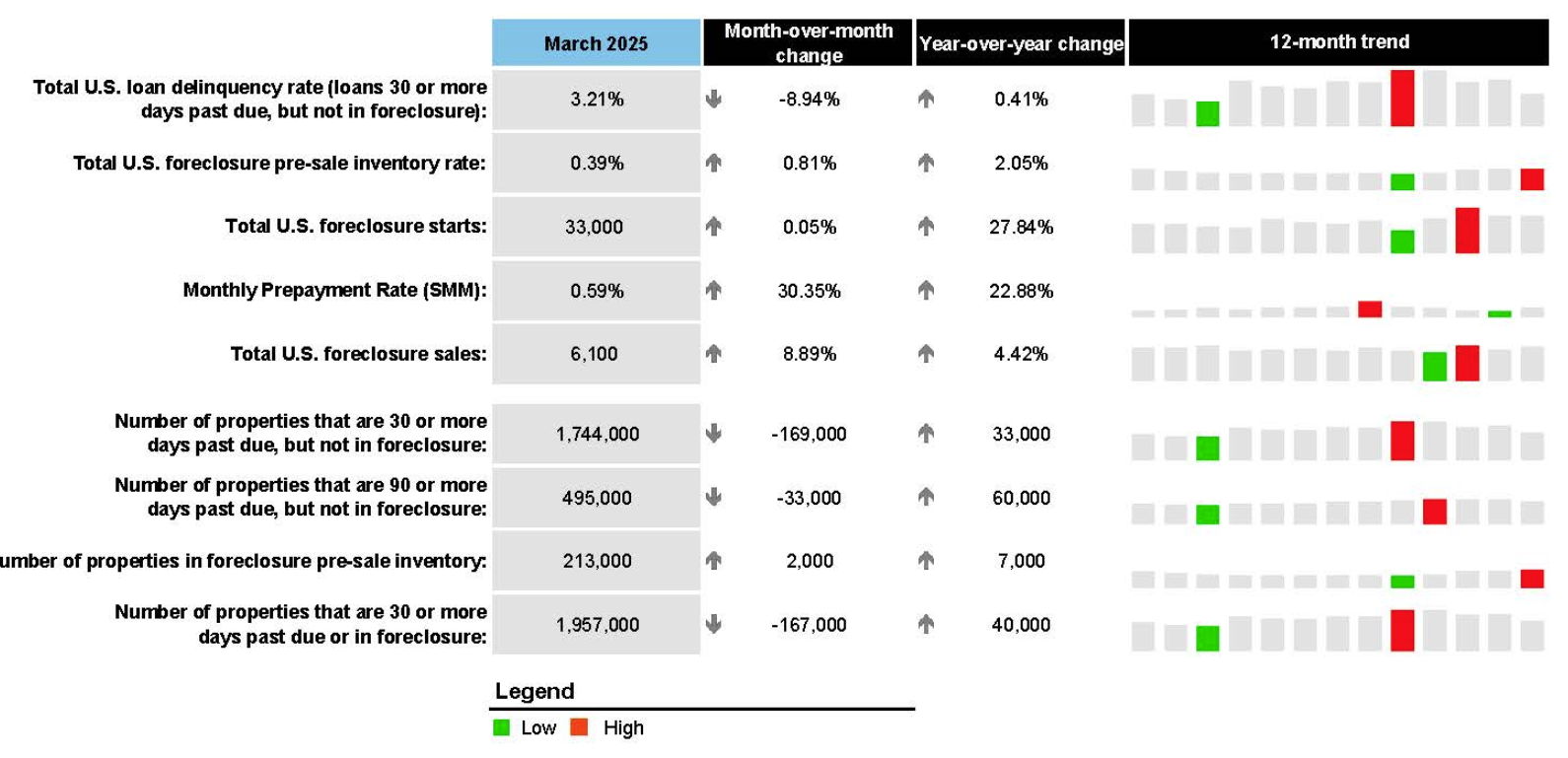 Click on graph for larger image.
Here is a table from ICE.
Hotels: Occupancy Rate Decreased 2.4% Year-over-year
by Calculated Risk on 6/24/2025 01:16:00 PM
The U.S. hotel industry reported mostly negative year-over-year comparisons, according to CoStar’s latest data through 14 June. ...The following graph shows the seasonal pattern for the hotel occupancy rate using the four-week average.
8-14 June 2025 (percentage change from comparable week in 2024):
• Occupancy: 68.6% (-2.4%)
• Average daily rate (ADR): US$163.43 (+0.6%)
• Revenue per available room (RevPAR): US$112.11 (-1.8%)
emphasis added
 Click on graph for larger image.
The red line is for 2025, blue is the median, and dashed light blue is for 2024. Dashed purple is for 2018, the record year for hotel occupancy.
The 4-week average of the occupancy rate is tracking behind both last year and the median rate for the period 2000 through 2024 (Blue).
Note: Y-axis doesn't start at zero to better show the seasonal change.
The 4-week average will increase during the summer travel season; however, we will likely see a hit to occupancy during the summer months due to less international tourism.
Newsletter: Case-Shiller: National House Price Index Up 2.7% year-over-year in April
by Calculated Risk on 6/24/2025 09:39:00 AM
Today, in the Calculated Risk Real Estate Newsletter: Case-Shiller: National House Price Index Up 2.7% year-over-year in April
Excerpt:
S&P/Case-Shiller released the monthly Home Price Indices for April ("April" is a 3-month average of February, March and April closing prices). February closing prices include some contracts signed in December, so there is a significant lag to this data. Here is a graph of the month-over-month (MoM) change in the Case-Shiller National Index Seasonally Adjusted (SA).
The MoM decrease in the seasonally adjusted (SA) Case-Shiller National Index was at -0.51% (a -4.8% annual rate). This was the second consecutive MoM decrease.
On a seasonally adjusted basis, prices increased month-to-month in just 5 of the 20 Case-Shiller cities. San Francisco has fallen 6.4% from the recent peak, Tampa is down 2.7% from the peak, and Denver down 2.0%.




