
 RSS Feed
 by Calculated Risk on 5/02/2025 08:30:00 AM
Friday, May 02, 2025
April Employment Report: 177 thousand Jobs, 4.2% Unemployment Rate
From the BLS: Employment Situation
Total nonfarm payroll employment increased by 177,000 in April, and the unemployment rate was unchanged at 4.2 percent, the U.S. Bureau of Labor Statistics reported today. Employment continued to trend up in health care, transportation and warehousing, financial activities, and social assistance. Federal government employment declined.
...
The change in total nonfarm payroll employment for February was revised down by 15,000, from +117,000 to +102,000, and the change for March was revised down by 43,000, from +228,000 to +185,000. With these revisions, employment in February and March combined is 58,000 lower than previously reported.
emphasis added
 Click on graph for larger image.
The first graph shows the jobs added per month since January 2021.
Total payrolls increased by 177 thousand in April. Private payrolls increased by 167 thousand, and public payrolls increased 10 thousand (Federal payrolls decreased 9 thousand).
Payrolls for February and March were revised down by 58 thousand, combined.
Payrolls for February and March were revised down by 58 thousand, combined.
 The second graph shows the year-over-year change in total non-farm employment since 1968.
In April, the year-over-year change was 1.88 million jobs. Employment was up solidly year-over-year.
The third graph shows the employment population ratio and the participation rate.
 The Labor Force Participation Rate increased to 62.6% in April, from 62.5% in March. This is the percentage of the working age population in the labor force.
 The Employment-Population ratio increased to 60.0% from 59.9% in March (blue line).
I'll post the 25 to 54 age group employment-population ratio graph later.
 The fourth graph shows the unemployment rate.
 The unemployment rate was unchanged at 4.2% in April from 4.2% in March.
This was above consensus expectations; however, February and March payrolls were revised down by 58,000 combined.
Thursday, May 01, 2025
Friday: Employment Report
by Calculated Risk on 5/01/2025 09:04:00 PM
 Note: Mortgage rates are from MortgageNewsDaily.com and are for top tier scenarios.
Thursday:
• At 8:30 AM ET, Employment Report for April. The consensus is for 130,000 jobs added, and for the unemployment rate to be unchanged at 4.2%.
Light Vehicles Sales "Beat the tariff" at 17.3 million SAAR in April
by Calculated Risk on 5/01/2025 05:08:00 PM
Wards Auto released their estimate of light vehicle sales for April: Tariff-Induced Buying Pumps U.S. Light-Vehicle Sales for Second Month in April (pay site).
Tariff-related buying lifted sales over the past two months to a seasonally adjusted annual selling rate of 17.6 million, well above the roughly 16.0 million they would have totaled otherwise. There was some indication that the surge was decelerating by the end of the month, probably due to tariff “exuberance” starting to dry up and because of a drain to inventory. There was more strength, in general, in demand for fullsize and luxury-segment trucks than for more affordable vehicles, including cars and small and midsize CUVs and SUVs.
 Click on graph for larger image.
This graph shows light vehicle sales since 2006 from the BEA (blue) and Wards' estimate for April (red).
Sales in April (17.27 million SAAR) were down 2.8% from March, and up 7.7% from April 2024.
Sales in April were above the consensus forecast.
Sales in April were above the consensus forecast.
The second graph shows light vehicle sales since the BEA started keeping data in 1967.

This "beat the tariff" induced surge in buying was the best April since 2021.
April Employment Preview
by Calculated Risk on 5/01/2025 03:05:00 PM
On Friday at 8:30 AM ET, the BLS will release the employment report for April. The consensus is for 130,000 jobs added, and for the unemployment rate to be unchanged at 4.2%. There were 228,000 jobs added in March, and the unemployment rate was at 4.2%.
From Goldman Sachs:
We forecast that payrolls rose 140k in April (vs. consensus +130k) and the unemployment rate was flat at 4.2%. ... Big data indicators suggest slower but still healthy job growth in April. We expect a 15k decline in federal government payrolls and a slower but still positive 15k increase in state and local payrolls. We think April was probably too early to see large negative trade war or policy uncertainty effects on hiring.From BofA:
emphasis added
Apr payrolls are likely to rise by a robust 165k, higher than consensus expectations of 130k. Government job growth is expected to come in at 10k due to the federal hiring freeze/DOGE. Given the muted claims data in the survey week, we do not expect DOGE driven job cuts to be a sizable drag. Immigration restrictions are likely to weigh on payrolls in the coming months but we don’t think they’ll have a substantial impact in Apr. That said, risks are to the downside. We expect the u-rate to remain at 4.2%.• ADP Report: The ADP employment report showed 62,000 private sector jobs were added in April. This was well below consensus forecasts and suggests job gains below consensus expectations, however, in general, ADP hasn't been very useful in forecasting the BLS report.
• ISM Surveys: Note that the ISM indexes are diffusion indexes based on the number of firms hiring (not the number of hires). The ISM® manufacturing employment index 46.5%, up from 44.7% the previous month. This would suggest about 40,000 jobs lost in manufacturing. The ADP report indicated 4,000 manufacturing jobs added in April.
The ISM® services employment index will be released next week.
• Unemployment Claims: The weekly claims report showed about the same initial unemployment claims during the reference week at 216,000 inApril compared to 225,000 in March. This suggests layoffs in April were about the same or a little less as in March.
• Conclusion: Over the last year, employment gains averaged 157 thousand per month - and that was probably the trend prior to policy changes. It still seems early for the government (DOGE) layoffs and tariff related layoffs to impact the employment report. However, my guess is we will start to see the impact of policy uncertainty impacting employment - a little - and I'll take the under for April.
Inflation Adjusted House Prices 0.8% Below 2022 Peak; Price-to-rent index is 7.5% below 2022 peak
by Calculated Risk on 5/01/2025 01:15:00 PM
Today, in the Calculated Risk Real Estate Newsletter: Inflation Adjusted House Prices 0.8% Below 2022 Peak
Excerpt:
It has been over 18 years since the housing bubble peak. In the February Case-Shiller house price index released this week, the seasonally adjusted National Index (SA), was reported as being 79% above the bubble peak in 2006. However, in real terms, the National index (SA) is about 12% above the bubble peak (and historically there has been an upward slope to real house prices). The composite 20, in real terms, is 3% above the bubble peak.There is much more in the article!
People usually graph nominal house prices, but it is also important to look at prices in real terms. As an example, if a house price was $300,000 in January 2010, the price would be $441,000 today adjusted for inflation (47% increase). That is why the second graph below is important - this shows "real" prices.
The third graph shows the price-to-rent ratio, and the fourth graph is the affordability index. The last graph shows the 5-year real return based on the Case-Shiller National Index.
...
The second graph shows the same two indexes in real terms (adjusted for inflation using CPI).
In real terms (using CPI), the National index is 0.8% below the recent peak, and the Composite 20 index is 1.1% below the recent peak in 2022.
Both the real National index and the Comp-20 index increased slightly in February.
It has now been 33 months since the real peak in house prices. Typically, after a sharp increase in prices, it takes a number of years for real prices to reach new highs (see House Prices: 7 Years in Purgatory)

Construction Spending Decreased 0.5% in March
by Calculated Risk on 5/01/2025 10:17:00 AM
From the Census Bureau reported that overall construction spending decreased:
Construction spending during March 2025 was estimated at a seasonally adjusted annual rate of $2,196.1 billion, 0.5 percent below the revised February estimate of $2,206.9 billion. The March figure is 2.8 percent above the March 2024 estimate of $2,135.8 billion.Both private and public spending increased:
emphasis added
Spending on private construction was at a seasonally adjusted annual rate of $1,688.0 billion, 0.6 percent below the revised February estimate of $1,697.7 billion. ...
In March, the estimated seasonally adjusted annual rate of public construction spending was $508.1 billion, 0.2 percent below the revised February estimate of $509.2 billion.
 Click on graph for larger image.
This graph shows private residential and nonresidential construction spending, and public spending, since 1993. Note: nominal dollars, not inflation adjusted.
Private residential (red) spending is 4.4% below the peak in 2022.
Private non-residential (blue) spending is 0.8% below the peak in February 2025.
Public construction spending (orange) is slightly 0.2% the peak the previous month.
 The second graph shows the year-over-year change in construction spending.
On a year-over-year basis, private residential construction spending is up 2.8%. Private non-residential spending is up 1.6% year-over-year. Public spending is up 4.7% year-over-year.
This was below consensus expectations; however, spending for the previous two months was revised up.
ISM® Manufacturing index Decreased to 48.7% in April
by Calculated Risk on 5/01/2025 10:00:00 AM
(Posted with permission). The ISM manufacturing index indicated expansion. The PMI® was at 48.7% in April, down from 49.0% in March. The employment index was at 46.5%, up from 44.7% the previous month, and the new orders index was at 47.2%, up from 45.2%.
From ISM: Manufacturing PMI® at 48.7% April 2025 Manufacturing ISM® Report On Business®
Economic activity in the manufacturing sector contracted in April for the second month in a row, following a two-month expansion preceded by 26 straight months of contraction, say the nation's supply executives in the latest Manufacturing ISM® Report On Business®.This suggests manufacturing contracted in April. This was slightly above the consensus forecast, however new export orders were weak and prices very strong.
The report was issued today by Timothy R. Fiore, CPSM, C.P.M., Chair of the Institute for Supply Management® (ISM®) Manufacturing Business Survey Committee:
“The Manufacturing PMI® registered 48.7 percent in April, 0.3 percentage point lower compared to the 49 percent recorded in March. The overall economy continued in expansion for the 60th month after one month of contraction in April 2020. (A Manufacturing PMI® above 42.3 percent, over a period of time, generally indicates an expansion of the overall economy.) The New Orders Index contracted for the third month in a row following a three-month period of expansion; the figure of 47.2 percent is 2 percentage points higher than the 45.2 percent recorded in March. The April reading of the Production Index (44 percent) is 4.3 percentage points lower than March’s figure of 48.3 percent. The index returned to contraction last month after two months of expansion preceded by eight months of contraction. The Prices Index remained in expansion (or ‘increasing’) territory, registering 69.8 percent, up 0.4 percentage point compared to the reading of 69.4 percent in March. The Backlog of Orders Index registered 43.7 percent, down 0.8 percentage point compared to the 44.5 percent recorded in March. The Employment Index registered 46.5 percent, up 1.8 percentage points from March’s figure of 44.7 percent.
“The Supplier Deliveries Index indicated a continued slowing of deliveries, registering 55.2 percent, 1.7 percentage points higher than the 53.5 percent recorded in March. (Supplier Deliveries is the only ISM® Report On Business® index that is inversed; a reading of above 50 percent indicates slower deliveries, which is typical as the economy improves and customer demand increases.) The Inventories Index registered 50.8 percent, down 2.6 percentage points compared to March’s reading of 53.4 percent. The index indicated expansion for a second consecutive month after six months of contraction.
“The New Export Orders Index reading of 43.1 percent is 6.5 percentage points lower than the reading of 49.6 percent registered in March. The Imports Index dropped into contraction in April, registering 47.1 percent, 3 percentage points lower than March’s reading of 50.1 percent.”
emphasis added
Weekly Initial Unemployment Claims Increase to 241,000
by Calculated Risk on 5/01/2025 08:30:00 AM
The DOL reported:
In the week ending April 26, the advance figure for seasonally adjusted initial claims was 241,000, an increase of 18,000 from the previous week's revised level. The previous week's level was revised up by 1,000 from 222,000 to 223,000. The 4-week moving average was 226,000, an increase of 5,500 from the previous week's revised average. The previous week's average was revised up by 250 from 220,250 to 220,500.The following graph shows the 4-week moving average of weekly claims since 1971.
emphasis added
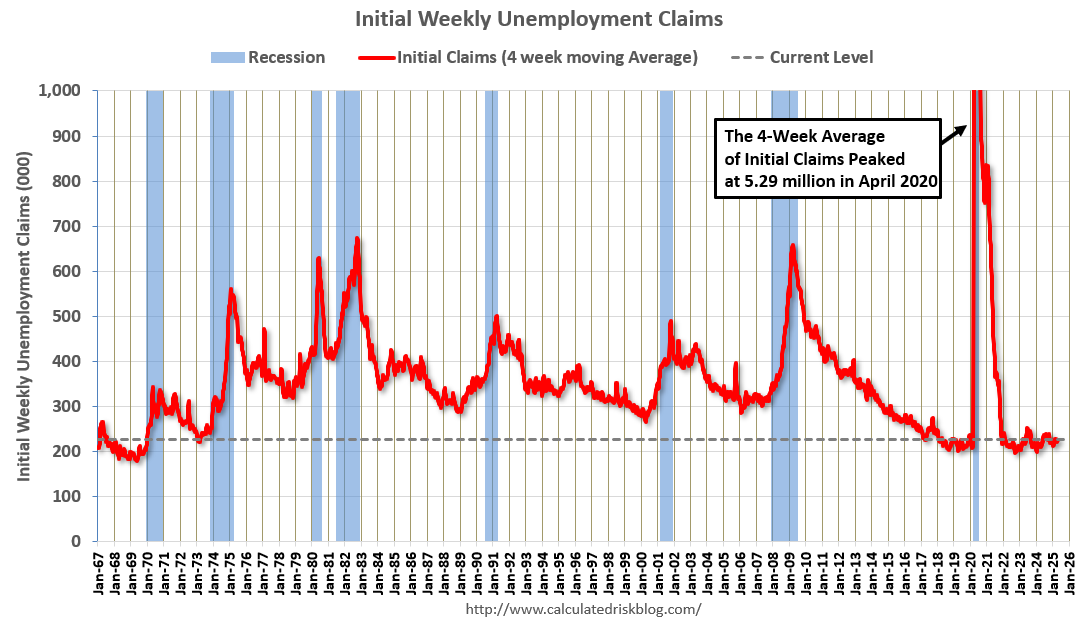 Click on graph for larger image.
The dashed line on the graph is the current 4-week average. The four-week average of weekly unemployment claims increased to 226,000.
The previous week was revised up.
Weekly claims were above the consensus forecast.
Wednesday, April 30, 2025
Thursday: Unemployment Claims, ISM Mfg, Construction Spending, Vehicle Sales
by Calculated Risk on 4/30/2025 07:54:00 PM
 Note: Mortgage rates are from MortgageNewsDaily.com and are for top tier scenarios.
Thursday:
• At 8:30 AM ET, The initial weekly unemployment claims report will be released. The consensus is for initial claims of 218 thousand, down from 222 thousand last week.
• At 10:00 AM ET, ISM Manufacturing Index for April. The consensus is for the ISM to be at 48.1, down from 49.0 in March.
• Also at 10:00 AM, Construction Spending for March. The consensus is for a 0.3% increase in construction spending.
• All day, Light vehicle sales for April. The consensus expectation is for light vehicle sales to be 16.8 million SAAR in April, down from 17.8 million in March (Seasonally Adjusted Annual Rate). The WardsAuto estimate is for sales of 17.4 million SAAR in April.
Freddie Mac House Price Index Mostly Unchanged in March; Up 3.0% Year-over-year
by Calculated Risk on 4/30/2025 12:45:00 PM
Today, in the Calculated Risk Real Estate Newsletter: Freddie Mac House Price Index Mostly Unchanged in March; Up 3.0% Year-over-year
A brief excerpt:
Freddie Mac reported that its “National” Home Price Index (FMHPI) increased 0.01% month-over-month on a seasonally adjusted (SA) basis in March. On a year-over-year basis, the National FMHPI was up 3.0% in March, down from up 3.4% YoY in February. The YoY increase peaked at 19.0% in July 2021, and for this cycle, bottomed at up 0.9% YoY in May 2023. ...There is much more in the article!
As of March, 25 states and D.C. were below their previous peaks, Seasonally Adjusted. The largest seasonally adjusted declines from the recent peaks are in D.C. (-4.9), Oregon (-1.6%), Arkansas (-1.6%), Delaware (-1.3%), Idaho (-1.2%) and Oklahoma (-1.2%).
For cities (Core-based Statistical Areas, CBSA), here are the 30 cities with the largest declines from the peak, seasonally adjusted. Austin continues to be the worst performing city. However, 10 of the 19 cities with the largest price declines are in Florida.

PCE Measure of Shelter Decreases Slightly to 4.3% YoY in March
by Calculated Risk on 4/30/2025 10:30:00 AM
Here is a graph of the year-over-year change in shelter from the CPI report and housing from the PCE report this morning, both through March 2025.
 CPI Shelter was up 4.0% year-over-year in March, down from 4.2% in February, and down from the cycle peak of 8.2% in March 2023.
Housing (PCE) was up 4.3% YoY in March, down slightly from 4.3% in February and down from the cycle peak of 8.3% in April 2023.
Since asking rents are mostly flat year-over-year, these measures will slowly continue to decline over the next year as rents for existing tenants continue to increase.
Since asking rents are mostly flat year-over-year, these measures will slowly continue to decline over the next year as rents for existing tenants continue to increase.
 The second graph shows PCE prices, Core PCE prices and Core ex-housing over the last 3 months (annualized):
Key measures are above the Fed's target on a 3-month basis.
3-month annualized change:
PCE Price Index: 3.1%
Core PCE Prices: 3.5%
Core minus Housing: 3.4%
Core PCE Prices: 3.5%
Core minus Housing: 3.4%
Note: It is likely there is still some residual seasonality distorting PCE prices in Q1.
Personal Income increased 0.5% in March; Spending increased 0.7%
by Calculated Risk on 4/30/2025 10:15:00 AM
The BEA released the Personal Income and Outlays report for March:
Personal income increased $116.8 billion (0.5 percent at a monthly rate) in March, according to estimates released today by the U.S. Bureau of Economic Analysis. Disposable personal income (DPI)—personal income less personal current taxes—increased $102.0 billion (0.5 percent) and personal consumption expenditures (PCE) increased $134.5 billion (0.7 percent).The March PCE price index increased 2.3 percent year-over-year (YoY), down from 2.7 percent YoY in February, and down from the recent peak of 7.2 percent in June 2022.
Personal outlays—the sum of PCE, personal interest payments, and personal current transfer payments—increased $136.6 billion in March. Personal saving was $872.3 billion in March and the personal saving rate—personal saving as a percentage of disposable personal income—was 3.9 percent.
From the preceding month, the PCE price index for March decreased less than 0.1 percent. Excluding food and energy, the PCE price index increased less than 0.1 percent.
From the same month one year ago, the PCE price index for March increased 2.3 percent. Excluding food and energy, the PCE price index increased 2.6 percent from one year ago.
emphasis added
The PCE price index, excluding food and energy, increased 2.6 percent YoY, down from 3.0 percent in January, and down from the recent peak of 5.6 percent in February 2022.
The following graph shows real Personal Consumption Expenditures (PCE) through March 2025 (2017 dollars). Note that the y-axis doesn't start at zero to better show the change.
 Click on graph for larger image.
The dashed red lines are the quarterly levels for real PCE.
Personal income and PCE were above expectations.
The following graph shows real Personal Consumption Expenditures (PCE) through March 2025 (2017 dollars). Note that the y-axis doesn't start at zero to better show the change.
 Click on graph for larger image.
The dashed red lines are the quarterly levels for real PCE.
Personal income and PCE were above expectations.
Inflation was below expectations.
NAR: Pending Home Sales Increase 6.1% in March; Down 0.6% YoY
by Calculated Risk on 4/30/2025 10:00:00 AM
From the NAR: Pending Home Sales Jumped 6.1% in March
Pending home sales increased 6.1% in March – the greatest month-to-month increase since December 2023 (+7.0%) – according to the National Association of REALTORS®. The Northeast experienced month-over-month losses in transactions, while the Midwest, South and West saw gains, which were most substantial in the South. Year-over-year, contract signings grew in the Midwest but fell in the Northeast, South and West – with the Northeast undergoing the greatest decrease.Note: Contract signings usually lead sales by about 45 to 60 days, so this would usually be for closed sales in April and May.
The Pending Home Sales Index (PHSI)* – a forward-looking indicator of home sales based on contract signings – augmented 6.1% to 76.5 in March. Year-over-year, pending transactions lessened by 0.6%. An index of 100 is equal to the level of contract activity in 2001.
"Home buyers are acutely sensitive to even minor fluctuations in mortgage rates," said NAR Chief Economist Lawrence Yun. "While contract signings are not a guarantee of eventual closings, the solid rise in pending home sales implies a sizable build-up of potential home buyers, fueled by ongoing job growth."
...
The Northeast PHSI dropped 0.5% from last month to 62.5, down 3.0% from March 2024. The Midwest index expanded 4.9% to 77.7 in March, up 1.4% from the previous year.
The South PHSI soared 9.8% to 94.1 in March, down 0.4% from a year ago. The West index climbed 4.8% from the prior month to 58.6, down 2.0% from March 2024.
emphasis added
BEA: Real GDP decreased at 0.3% Annualized Rate in Q1
by Calculated Risk on 4/30/2025 08:30:00 AM
From the BEA: Gross Domestic Product, 1st Quarter 2025 (Advance Estimate)
Real gross domestic product (GDP) decreased at an annual rate of 0.3 percent in the first quarter of 2025 (January, February, and March), according to the advance estimate released by the U.S. Bureau of Economic Analysis. In the fourth quarter of 2024, real GDP increased 2.4 percent.PCE increased at a 1.8% annual rate, and residential investment increased at a 1.3% rate. The advance Q1 GDP report, with 0.3% annualized decrease, was below expectations.
The decrease in real GDP in the first quarter primarily reflected an increase in imports, which are a subtraction in the calculation of GDP, and a decrease in government spending. These movements were partly offset by increases in investment, consumer spending, and exports. ...
Compared to the fourth quarter, the downturn in real GDP in the first quarter reflected an upturn in imports, a deceleration in consumer spending, and a downturn in government spending that were partly offset by upturns in investment and exports.
Real final sales to private domestic purchasers, the sum of consumer spending and gross private fixed investment, increased 3.0 percent in the first quarter, compared with an increase of 2.9 percent in the fourth quarter.
The price index for gross domestic purchases increased 3.4 percent in the first quarter, compared with an increase of 2.2 percent in the fourth quarter. The personal consumption expenditures (PCE) price index increased 3.6 percent, compared with an increase of 2.4 percent. Excluding food and energy prices, the PCE price index increased 3.5 percent, compared with an increase of 2.6 percent.
emphasis added
I'll have more later ...
ADP: Private Employment Increased 62,000 in April
by Calculated Risk on 4/30/2025 08:15:00 AM
“Unease is the word of the day. Employers are trying to reconcile policy and consumer uncertainty with a run of mostly positive economic data,” said Dr. Nela Richardson, chief economist, ADP. “It can be difficult to make hiring decisions in such an environment.”This was well below the consensus forecast of 130,000. The BLS report will be released Friday, and the consensus is for 130,000 non-farm payroll jobs added in April.
emphasis added
MBA: Mortgage Applications Decrease in Latest MBA Weekly Survey
by Calculated Risk on 4/30/2025 07:00:00 AM
From the MBA: Mortgage Applications Decrease in Latest MBA Weekly Survey
Mortgage applications decreased 4.2 percent from one week earlier, according to data from the Mortgage Bankers Association’s (MBA) Weekly Mortgage Applications Survey for the week ending April 25, 2025.
The Market Composite Index, a measure of mortgage loan application volume, decreased 4.2 percent on a seasonally adjusted basis from one week earlier. On an unadjusted basis, the Index decreased 4 percent compared with the previous week. The Refinance Index decreased 4 percent from the previous week and was 42 percent higher than the same week one year ago. The seasonally adjusted Purchase Index decreased 4 percent from one week earlier. The unadjusted Purchase Index decreased 3 percent compared with the previous week and was 3 percent higher than the same week one year ago.
“Mortgage rates were little changed last week with the 30-year fixed rate at 6.89 percent. Mortgage application activity, particularly for home purchases, continues to be subdued by broader economic uncertainty and signs of labor market weakness, dropping to the slowest pace since February,” said Joel Kan, MBA’s Vice President and Deputy Chief Economist. “Even with the spring homebuying season underway, purchase applications decreased, as conventional and VA applications saw declines of 6 percent and 4 percent, respectively. With slowly-increasing housing inventory in many markets and first time homebuyers still in the mix, FHA purchase applications fared better with only a slight decline. Overall purchase applications continued to run ahead of last year’s pace.
Added Kan, “Refinance activity dipped again, as mortgage rates remained close to 7 percent, and borrowers hold out for a bigger decline in rates. Given the pullback in refinancing, the average loan size for refinances declined to just under $290,000, the lowest level in three months.”
...
The average contract interest rate for 30-year fixed-rate mortgages with conforming loan balances ($806,500 or less) decreased to 6.89 percent from 6.90 percent, with points increasing to 0.67 from 0.66 (including the origination fee) for 80 percent loan-to-value ratio (LTV) loans.
emphasis added
 Click on graph for larger image.
The first graph shows the MBA mortgage purchase index.
According to the MBA, purchase activity is up 3% year-over-year unadjusted.
Red is a four-week average (blue is weekly).
Purchase application activity is up from the lows in late October 2023 but is 3% below the lowest levels during the housing bust.

The second graph shows the refinance index since 1990.
The refinance index decreased and remained very low.
Tuesday, April 29, 2025
Wednesday: GDP, Personal Income and Outlays, Pending Home Sales
by Calculated Risk on 4/29/2025 07:11:00 PM
 Note: Mortgage rates are from MortgageNewsDaily.com and are for top tier scenarios.
Wednesday:
• At 7:00 AM ET, The Mortgage Bankers Association (MBA) will release the results for the mortgage purchase applications index.
• At 8:15 AM, The ADP Employment Report for April. This report is for private payrolls only (no government). The consensus is for 130,000 payroll jobs added in April, down from 155,000 added in March.
• At 8:30 AM, Gross Domestic Product, 1st quarter 2025 (Advance estimate). The consensus is that real GDP increased 0.4% annualized in Q1, down from 2.4% in Q4.
9:45 AM, Chicago Purchasing Managers Index for April. The consensus is for a reading of 45.5, down from 47.6 in March.
• At 10:00 AM, Personal Income and Outlays, March 2025. The consensus is for a 0.4% increase in personal income, and for a 0.6% increase in personal spending. And for the Core PCE price index to increase 0.1%. PCE prices are expected to be up 2.6% YoY, and core PCE prices up 2.2% YoY.
• Also at 10:00 AM, Pending Home Sales Index for March. The consensus is for a 1.0% increase in the index.
Las Vegas in March: Visitor Traffic Down 7.8% YoY; Convention Traffic Up 10.2% YoY
by Calculated Risk on 4/29/2025 03:32:00 PM
From the Las Vegas Visitor Authority: March 2025 Las Vegas Visitor Statistics
With a slightly less‐packed event calendar and as‐yet unclear impacts of evolving federal policies rippling thru international and domestic markets, visitation saw a ‐7.8% YoY decline as the destination hosted approximately 3.39 million visitors in March.
Rotation cycles helped convention attendance in March as the destination hosted roughly 534k attendees for the month, up 10.2% YoY, reflecting in part the calendar impact of the in‐rotation of the Healthcare Information & Management Systems Society conference (48k attendees) which was held elsewhere last year.
Occupancy reached 82.9%, down ‐2.4 pts with Weekend occupancy of 90.8% (down ‐1.0 pts) and Midweek occupancy of 79.7% (down ‐2.5 pts). ADR for the month reached $184 (+3.1% YoY) with RevPAR of $152 (+0.2% YoY).
emphasis added
 Click on graph for larger image.
 The first graph shows visitor traffic for 2019 (Black), 2020 (dark blue), 2021 (light blue), 2022 (light orange), 2023 (orange), 2024 (dark orange) and 2025 (red).
Visitor traffic was down 7.8% compared to last March. Visitor traffic was down 8.4% compared to March 2019.
Year-to-date (YTD) visitor traffic is down 10.4% compared to the same period in 2019.
 Convention traffic was up 10.2% compared to March 2024, and down 17.8% compared to March 2019.
The second graph shows convention traffic.

YTD convention traffic is down 5.8% compared to 2019.
"Inside the Auto Tariff Battle: What Washington Is Not Saying Out Loud"
by Calculated Risk on 4/29/2025 01:28:00 PM
This substack is from a auto industry insider: Inside the Auto Tariff Battle: What Washington Is Not Saying Out Loud
A friend of mine who lives in the thick of Washington called me this week. What he said made me sit up straight.CR Note: From ABC News this morning: Trump to ease tariffs faced by US automakers
The news is spinning a safe version of what is happening.
They are missing the real pulse.
Right now, April 2025, the Trump administration has dropped a hammer.
...
Some midsize SUVs and pickup trucks are quietly getting new sticker prices.
The big jump is expected by June.
Most insiders are whispering five to fifteen percent increases depending on the model.
Some high-volume imports could climb even higher.
President Donald Trump is set to provide tariff relief for carmakers on Tuesday, just weeks after the onset of auto levies triggered warnings of price increases.
An administration official confirmed that the 25% tariff on finished foreign-made cars and parts will remain -- but today's announcement will prevent tariffs from stacking on top of other tariffs he's imposed, such as duties on steel and aluminum.
Trump's 25% tariff on foreign auto parts goes into effect on Saturday and automakers will also be reimbursed for those tariffs up to an amount equal to 3.75% of the value of a U.S.-made car for one year. Reimbursement would fall to 2.5% of the car's value in a second year, and then completely phased out altogether.
emphasis added
BLS: Job Openings Decreased to 7.2 million in March
by Calculated Risk on 4/29/2025 10:00:00 AM
From the BLS: Job Openings and Labor Turnover Summary
The number of job openings was little changed at 7.2 million in March, the U.S. Bureau of Labor Statistics reported today. Over the month, hires held at 5.4 million, and total separations changed little at 5.1 million. Within separations, quits (3.3 million) were unchanged and layoffs and discharges (1.6 million) edged down.The following graph shows job openings (black line), hires (dark blue), Layoff, Discharges and other (red column), and Quits (light blue column) from the JOLTS.
emphasis added
This series started in December 2000.
Note: The difference between JOLTS hires and separations is similar to the CES (payroll survey) net jobs headline numbers. This report is for March; the employment report this Friday will be for April.
 Click on graph for larger image.
Note that hires (dark blue) and total separations (red and light blue columns stacked) are usually pretty close each month. This is a measure of labor market turnover. When the blue line is above the two stacked columns, the economy is adding net jobs - when it is below the columns, the economy is losing jobs.
The spike in layoffs and discharges in March 2020 is labeled, but off the chart to better show the usual data.
Jobs openings decreased in March to 7.19 million from 7.48 million in February.
The number of job openings (black) were down 11% year-over-year.
Quits were unchanged year-over-year. These are voluntary separations. (See light blue columns at bottom of graph for trend for "quits").



