
 RSS Feed
 by Calculated Risk on 4/24/2025 08:30:00 AM
Thursday, April 24, 2025
Weekly Initial Unemployment Claims Increase to 222,000
The DOL reported:
In the week ending April 19, the advance figure for seasonally adjusted initial claims was 222,000, an increase of 6,000 from the previous week's revised level. The previous week's level was revised up by 1,000 from 215,000 to 216,000. The 4-week moving average was 220,250, a decrease of 750 from the previous week's revised average. The previous week's average was revised up by 250 from 220,750 to 221,000.The following graph shows the 4-week moving average of weekly claims since 1971.
emphasis added
 Click on graph for larger image.
The dashed line on the graph is the current 4-week average. The four-week average of weekly unemployment claims decreased to 220,250.
The previous week was revised up.
Weekly claims were close to the consensus forecast.
Wednesday, April 23, 2025
Thursday: Unemployment Claims, Durable Goods, Existing Home Sales
by Calculated Risk on 4/23/2025 08:36:00 PM
 Note: Mortgage rates are from MortgageNewsDaily.com and are for top tier scenarios.
Thursday:
• At 8:30 AM ET, The initial weekly unemployment claims report will be released. Initial claims were at 215 thousand last week.
• Also at 8:30 AM, Durable Goods Orders for March from the Census Bureau. The consensus is for a 0.8% increase in durable goods orders.
• Also at 8:30 AM, Chicago Fed National Activity Index for March. This is a composite index of other data.
• At 10:00 AM, Existing Home Sales for March from the National Association of Realtors (NAR). The consensus is for 4.14 million SAAR, down from 4.26 million.
• At 11:00 AM, the Kansas City Fed manufacturing survey for April.
April Vehicle Forecast: Sales at 17.4 million SAAR, Up 8.6% YoY
by Calculated Risk on 4/23/2025 06:31:00 PM
From WardsAuto: Pre-Tariff U.S. Light-Vehicle Sales Surge Continues in April, Sapping Dealer Inventory (pay content). Brief excerpt:
If the forecast holds firm, inventory will fall below the year-ago month for the first time in nearly three years. Less inventory could take pressure off automakers and dealers to limit price hikes by absorbing some of the higher costs caused by tariffs, if they remain in place. Conversely, it also means a higher mix of pricier vehicles on dealer lots and lower sales volumes – and automakers, at least for now, are more inclined to emphasize production cuts, and not big discounts to consumers, to manage inventory in the face of weakening demand.
emphasis added
 Click on graph for larger image.
This graph shows actual sales from the BEA (Blue), and Wards forecast for April (Red).
On a seasonally adjusted annual rate basis, the Wards forecast of 17.4 million SAAR, would be down 2.1% from last month, and up 8.6% from a year ago.
Car buyers have rushed to buy over the last couple of months to beat the tariffs. There will be payback in coming months.
AIA: "Business conditions at architecture firms soften further"
by Calculated Risk on 4/23/2025 06:06:00 PM
Note: This index is a leading indicator primarily for new Commercial Real Estate (CRE) investment.
From the AIA: ABI March 2025: Business conditions at architecture firms soften further
The ABI/Deltek Architecture Billings Index dipped further from February to 44.1 in March, as even more firms reported a decline in billings from the previous month. Since the ABI first dropped below 50 in October 2022, following the post-pandemic boom, billings have declined 27 of the last 30 months. Unfortunately, this softness is likely to continue as indicators of future work remain weak. Inquiries into new work declined for the second month in March, while the value of newly signed design contracts fell for the thirteenth consecutive month. Clients are increasingly nervous about the uncertain economic outlook, and many remain wary of starting new projects at this time. However, backlogs at architecture firms remain reasonably healthy at 6.5 months, on average, which means that even though little new work is coming in currently, they still have a decent amount in the pipeline.• Northeast (40.5); Midwest (45.5); South (48.3); West (43.0)
Firm billings continued to decline in all regions of the country in March as well. Billings were softest at firms located in the Northeast for the sixth consecutive month but also weakened further at firms located in the West and Midwest. Firms located in the South reported the smallest decline in billings. Business conditions also remained weak at firms of all specializations, with firms with a multifamily residential specialization continuing to report the softest conditions. Billings were trending stronger at firms with an institutional specialization late last year but have softened significantly since then.
...
The ABI score is a leading economic indicator of construction activity, providing an approximately nine-to-twelve-month glimpse into the future of nonresidential construction spending activity. The score is derived from a monthly survey of architecture firms that measures the change in the number of services provided to clients.
emphasis added
• Sector index breakdown: commercial/industrial (46.9); institutional (46.4); multifamily residential (40.3)
 Click on graph for larger image.
This graph shows the Architecture Billings Index since 1996. The index was at 45.5 in February, down from 45.6 in January. Anything below 50 indicates a decrease in demand for architects' services.
This index has indicated contraction for 27 of the last 30 months.
Note: This includes commercial and industrial facilities like hotels and office buildings, multi-family residential, as well as schools, hospitals and other institutions.
This index usually leads CRE investment by 9 to 12 months, so this index suggests a slowdown in CRE investment throughout 2025 and into 2026.
Note: This includes commercial and industrial facilities like hotels and office buildings, multi-family residential, as well as schools, hospitals and other institutions.
This index usually leads CRE investment by 9 to 12 months, so this index suggests a slowdown in CRE investment throughout 2025 and into 2026.
Multi-family billings remained negative has been negative for the last 32 months. This suggests we will see continued weakness in multi-family starts.
U.S. Births Increased in 2024
by Calculated Risk on 4/23/2025 02:17:00 PM
From the National Center for Health Statistics: Births: Provisional Data for 2024. The NCHS reports:
The provisional number of births for the United States in 2024 was 3,622,673, up 1% from 2023. The general fertility rate was 54.6 births per 1,000 females ages 15–44, an increase of less than 1% from 2023. The total fertility rate was 1,626.5 births per 1,000 women in 2024, an increase of less than 1% from 2023. Birth rates declined for females in 5-year age groups 15–24, rose for women in age groups 25–44, and were unchanged for females ages 10–14 and for women ages 45–49 in 2024. The birth rate for teenagers ages 15–19 declined by 3% in 2024 to 12.7 births per 1,000 females; the rates for younger (15–17) and older (18–19) teenagers declined 4% and 3%, respectively.Here is a long-term graph of annual U.S. births through 2023.
emphasis added
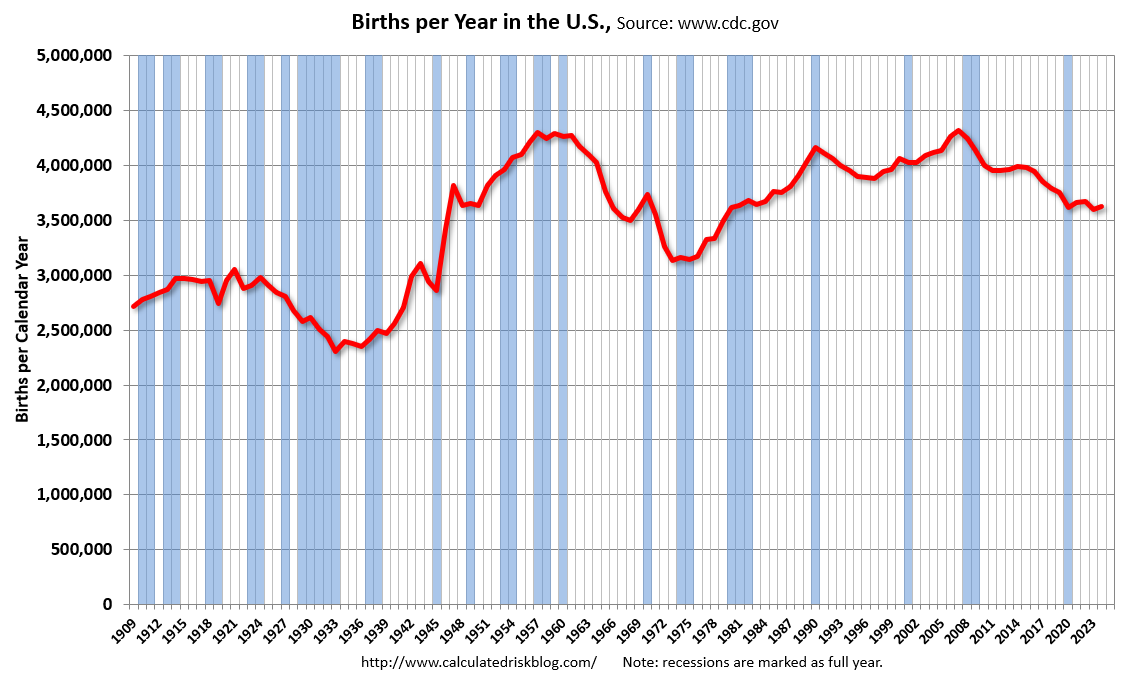 Click on graph for larger image.
Births peaked in 2007 and have generally declined since then.
Note the amazing decline in teenage births.
There is much more in the report.
Fed's Beige Book: "Economic outlook worsened considerably"
by Calculated Risk on 4/23/2025 02:03:00 PM
Economic activity was little changed since the previous report, but uncertainty around international trade policy was pervasive across reports. Just five Districts saw slight growth, three Districts noted activity was relatively unchanged, and the remaining four Districts reported slight to modest declines. Non-auto consumer spending was lower overall; however, most Districts saw moderate to robust sales of vehicles and of some nondurables, generally attributed to a rush to purchase ahead of tariff-related price increases. Both leisure and business travel were down, on balance, and several Districts noted a decline in international visitors. Home sales rose somewhat, and many Districts continued to note low inventory levels. Commercial real estate (CRE) activity expanded slightly as multifamily propped up the industrial and office sectors. Loan demand was flat to modestly higher, on net. Several Districts saw a deterioration in demand for non-financial services. Transportation activity expanded modestly, on balance. Manufacturing was mixed, but two-thirds of Districts said activity was little changed or had declined. The energy sector experienced modest growth. Agricultural conditions were fairly stable across multiple Districts. Cuts to federal grants and subsidies along with declines in philanthropic donations caused gaps in services provided by many community organizations. The outlook in several Districts worsened considerably as economic uncertainty, particularly surrounding tariffs, rose.
Labor Markets
Employment was little changed to up slightly in most Districts, with one District reporting a modest increase, four reporting a slight increase, four reporting no change, and three reporting a slight decline. This is a slight deterioration from the previous report with a few more Districts reporting declines. Hiring was generally slower for consumer-facing firms than for business-to-business firms. The most notable declines in headcount were in government roles or roles at organizations receiving government funding. Several Districts reported that firms were taking a wait-and-see approach to employment, pausing or slowing hiring until there is more clarity on economic conditions. In addition, there were scattered reports of firms preparing for layoffs. Most Districts and markets reported an improvement in overall labor availability, although there were some reports of constraints on labor supply resulting from shifting immigration policies in certain sectors and regions. Wages generally grew at a modest pace, as wage growth slowed from the previous report in multiple Districts.
Prices
Prices increased across Districts, with six characterizing price growth as modest and six characterizing it as moderate, similar to the previous report. Most Districts noted that firms expected elevated input cost growth resulting from tariffs. Many firms have already received notices from suppliers that costs would be increasing. Firms reported adding tariff surcharges or shortening pricing horizons to account for uncertain trade policy. Most businesses expected to pass through additional costs to customers. However, there were reports about margin compression amid increased costs, as demand remained tepid in some sectors, especially for consumer-facing firms.
emphasis added
Newsletter: New Home Sales Increase to 724,000 Annual Rate in March
by Calculated Risk on 4/23/2025 10:35:00 AM
Today, in the Calculated Risk Real Estate Newsletter: New Home Sales Increase to 724,000 Annual Rate in March
Brief excerpt:
The Census Bureau reported New Home Sales in March were at a seasonally adjusted annual rate (SAAR) of 724 thousand. The previous three months were revised down, combined.There is much more in the article.
...
The next graph shows new home sales for 2024 and 2025 by month (Seasonally Adjusted Annual Rate). Sales in March 2025 were up 6.0% from March 2024.
New home sales, seasonally adjusted, have increased year-over-year in 21 of the last 24 months. This is essentially the opposite of what happened with existing home sales that had been down year-over-year every month for 3+ years (existing home sales have been up year-over-year for the last 4 or the last 5 months).

New Home Sales Increase to 724,000 Annual Rate in March
by Calculated Risk on 4/23/2025 10:00:00 AM
The Census Bureau reports New Home Sales in March were at a seasonally adjusted annual rate (SAAR) of 724 thousand.
The previous three months were revised down, combined.
Sales of new single-family houses in March 2025 were at a seasonally-adjusted annual rate of 724,000, according to estimates released jointly today by the U.S. Census Bureau and the Department of Housing and Urban Development. This is 7.4 percent above the February 2025 rate of 674,000, and is 6.0 percent above the March 2024 rate of 683,000.
emphasis added
 Click on graph for larger image.
The first graph shows New Home Sales vs. recessions since 1963. The dashed line is the current sales rate.
New home sales were above pre-pandemic levels.
The second graph shows New Home Months of Supply.
 The months of supply decreased in March to 8.3 months from 8.9 months in February.
 The all-time record high was 12.2 months of supply in January 2009. The all-time record low was 3.3 months in August 2020.
This is well above the top of the normal range (about 4 to 6 months of supply is normal).
"The seasonally-adjusted estimate of new houses for sale at the end of March 2025 was 503,000. This is 0.6 percent above the February 2025 estimate of 500,000, and is 7.9 percent above the March 2024 estimate of 466,000.Sales were above expectations of 680 thousand SAAR, however sales for the three previous months were revised down, combined. I'll have more later today.
This represents a supply of 8.3 months at the current sales rate. The months' supply is 6.7 percent below the February 2025 estimate of 8.9 months, and is 1.2 percent above the March 2024 estimate of 8.2 months."
MBA: Mortgage Applications Decrease in Latest MBA Weekly Survey
by Calculated Risk on 4/23/2025 07:00:00 AM
From the MBA: Mortgage Applications Decrease in Latest MBA Weekly Survey
Mortgage applications decreased 12.7 percent from one week earlier, according to data from the Mortgage Bankers Association’s (MBA) Weekly Mortgage Applications Survey for the week ending April 18, 2025.
The Market Composite Index, a measure of mortgage loan application volume, decreased 12.7 percent on a seasonally adjusted basis from one week earlier. On an unadjusted basis, the Index decreased 11 percent compared with the previous week. The Refinance Index decreased 20 percent from the previous week and was 43 percent higher than the same week one year ago. The seasonally adjusted Purchase Index decreased 7 percent from one week earlier. The unadjusted Purchase Index decreased 6 percent compared with the previous week and was 6 percent higher than the same week one year ago.
“Overall mortgage application activity declined last week, as rates increased to their highest level in two months. The 30-year fixed rate rose for the second straight week to 6.9 percent, an almost 30-basis-point increase over two weeks,” said Joel Kan, MBA’s Vice President and Deputy Chief Economist. “These higher rates drove a 20 percent drop in refinance applications, especially for higher balance loans, with the average loan size falling substantially. The refinance share of applications at 37.3 percent was the lowest since January. Similar to the previous week, economic uncertainty and rate volatility impacted prospective homebuyers as we saw a 7 percent decline in purchase applications. Both conventional and government purchase activity fell relative to the week before, but the overall level of purchase applications was still 6 percent higher than a year ago.”
...
The average contract interest rate for 30-year fixed-rate mortgages with conforming loan balances ($806,500 or less) increased to 6.90 percent from 6.81 percent, with points increasing to 0.66 from 0.62 (including the origination fee) for 80 percent loan-to-value ratio (LTV) loans.
emphasis added
 Click on graph for larger image.
The first graph shows the MBA mortgage purchase index.
According to the MBA, purchase activity is up 6% year-over-year unadjusted.
Red is a four-week average (blue is weekly).
Purchase application activity is up about 22% from the lows in late October 2023 and is 2% above the lowest levels during the housing bust.

The second graph shows the refinance index since 1990.
The refinance index decreased.
Tuesday, April 22, 2025
Wednesday: New Home Sales, Architecture Billings Index, Beige Book
by Calculated Risk on 4/22/2025 07:44:00 PM
 Note: Mortgage rates are from MortgageNewsDaily.com and are for top tier scenarios.
Wednesday:
• At 7:00 AM ET, The Mortgage Bankers Association (MBA) will release the results for the mortgage purchase applications index.
• At 10:00 AM, New Home Sales for March from the Census Bureau. The consensus is for 680 thousand SAAR, up from 676 thousand in February.
• During the day, The AIA's Architecture Billings Index for March (a leading indicator for commercial real estate).
• At 2:00 PM, the Federal Reserve Beige Book, an informal review by the Federal Reserve Banks of current economic conditions in their Districts.
Goldman: "When Will Growth Slow, and When Will We Know?"
by Calculated Risk on 4/22/2025 12:49:00 PM
Goldman Sachs economists put out a note this morning: When Will Growth Slow, and When Will We Know?
A few brief excerpts:
Most of the sequential inflation increases in the last trade war took place within 2-3 months of the tariffs’ implementation, and we expect spending growth to slow shortly after prices start rising.It will take some time for tariffs and policy uncertainty to show up in the hard data. I think we will start seeing the impact of tariffs on inflation in the May or June reports (released in June and July).
...
[W]e expect to see continued softness in the survey data before the hard data start to weaken around mid-to-late summer. Our analysis cautions against dismissing the current deterioration in the survey data despite their recent record, and the evolution of the data in recent weeks is consistent with previous “event-driven” growth slowdowns. Still, it is too early to draw strong conclusions from the limited data we have so far, and we will continue to watch for indications of slower growth in the coming months.
We might see the impact earlier on New Home sales. New home sales are reported when the contract is signed, so the report tomorrow will be for contracts signed in March (prior to the April 2nd tariff shock). But we might see policy and the stock market sell-off impacting April new home sales in the May report.
NMHC on Apartments: Market conditions Tightened in Q1 pre-Tariffs
by Calculated Risk on 4/22/2025 09:49:00 AM
Today, in the CalculatedRisk Real Estate Newsletter: NMHC on Apartments: Market conditions Tightened in Q1 pre-Tariffs
Excerpt:
From the NMHC: Apartment Market Sees Tighter Conditions, Rebounding Deal Flow and Improved Debt Financing in First QuarterThere is much more in the article.Changes in U.S. trade policy over the past two weeks have impacted global financial markets, causing stock prices to fall (and then partially recover) and long-term yields to increase amidst a retreat of capital from U.S. Treasuries.However, take this quarter’s survey results with a grain of salt. As economists at the NMHC mentioned, the negative impact of policy was probably not picked up in this quarter’s market tightness index.
This volatility had a noticeable effect on apartment market sentiment captured in the National Multifamily Housing Council’s (NMHC’s) latest Quarterly Survey of Apartment Market Conditions. More specifically, apartment executives who responded to this month’s survey after the announcement of tariffs on April 2nd—as opposed to the roughly half of respondents who responded in the days prior—were more likely to report worsening conditions for debt and equity financing as well as decreasing sales volume over the preceding three months.
...• The Market Tightness Index came in at 52 this quarter – above the breakeven level of 50 for the first time since July 2022 – indicating tighter market conditions. This also appears to be the only index value that wat not meaningfully affected by market volatility this round (it makes sense that it would take longer to observe changes in the supply and demand for physical apartment space).

MBA Survey: Share of Mortgage Loans in Forbearance Decreases to 0.36% in March
by Calculated Risk on 4/22/2025 08:12:00 AM
From the MBA: Share of Mortgage Loans in Forbearance Decreases Slightly to 0.36% in March
The Mortgage Bankers Association’s (MBA) monthly Loan Monitoring Survey revealed that the total number of loans now in forbearance decreased by 2 basis points from 0.38% of servicers’ portfolio volume in the prior month to 0.36% as of March 31, 2025. According to MBA’s estimate, 180,000 homeowners are in forbearance plans. Mortgage servicers have provided approximately 8.6 million forbearances since March 2020.At the end of March, there were about 180,000 homeowners in forbearance plans.
The share of Fannie Mae and Freddie Mac loans in forbearance decreased 2 basis points to 0.13% in March 2025. Ginnie Mae loans in forbearance decreased by 1 basis points to 0.83%, and the forbearance share for portfolio loans and private-label securities (PLS) decreased 4 basis points to 0.33%.
“Overall mortgage performance improved in March, with more borrowers making their mortgage payments and fewer borrowers in forbearance and loan workouts compared to the prior month,” said MBA’s Vice President of Industry Analysis Marina Walsh, CMB. “This monthly improvement may be tied to several factors such as receipt of tax refunds and homeowner recovery from natural disasters.”
Added Walsh, “The labor market is relatively healthy, which is helping mortgage performance remain strong. However, compared to one year ago, there are fewer borrowers current on their mortgages. Also, more borrowers in loan workouts – particularly those with FHA loans – are having difficulty staying current.”
...
By reason, 76.0% of borrowers are in forbearance for reasons such as a temporary hardship caused by job loss, death, divorce, or disability. Another 21.4% are in forbearance because of a natural disaster. The remaining 2.6% of borrowers are still in forbearance because of COVID-19.
emphasis added
Monday, April 21, 2025
Tuesday: Richmond Fed Mfg
by Calculated Risk on 4/21/2025 07:33:00 PM
 From Matthew Graham at Mortgage News Daily: Mortgage Rates Jump Back Toward 7%
The latest headlines involve heavy criticism of Fed Chair Powell on the part of The President. Without any comment on whether that criticism is justified, we can still observe that markets find it unsettling. Traders are expressing that sentiment by pushing stocks lower and rates higher.Tuesday:
Mortgage rates jumped fairly sharply today, with the average lender moving up from 6.87% to just under 7.00% for top tier 30yr fixed scenarios. [30 year fixed 6.98%]
emphasis added
• At 10:00 AM ET, Richmond Fed Survey of Manufacturing Activity for April.
Lawler: Early Read on Existing Home Sales in March
by Calculated Risk on 4/21/2025 02:03:00 PM
From housing economist Tom Lawler:
Based on publicly-available local realtor/MLS reports released across the country through today, I project that existing home sales as estimated by the National Association of Realtors ran at a seasonally adjusted annual rate of 4.06 million in March, down 4.7% from February’s preliminary pace and down 1.5% from last March’s seasonally adjusted pace.
Local realtor/MLS reports suggest that the median existing single-family home sales price last month was up by about 2.6% from a year earlier.
CR Note: The NAR is scheduled to release March Existing Home sales on Thursday, April 24th at 10:00 AM. The consensus is for 4.14 million SAAR, down from 4.26 million. Last year, the NAR reported sales in March 2024 at 4.12 million SAAR.
LA Ports: March Inbound Traffic Up YoY, Outbound Down
by Calculated Risk on 4/21/2025 02:01:00 PM
Container traffic gives us an idea about the volume of goods being exported and imported - and usually some hints about the trade report since LA area ports handle about 40% of the nation's container port traffic.
The following graphs are for inbound and outbound traffic at the ports of Los Angeles and Long Beach in TEUs (TEUs: 20-foot equivalent units or 20-foot-long cargo container).
To remove the strong seasonal component for inbound traffic, the first graph shows the rolling 12-month average.
 Click on graph for larger image.
On a rolling 12-month basis, inbound traffic increased 0.8% in March compared to the rolling 12 months ending the previous month. Outbound traffic decreased 0.9% compared to the rolling 12 months ending the previous month.
The 2nd graph is the monthly data (with a strong seasonal pattern for imports).
 Usually imports peak in the July to October period as retailers import goods for the Christmas holiday and then decline sharply and bottom in the Winter depending on the timing of the Chinese New Year.
 Usually imports peak in the July to October period as retailers import goods for the Christmas holiday and then decline sharply and bottom in the Winter depending on the timing of the Chinese New Year.
 Imports were up 12% YoY in March and exports were down 9% YoY.
Recently importers rushed to beat the tariffs. And port traffic will likely slow sharply in coming months.
California Home Sales Up 4.9% YoY in March; 4th Look at Local Housing Markets
by Calculated Risk on 4/21/2025 10:45:00 AM
Today, in the Calculated Risk Real Estate Newsletter: California Home Sales Up 4.9% YoY in March; 4th Look at Local Housing Markets
A brief excerpt:
From the California Association of Realtors® (C.A.R.): Elevated interest rates and economic uncertainty ease March home sales, C.A.R. reportsThere is much more in the article.March’s sales pace fell 2.3 percent from the 284,540 homes sold in February and was up 4.9 percent from a year ago, when a revised 264,200 homes were sold on an annualized basis....
In March, sales in these markets were down 3.0% YoY. Last month, in February, these same markets were down 6.1% year-over-year Not Seasonally Adjusted (NSA).
Important: There were the same number of working days in March 2025 (21) as in March 2024 (21). So, the year-over-year change in the headline SA data will be close to the change in the NSA data (there are other seasonal factors).
...
Several local markets - like Illinois, Miami, New Jersey and New York - will report after the NAR release.

Housing April 21st Weekly Update: Inventory up 2.4% Week-over-week, Up 33.4% Year-over-year
by Calculated Risk on 4/21/2025 08:11:00 AM
Altos reports that active single-family inventory was up 2.4% week-over-week.
Inventory is now up 15.2% from the seasonal bottom in January and is increasing.
Usually, inventory is up about 6% or 7% from the seasonal low by this week in the year. So, 2025 is seeing a larger than normal pickup in inventory.
The first graph shows the seasonal pattern for active single-family inventory since 2015.
 Click on graph for larger image.
The red line is for 2025. The black line is for 2019.
Inventory was up 32.6% compared to the same week in 2024 (last week it was up 33.4%), and down 16.7% compared to the same week in 2019 (last week it was down 17.5%).
Inventory will pass 2020 levels in the next two weeks, and it now appears inventory will be close to 2019 levels towards the end of 2025.
 This second inventory graph is courtesy of Altos Research.
As of April 18th, inventory was at 719 thousand (7-day average), compared to 702 thousand the prior week.
Mike Simonsen discusses this data regularly on Youtube
Sunday, April 20, 2025
Sunday Night Futures
by Calculated Risk on 4/20/2025 06:37:00 PM
Weekend:
• Schedule for Week of April 20, 2025
Monday:
• No major economic releases scheduled.
From CNBC: Pre-Market Data and Bloomberg futures S&P 500 are down 20 and DOW futures are down 128 (fair value).
Oil prices were up over the last week with WTI futures at $64.68 per barrel and Brent at $67.96 per barrel. A year ago, WTI was at $84, and Brent was at $88 - so WTI oil prices are down about 23% year-over-year.
Here is a graph from Gasbuddy.com for nationwide gasoline prices. Nationally prices are at $3.12 per gallon. A year ago, prices were at $3.66 per gallon, so gasoline prices are down $0.54 year-over-year.
TSA: Airline Travel up 1% YoY
by Calculated Risk on 4/20/2025 10:00:00 AM
This is something to watch with less international travel.
Here are the daily travel numbers from the TSA.
This data is as of April 16, 2025.
 Click on graph for larger image.
This data shows the 7-day average of daily total traveler throughput from the TSA (Blue).
This data is as of April 16, 2025.
 Click on graph for larger image.
This data shows the 7-day average of daily total traveler throughput from the TSA (Blue).
Air travel is up about 1.3% YoY.
The red line is the percent of 2019 for the seven-day average. Air travel - as a percent of 2019 - is up about 7% from pre-pandemic levels.
The red line is the percent of 2019 for the seven-day average. Air travel - as a percent of 2019 - is up about 7% from pre-pandemic levels.



