RSS Feed
 by Calculated Risk on 4/09/2025 08:14:00 PM
Wednesday, April 09, 2025
Thursday: Unemployment Claims, CPI
 Note: Mortgage rates are from MortgageNewsDaily.com and are for top tier scenarios.
Thursday:
• At 8:30 AM ET, The initial weekly unemployment claims report will be released. The consensus is for 225 initial claims up from 219 thousand last week.
• Also at 8:30 AM, The Consumer Price Index for March from the BLS. The consensus is for 0.1% increase in CPI (up 2.6% YoY) and a 0.3% increase in core CPI (up 3.0% YoY).
Philly Fed: State Coincident Indexes Increased in 45 States in February (3-Month Basis)
by Calculated Risk on 4/09/2025 05:01:00 PM
From the Philly Fed:
The Federal Reserve Bank of Philadelphia has released the coincident indexes for the 50 states for February 2025. Over the past three months, the indexes increased in 45 states, decreased in three states, and remained stable in two, for a three-month diffusion index of 84. Additionally, in the past month, the indexes increased in 38 states, decreased in six states, and remained stable in six, for a one-month diffusion index of 64. For comparison purposes, the Philadelphia Fed has also developed a similar coincident index for the entire United States. The Philadelphia Fed’s U.S. index increased 0.8 percent over the past three months and 0.1 percent in February.Note: These are coincident indexes constructed from state employment data. An explanation from the Philly Fed:
emphasis added
The coincident indexes combine four state-level indicators to summarize current economic conditions in a single statistic. The four state-level variables in each coincident index are nonfarm payroll employment, average hours worked in manufacturing by production workers, the unemployment rate, and wage and salary disbursements deflated by the consumer price index (U.S. city average). The trend for each state’s index is set to the trend of its gross domestic product (GDP), so long-term growth in the state’s index matches long-term growth in its GDP.
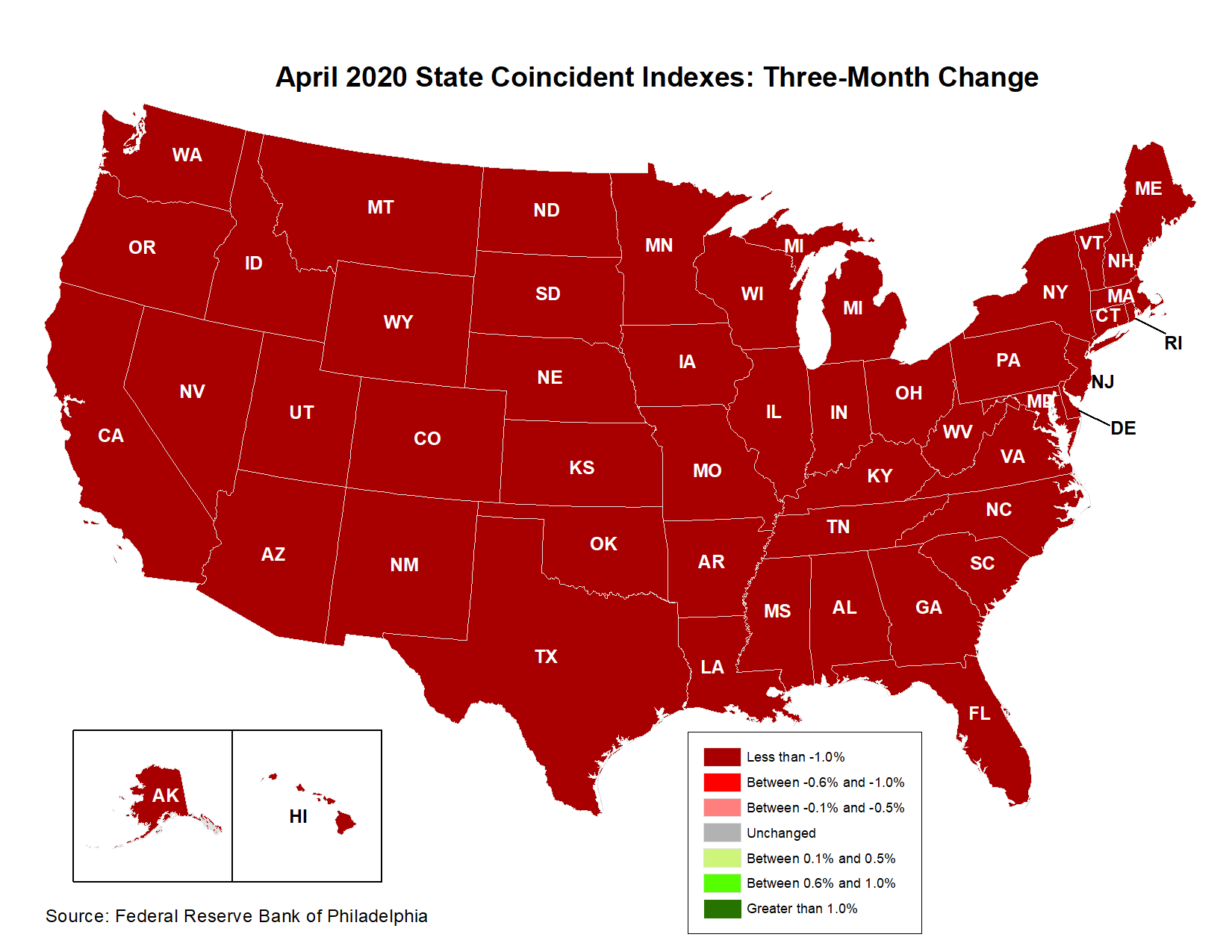
 Click on map for larger image.
Here is a map of the three-month change in the Philly Fed state coincident indicators. This map was all red during the worst of the Pandemic and also at the worst of the Great Recession.
The map is mostly positive on a three-month basis.
Source: Philly Fed.
 And here is a graph is of the number of states with one month increasing activity according to the Philly Fed.
 This graph includes states with minor increases (the Philly Fed lists as unchanged).
In February, 41 states had increasing activity including minor increases.
In February, 41 states had increasing activity including minor increases.
FOMC Minutes: "Inflation was likely to be boosted this year"
by Calculated Risk on 4/09/2025 02:06:00 PM
From the Fed: Minutes of the Federal Open Market Committee, March 18–19, 2025. Excerpt:
With regard to the outlook for inflation, participants judged that inflation was likely to be boosted this year by the effects of higher tariffs, although significant uncertainty surrounded the magnitude and persistence of such effects. Several participants noted that the announced or planned tariff increases were larger and broader than many of their business contacts had expected. Several participants also noted that their contacts were already reporting increases in costs, possibly in anticipation of rising tariffs, or that their contacts had indicated willingness to pass on to consumers higher input costs that would arise from potential tariff increases. A couple of participants highlighted factors that might limit the inflationary effects of tariffs, noting that many households had depleted the excess savings they had accumulated during the pandemic and were less likely to accept additional price increases, or that stricter immigration policies might reduce demand for rental and affordable housing and alleviate upward pressures on housing inflation. A couple of participants noted that the continued balance in the labor market suggested that labor market conditions were unlikely to be a source of inflationary pressure. A couple of participants noted that, in the period ahead, it could be especially difficult to distinguish between relatively persistent changes in inflation and more temporary changes that might be associated with the introduction of tariffs. Participants commented on a range of factors that could influence the persistence of tariff effects, including the extent to which tariffs are imposed on intermediate goods and thus affect input costs at various stages of production, the extent to which complex supply chains need to be restructured, the actions of trading partners in responding with retaliatory increases in tariffs, and the stability of longer-term inflation expectations.
emphasis added
Trump Drops Tariffs to 10%
by Calculated Risk on 4/09/2025 02:00:00 PM
Just minutes after Goldman Sachs put out a note forecasting a recession, Mr. Trump lowered all tariffs to 10% (except China).
First, from Goldman Sachs economists:
Moving to a Recession Baseline We now expect the US’s effective tariff rate to rise by at least 20pp and are forecasting a recession with a 12-month probability of 65%. We think the White House is unlikely to quickly reverse most of the new tariffs, but our probability of recession would decline if it does.And just minutes later from CNBC: Trump temporarily drops tariffs to 10% for most countries, hits China harder with 125%
We now forecast GDP growth of -1% this year on a Q4/Q4 basis (or +0.7% on an annual average basis) and a 1.5pp increase in the unemployment rate to 5.7%. This would be less severe than most past US recessions, in part because we do not see major financial imbalances that need to unwind, private sector balance sheets remain strong, and we see some room for trade deals to eventually lower tariff rates somewhat.
emphasis added
President Donald Trump on Wednesday dropped tariffs under his new trade plan to 10% on imports from most countries, as he announced a 90-day pause for stiffer, so-called reciprocal tariffs that took effect this week.It is impossible to forecast with rapidly changing policy.
Trump also said in a social media post that he was raising the tariffs imposed on imports from China to 125% “effective immediately” due to the “lack of respect that China has shown to the World’s Markets.”
Part 1: Current State of the Housing Market; Overview for mid-April 2025
by Calculated Risk on 4/09/2025 11:14:00 AM
Today, in the Calculated Risk Real Estate Newsletter: Part 1: Current State of the Housing Market; Overview for mid-April 2025
A brief excerpt:
This 2-part overview for mid-April provides a snapshot of the current housing market.There is much more in the article.
At this moment, we can’t talk housing without mentioning the overall economy.
Just over two weeks ago, I revised down my outlook for housing this year, see Policy and 2025 Housing Outlook. Since then, policy and the outlook have taken a turn for the worse. One point I made in March was:And another factor is the recent stock market volatility. Ten percent corrections are common, a further sell-off will have a negative wealth effect for potential home buyers.Stock markets are now down around 20% (with crazy volatility). And it is likely this will negatively impact home sales.
On my blog, I went on Recession Watch over the weekend (not predicting a recession yet because the U.S. economy is very resilient, was on solid footing at the beginning of the year, and the tariffs might be lowered or reversed). And I discussed some of the data I’ll be watching in Recession Watch Metrics.
And on housing: Inventory, inventory, inventory! Inventory is increasing sharply, and inventory usually tells the tale.
...
Since both inventory and sales have fallen significantly, a key for house prices is to watch months-of-supply. The following graph shows months-of-supply since 2017. The following graph shows months-of-supply since 2017. Note that months-of-supply is higher than 6 of the last 8 years, and at the same level as in 2017.
Months-of-supply was at 3.5 months in February compared to 3.6 months in February 2019. It appears national months-of-supply will be above pre-pandemic levels this summer, and likely above 5.0 months (putting some pressure on prices).
Inventory would probably have to increase to 5 1/2 to 6 months of supply to see national price declines again.

MBA: Mortgage Applications Increase in Latest MBA Weekly Survey
by Calculated Risk on 4/09/2025 07:00:00 AM
From the MBA: Mortgage Applications Increase in Latest MBA Weekly Survey
Mortgage applications increased 20.0 percent from one week earlier, according to data from the Mortgage Bankers Association’s (MBA) Weekly Mortgage Applications Survey for the week ending April 4, 2025.
The Market Composite Index, a measure of mortgage loan application volume, increased 20.0 percent on a seasonally adjusted basis from one week earlier. On an unadjusted basis, the Index increased 20 percent compared with the previous week. The Refinance Index increased 35 percent from the previous week and was 93 percent higher than the same week one year ago. The seasonally adjusted Purchase Index increased 9 percent from one week earlier. The unadjusted Purchase Index increased 10 percent compared with the previous week and was 24 percent higher than the same week one year ago.
“Mortgage applications increased by 20 percent to its highest level since September 2024, driven by purchase and refinance applications picking up in a volatile week where economic uncertainty caused rates to drop across the board. The 30-year fixed mortgage rate was 6.61 percent, the lowest rate since October 2024,” said Joel Kan, MBA’s Vice President and Deputy Chief Economist. “Both homebuyers and refinance borrowers were quick to take advantage of this dip in rates, driving the purchase index 24 percent higher than a year ago to the strongest pace since January 2024. Refinance applications rose by 35 percent to the highest level in six months, as borrowers with larger loan sizes tend to be more sensitive to rate changes. The average refinance loan size jumped to its second highest in the survey at $399,600.”
...
The average contract interest rate for 30-year fixed-rate mortgages with conforming loan balances ($806,500 or less) decreased to 6.61 percent from 6.70 percent, with points increasing to 0.63 from 0.62 (including the origination fee) for 80 percent loan-to-value ratio (LTV) loans.
emphasis added
 Click on graph for larger image.
The first graph shows the MBA mortgage purchase index.
According to the MBA, purchase activity is up 24% year-over-year unadjusted.
Red is a four-week average (blue is weekly).
Purchase application activity is up about 38% from the lows in late October 2023 and is 14% above the lowest levels during the housing bust.

The second graph shows the refinance index since 1990.
The refinance index increased but remained very low.
Tuesday, April 08, 2025
Wednesday: FOMC Minutes
by Calculated Risk on 4/08/2025 07:19:00 PM
 Note: Mortgage rates are from MortgageNewsDaily.com and are for top tier scenarios.
Wednesday:
• At 7:00 AM ET, The Mortgage Bankers Association (MBA) will release the results for the mortgage purchase applications index.
• At 2:00 PM, FOMC Minutes, Meeting of March 18-19
By Request: Public and Private Sector Payroll Jobs During Presidential Terms
by Calculated Risk on 4/08/2025 02:17:00 PM
Note: I've received a number of requests to post this again after the start of President Trump's 2nd term. So here is another update of tracking employment during Presidential terms. We frequently use Presidential terms as time markers - we could use Speaker of the House, Fed Chair, or any other marker.
Important: There are many differences between these periods. Overall employment was smaller in the '80s, however the participation rate was increasing in the '80s (younger population and women joining the labor force), and the participation rate is generally declining now. But these graphs give an overview of employment changes.
The first graph shows the change in private sector payroll jobs from when each president took office until the end of their term(s). Presidents Carter, George H.W. Bush, and Biden only served one term.
Mr. G.W. Bush (red) took office following the bursting of the stock market bubble and left during the bursting of the housing bubble. Mr. Obama (dark blue) took office during the financial crisis and great recession. There was also a significant recession in the early '80s right after Mr. Reagan (dark red) took office.
There was a recession towards the end of President G.H.W. Bush (light purple) term, and Mr. Clinton (light blue) served for eight years without a recession. There was a pandemic related recession in 2020.
First, here is a table for private sector jobs for each term. (Blue for Democrats, Red for Republicans)
| Term | Private Sector Jobs Added (000s) |
|---|---|
| Biden | 14,327 |
| Clinton 1 | 10,875 |
| Clinton 2 | 10,104 |
| Obama 2 | 9,924 |
| Reagan 2 | 9,351 |
| Carter | 9,039 |
| Reagan 1 | 5,363 |
| Obama 1 | 1,889 |
| GHW Bush | 1,507 |
| GW Bush 2 | 453 |
| Trump 2 | 3251 |
| GW Bush 1 | -822 |
| Trump 1 | -2,178 |
| 1Through 2 months | |
 Click on graph for larger image.
The first graph is for private employment only.
Private sector employment increased by 9,039,000 under President Carter (dashed green), by 14,714,000 under President Reagan (dark red), 1,507,000 under President G.H.W. Bush (light purple), 20,979,000 under President Clinton (light blue), lost 369,000 under President G.W. Bush, and gained 11,813,000 under President Obama (dark dashed blue). During President Trump's terms (Orange), the economy has lost 1,853,000 private sector jobs.
 A big difference between the presidencies has been public sector employment. Note: the bumps in public sector employment due to the decennial Census in 1980, 1990, 2000, 2010 and 2020.
 The public sector grew during Mr. Carter's term (up 1,304,000), during Mr. Reagan's terms (up 1,414,000), during Mr. G.H.W. Bush's term (up 1,127,000), during Mr. Clinton's terms (up 1,934,000), and during Mr. G.W. Bush's terms (up 1,744,000 jobs). However, the public sector declined significantly while Mr. Obama was in office (down 263,000 jobs). During Mr. Trump's terms, the economy lost 517,000 public sector jobs (mostly teachers during the pandemic).
And a table for public sector jobs. Public sector jobs increased have increased the most during Biden's term (mostly state and local employment), ahead of the number during Reagan's 2nd term. Public sector jobs declined the most during Obama's first term.
| Term | Public Sector Jobs Added (000s) |
|---|---|
| Biden | 1,813 |
| Reagan 2 | 1,438 |
| Carter | 1,304 |
| Clinton 2 | 1,242 |
| GHW Bush | 1,127 |
| GW Bush 1 | 900 |
| GW Bush 2 | 844 |
| Clinton 1 | 692 |
| Obama 2 | 447 |
| Trump 2 | 201 |
| Reagan 1 | -24 |
| Trump | -537 |
| Obama 1 | -710 |
| 1Through 2 months | |
1st Look at Local Housing Markets in March
by Calculated Risk on 4/08/2025 10:40:00 AM
Today, in the Calculated Risk Real Estate Newsletter: 1st Look at Local Housing Markets in March
A brief excerpt:
This is the first look at several early reporting local markets in March. I’m tracking over 40 local housing markets in the US. Some of the 40 markets are states, and some are metropolitan areas. I’ll update these tables throughout the month as additional data is released.There is much more in the article.
Closed sales in March were mostly for contracts signed in January and February when 30-year mortgage rates averaged 6.96% and 6.84%, respectively (Freddie Mac PMMS). This was an increase from the average rate for homes that closed in February. This was before the recent surge in economic uncertainty and stock market volatility that might impact existing home sales.
...
In March, sales in these markets were down 0.7% YoY. Last month, in February, these same markets were down 4.2% year-over-year Not Seasonally Adjusted (NSA).
Note that most of these early reporting markets have shown stronger year-over-year sales than most other markets for the last several months.
Important: There were the same number of working days in March 2025 (21) as in March 2024 (21). So, the year-over-year change in the headline SA data will be close to the change in the NSA data (there are other seasonal factors).
...
This was just several early reporting markets. Many more local markets to come!

Leading Index for Commercial Real Estate Decreased 7% in March
by Calculated Risk on 4/08/2025 08:13:00 AM
From Dodge Data Analytics: Dodge Momentum Index Declines 7% in March
The Dodge Momentum Index (DMI), issued by Dodge Construction Network, receded 6.9% in March to 205.6 (2000=100) from the revised February reading of 220.9. Over the month, commercial planning declined 7.8% while institutional planning fell 5.0%.
“Increased uncertainty around material prices and fiscal policies may have begun to factor into planning decisions throughout March,” stated Sarah Martin, associate director of forecasting at Dodge Construction Network. “While planning data has weakened across most nonresidential sectors this month, activity remains considerably higher than year-ago levels and still suggests steady construction activity in mid-2026.”
On the commercial side, weaker planning activity for warehouses, data centers and retail stores drove this month’s decline. Meanwhile, hotel and office planning continued to accelerate. On the institutional side, planning activity slowed for education, healthcare and government buildings. In March, the DMI was up 30% when compared to year-ago levels. The commercial segment was up 32% from March 2024. The institutional segment was up 27% over the same period, following a very weak March last year. The influence of data centers on the DMI this year remains substantial. If we remove all data center projects between 2023 and 2025, commercial planning would be up 4% from year-ago levels, and the entire DMI would be up 12%. While momentum decelerated for data centers this month, levels of activity remain very high.
...
The DMI is a monthly measure of the value of nonresidential building projects going into planning, shown to lead construction spending for nonresidential buildings by a full year.
emphasis added
 Click on graph for larger image.
This graph shows the Dodge Momentum Index since 2002. The index was at 205.6 in March, down from 220.9 the previous month.
According to Dodge, this index leads "construction spending for nonresidential buildings by a full year". This index suggests a pickup in mid-2025, however, uncertainty might impact these projects.
Commercial construction is typically a lagging economic indicator.
Monday, April 07, 2025
Tuesday: Small Business Optimism
by Calculated Risk on 4/07/2025 07:20:00 PM
 From Matthew Graham at Mortgage News Daily: Worst 24 Hours For Rates So Far This Year
While there was certainly some volatility surrounding news headlines that were less than credible (specifically, that Trump was considering a 90 day pause on Tariffs), bonds maintained steady selling pressure all day.Tuesday:
As a result, mortgage lenders were under progressive pressure to bump today's mortgages rates higher several times. The net effect is that we've moved from 2025's lowest rates to highest since late February in the space of 24 hours. That said, today's highs are right in line with many other days from the past several weeks. [30 year fixed 6.82%]
emphasis added
• At 6:00 AM ET, NFIB Small Business Optimism Index for March.
Wholesale Used Car Prices Decreased in March; Down 0.2% Year-over-year
by Calculated Risk on 4/07/2025 03:15:00 PM
From Manheim Consulting today: Manheim Used Vehicle Value Index Shows Seasonal Decline in March Despite Strong Market Demand
Wholesale used-vehicle prices (on a mix, mileage, and seasonally adjusted basis) were lower in March compared to February. The Manheim Used Vehicle Value Index (MUVVI) declined to 202.6, which is a decrease of 0.2% from a year ago and also lower than the February levels. The seasonal adjustment caused the index to decline for the month, as non-seasonally adjusted values rose but not enough to account for the normal seasonal move. The non-adjusted price in March increased by 2.7% compared to February, moving the unadjusted average price up 0.4% year over year.
emphasis added
 Click on graph for larger image.
This index from Manheim Consulting is based on all completed sales transactions at Manheim’s U.S. auctions.
The Manheim index suggests used car prices decreased in March (seasonally adjusted) and were down 0.2% YoY.
The tariffs will likely make imported used cars more attractive.
ICE Mortgage Monitor: Home Prices Continue to Cool
by Calculated Risk on 4/07/2025 12:28:00 PM
Today, in the Real Estate Newsletter: ICE Mortgage Monitor: Home Prices Continue to Cool
Brief excerpt:
Note: I made a mistake last week and posted this prior to the embargo lifting. My apologies to Intercontinental Exchange and all my readers.There is much more in the newsletter.
House Price Growth Continues to Slow
Here is the year-over-year in house prices according to the ICE Home Price Index (HPI). The ICE HPI is a repeat sales index. ICE reports the median price change of the repeat sales. The index was up 2.7% year-over-year in February, down from 3.4% YoY in January.
• Home price growth is beginning to cool as modestly improved demand is running up against higher levels of inventory across most major marketsThere is much more in the mortgage monitor.
• The annual home price growth rate dipped to +2.7% in February from +3.4% the month prior, marking the sharpest single month of deceleration in the annual home price growth rate since early 2023, 2023, with an early look at March data via ICE's enhanced Home Price Index suggesting that price growth has cooled further to +2.2%
• On a seasonally adjusted basis, home prices rose by +0.11% in the month, equivalent to a seasonally adjusted annualized rate of +1.3%, the softest such growth in five months
• In simple terms, that means that if the current rate of monthly growth we’ve seen in recent months were to persist, it would result in annual home price growth continuing to slow as we make our way through Q1 and into Q2 2025

Recession Watch Metrics
by Calculated Risk on 4/07/2025 10:04:00 AM
Early in February, I expressed my "increasing concern" about the negative economic impact of "executive / fiscal policy errors", however, I concluded that post by noting that I was not currently on recession watch.
Now I am on recession watch, but still not yet predicting a recession for several reasons: the U.S. economy is very resilient and was on solid footing at the beginning of the year, the administration might reverse many of the tariffs (we've seen that before), and Congress might take back complete authority for tariffs. Also, perhaps these tariffs are not enough to topple the economy.
"If most of the April 9 tariffs do take effect, then the effective tariff rate will rise by an estimated 20pp once those increases and likely sectoral tariffs take effect, even allowing for some country-specific agreements at a later date. If so, we expect to change our forecast to a recession."
Here is some of the data I'm watching.
Housing: Housing is the basis of one of my favorite models for business cycle forecasting. This graph uses new home sales, single family housing starts and residential investment. (I prefer single family starts to total starts). The purpose of this graph is to show that these three indicators generally reach peaks and troughs together. Note that Residential Investment is quarterly and single-family starts and new home sales are monthly.
 Click on graph for larger image.
The arrows point to some of the earlier peaks and troughs for these three measures - and the most recent peak.
New home sales peaked in 2020 as pandemic buying soared. Then new home sales and single-family starts turned down in 2021, but that was partly due to the huge surge in sales during the pandemic. In 2022, both new home sales and single-family starts turned down in response to higher mortgage rates.
This decline in residential investment would typically have suggested that a recession was coming, however I looked past the pandemic distortions and correctly predicted no recession! The low level of existing home inventory led me to predict that new home sales would pick up - and that happened. This is a reminder that we can't be a slave to any model.
 This second graph shows the YoY change in New Home Sales from the Census Bureau. Currently new home sales (based on 3-month average of NSA data) are down 4% year-over-year.
Usually when the YoY change in New Home Sales falls about 20%, a recession will follow. An exception for this data series was the mid '60s when the Vietnam buildup kept the economy out of recession. Another exception was in late 2021 - we saw a significant YoY decline in new home sales related to the pandemic and the surge in new home sales in the second half of 2020. I ignored that downturn as a pandemic distortion. Also note that the sharp decline in 2010 was related to the housing tax credit policy in 2009 - and was just a continuation of the housing bust.
The YoY change in new home sales in late 2022 and early 2023 suggested a possible recession. But as I noted earlier, I was able to look past the pandemic distortion and was able to predict a pickup in new home sales due to the low level of existing home inventory and because homebuilders could offer mortgage incentives that would somewhat offset the sharp increase in mortgage rates.
There are no special circumstances now, and if this measure falls to off 20% a recession seems likely.
Yield Curve: The yield curve is a commonly used leading indicator. I dismissed it when the yield curve inverted in 2019 and again in 2022. Both times dismissing the yield curve was correct (the recession in 2020 was obviously due to the pandemic, so we will never know if the yield curve failed to predict a recession in 2019).

Here is a graph of 10-Year Treasury Constant Maturity Minus 2-Year Treasury Constant Maturity from FRED since 1976.
The yield curve reverted to normal last year and is currently slightly positive at 0.33. If this inverts, this might suggest a recession is coming.


Heavy Truck (and Vehicle Sales): Another indicator I like to use is heavy truck sales. This graph shows heavy truck sales since 1967 using data from the BEA. he dashed line is the March 2025 seasonally adjusted annual sales rate (SAAR) of 403 thousand. Note: "Heavy trucks - trucks more than 14,000 pounds gross vehicle weight."
Heavy truck sales were at 403 thousand SAAR in March, down from 436 thousand in February, and down 12.1% from 459 thousand SAAR in February 2025.
Usually, heavy truck sales decline sharply prior to a recession. Perhaps heavy truck sales will be revised up, but sales in March were somewhat weak.
 On the other hand, light vehicle sales were strong in March.
 This graph shows light vehicle sales since the BEA started keeping data in 1967. This is more of a concurrent indicator than heavy trucks.
Light vehicle sales surged to 17.77 million SAAR in March, up 11.0% from February, and up 13.3% from March 2024 as some buyers rushed to beat the tariffs.
Unemployment: Two other concurrent indicators are the unemployment rate (using the "Sahm Rule") and weekly unemployment claims.
 Here is a graph of the Sahm rule from FRED since 1959.
The rule was triggered in 2024 (slightly), but Dr. Claudia Sahm said at the time:
“I am not concerned that, at this moment, we are in a recession,” she told Fortune ... “This time really could be different,” Sahm said. “[The Sahm Rule] may not tell us what it’s told us in the past, because of these swings from labor shortages, with people dropping out of the labor force, to now having immigrants coming lately. That all can show up in changes in the unemployment rate, which is the core of the Sahm Rule.”
 And weekly unemployment claims always rise sharply at the beginning of a recession (other events - like hurricane Katrina - can cause a temporary spike in weekly claims).
As I noted earlier, I'm not sure how to estimate the economic damage caused by these tariffs. And they might just go away (no one knows). There are also boycotts of U.S. goods and less international tourism based on both the tariffs and the inflammatory rhetoric of the new administration.
For now, I'll focus on the leading indicators (especially housing) and I'll update this post monthly while I'm on recession watch.
Housing April 7th Weekly Update: Inventory up 2.3% Week-over-week, Up 34.7% Year-over-year
by Calculated Risk on 4/07/2025 08:11:00 AM
Altos reports that active single-family inventory was up 2.3% week-over-week.
Inventory is now up 10.7% from the seasonal bottom in January and is increasing.
Usually, inventory is up about 4% or 5% from the seasonal low by this week in the year. So, 2025 is seeing a larger than normal pickup in inventory.
The first graph shows the seasonal pattern for active single-family inventory since 2015.
 Click on graph for larger image.
The red line is for 2025. The black line is for 2019.
Inventory was up 34.7% compared to the same week in 2024 (last week it was up 30.6%), and down 17.4% compared to the same week in 2019 (last week it was down 19.0%).
Inventory will pass 2020 levels soon, and it now appears inventory will be close to 2019 levels towards the end of 2025.
 This second inventory graph is courtesy of Altos Research.
As of April 4th, inventory was at 691 thousand (7-day average), compared to 676 thousand the prior week.
Mike Simonsen discusses this data regularly on Youtube
Sunday, April 06, 2025
Sunday Night Futures
by Calculated Risk on 4/06/2025 06:11:00 PM
Weekend:
• Schedule for Week of April 6, 2025
• Recession Watch
Monday:
• No major economic releases scheduled.
From CNBC: Pre-Market Data and Bloomberg futures S&P 500 are down 200 and DOW futures are down 1,200 (fair value).
Oil prices were down over the last week with WTI futures at $61.99 per barrel and Brent at $65.58 per barrel. A year ago, WTI was at $88, and Brent was at $93 - so WTI oil prices are down about 25% year-over-year.
Here is a graph from Gasbuddy.com for nationwide gasoline prices. Nationally prices are at $3.21 per gallon. A year ago, prices were at $3.57 per gallon, so gasoline prices are down $0.36 year-over-year.
AAR: Rail Carloads and Intermodal Up in March
by Calculated Risk on 4/06/2025 08:56:00 AM
From the Association of American Railroads (AAR) AAR Data Center. Graph and excerpts reprinted with permission.
Recent changes in U.S. trade policy represent a notable shift from previous approaches. These developments will affect multiple sectors, including freight rail, where global trade accounts for approximately 38% of unit volume and 37% of total revenue. Even in stable times, railroads must constantly adjust to evolving economic conditions; they are operationally equipped to adapt to this latest round of policy change as well.
At present, rail traffic is holding steady. While some “soft” economic indicators, such as consumer confidence, have weakened in recent months, many “hard” economic metrics—including job gains, unemployment, and consumer spending—remain resilient. That continued strength has supported modest gains in rail volumes. That said, manufacturing remains mired in a prolonged period of weakness, limiting growth in several carload categories.
emphasis added
 Click on graph for larger image.
This graph from the AAR shows their index ("The AAR’s Freight Rail Index (FRI) is defined as intermodal plus carloads excluding coal and grain. We exclude coal and grain because their carloads tend to rise or fall for reasons that have little to do with what’s going on in the broader economy.")
U.S. railroads originated 906,253 total carloads in March 2025, up 4.5% (39,342 carloads) over last March and the third year-over-year increase in total carloads over the past 15 months. Total carloads averaged 226,563 in March 2025, the most in six months and the most for March since 2022.
...
U.S. railroads also originated 1.10 million containers and trailers in March 2025, up 8.0% (82,151 units) over March 2024 and intermodal’s 19th consecutive year-over-year gain.
Saturday, April 05, 2025
Recession Watch
by Calculated Risk on 4/05/2025 07:19:00 PM
I am going on "recession watch" for only the 4th time in the 20+ years that I've been writing this blog. In December 2022 I went on "recession watch", but I noted "My sense is growth will stay sluggish in 2023, but the economy will avoid recession." And the economy did avoid recession!
The other two times were in early 2007 (housing bust / financial crisis), and in March 2020 (pandemic). And I correctly called a recession.
Mostly I've made fun of the persistent recession callers!
Now I'm concerned about tariff policy impacting the economy. Usually fiscal, executive and trade policy decisions wouldn't lead to an immediate recession, but these tariffs are a huge blunder. There have been other unforced errors - like cutting basic research spending - but that is more of a long-term issue.
As an aside: Imagine a tech company announcing they were going to cut spending by eliminating R&D. Their stock would plummet. That is what the U.S. has done with some of the DOGE cuts.
Some analysts have started forecasting a recession later this year due to the tariffs. For example, from Yahoo Finance: JPMorgan becomes the first Wall Street bank to forecast a US recession following Trump's tariffs
I'm not sure how to estimate the economic damage caused by these tariffs. And they might just go away (no one knows). There are also boycotts of U.S. goods and less international tourism based on both the tariffs and the inflammatory rhetoric of the new administration. Some analysts have started forecasting a recession later this year due to the tariffs. For example, from Yahoo Finance: JPMorgan becomes the first Wall Street bank to forecast a US recession following Trump's tariffs
JPMorgan believes the US economy will enter a recession in the back half of 2025 as the impact of President Trump tariffs takes hold in the economy.
The firm's chief US economist Michael Feroli sees a two-quarter recession occurring in the back half of 2025 as GDP contracts by 1% in the third quarter of the year and by 0.5% in the fourth quarter. For the full-year 2025, Feroli's team projects GDP will fall by 0.3%.
...
Feroli added that a "recession in economic activity" will push the unemployment rate up to 5.3%.

On the other hand, the U.S. economy is very resilient and was on solid footing at the beginning of the year.
So, although I'm on "recession watch", I'm not currently predicting a recession.
These two Economist covers capture the rapid change over the last 6 months. The first is from October 2024.
Click on graph for larger image.
Just after the election, Fed Chair Powell said, "The recent performance of our economy has been remarkably good, by far the best of any major economy in the world."
And in December, Powell said the US economy is the "envy of other large economies around the world".
The 2nd cover is the current edition. "Ruination Day". Ouch.

Mostly I'll be watching my favorite model for business cycle forecasting that uses new home sales (also housing starts and residential investment).The 2nd cover is the current edition. "Ruination Day". Ouch.

I'll also be watching the yield curve, vehicle sales, heavy truck sales and weekly unemployment claims - amoung other indicators.
To conclude: I'm now on recession watch, but I'm not predicting a recession.
Real Estate Newsletter Articles this Week: "54% of outstanding mortgage loans are under 4%"
by Calculated Risk on 4/05/2025 02:11:00 PM
At the Calculated Risk Real Estate Newsletter this week:
 Click on graph for larger image.
• FHFA’s National Mortgage Database: Outstanding Mortgage Rates, LTV and Credit Scores
• Moody's: Q1 2025 Apartment Vacancy Rate Highest Since 2010; Office Vacancy Rate at Record High
• Freddie Mac House Price Index Increased in February; Up 3.4% Year-over-year
• Asking Rents Mostly Unchanged Year-over-year
This is usually published 4 to 6 times a week and provides more in-depth analysis of the housing market.
Schedule for Week of April 6, 2025
by Calculated Risk on 4/05/2025 08:11:00 AM
The key economic report this week is March CPI.
No major economic releases scheduled.
6:00 AM ET: NFIB Small Business Optimism Index for March.
7:00 AM ET: The Mortgage Bankers Association (MBA) will release the results for the mortgage purchase applications index.
2:00 PM: FOMC Minutes, Meeting of March 18-19
8:30 AM: The initial weekly unemployment claims report will be released. The consensus is for 225 initial claims up from 219 thousand last week.
8:30 AM: The Consumer Price Index for March from the BLS. The consensus is for 0.1% increase in CPI (up 2.6% YoY) and a 0.3% increase in core CPI (up 3.0% YoY).
8:30 AM: The Producer Price Index for March from the BLS. The consensus is for a 0.2% increase in PPI, and a 0.3% increase in core PPI.
10:00 AM: University of Michigan's Consumer sentiment index (Preliminary for April).