RSS Feed
 by Calculated Risk on 4/04/2025 07:56:00 PM
Friday, April 04, 2025
April 4th COVID Update: COVID Deaths Continue Declining
 Note: Mortgage rates are from MortgageNewsDaily.com and are for top tier scenarios.
For deaths, I'm currently using 4 weeks ago for "now", since the most recent three weeks will be revised significantly.
Note: "Effective May 1, 2024, hospitals are no longer required to report COVID-19 hospital admissions, hospital capacity, or hospital occupancy data." So, I'm no longer tracking hospitalizations.
| COVID Metrics | ||||
|---|---|---|---|---|
| Now | Week Ago | Goal | ||
| Deaths per Week | 576 | 655 | ≤3501 | |
| 1my goals to stop weekly posts. 🚩 Increasing number weekly for Deaths. ✅ Goal met. | ||||
 Click on graph for larger image.
This graph shows the weekly (columns) number of deaths reported since Jan 2023.
Although weekly deaths met the original goal to stop posting in June 2023 (low of 314 deaths), I've continued to post since deaths are above the goal again - and I'll continue to post until weekly deaths are once again below the goal.
Weekly deaths are now decreasing following the winter pickup and just under double the low of last June.
 This appears to be a leading indicator for COVID hospitalizations and deaths. This has generally been moving down.
Nationally COVID in wastewater is "Low", down from "Moderate" two weeks ago according to the CDC.
Asking Rents Mostly Unchanged Year-over-year
by Calculated Risk on 4/04/2025 02:36:00 PM
Today, in the Real Estate Newsletter: Asking Rents Mostly Unchanged Year-over-year
Brief excerpt:
Another monthly update on rents.This is much more in the article.
Tracking rents is important for understanding the dynamics of the housing market. Slower household formation and increased supply (more multi-family completions) has kept asking rents under pressure. ...
Apartment List: Asking Rent Growth -0.4% Year-over-year ...
On the supply side of the rental market, our national vacancy index now sits at 6.9 percent, the highest reading in the history of that monthly data series, which goes back to the start of 2017. After a historic tightening in 2021, multifamily occupancy has been slowly but consistently easing for over three years amid an influx of new inventory. 2024 saw the most new apartment completions since the mid-1980s, and with 750 thousand units still in the construction pipeline, the supply boom has runway to continue this year.Realtor.com: 19th Consecutive Month with Year-over-year Decline in RentsThe median asking rent across the 50 largest metropolitan areas in the United States fell again in February, to $1,691. This marks 19 months in a row in which rent has fallen year over year, this time by 0.9% from February 2024.

Q1 GDP Tracking: Near Zero Growth
by Calculated Risk on 4/04/2025 01:12:00 PM
From BofA:
Since our last publication, our 1Q GDP tracking is up from 0.1% q/q saar to 0.4% q/q saar. [Apr 4th estimate]From Goldman:
emphasis added
We left our Q1 GDP tracking estimate unchanged at +0.3% (quarter-over-quarter annualized). [Apr 3rd estimate]
 And from the Atlanta Fed: GDPNow
The GDPNow model estimate for real GDP growth (seasonally adjusted annual rate) in the first quarter of 2025 is -2.8 percent on April 3, up from -3.7 percent on April 1. The alternative model forecast, which adjusts for imports and exports of gold as described here, is -0.8 percent. [Apr 3rd estimate]
Fed Chair Powell: "Tariff increases will be significantly larger than expected"', Expect "higher inflation and slower growth"
by Calculated Risk on 4/04/2025 11:25:00 AM
From Fed Chair Jerome Powell: Economic Outlook. Excerpt:
Turning to monetary policy, we face a highly uncertain outlook with elevated risks of both higher unemployment and higher inflation. The new Administration is in the process of implementing substantial policy changes in four distinct areas: trade, immigration, fiscal policy, and regulation. Our monetary policy stance is well positioned to deal with the risks and uncertainties we face as we gain a better understanding of the policy changes and their likely effects on the economy. It is not our role to comment on those policies. Rather, we make an assessment of their likely effects, observe the behavior of the economy, and set monetary policy in a way that best achieves our dual-mandate goals.
We have stressed that it will be very difficult to assess the likely economic effects of higher tariffs until there is greater certainty about the details, such as what will be tariffed, at what level and for what duration, and the extent of retaliation from our trading partners. While uncertainty remains elevated, it is now becoming clear that the tariff increases will be significantly larger than expected. The same is likely to be true of the economic effects, which will include higher inflation and slower growth. The size and duration of these effects remain uncertain. While tariffs are highly likely to generate at least a temporary rise in inflation, it is also possible that the effects could be more persistent. Avoiding that outcome would depend on keeping longer-term inflation expectations well anchored, on the size of the effects, and on how long it takes for them to pass through fully to prices. Our obligation is to keep longer-term inflation expectations well anchored and to make certain that a one-time increase in the price level does not become an ongoing inflation problem.
emphasis added
Comments on March Employment Report
by Calculated Risk on 4/04/2025 09:14:00 AM
The headline jobs number in the March employment report was above expectations, however, January and February payrolls were revised down by 48,000 combined. The participation rate increased, the employment population ratio was unchanged, and the unemployment rate increased to 4.2%.
Prime (25 to 54 Years Old) Participation
 Since the overall participation rate is impacted by both cyclical (recession) and demographic (aging population, younger people staying in school) reasons, here is the employment-population ratio for the key working age group: 25 to 54 years old.
The 25 to 54 years old participation rate decreased in March to 83.3% from 83.5% in February.
The 25 to 54 employment population ratio decreased to 80.4% from 80.5% the previous month.
Both are down from the recent peaks, but still near the highest level this millennium.
Average Hourly Wages
 The graph shows the nominal year-over-year change in "Average Hourly Earnings" for all private employees from the Current Employment Statistics (CES).
Average Hourly Wages
 The graph shows the nominal year-over-year change in "Average Hourly Earnings" for all private employees from the Current Employment Statistics (CES).
 There was a huge increase at the beginning of the pandemic as lower paid employees were let go, and then the pandemic related spike reversed a year later.
Wage growth has trended down after peaking at 5.9% YoY in March 2022 and was at 3.8% YoY in March.
Wage growth has trended down after peaking at 5.9% YoY in March 2022 and was at 3.8% YoY in March.
Part Time for Economic Reasons
 From the BLS report:
"The number of people employed part time for economic reasons, at 4.8 million, changed little in March. These individuals would have preferred full-time employment but were working part time because their hours had been reduced or they were unable to find full-time jobs"The number of persons working part time for economic reasons decreased in March to 4.78 million from 4.94 million in February. This is above the pre-pandemic levels.
These workers are included in the alternate measure of labor underutilization (U-6) that decreased to 7.9% from 8.0% in the previous month. This is down from the record high in April 2020 of 22.9% and up from the lowest level on record (seasonally adjusted) in December 2022 (6.6%). (This series started in 1994). This measure is above the 7.0% level in February 2020 (pre-pandemic).
Unemployed over 26 Weeks
 This graph shows the number of workers unemployed for 27 weeks or more.
 According to the BLS, there are 1.46 million workers who have been unemployed for more than 26 weeks and still want a job, up from 1.44 million the previous month.
This is down from post-pandemic high of 4.171 million, and up from the recent low of 1.056 million.
This is above pre-pandemic levels.
Job Streak
Summary:
The headline jobs number in the March employment report was above expectations, however, January and February payrolls were revised down by 48,000 combined. The participation rate increased, the employment population ratio was unchanged, and the unemployment rate increased to 4.2%.
This is above pre-pandemic levels.
Job Streak
Through March 2025, the employment report indicated positive job growth for 51 consecutive months, putting the current streak in 2nd place of the longest job streaks in US history (since 1939).
| Headline Jobs, Top 10 Streaks | ||
|---|---|---|
| Year Ended | Streak, Months | |
| 1 | 2020 | 113 |
| 2 | Current, N/A | 511 |
| 3 | 1990 | 48 |
| 4 | 2007 | 46 |
| 5 | 1979 | 45 |
| 6 tie | 1943 | 33 |
| 6 tie | 1986 | 33 |
| 6 tie | 2000 | 33 |
| 9 | 1967 | 29 |
| 10 | 1995 | 25 |
| 1Currrent Streak | ||
Summary:
The headline jobs number in the March employment report was above expectations, however, January and February payrolls were revised down by 48,000 combined. The participation rate increased, the employment population ratio was unchanged, and the unemployment rate increased to 4.2%.
This was a solid employment report.
March Employment Report: 228 thousand Jobs, 4.2% Unemployment Rate
by Calculated Risk on 4/04/2025 08:30:00 AM
From the BLS: Employment Situation
Total nonfarm payroll employment rose by 228,000 in March, and the unemployment rate changed little at 4.2 percent, the U.S. Bureau of Labor Statistics reported today. Job gains occurred in health care, in social assistance, and in transportation and warehousing. Employment also increased in retail trade, partially reflecting the return of workers from a strike. Federal government employment declined.
...
The change in total nonfarm payroll employment for January was revised down by 14,000, from +125,000 to +111,000, and the change for February was revised down by 34,000, from +151,000 to +117,000. With these revisions, employment in January and February combined is 48,000 lower than previously reported.
emphasis added
 Click on graph for larger image.
The first graph shows the jobs added per month since January 2021.
Total payrolls increased by 228 thousand in March. Private payrolls increased by 209 thousand, and public payrolls increased 19 thousand (Federal payrolls decreased 4 thousand).
Payrolls for January and February were revised down by 48 thousand, combined.
Payrolls for January and February were revised down by 48 thousand, combined.
 The second graph shows the year-over-year change in total non-farm employment since 1968.
In March, the year-over-year change was 1.88 million jobs. Employment was up solidly year-over-year.
The third graph shows the employment population ratio and the participation rate.
 The Labor Force Participation Rate increased to 62.5% in March, from 62.4% in February. This is the percentage of the working age population in the labor force.
 The Employment-Population ratio was unchanged at 59.9% from 59.9% in February (blue line).
I'll post the 25 to 54 age group employment-population ratio graph later.
 The fourth graph shows the unemployment rate.
 The unemployment rate increased to 4.2% in March from 4.1% in February.
This was above consensus expectations; however, January and February payrolls were revised down by 48,000 combined.
Thursday, April 03, 2025
Friday: Employment Report, Fed Chair Powell Speaks
by Calculated Risk on 4/03/2025 08:08:00 PM
 Note: Mortgage rates are from MortgageNewsDaily.com and are for top tier scenarios.
Friday:
• At 8:30 AM ET, Employment Report for March. The consensus is for 135,000 jobs added, and for the unemployment rate to be unchanged at 4.1%.
• At 11:25 AM, Speech, Fed Chair Jerome Powell, Economic Outlook, At the Society for Advancing Business Editing and Writing (SABEW) Annual Conference, Arlington, Virginia
March Employment Preview
by Calculated Risk on 4/03/2025 04:27:00 PM
On Friday at 8:30 AM ET, the BLS will release the employment report for March. The consensus is for 135,000 jobs added, and for the unemployment rate to be unchanged at 4.1%.
From Goldman Sachs:
We estimate nonfarm payrolls rose by 150k in March, slightly above consensus ... We estimate that the unemployment rate was unchanged on a rounded basis at 4.1%.From BofA:
emphasis added
Nonfarm payrolls are likely to increase by a robust 185k in March, higher than consensus expectations of 135k, due to payback in leisure & hospitality for cold weather in Jan and Feb. Government job growth is expected to come in at just 10k due to the federal hiring freeze/DOGE. Given the muted claims data in the survey week, we do not expect DOGE driven job cuts to be a sizable drag, although risks are to the downside. We expect the u rate to remain at 4.1%.• ADP Report: The ADP employment report showed 155,000 private sector jobs were added in March. This was above consensus forecasts and suggests job gains above consensus expectations, however, in general, ADP hasn't been very useful in forecasting the BLS report.
• ISM Surveys: Note that the ISM indexes are diffusion indexes based on the number of firms hiring (not the number of hires). The ISM® manufacturing employment index decreased to 44.7%, down from 47.6% the previous month. This would suggest about 50,000 jobs lost in manufacturing. The ADP report indicated 21,000 manufacturing jobs added in March.
The ISM® services employment index decreased to 46.2%, from 53.5%. This would suggest 30,000 jobs lost in the service sector. Combined this suggests 80,000 jobs added, well below consensus expectations. (Note: The ISM surveys have been way off recently)
• Unemployment Claims: The weekly claims report showed about the same initial unemployment claims during the reference week at 225,000 in March compared to 224,000 in February. This suggests layoffs in March were about the same as in February.
• Conclusion: Over the last year, employment gains averaged 155 thousand per month - and that is probably the current trend. It seems early for the government related layoffs to significantly impact employment. Also, although the ISM employment indexes were weak this month, my guess is headline employment gains will be above consensus in March.
Hotels: Occupancy Rate Increased 4.4% Year-over-year (Easter Timing boosted YoY Occupancy)
by Calculated Risk on 4/03/2025 03:35:00 PM
On the positive side of the Easter calendar shift, the U.S. hotel industry reported increases across the key performance metrics, according to CoStar’s latest data through 29 March. ...The following graph shows the seasonal pattern for the hotel occupancy rate using the four-week average.
23-29 March 2025 (percentage change from comparable week in 2024):
• Occupancy: 65.1% (+4.4%)
• Average daily rate (ADR): US$161.65 (+2.5%)
• Revenue per available room (RevPAR): US$105.19 (+7.0%)
emphasis added
 Click on graph for larger image.
The red line is for 2025, blue is the median, and dashed light blue is for 2024. Dashed purple is for 2018, the record year for hotel occupancy.
The 4-week average of the occupancy rate is tracking last year and is lower than the median rate for the period 2000 through 2024 (Blue).
Note: Y-axis doesn't start at zero to better show the seasonal change.
The 4-week average will mostly move sideways until the summer travel season. We might see a hit to occupancy during the summer months due to less international tourism.
ISM® Services Index Decreased to 50.8% in March; Employment Index Declined Sharply
by Calculated Risk on 4/03/2025 10:00:00 AM
(Posted with permission). The ISM® Services index was at 50.8%, down from 53.5% last month. The employment index decreased to 46.2%, from 53.5%. Note: Above 50 indicates expansion, below 50 in contraction.
From the Institute for Supply Management: Services PMI® at 50.8% March 2025 Services ISM® Report On Business®
Economic activity in the services sector expanded for the ninth consecutive month in March, say the nation's purchasing and supply executives in the latest Services ISM® Report On Business®. The Services PMI® registered 50.8 percent, indicating expansion for the 55th time in 58 months since recovery from the coronavirus pandemic-induced recession began in June 2020.This was below consensus expectations.
The report was issued today by Steve Miller, CPSM, CSCP, Chair of the Institute for Supply Management® (ISM®) Services Business Survey Committee: “In March, the Services PMI® registered 50.8 percent, 2.7 percentage points lower than the February figure of 53.5 percent. The Business Activity Index registered 55.9 percent in March, 1.5 percentage points higher than the 54.4 percent recorded in February. This is the index’s 58th consecutive month of expansion. The New Orders Index recorded a reading of 50.4 percent in March, 1.8 percentage points lower than the February figure of 52.2 percent. The Employment Index dropped into contraction territory for its first time in six months; the reading of 46.2 percent is a 7.7-percentage point decrease compared to the 53.9 percent recorded in February.
emphasis added
Trade Deficit decreased to $122.7 Billion in February
by Calculated Risk on 4/03/2025 08:49:00 AM
The Census Bureau and the Bureau of Economic Analysis reported:
The U.S. Census Bureau and the U.S. Bureau of Economic Analysis announced today that the goods and services deficit was $122.7 billion in February, down $8.0 billion from $130.7 billion in January, revised. .
February exports were $278.5 billion, $8.0 billion more than January exports. February imports were $401.1 billion, less than $0.1 billion less than January imports.
emphasis added
 Click on graph for larger image.
Exports increased and imports decreased in February.
Exports were up 4.8% year-over-year; imports were up 19.7% year-over-year.
Exports have generally increased recently, and imports increased sharply.
The second graph shows the U.S. trade deficit, with and without petroleum.
 The blue line is the total deficit, and the black line is the petroleum deficit, and the red line is the trade deficit ex-petroleum products.
Note that net, exports of petroleum products are positive and have been increasing.
The trade deficit with China increased to $21.1 billion from $19.9 billion a year ago.
The surge in imports in January and February happened as some importers were avoiding the coming tariffs.
Weekly Initial Unemployment Claims Decrease to 219,000
by Calculated Risk on 4/03/2025 08:34:00 AM
The DOL reported:
In the week ending March 29, the advance figure for seasonally adjusted initial claims was 219,000, a decrease of 6,000 from the previous week's revised level. The previous week's level was revised up by 1,000 from 224,000 to 225,000. The 4-week moving average was 223,000, a decrease of 1,250 from the previous week's revised average. The previous week's average was revised up by 250 from 224,000 to 224,250.The following graph shows the 4-week moving average of weekly claims since 1971.
emphasis added
 Click on graph for larger image.
The dashed line on the graph is the current 4-week average. The four-week average of weekly unemployment claims decreased to 223,000.
The previous week was revised up.
Weekly claims were below the consensus forecast.
Wednesday, April 02, 2025
Thursday: Unemployment Claims, Trade Deficit, ISM Services
by Calculated Risk on 4/02/2025 07:34:00 PM
 Note: Mortgage rates are from MortgageNewsDaily.com and are for top tier scenarios.
Thursday:
• At 8:30 AM ET, The initial weekly unemployment claims report will be released. The consensus is for 225 initial claims up from 224 thousand last week.
• Also at 8:30 AM, Trade Balance report for February from the Census Bureau. The consensus is the trade deficit to be $110.0 billion. The U.S. trade deficit was at $131.4 billion in January.
• At 10:00 AM, the ISM Services Index for March.
Philly Fed: State Coincident Indexes Increased in 47 States in January (3-Month Basis)
by Calculated Risk on 4/02/2025 05:38:00 PM
From the Philly Fed:
The Federal Reserve Bank of Philadelphia has released the coincident indexes for the 50 states for January 2025. Over the past three months, the indexes increased in 47 states, decreased in one state, and remained stable in two, for a three-month diffusion index of 92. Additionally, in the past month, the indexes increased in 35 states, decreased in nine states, and remained stable in six, for a one-month diffusion index of 52. For comparison purposes, the Philadelphia Fed has also developed a similar coincident index for the entire United States. The Philadelphia Fed’s U.S. index increased 0.6 percent over the past three months and 0.2 percent in January.Note: These are coincident indexes constructed from state employment data. An explanation from the Philly Fed:
emphasis added
The coincident indexes combine four state-level indicators to summarize current economic conditions in a single statistic. The four state-level variables in each coincident index are nonfarm payroll employment, average hours worked in manufacturing by production workers, the unemployment rate, and wage and salary disbursements deflated by the consumer price index (U.S. city average). The trend for each state’s index is set to the trend of its gross domestic product (GDP), so long-term growth in the state’s index matches long-term growth in its GDP.
 Click on map for larger image.
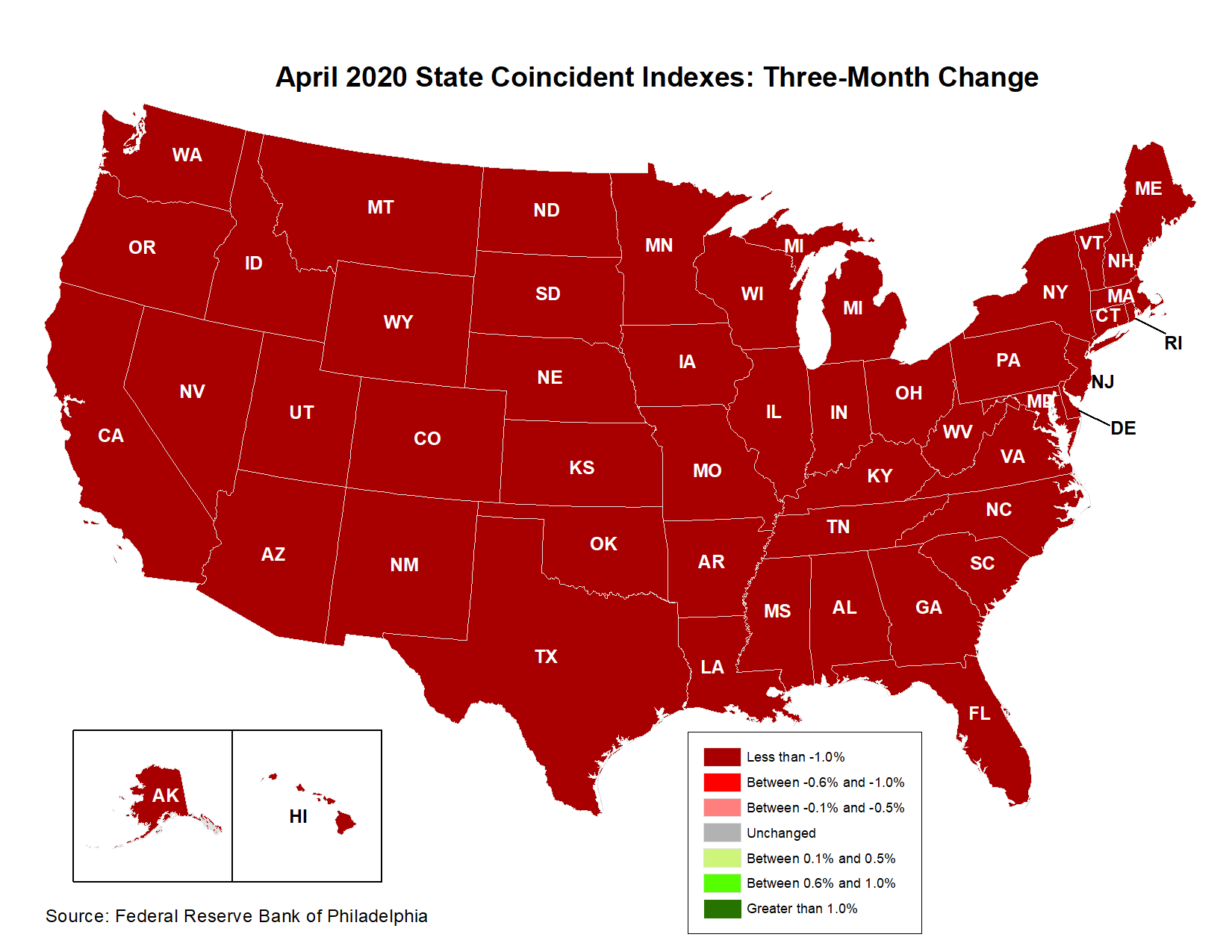
Here is a map of the three-month change in the Philly Fed state coincident indicators. This map was all red during the worst of the Pandemic and also at the worst of the Great Recession.
The map is mostly positive on a three-month basis.
Source: Philly Fed.
 And here is a graph is of the number of states with one month increasing activity according to the Philly Fed.
 This graph includes states with minor increases (the Philly Fed lists as unchanged).
In January, 36 states had increasing activity including minor increases.
In January, 36 states had increasing activity including minor increases.
Heavy Truck Sales Decreased 12% YoY in March: Lowest since May 2020
by Calculated Risk on 4/02/2025 01:16:00 PM
This graph shows heavy truck sales since 1967 using data from the BEA. The dashed line is the March 2025 seasonally adjusted annual sales rate (SAAR) of 403 thousand.
Heavy truck sales really collapsed during the great recession, falling to a low of 180 thousand SAAR in May 2009. Then heavy truck sales increased to a new record high of 570 thousand SAAR in April 2019.
 Click on graph for larger image.
Note: "Heavy trucks - trucks more than 14,000 pounds gross vehicle weight."
Heavy truck sales declined sharply at the beginning of the pandemic, falling to a low of 288 thousand SAAR in May 2020.
Heavy truck sales were at 403 thousand SAAR in March, down from 436 thousand in February, and down 12.1% from 459 thousand SAAR in February 2025.
Year-to-date (NSA) sales are down 10.1%.
Usually, heavy truck sales decline sharply prior to a recession. Perhaps heavy truck sales will be revised up, but this was somewhat weak.
As I mentioned yesterday, light vehicle sales "surged" in March to 17.77 million SAAR as some buyers rushed to beat the tariffs.
 The second graph shows light vehicle sales since the BEA started keeping data in 1967.
 Light vehicle sales were at 17.77 million SAAR in March, up 11.0% from February, and up 13.3% from March 2024.
Moody's: Q1 2025 Apartment Vacancy Rate Highest Since 2010; Office Vacancy Rate at Record High
by Calculated Risk on 4/02/2025 09:51:00 AM
Today, in the Calculated Risk Real Estate Newsletter: Moody's: Q1 2025 Apartment Vacancy Rate Highest Since 2010; Office Vacancy Rate at Record High
A brief excerpt:
From Moody’s Analytics Economists: Q1 Moody’s CRE Preliminary Trend AnalysisThere is much more in the article.The national multifamily market has been under supply-side pressure over the past two years. Steady demand finally paused the vacancy climb after a banner year with record-level inventory growth. Average vacancy stalled at 6.3%, the highest since 2010.Moody’s Analytics reported that the apartment vacancy rate was at 6.3% in Q1 2025, unchanged from an upwardly revised 6.3% in Q4, and up from 5.8% in Q1 2024. This is the highest vacancy rate since 2010.
This graph shows the apartment vacancy rate starting in 1980. (Annual rate before 1999, quarterly starting in 1999). Note: Moody’s Analytics is just for large cities.

ADP: Private Employment Increased 155,000 in March
by Calculated Risk on 4/02/2025 08:15:00 AM
“Despite policy uncertainty and downbeat consumers, the bottom line is this: The March topline number was a good one for the economy and employers of all sizes, if not necessarily all sectors,” said Nela Richardson, chief economist, ADP.This was above the consensus forecast of 119,000. The BLS report will be released Friday, and the consensus is for 135,000 non-farm payroll jobs added in March.
emphasis added
MBA: Mortgage Applications Decrease in Latest MBA Weekly Survey
by Calculated Risk on 4/02/2025 07:00:00 AM
From the MBA: Mortgage Applications Decrease in Latest MBA Weekly Survey
Mortgage applications decreased 1.6 percent from one week earlier, according to data from the Mortgage Bankers Association’s (MBA) Weekly Mortgage Applications Survey for the week ending March 28, 2025.
The Market Composite Index, a measure of mortgage loan application volume, decreased 1.6 percent on a seasonally adjusted basis from one week earlier. On an unadjusted basis, the Index decreased 1 percent compared with the previous week. The Refinance Index decreased 6 percent from the previous week and was 57 percent higher than the same week one year ago. The seasonally adjusted Purchase Index increased 2 percent from one week earlier. The unadjusted Purchase Index increased 2 percent compared with the previous week and was 9 percent higher than the same week one year ago.
“Treasury yields continue to be volatile as economic uncertainty dominates markets. Most mortgage rates finished last week lower, with the 30-year fixed essentially unchanged at 6.70 percent. Last week’s level of purchase applications was its highest since the end of January, driven by a 3 percent increase in conventional purchases, while government purchase applications were down 2 percent,” said Joel Kan, MBA’s Vice President and Deputy Chief Economist. “Overall purchase activity has shown year-over-year growth for more than two months as the inventory of existing homes for sale continues to increase, a positive development for the housing market despite the uncertain near-term outlook. Refinance applications were down almost 6 percent last week and remain very sensitive to rate movements, as most borrowers have mortgages with lower rates.”
...
The average contract interest rate for 30-year fixed-rate mortgages with conforming loan balances ($806,500 or less) decreased to 6.70 percent from 6.71 percent, with points increasing to 0.62 from 0.60 (including the origination fee) for 80 percent loan-to-value ratio (LTV) loans.
emphasis added
 Click on graph for larger image.
The first graph shows the MBA mortgage purchase index.
According to the MBA, purchase activity is up 9% year-over-year unadjusted.
Red is a four-week average (blue is weekly).
Purchase application activity is up about 26% from the lows in late October 2023 and is 5% above the lowest levels during the housing bust.

The second graph shows the refinance index since 1990.
The refinance index declined and remains very low.
Tuesday, April 01, 2025
Wednesday: ADP Employment
by Calculated Risk on 4/01/2025 08:57:00 PM
 Note: Mortgage rates are from MortgageNewsDaily.com and are for top tier scenarios.
Wednesday:
• At 7:00 AM ET: The Mortgage Bankers Association (MBA) will release the results for the mortgage purchase applications index.
• At 8:15 AM, The ADP Employment Report for March. This report is for private payrolls only (no government). The consensus is for 119,000 payroll jobs added in March, up from 77,000 added in February.
Vehicles Sales "Surge" to 17.8 million SAAR in March
by Calculated Risk on 4/01/2025 06:32:00 PM
Wards Auto released their estimate of light vehicle sales for March: March U.S. Light-Vehicle Sales Surge in Preemptive Move to Potential Tariff-Based Price Increases (pay site).
March sales were proof that U.S. consumers are very much paying attention to tariffs, as demand on a seasonally adjusted annualized basis surged to 17.8 million units, highest for any month in nearly four years, and far above January-February’s combined total of 15.8 million. Buyers flocking to dealer lots to beat potential price increases, combined with some pre-tariff push by automakers raising deliveries to fleet customers lifted raw volume to over a 4-year high, not to mention a rare double-digit year-over-year gain. Regardless of any coming impacts from tariffs, March's booming results will cause lower volume in the second quarter due to the additional drain to dealer inventory that, based on industry norms, was already lean prior to the month.
 Click on graph for larger image.
This graph shows light vehicle sales since 2006 from the BEA (blue) and Wards' estimate for February (red).
Sales in March (17.77 million SAAR) were up 11.1% from February, and up 13.3% from March 2024.
Sales in March were well above the consensus forecast.
Sales in March were well above the consensus forecast.
The second graph shows light vehicle sales since the BEA started keeping data in 1967.

This was the best March since 2021.