
 RSS Feed
 by Calculated Risk on 3/05/2025 07:00:00 AM
Wednesday, March 05, 2025
MBA: Mortgage Applications Increase in Latest MBA Weekly Survey
From the MBA: Mortgage Applications Increase in Latest MBA Weekly Survey
Mortgage applications increased 20.4 percent from one week earlier, according to data from the Mortgage Bankers Association’s (MBA) Weekly Mortgage Applications Survey for the week ending February 28, 2025.
The Market Composite Index, a measure of mortgage loan application volume, increased 20.4 percent on a seasonally adjusted basis from one week earlier. On an unadjusted basis, the Index increased 22 percent compared with the previous week. The Refinance Index increased 37 percent from the previous week and was 83 percent higher than the same week one year ago. The seasonally adjusted Purchase Index increased 9 percent from one week earlier. The unadjusted Purchase Index increased 12 percent compared with the previous week and was 2 percent higher than the same week one year ago.
“Mortgage rates declined last week on souring consumer sentiment regarding the economy and increasing uncertainty over the impact of new tariffs levied on imported goods into the U.S. Those factors resulted in the largest weekly decline in the 30-year fixed rate since November 2024. At 6.73 percent, the rate is now at its lowest level since December 2024,” said Joel Kan, MBA’s Vice President and Deputy Chief Economist. “Additionally, the FHA rate dipped to 6.42 percent. Refinance activity was at its fastest pace since October 2024, as conventional refinance applications rose 34 percent and government refinance applications increased by 42 percent over the week. The move in government refinances was driven by a 75 percent increase in VA loans, which have been prone to large changes in recent months.”
Added Kan, “This is a period where we typically see purchase activity ramp up and purchase applications were up over the week and continued to run ahead of last year’s pace, more green shoots as we head into the spring homebuying season."
...
The average contract interest rate for 30-year fixed-rate mortgages with conforming loan balances ($806,500 or less) decreased to 6.73 percent from 6.88 percent, with points decreasing to 0.60 from 0.61 (including the origination fee) for 80 percent loan-to-value ratio (LTV) loans.
emphasis added
 Click on graph for larger image.
The first graph shows the MBA mortgage purchase index.
According to the MBA, purchase activity is up 2% year-over-year unadjusted.
Red is a four-week average (blue is weekly).
Purchase application activity is up about 15% from the lows in late October 2023 and is now 4% below the lowest levels during the housing bust.

The second graph shows the refinance index since 1990.
The refinance index increased sharply this week but remains very low.
Tuesday, March 04, 2025
Wednesday: ADP Employment, ISM Services, Beige Book
by Calculated Risk on 3/04/2025 07:18:00 PM
 Note: Mortgage rates are from MortgageNewsDaily.com and are for top tier scenarios.
Wednesday:
• At 7:00 AM ET, The Mortgage Bankers Association (MBA) will release the mortgage purchase applications index.
• At 8:15 AM, The ADP Employment Report for February. This report is for private payrolls only (no government). The consensus is for 140,000 payroll jobs added in February, down from 183,000 added in January.
• At 10:00 AM, the ISM Services Index for February.
• At 2:00 PM, the Federal Reserve Beige Book, an informal review by the Federal Reserve Banks of current economic conditions in their Districts.
Update: Lumber Prices Up 7% YoY
by Calculated Risk on 3/04/2025 02:49:00 PM
This is something to watch again. Here is another monthly update on lumber prices.
SPECIAL NOTE: The CME group discontinued the Random Length Lumber Futures contract on May 16, 2023. I switched to a physically-delivered Lumber Futures contract that was started in August 2022. Unfortunately, this impacts long term price comparisons since the new contract was priced about 24% higher than the old random length contract for the period when both contracts were available.
This graph shows CME random length framing futures through August 2022 (blue), and the new physically-delivered Lumber Futures (LBR) contract starting in August 2022 (Red).
On March 4, 2025, LBR was at $658.00 per 1000 board feet, up 6.9% from a year ago.
 Click on graph for larger image.
There is somewhat of a seasonal demand for lumber, and lumber prices frequently peak in the first half of the year.
We didn't see a significant runup in the Spring period of 2023 or 2024 due to the housing slowdown.
The recent increase might be due to the tariffs on Canadian lumber.
Heavy Truck Sales Decreased 9% YoY in February
by Calculated Risk on 3/04/2025 12:57:00 PM
This graph shows heavy truck sales since 1967 using data from the BEA. The dashed line is the February 2025 seasonally adjusted annual sales rate (SAAR) of 460 thousand.
Heavy truck sales really collapsed during the great recession, falling to a low of 180 thousand SAAR in May 2009. Then heavy truck sales increased to a new record high of 570 thousand SAAR in April 2019.
 Click on graph for larger image.
Note: "Heavy trucks - trucks more than 14,000 pounds gross vehicle weight."
Heavy truck sales declined sharply at the beginning of the pandemic, falling to a low of 288 thousand SAAR in May 2020.
Heavy truck sales were at 460 thousand SAAR in February, down from 491 thousand in January, and down 9.3% from 508 thousand SAAR in February 2025.
Usually, heavy truck sales decline sharply prior to a recession. Currently heavy truck sales are somewhat solid.
As I mentioned yesterday, light vehicle sales increased in February to 16.00 million SAAR.
 The second graph shows light vehicle sales since the BEA started keeping data in 1967.
 Light vehicle sales were at 16.00 million SAAR in February, up 2.5% from January, and up 2.1% from February 2024.
Fannie and Freddie: Single Family Serious Delinquency Rates Increased in January; Fannie Mae Multi-Family Delinquency Rate Highest Since 2011 (ex-Pandemic)
by Calculated Risk on 3/04/2025 09:38:00 AM
Today, in the Calculated Risk Real Estate Newsletter: Fannie and Freddie: Single Family Serious Delinquency Rates Increased in January
Excerpt:
Freddie Mac reported that the Single-Family serious delinquency rate in January was 0.61%, up from 0.59% December. Freddie's rate is up year-over-year from 0.55% in January 2024, however, this is close to the pre-pandemic level of 0.60%.
Some of the recent increase in the 90+ day delinquency rate is probably related to the hurricanes last year.
Freddie's serious delinquency rate peaked in February 2010 at 4.20% following the housing bubble and peaked at 3.17% in August 2020 during the pandemic.
Fannie Mae reported that the Single-Family serious delinquency rate in January was 0.57%, up from 0.56% in December. The serious delinquency rate is up year-over-year from 0.54% in January 2024, however, this is below the pre-pandemic lows of 0.65%.
The Fannie Mae serious delinquency rate peaked in February 2010 at 5.59% following the housing bubble and peaked at 3.32% in August 2020 during the pandemic.

There is much more in the article.
Lawler: Federal Reserve Earnings Still Running Negative; No Remittances to Treasury for a While
by Calculated Risk on 3/04/2025 08:28:00 AM
From housing economist Tom Lawler: Federal Reserve Earnings Still Running Negative; No Remittances to Treasury for a While
The sharp runup in short-term interest rates over the last few years that followed the Federal Reserve’s huge purchases of long-term Treasuries and MBS at extremely low interest rates has resulted in negative earnings at the Federal Reserve since the latter part of 2022. The reason, of course, is that the Federal Reserve “funded” the bulk of these long-term fixed rate assets with increases in interest-bearing very short-term liabilities – mainly depository institution deposits (reserves) and repos --with interest rates tied to the federal funds rate. While the Fed has more interest earning assets than interest-bearing liabilities – with the “gap” mainly reflecting Federal Reserve Notes outstanding (currency) and Treasury general account deposits – the sharp increase the federal funds rate resulted in interest expense surging relative to the interest income on the Fed’s long duration assets.
Below is a table showing Federal Reserve net income – the vast bulk of which reflects net interest income – from 2008 to 2024 (2024 is my estimate), as well as Fed remittances to the Treasury as shown in the Fed’s financials (more on this later).
 As the table shows, Federal Reserve net income was substantially negative in 2023 and 2024, with a combined net loss in these two years of almost $200 billion.
At first glance one might think that this table suggests the Treasury remitted almost $200 billion to the Federal Reserve over the last two years. That is not, however, the case. If the Federal Reserve books a net loss, then it “books” a negative remittance to the Treasury but it also “books” an increase in its “deferred asset – remittance to Treasury.” This deferred asset reflects the fact that the Treasury does not in fact remit any funds to the Fed when the Fed books a loss. Rather, the deferred asset balance reflects the amount of positive net income the Fed would earn in the future without remitting any funds to the Treasury. For example, if this deferred asset balance were $200 billion and over the next four years the Fed’s net income totaled $200 billion, then the Fed would not remit any funds to the Treasury over those four years.
Weekly data on this deferred asset balance is from the Fed’s H4.1 release, and is available in the FRED database. Here is a chart from 9/7/22 to 2/26/25.
 As of 2/26/2025, the Fed’s “deferred asset-remittance to Treasury was -$223.98 billion. Note that (1) this balance has continued to grow in the first 8 weeks of this year, suggesting that Fed net income was still negative over this period; and (2) the growth in the negative balance has slowed, suggesting that net losses are shrinking. This of course is not surprising, as the funds rate is 100 basis points lower now than prior to mid-September of last year.
Trying to predict Fed net income over the next year of two depends very heavily on projections of the federal funds rate, and depends somewhat on the pace of balance sheet reduction and the Fed’s reinvestment strategy. However, it is highly likely that the Fed will not be remitting any funds to Treasury anytime soon.
Chart of the Day: When Will Quantitative Tightening Begin?
 Data through 2/26/2025
Monday, March 03, 2025
Tuesday: Tariffs!
by Calculated Risk on 3/03/2025 07:41:00 PM
 From Matthew Graham at Mortgage News Daily: Mortgage Rates Roughly Unchanged Over The Weekend
Mortgage rates faced a very small threat of a very small increase this morning. The underlying bond market was in weaker territory to start the day and that typically means mortgage lenders raise rates. Indeed, many lenders were slightly higher at first.Tuesday:
But just as the first lenders were publishing rates for the day, the ISM Manufacturing Index (an important economic report that often causes a reaction in bonds) was released. The results were good for bonds, thus allowing mortgage lenders to set rates in line with Friday's latest levels, on average.... [30 year fixed 6.74%]
emphasis added
• No major economic releases scheduled.
Vehicles Sales Increase to 16.00 million SAAR in February
by Calculated Risk on 3/03/2025 06:18:00 PM
Wards Auto released their estimate of light vehicle sales for January: Despite Affordability Headwind, U.S. Light-Vehicle Sales Rise 3.4% in February (pay site).
Continuing January’s trend, market strength was at the two far ends of the affordability scale, as entry-price cars and lower-cost CUVs posted big gains, while the same was true in most premium-price segments. The range of vehicles generally thought of as the bread-and-butter of the market, non-luxury compact and midsize cars, CUVs and SUVs, all recorded big declines. However, even when including lower-price vehicles, sales of non-luxury sedans and compact/midsize CUVs and SUVs were down 3.8% in January-February, which really is indicating a continued affordability issue – at least compared with pre-2020 (pandemic) history.
 Click on graph for larger image.
This graph shows light vehicle sales since 2006 from the BEA (blue) and Wards' estimate for February (red).
Sales in February (16.00 million SAAR) were up 2.5% from January, and up 2.1% from February 2024.
Sales in February were slightly above the consensus forecast.
Sales in February were slightly above the consensus forecast.
The second graph shows light vehicle sales since the BEA started keeping data in 1967.

This was the best February since 2020.
A Comment on GDPNow
by Calculated Risk on 3/03/2025 01:59:00 PM
On Friday, I noted: Q1 GDP Tracking: Wide Range, GDPNow Goes Negative
GDPNow from the Atlanta Fed went strongly negative in the most recent reading: "The GDPNow model estimate for real GDP growth (seasonally adjusted annual rate) in the first quarter of 2025 is -1.5 percent on February 28".
GDPNow is an excellent tracking model, however, the January surge in imports - especially for gold - caused the model to move negative. As the Atlanta Fed noted: "the contribution of net exports to first-quarter real GDP growth fell from -0.41 percentage points to -3.70 percentage points".
Usually there would be an offsetting increase in inventories, but that is a lagging indicator. This is a short-term distortion and will balance out over the next month or so. I don't expect negative GDP in Q1.
Final Look at Local Housing Markets in January and a Look Ahead to February Sales
by Calculated Risk on 3/03/2025 11:10:00 AM
Today, in the Calculated Risk Real Estate Newsletter: Final Look at Local Housing Markets in January and a Look Ahead to February Sales
A brief excerpt:
After the National Association of Realtors® (NAR) releases the monthly existing home sales report, I pick up additional local market data that is reported after the NAR. This is the final look at local markets in January.There is much more in the article.
The big story for January was that existing home sales increased year-over-year (YoY) for the fourth consecutive month following year-over-year declines every month since July 2021. However, sales in January, at 4.08 million on a seasonally adjusted annual rate basis (SAAR) were down from December and still historically low. Sales averaged almost 5.5 million SAAR in the January 2017-2020 period. So, sales were still about 25% below pre-pandemic levels.
...
Here is a look at months-of-supply using NSA sales. Since this is NSA data, it is likely this is close to the seasonal low for months-of-supply.
Miami is off the charts!
...
More local data coming in March for activity in February!

Construction Spending Decreased 0.2% in January
by Calculated Risk on 3/03/2025 10:17:00 AM
From the Census Bureau reported that overall construction spending decreased:
Construction spending during January 2025 was estimated at a seasonally adjusted annual rate of $2,192.5 billion, 0.2 percent below the revised December estimate of $2,196.0 billion. The January figure is 3.3 percent above the January 2024 estimate of $2,122.2 billion.Private spending decreased and public spending increased:
emphasis added
Spending on private construction was at a seasonally adjusted annual rate of $1,686.0 billion, 0.2 percent below the revised December estimate of $1,690.1 billion. ...
In January, the estimated seasonally adjusted annual rate of public construction spending was $506.6 billion, 0.1 percent above the revised December estimate of $505.9 billion.
 Click on graph for larger image.
This graph shows private residential and nonresidential construction spending, and public spending, since 1993. Note: nominal dollars, not inflation adjusted.
Private residential (red) spending is 4.9% below the peak in 2022.
Private non-residential (blue) spending is at a new peak.
Public construction spending is 0.1% below the peak in November 2024.
 The second graph shows the year-over-year change in construction spending.
On a year-over-year basis, private residential construction spending is up 3.1%. Private non-residential spending is up 1.8% year-over-year. Public spending is up 5.9% year-over-year.
This was below consensus expectations; however, spending for the previous two months was revised up.
ISM® Manufacturing index Decreased to 50.3% in February
by Calculated Risk on 3/03/2025 10:00:00 AM
(Posted with permission). The ISM manufacturing index indicated expansion. The PMI® was at 50.3% in February, down from 50.9% in January. The employment index was at 47.6%, down from 50.3% the previous month, and the new orders index was at 48.6%, down from 52.1%.
From ISM: Manufacturing PMI® at 50.3%
February 2025 Manufacturing ISM® Report On Business®
Economic activity in the manufacturing sector expanded for the second month in a row in February after 26 consecutive months of contraction, say the nation's supply executives in the latest Manufacturing ISM® Report On Business®.This suggests manufacturing expanded in February. This was below the consensus forecast.
The report was issued today by Timothy R. Fiore, CPSM, C.P.M., Chair of the Institute for Supply Management® (ISM®) Manufacturing Business Survey Committee:
“The Manufacturing PMI® registered 50.3 percent in February, 0.6 percentage point lower compared to the 50.9 percent recorded in January. The overall economy continued in expansion for the 58th month after one month of contraction in April 2020. (A Manufacturing PMI® above 42.3 percent, over a period of time, generally indicates an expansion of the overall economy.) The New Orders Index dropped back into contraction territory after expanding for three months, registering 48.6 percent, 6.5 percentage points lower than the 55.1 percent recorded in January. The February reading of the Production Index (50.7 percent) is 1.8 percentage points lower than January’s figure of 52.5 percent. The index expanded for the second month in a row after eight months in contraction. The Prices Index surged further into expansion (or ‘increasing’) territory, registering 62.4 percent, up 7.5 percentage points compared to the reading of 54.9 percent in January. The Backlog of Orders Index registered 46.8 percent, up 1.9 percentage points compared to the 44.9 percent recorded in January. The Employment Index registered 47.6 percent, down 2.7 percentage points from January’s figure of 50.3 percent.
emphasis added
Housing March 3rd Weekly Update: Inventory down 0.1% Week-over-week, Up 28.3% Year-over-year
by Calculated Risk on 3/03/2025 08:11:00 AM
Altos reports that active single-family inventory was down 0.1% week-over-week.
Inventory is now up 2.4% from the seasonal bottom seven weeks ago in January and should start increasing seasonally in March.
The first graph shows the seasonal pattern for active single-family inventory since 2015.
 Click on graph for larger image.
The red line is for 2025. The black line is for 2019.
Inventory was up 28.3% compared to the same week in 2024 (last week it was up 28.7%), and down 21.8% compared to the same week in 2019 (last week it was down 21.9%).
Back in June 2023, inventory was down almost 54% compared to 2019, so the gap to more normal inventory levels has closed significantly!
 This second inventory graph is courtesy of Altos Research.
As of Feb 28th, inventory was at 639 thousand (7-day average), compared to 640 thousand the prior week.
Mike Simonsen discusses this data regularly on Youtube
Sunday, March 02, 2025
Monday: ISM Mfg, Construction Spending, Vehicle Sales
by Calculated Risk on 3/02/2025 06:22:00 PM
Weekend:
• Schedule for Week of March 2, 2025
Monday:
• At 10:00 AM ET, ISM Manufacturing Index for February. The consensus is for the ISM to be at 50.8, down from 50.9 in January.
• At 10:00 AM, Construction Spending for January. The consensus is for a 0.2% increase in construction spending.
• All day, Light vehicle sales for February. Sales were at 15.6 million in January (Seasonally Adjusted Annual Rate). The consensus is for an increase in sales to 15.9 million SAAR.
From CNBC: Pre-Market Data and Bloomberg futures S&P 500 are up 17 and DOW futures are up 55 (fair value).
Oil prices were down over the last week with WTI futures at $70.10 per barrel and Brent at $73.16 per barrel. A year ago, WTI was at $81, and Brent was at $85 - so WTI oil prices are down about 15% year-over-year.
Here is a graph from Gasbuddy.com for nationwide gasoline prices. Nationally prices are at $3.04 per gallon. A year ago, prices were at $3.33 per gallon, so gasoline prices are down $0.29 year-over-year.
Hotels: Occupancy Rate Decreased 2.7% Year-over-year
by Calculated Risk on 3/02/2025 09:19:00 AM
The U.S. hotel industry reported mixed year-over-year comparisons, according to CoStar’s latest data through 22 February. ...The following graph shows the seasonal pattern for the hotel occupancy rate using the four-week average.
16-22 February 2025 (percentage change from comparable week in 2024):
• Occupancy: 60.3% (-2.7%)
• Average daily rate (ADR): US$159.90 (+2.5%)
• Revenue per available room (RevPAR): US$96.49 (-0.3%)
emphasis added
 Click on graph for larger image.
The red line is for 2025, blue is the median, and dashed light blue is for 2024. Dashed purple is for 2018, the record year for hotel occupancy.
The 4-week average of the occupancy rate is tracking last year and is lower than the median rate for the period 2000 through 2024 (Blue).
Note: Y-axis doesn't start at zero to better show the seasonal change.
The 4-week average will increase seasonally for the next several weeks.
Saturday, March 01, 2025
Real Estate Newsletter Articles this Week: New Home Sales Decrease to 657,000 Annual Rate in January
by Calculated Risk on 3/01/2025 02:22:00 PM
At the Calculated Risk Real Estate Newsletter this week:
 Click on graph for larger image.
• New Home Sales Decrease to 657,000 Annual Rate in January
• Case-Shiller: National House Price Index Up 3.9% year-over-year in December
• Inflation Adjusted House Prices 1.0% Below 2022 Peak
• Freddie Mac House Price Index Increased in January; Up 3.9% Year-over-year
This is usually published 4 to 6 times a week and provides more in-depth analysis of the housing market.
Schedule for Week of March 2, 2025
by Calculated Risk on 3/01/2025 08:11:00 AM
The key report scheduled for this week is the February employment report.
Fed Chair Powell speaks on the economic outlook on Friday.
10:00 AM: ISM Manufacturing Index for February. The consensus is for the ISM to be at 50.8, down from 50.9 in January.
10:00 AM: Construction Spending for January. The consensus is for a 0.2% increase in construction spending.
 All day: Light vehicle sales for February. Sales were at 15.6 million in January (Seasonally Adjusted Annual Rate). The consensus is for an increase in sales to 15.9 million SAAR.
This graph shows light vehicle sales since the BEA started keeping data in 1967. The dashed line is the January sales rate.
No major economic releases scheduled.
7:00 AM ET: The Mortgage Bankers Association (MBA) will release the results for the mortgage purchase applications index.
8:15 AM: The ADP Employment Report for February. This report is for private payrolls only (no government). The consensus is for 140,000 payroll jobs added in February, down from 183,000 added in January.
10:00 AM: the ISM Services Index for February.
2:00 PM: the Federal Reserve Beige Book, an informal review by the Federal Reserve Banks of current economic conditions in their Districts.
8:30 AM: The initial weekly unemployment claims report will be released. The consensus is for 234 initial claims down from 242 thousand last week.
 8:30 AM: U.S. International Trade in Goods and Services for January from the Census Bureau.
 This graph shows the U.S. trade deficit, with and without petroleum, through the most recent report. The blue line is the total deficit, and the black line is the petroleum deficit, and the red line is the trade deficit ex-petroleum products.
TThe consensus is for a record U.S. trade deficit of $128.3 billion from $98.4 billion in December. Many importers were racing to beat potential tariffs.
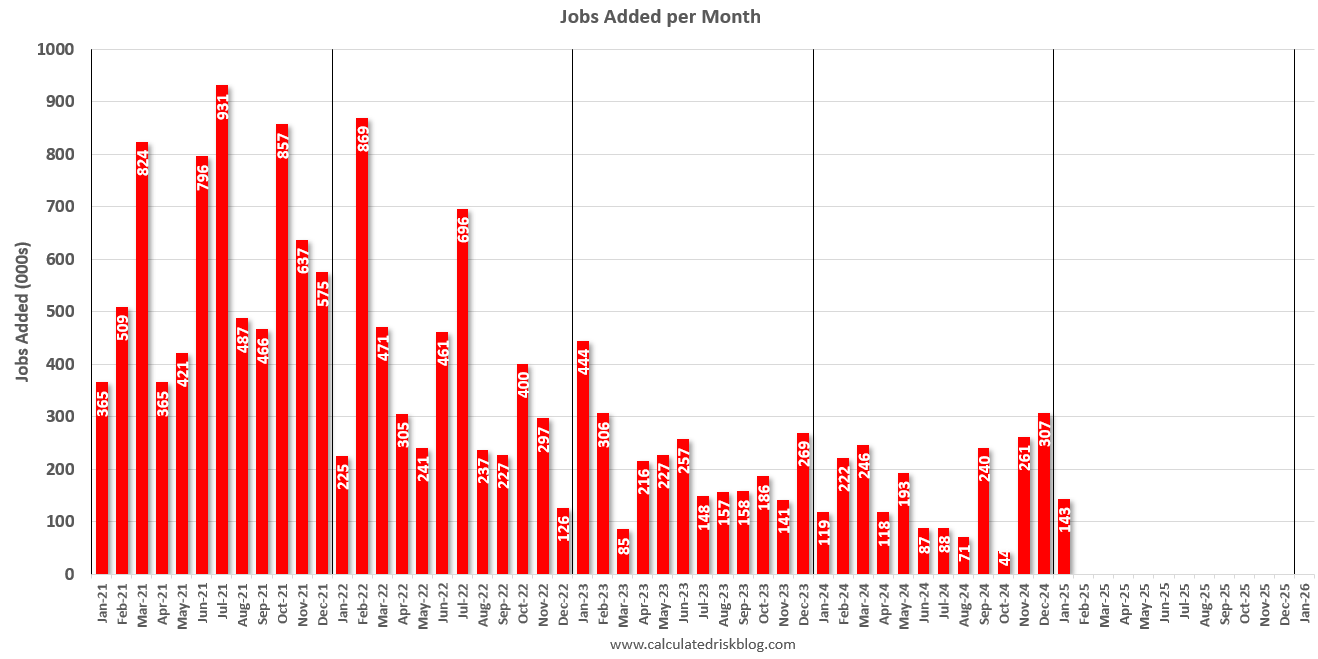 8:30 AM: Employment Report for February. The consensus is for 158,000 jobs added, and for the unemployment rate to be unchanged at 4.0%.
There were 143,000 jobs added in January, and the unemployment rate was at 4.0%.
This graph shows the jobs added per month since January 2021.
12:30 PM: Speech, Fed Chair Jerome Powell, Economic Outlook, At The University of Chicago Booth School of Business 2025 U.S. Monetary Policy Forum, New York, N.Y.
Friday, February 28, 2025
February 28th COVID Update: COVID Deaths Declining
by Calculated Risk on 2/28/2025 07:03:00 PM
 Note: Mortgage rates are from MortgageNewsDaily.com and are for top tier scenarios.
For deaths, I'm currently using 4 weeks ago for "now", since the most recent three weeks will be revised significantly.
Note: "Effective May 1, 2024, hospitals are no longer required to report COVID-19 hospital admissions, hospital capacity, or hospital occupancy data." So I'm no longer tracking hospitalizations.
| COVID Metrics | ||||
|---|---|---|---|---|
| Now | Week Ago | Goal | ||
| Deaths per Week | 850 | 893 | ≤3501 | |
| 1my goals to stop weekly posts. 🚩 Increasing number weekly for Deaths. ✅ Goal met. | ||||
 Click on graph for larger image.
This graph shows the weekly (columns) number of deaths reported since Jan 2023.
Although weekly deaths met the original goal to stop posting in June 2023 (low of 314 deaths), I'm continuing to post now that deaths are above the goal again - and I'll continue to post until weekly deaths are once again below the goal.
Weekly deaths are now decreasing following the winter pickup.
 This appears to be a leading indicator for COVID hospitalizations and deaths. This has moving down recently.
Nationally COVID in wastewater is "Moderate", down from "High" two weeks ago, according to the CDC.
Q1 GDP Tracking: Wide Range, GDPNow Goes Negative
by Calculated Risk on 2/28/2025 11:49:00 AM
From BofA:
The second print of 4Q GDP came in at 2.3% q/q saar, unchanged from the advance print and a tenth higher than our tracking estimate. Meanwhile, our 1Q GDP tracking is unchanged at 2.3% q/q saar since our last weekly publication. [Feb 28th]From Goldman:
emphasis added
We lowered our Q1 GDP tracking estimate by 0.4pp to +1.4% (quarter-over-quarter annualized). Our tracking estimate exaggerates the softness in Q1 to some extent because elevated gold imports ought to result in an offsetting increase in inventory accumulation, but the Q4 GDP data suggest this offset is unlikely to be captured in real time. [Feb 28th estimate]
 And from the Atlanta Fed: GDPNow
The GDPNow model estimate for real GDP growth (seasonally adjusted annual rate) in the first quarter of 2025 is -1.5 percent on February 28, down from 2.3 percent on February 19. After recent releases from the US Bureau of Economic Analysis and the US Census Bureau, the nowcast of the contribution of net exports to first-quarter real GDP growth fell from -0.41 percentage points to -3.70 percentage points while the nowcast of first-quarter real personal consumption expenditures growth fell from 2.3 percent to 1.3 percent. [Feb 28th estimate]
Freddie Mac House Price Index Increased in January; Up 3.9% Year-over-year
by Calculated Risk on 2/28/2025 10:47:00 AM
Today, in the Calculated Risk Real Estate Newsletter: Freddie Mac House Price Index Increased in January; Up 3.9% Year-over-year
A brief excerpt:
Freddie Mac reported that its “National” Home Price Index (FMHPI) increased 0.41% month-over-month on a seasonally adjusted (SA) basis in January. On a year-over-year basis, the National FMHPI was up 3.9% in January, down from up 4.1% YoY in December. The YoY increase peaked at 19.0% in July 2021, and for this cycle, bottomed at up 0.9% YoY in May 2023. ...There is much more in the article!
For cities (Core-based Statistical Areas, CBSA), here are the 30 cities with the largest declines from the peak, seasonally adjusted. Austin continues to be the worst performing city. However, 4 of the 6 cities with the largest price declines are in Florida (and Florida has 6 of the top 10 cities with the largest price declines).




