
 RSS Feed
 by Calculated Risk on 1/21/2025 01:07:00 PM
Tuesday, January 21, 2025
Benchmarking the U.S. economy
Presidents receive too much credit and blame for the economy!
But it worth looking at the current state of the economy. From economist Ernie Tedeschi: Benchmarking the U.S. economy that President Donald Trump is set to inherit
• While the U.S. economy still has challenges, especially lingering inflation and poor consumer sentiment, many important economic metrics are outperforming the 2008 cycle (the most recent nonpandemic business cycle and the cycle in which the first Trump administration began), and some are even at historical highs.
• Some measures have already met goals set by the incoming administration, even before Inauguration Day. Real Gross Domestic Product growth, for example, has averaged 3 percent over the past two years.
• Expectations are for output growth to moderate to trend next year, inflation to take roughly two years to fully return to the Federal Reserve’s 2 percent target, and the unemployment rate to remain roughly at current levels.
• Economic forecasts even one year or two years out are highly uncertain.
...
Broadly speaking, the data indicate that the U.S. economy in the later part of 2024 was in a strong position. Growth in output, measured by real GDP, and nonfarm productivity were above estimates of trend, employment levels were at near-historic highs, and real wage and income growth was positive. Though inflation was not yet fully back to the Federal Reserve’s inflation target of 2 percent, it was generally thought to be in the “last mile,” or the phase when inflation declines tend to slow as inflation approaches 2 percent. The risk of inflation reaccelerating, however, remains a concern. And some measures of labor market momentum, such as quits and hires, softened in recent quarters off of their prior strong reads.
Table 1 below summarizes recent U.S. economic data and contrasts it with the performance over the 2008–2019 business cycle, which includes the Great Recession of 2007–2009 and the subsequent recovery prior to the onset of the COVID-19 recession in 2020. Numbers in blue are metrics that outperformed the average over the entire previous business cycle, while numbers in purple indicate metrics that outperformed the second half of the previous cycle, from 2014 to 2019, when the Great Recession recovery accelerated. (See Table 1.)
 Click on graph for larger image.
NOTE: I broke the table in two to make it more readable.
As a caveat, economic aggregates are, by their nature, summary statistics that do not represent all lived experiences. Indeed, by definition, half of people are above and below the median. No one economic measure or set of measures perfectly encapsulates all the positives and negatives of the U.S. economy. With that said, were one to compare U.S. outcomes in 2025 and 2026 to those coming out of 2024, Table 1 gives a sense of what the most prominent metrics look like at the end of President Biden’s term in office.

3rd Look at Local Housing Markets in December
by Calculated Risk on 1/21/2025 09:24:00 AM
Today, in the Calculated Risk Real Estate Newsletter: 3rd Look at Local Housing Markets in December
A brief excerpt:
The NAR is scheduled to release December Existing Home sales on Friday, January 24th at 10:00 AM. The consensus is for 4.20 million SAAR, up from 4.15 million in November. Last year, the NAR reported sales in December 2023 at 3.88 million SAAR. This will be the third consecutive month with a year-over-year increase following YoY declines every month since July 2021.There is much more in the article.
Housing economist Tom Lawler expects the NAR to report sales of 4.15 million SAAR for December.
...
Here is a look at months-of-supply using NSA sales. Since this is NSA data, it is likely this will be the seasonal low for months-of-supply.
Note the regional differences with more months-of-supply in the South, especially in Florida and Texas.
...
More local markets to come!

Monday, January 20, 2025
Monday Night Futures
by Calculated Risk on 1/20/2025 06:29:00 PM
Tuesday:
• No major economic releases scheduled.
From CNBC: Pre-Market Data and Bloomberg futures S&P 500 are up 32 and DOW futures are up 225 (fair value).
1.73 million Total Housing Completions in 2024 including Manufactured Homes; Most Since 2006
by Calculated Risk on 1/20/2025 02:04:00 PM
Today, in the Calculated Risk Real Estate Newsletter: 1.73 million Total Housing Completions in 2024 including Manufactured Homes; Most Since 2006
A brief excerpt:
Although total housing starts decreased 3.9% in 2024 compared to 2023, completions increased sharply year-over-year. There were 1.731 million total completions and placements in 2024, up 12.5% compared to 2023, and the most since 2006.There is much more in the article.
Not counting Manufactured homes, there are 1.628 million completions in 2024, up 12.4% from 1.449 million in 2023, and also the most since 2006.
...
The housing start report last week indicated 1,020.4 thousand single family completions in 2024 (red), up 2.2% from 998.8 thousand in 2023. There were 16.8 thousand completions of 2-to-4 units, and 590.6 thousand completions of 5+ units (blue), up 35% from 2023, and the most since 1974!

AAR: Rail Carloads Down YoY in 2024, Intermodal Up
by Calculated Risk on 1/20/2025 11:17:00 AM
From the Association of American Railroads (AAR) Rail Time Indicators. Graphs and excerpts reprinted with permission.
For the full year 2024, total U.S. carloads were 11.34 million, down 2.9% (343,156 carloads) from 2023 and down 2.3% (265,491 carloads) from 2022. ... Carloads excluding coal, on the other hand, rose in 2024 — up 1.4%, or 117,264 carloads, over 2023 and their third year-over-year gain in the past four years.
U.S. railroads originated 13.84 million containers and trailers in 2024, the most since 2021; the third most ever (behind 2018 and 2021); and up 9.3% (1.17 million units) over 2023.
emphasis added
 Click on graph for larger image.
This graph from the Rail Time Indicators report shows the six-week average for carloads for the last 3 years. Total carloads were down 2.0% in Q4 YoY.
Total originated carloads on U.S. railroads in the fourth quarter of 2024 fell 2.0%, or 57,285 carloads, from the fourth quarter of 2023. Total carloads fell year-over-year each quarter in 2024 after rising (albeit modestly) in three of the four quarters of 2023. Total carloads averaged 220,336 per week in Q4 2024. In our records that begin in 1988, only 2020 had a lower fourth-quarter weekly average.
 And on Intermodal:
In Q4 2024, intermodal averaged 279,275 units per week, up 8.8% over Q4 2023 and the most ever for a fourth quarter in our records. (Q3 2018 and Q2 2021 were higher among all quarters.) Container volume averaged 269,460 per week in Q4 2024, up 10.0% over Q4 2023 and the most ever for any quarter.Note: rail traffic was weak even before the pandemic. As AAR noted: "Trade tensions and declining mfrg. output lead to lower rail volumes" in 2019. These factors might impact rail traffic again in 2025.
Housing Jan 20th Weekly Update: Inventory Up 1.2% Week-over-week, Up 24.8% Year-over-year
by Calculated Risk on 1/20/2025 08:11:00 AM
Altos reports that active single-family inventory was up 1.2% week-over-week.
Inventory always declines seasonally in the Winter and usually bottoms in late January or February. If the previous week was the seasonal bottom, that would be very early in the year, but that has happened before.
The first graph shows the seasonal pattern for active single-family inventory since 2015.
 Click on graph for larger image.
The red line is for 2024. The black line is for 2019.
Inventory was up 24.8% compared to the same week in 2024 (last week it was up 23.6%), and down 23.4% compared to the same week in 2019 (last week it was down 23.3%).
Back in June 2023, inventory was down almost 54% compared to 2019, so the gap to more normal inventory levels has closed significantly!
 This second inventory graph is courtesy of Altos Research.
As of Jan 17th, inventory was at 632 thousand (7-day average), compared to 624 thousand the prior week.
Mike Simonsen discusses this data regularly on Youtube
Sunday, January 19, 2025
Sunday Night: Markets Closed in observance of Martin Luther King Jr. Day
by Calculated Risk on 1/19/2025 07:16:00 PM
Weekend:
• Schedule for Week of January 19, 2025
Monday:
• All US markets will be closed in observance of Martin Luther King Jr. Day
Oil prices were up over the last week with WTI futures at $77.88 per barrel and Brent at $80.79 per barrel. A year ago, WTI was at $74, and Brent was at $81 - so WTI oil prices are up about 5% year-over-year.
Here is a graph from Gasbuddy.com for nationwide gasoline prices. Nationally prices are at $3.11 per gallon. A year ago, prices were at $3.10 per gallon, so gasoline prices are mostly unchanged year-over-year.
Hotels: Occupancy Rate Decreased 7.7% Year-over-year
by Calculated Risk on 1/19/2025 08:14:00 AM
The U.S. hotel industry reported negative year-over-year comparisons, according to CoStar’s latest data through 11 January. ...The following graph shows the seasonal pattern for the hotel occupancy rate using the four-week average.
5-11 January 2025 (percentage change from comparable week in 2024):
• Occupancy: 49.2% (-7.7%)
• Average daily rate (ADR): US$144.03 (-5.9%)
• Revenue per available room (RevPAR): US$70.92 (-13.2%)
emphasis added
 Click on graph for larger image.
The red line is for 2025, blue is the median, and dashed light blue is for 2024. Dashed purple is for 2018, the record year for hotel occupancy.
The 4-week average of the occupancy rate is close to both last year and the median rate for the period 2000 through 2024 (Blue).
Note: Y-axis doesn't start at zero to better show the seasonal change.
This is the weakest period of the year for hotel occupancy and the 4-week average will increase seasonally for the next several months.
Saturday, January 18, 2025
Real Estate Newsletter Articles this Week: Housing Starts Down 3.9% in 2024 compared to 2023
by Calculated Risk on 1/18/2025 02:11:00 PM
At the Calculated Risk Real Estate Newsletter this week:
 Click on graph for larger image.
• Housing Starts Increased to 1.499 million Annual Rate in December
• Housing Discussion with Altos Research's Mike Simonsen
• Lawler: Early Read on Existing Home Sales in December
• Part 1: Current State of the Housing Market; Overview for mid-January 2025
• Part 2: Current State of the Housing Market; Overview for mid-January 2025
• 2nd Look at Local Housing Markets in December
This is usually published 4 to 6 times a week and provides more in-depth analysis of the housing market.
Schedule for Week of January 19, 2025
by Calculated Risk on 1/18/2025 08:11:00 AM
The key report this week is December Existing Home Sales.
All US markets will be closed in observance of Martin Luther King Jr. Day
"Our lives begin to end the day we become silent about things that matter." Martin Luther King Jr.
No major economic releases scheduled.
7:00 AM ET: The Mortgage Bankers Association (MBA) will release the mortgage purchase applications index.
During the day: The AIA's Architecture Billings Index for December (a leading indicator for commercial real estate).
8:30 AM: The initial weekly unemployment claims report will be released. The consensus is for a increase to 227 thousand from 217 thousand last week.
11:00 AM: the Kansas City Fed manufacturing survey for January.
 10:00 AM: Existing Home Sales for December from the National Association of Realtors (NAR). The consensus is for 4.20 million SAAR, up from 4.15 million.
The graph shows existing home sales from 1994 through the report last month.
10:00 AM: University of Michigan's Consumer sentiment index (Preliminary for January).
Friday, January 17, 2025
January 19th COVID Update: COVID in Wastewater Decreasing
by Calculated Risk on 1/17/2025 07:48:00 PM
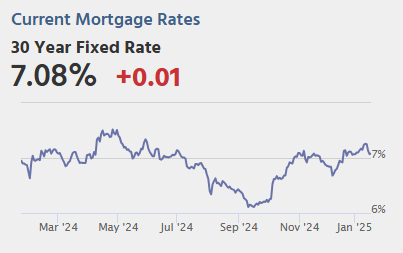 Note: Mortgage rates are from MortgageNewsDaily.com and are for top tier scenarios.
For deaths, I'm currently using 4 weeks ago for "now", since the most recent three weeks will be revised significantly.
Note: "Effective May 1, 2024, hospitals are no longer required to report COVID-19 hospital admissions, hospital capacity, or hospital occupancy data." So I'm no longer tracking hospitalizations.
| COVID Metrics | ||||
|---|---|---|---|---|
| Now | Week Ago | Goal | ||
| Deaths per Week | 518 | 524 | ≤3501 | |
| 1my goals to stop weekly posts. 🚩 Increasing number weekly for Deaths. ✅ Goal met. | ||||
 Click on graph for larger image.
This graph shows the weekly (columns) number of deaths reported since Jan 2020.
Although weekly deaths met the original goal to stop posting, I'm continuing to post now that deaths are above the goal again - and at a minimum, I'll continue to post through the Winter.
Weekly deaths have mostly been declining, however weekly deaths are still above the low of 313 in early June 2024.
 This appears to be a leading indicator for COVID hospitalizations and deaths.
Nationally COVID in wastewater is "HIGH" according to the CDC but is now declining.
Q4 GDP Tracking: 2.1% to 3.0% Range
by Calculated Risk on 1/17/2025 03:31:00 PM
From BofA:
Since our last weekly publication, our 4Q GDP tracking estimate has moved up three-tenths to 2.1% q/q saar. [Jan 17th estimate]From Goldman:
emphasis added
Following this morning’s data, we boosted our Q4 GDP tracking estimate by 0.1pp to +2.6% (quarter-over-quarter annualized) and our Q4 domestic final sales forecast by the same amount to +2.6%. [Jan 17th estimate]And from the Atlanta Fed: GDPNow
The GDPNow model estimate for real GDP growth (seasonally adjusted annual rate) in the fourth quarter of 2024 is 3.0 percent on January 17, unchanged from January 16 after rounding. After this morning’s releases from the US Census Bureau and the Federal Reserve Board of Governors, an increase in the nowcast of fourth-quarter real personal consumption expenditures growth from 3.7 percent to 3.8 percent was offset by a decrease in the nowcast of the contribution of inventory investment to real GDP growth from -0.37 percentage points to -0.41 percentage points. [Jan 17th estimate]
Lawler: Early Read on Existing Home Sales in December
by Calculated Risk on 1/17/2025 12:06:00 PM
From housing economist Tom Lawler:
Based on publicly-available local realtor/MLS reports released across the country through today, I project that existing home sales as estimated by the National Association of Realtors ran at a seasonally adjusted annual rate of 4.15 million in December, unchanged from November’s preliminary pace and up 7.0% from last December’s seasonally adjusted pace. Unadjusted sales should show a somewhat higher YOY % gain, reflecting this December’s business day count compared to last December’s.
Local realtor/MLS reports suggest that the median existing single-family home sales price last month was up by about 5.6% from a year earlier.
CR Note: The NAR is scheduled to release December Existing Home sales on Friday, January 24th at 10:00 AM. The consensus is for 4.20 million SAAR, up from 4.15 million in November. Last year, the NAR reported sales in December 2023 at 3.88 million SAAR. This will be the third consecutive month with a year-over-year increase following YoY declines every month since July 2021.
Housing Starts Increased to 1.499 million Annual Rate in December
by Calculated Risk on 1/17/2025 09:29:00 AM
Today, in the Calculated Risk Real Estate Newsletter: Housing Starts Increased to 1.499 million Annual Rate in December
A brief excerpt:
Total housing starts in December were above expectations and starts in October and November were revised up.There is much more in the article.
The third graph shows the month-to-month comparison for total starts between 2023 (blue) and 2024 (red).
Total starts were down 4.4% in December compared to December 2023. The YoY decrease in December total starts was mostly due to a difficult comparison to starts in December 2023.
Single family starts have been up year-over-year in 13 of the last 18 months, whereas multi-family has been up year-over-year in only 3 of last 19 months. For the year, total starts were down 2.6% compared to 2023. Single family starts were up 6.6% YoY in 2024, and multi-family were down 18.8% YoY.

Industrial Production Increased 0.9% in December
by Calculated Risk on 1/17/2025 09:15:00 AM
Earlier from the Fed: Industrial Production and Capacity Utilization
Industrial Production (IP) increased 0.9 percent in December after moving up 0.2 percent in November. In December, gains in the output of aircraft and parts contributed 0.2 percentage point to total IP growth following the resolution of a work stoppage at a major aircraft manufacturer. Manufacturing output rose 0.6 percent after gaining 0.4 percent in November. The indexes for mining and utilities climbed 1.8 percent and 2.1 percent, respectively, in December. At 103.2 percent of its 2017 average, total IP in December was 0.5 percent above its year-earlier level. Capacity utilization stepped up to 77.6 percent, a rate that is 2.1 percentage points below its long-run (1972–2023) average.
emphasis added
 Click on graph for larger image.
This graph shows Capacity Utilization. This series is up from the record low set in April 2020, and close to the level in February 2020 (pre-pandemic).
Capacity utilization at 77.6% is 2.1% below the average from 1972 to 2023. This was above consensus expectations.
Note: y-axis doesn't start at zero to better show the change.
 The second graph shows industrial production since 1967.
Industrial production increased to 103.2. This is above the pre-pandemic level.
Industrial production was well above consensus expectations.
Housing Starts Increased to 1.499 million Annual Rate in December
by Calculated Risk on 1/17/2025 08:30:00 AM
From the Census Bureau: Permits, Starts and Completions
Housing Starts:
Privately-owned housing starts in December were at a seasonally adjusted annual rate of 1,499,000. This is 15.8 percent above the revised November estimate of 1,294,000, but is 4.4 percent below the December 2023 rate of 1,568,000. Single-family housing starts in December were at a rate of 1,050,000; this is 3.3 percent above the revised November figure of 1,016,000. The December rate for units in buildings with five units or more was 418,000.
An estimated 1,364,100 housing units were started in 2024. This is 3.9 percent below the 2023 figure of 1,420,000.
Building Permits:
Privately-owned housing units authorized by building permits in December were at a seasonally adjusted annual rate of 1,483,000. This is 0.7 percent below the revised November rate of 1,493,000 and is 3.1 percent below the December 2023 rate of 1,530,000. Single-family authorizations in December were at a rate of 992,000; this is 1.6 percent above the revised November figure of 976,000. Authorizations of units in buildings with five units or more were at a rate of 437,000 in December.
An estimated 1,471,200 housing units were authorized by building permits in 2024. This is 2.6 percent below the 2023 figure of 1,511,100.
emphasis added
Click on graph for larger image.The first graph shows single and multi-family housing starts since 2000.
Multi-family starts (blue, 2+ units) increased month-over-month in December. Multi-family starts were down 8.4% year-over-year.
Single-family starts (red) increased in December and were down 2.6% year-over-year.
 The second graph shows single and multi-family housing starts since 1968.
 This shows the huge collapse following the housing bubble, and then the eventual recovery - and the recent collapse and recovery in single-family starts.
Total housing starts in December were above expectations and starts in October and November were revised up.
I'll have more later …
Thursday, January 16, 2025
Friday: Housing Starts, Industrial Production
by Calculated Risk on 1/16/2025 07:41:00 PM
 Note: Mortgage rates are from MortgageNewsDaily.com and are for top tier scenarios.
Friday:
• At 8:30 AM ET, Housing Starts for December. The consensus is for 1.315 million SAAR, up from 1.289 million SAAR.
• At 9:15 AM, The Fed will release Industrial Production and Capacity Utilization for December. The consensus is for a 0.3% increase in Industrial Production, and for Capacity Utilization to increase to 77.0%.
Housing Discussion with Altos Research's Mike Simonsen
by Calculated Risk on 1/16/2025 02:39:00 PM
Here is a YouTube video of a discussion with Mike Simonsen. Enjoy.
NAHB: Builder Confidence "Edges Up" in January
by Calculated Risk on 1/16/2025 10:19:00 AM
The National Association of Home Builders (NAHB) reported the housing market index (HMI) was at 47, up from 46 last month. Any number below 50 indicates that more builders view sales conditions as poor than good.
From the NAHB: Builder Confidence Edges Up Even as Market Risk Concerns Rise
Builder sentiment edged higher to begin the year on hopes for an improved economic growth and regulatory environment. At the same time, builders expressed concerns over how building material tariffs and costs and a larger government deficit would put upward pressure on inflation and mortgage rates.
Builder confidence in the market for newly built single-family homes was 47 in January, up one point from December, according to the National Association of Home Builders (NAHB)/Wells Fargo Housing Market Index (HMI) released today.
“Builders are facing continued challenges for housing demand in the near-term, with mortgage rates up from near 6.1% in late September to above 6.9% today,” said NAHB Chairman Carl Harris, a custom home builder from Wichita, Kan. “Land is expensive and financing for private builders remains costly. However, there is hope that policymakers are taking the impact of regulatory hurdles seriously and will make improvements in 2025.”
“NAHB is forecasting a slight gain for single-family housing starts in 2025, as the market faces offsetting upside and downside risks from an improving regulatory outlook and ongoing elevated interest rates,” said NAHB Chief Economist Robert Dietz. “And while ongoing, but slower easing from the Federal Reserve should help financing for private builders currently squeezed out of some local markets, builders report cancellations are climbing as a direct result of mortgage rates rising back up near 7%.”
The latest HMI survey also revealed that 30% of builders cut home prices in January. This share has been stable between 30% and 33% since last July. Meanwhile, the average price reduction was 5% in January, the same rate as in December. The use of sales incentives was 61% in January. This share has remained between 60% and 64% since last June.
...
The HMI index gauging current sales conditions rose three points to 51 and the gauge charting traffic of prospective buyers posted a two-point gain to 33. The component measuring sales expectations in the next six months fell six points to 60 in part due to the elevated interest rate environment. While this serves as a cautionary note, the future sales component is still the highest of the three sub-indices and well above the breakeven level of 50.
Looking at the three-month moving averages for regional HMI scores, the Northeast increased five points to 60, the Midwest moved one point higher to 47, the South posted a one-point gain to 46 and the West fell one point to 40.
emphasis added
 Click on graph for larger image.
This graph shows the NAHB index since Jan 1985.
This was above the consensus forecast.
Retail Sales Increased 0.4% in December
by Calculated Risk on 1/16/2025 10:12:00 AM
On a monthly basis, retail sales increased 0.4% from November to December (seasonally adjusted), and sales were up 3.9 percent from December 2023.
From the Census Bureau report:
Advance estimates of U.S. retail and food services sales for December 2024, adjusted for seasonal variation and holiday and trading-day differences, but not for price changes, were $729.2 billion, an increase of 0.4 percent from the previous month, and up 3.9 percent from December 2023. ... The October 2024 to November 2024 percent change was revised from up 0.7 percent to up 0.8 percent.
emphasis added
 Click on graph for larger image.
This graph shows retail sales since 1992. This is monthly retail sales and food service, seasonally adjusted (total and ex-gasoline).
Retail sales ex-gasoline was up 0.4% in December.
The second graph shows the year-over-year change in retail sales and food service (ex-gasoline) since 1993.
Retail and Food service sales, ex-gasoline, increased by 4.1% on a YoY basis.
 The change in sales in December were slightly below expectations, however sales in October and November were revised up.



