
 RSS Feed
 by Calculated Risk on 10/12/2008 11:39:00 AM
Sunday, October 12, 2008
Australia and New Zealand to Guarantee All Bank Deposits
From the WSJ: Australia to Guarantee All Bank Deposits
Australian Prime Minister Kevin Rudd said Sunday the government will guarantee all bank deposits for a period of three years.Over in Europe, UK Prime Minister Gordon Brown is in Paris today presenting the UK plan to other European leaders:
From Sunday, the government will also guarantee all term wholesale funding by Australian banks operating in international credit markets "to make sure they have the best possible access to global capital," Mr. Rudd said.
The New Zealand government followed Mr. Rudd's announcement by introducing a bank deposit guarantee program as both countries sought safeguards against turbulence in global credit markets.
Gordon Brown arrived at the Elysee Palace in Paris today for the latest international leg of his campaign to promote a British bank bailout plan among world leaders.
Despite the UK not being part of the euro, the Prime Minister met President Nicolas Sarkozy of France ahead of a summit of the 15 eurozone members and will brief them on the plan in which the Government will inject billions of pounds into struggling banks in return for preferential shares.
The plan is being looked upon favourably by Western leaders – including the Bush Administration – as a way of injecting confidence and liquidity into the financial system whilst retaining a politically favourable stake for the taxpayer. Europe also looks set to follow suit.
Recent Home Buyers Underwater
by Calculated Risk on 10/12/2008 10:03:00 AM
Here are a couple of articles that suggest a number of recent home buyers are already underwater (owe more than their homes are worth). Here is a graphic from the South Florida NewsPress.com: ‘Underwater’ borrowers sign of more trouble
Click on graph for larger image in new window.
Worst off are those who bought homes in 2006, just as the housing boom was ending: 78.5 percent of those now have home values less than the original loan amount, according to second-quarter statistics compiled by real estate data provider Zillow.com.But look at 2007 and even 2008. In Lee County Florida, according to NewsPress.com, 14.5% of homeowners who bought this year owe more than their homes are worth. And almost two-thirds of homebuyers in 2007 are underwater.
And the MercuryNews.com has a sad tale of a neighborhood devasted by foreclosures: Financial crisis: Homeowners in Manteca neighborhood cope with foreclosures.
The math alone is humiliating. The house was worth $770,000 after the Cantrells bought it [in 2006] and upgraded the back yard. They spent $250,000 for the down payment and pool but still owe about $520,000. They've had four offers on the house — the highest was $355,000.In October 2007 the home builder sold some of the homes at auction.
Representing his neighborhood with a promise to report back, [Dave Cantrell] attended the auction in a Pleasanton hotel ballroom last October. ... While Cantrell had paid a base price of $658,500 for his house, a nearly identical one sold for $391,000.Even the buyers who paid $391,000 last October have clearly lost money and with a 10% downypayment are close to being underwater.
Saturday, October 11, 2008
$400+ Billion German Bailout Possible
by Calculated Risk on 10/11/2008 07:13:00 PM
From the WSJ: German Bailout Likely to Be Over $400 Billion
German Chancellor Angela Merkel heads to Paris to present Sunday to her colleagues from the euro zone a financial sector bailout plan for Germany ... A person familiar with the situation told Dow Jones Newswires that the government is considering a total bailout plan of €300 billion to €400 billion ($402 billion to $536 billion), which includes state guarantees and the option to get a direct stake in banks. As part of this, the government is mulling recapitalizing financial institutions by injecting €50 billion to €100 billion in capital ...Looks like another busy Sunday!
UK Bailout: Details to be released at 7 AM Monday (London Time)
by Calculated Risk on 10/11/2008 06:42:00 PM
The bailout is to be announced Monday at 7 AM London Time (2 AM ET Monday AM).
The London stock market might be closed.
Current London Time:
From the WSJ: U.K. Banks to Announce Bailout Details
Some of the U.K.'s largest banks are expected to detail early Monday their participation in a bailout plan that could force the departure of some of their top executives, according to people familiar with the situation.The Times also mentions the possible market shutdown:
The announcement, aimed for about 7 a.m., is expected to include details on how much will be raised from the government and private investors.
...
One plan under consideration is to shutter London stock trading to allow investors to digest the news. That plan hasn't been finalized ...
The scale of the fundraising could lead to trading at the London stock market being suspended. This would be to give time for the market to digest the scale of the information and its impact.
UK to Invest in Banks on Monday
by Calculated Risk on 10/11/2008 04:26:00 PM
From The Times: State to save HBOS and RBS
THE government will tomorrow launch the biggest rescue of Britain’s high-street banks when the UK’s four biggest institutions ask for a £35 billion financial lifeline.Here is the WSJ article: U.K. Banks to Announce Details of Plan
The unprecedented move will make the government the biggest shareholder in at least two banks. The Royal Bank of Scot-land (RBS), which has seen its market value fall to under £12 billion, is to ask the government to underwrite a £15 billion cash call. HBOS, which is Britain’s biggest provider of mortgages, is requesting up to £10 billion. Lloyds TSB, which is in the process of acquiring HBOS, and Barclays require £7 billion and £3 billion.
...
The British bank rescue could leave the government owning 70% of HBOS and 50% of RBS. ... Further capital is also available and the Treasury has increased the total amount to £75 billion.
The Times article also comments on Morgan Stanley:
Separately, the future of Morgan Stanley, the American investment bank, is also in doubt today ... Mitsubishi UFJ Financial Group is reviewing the terms of a $9 billion (£5.3 billion) capital injection into the bank and may launch a takeover.
Treasury Official: Equity Purchase Plan to be Announced Within Days
by Calculated Risk on 10/11/2008 09:03:00 AM
David McCormick, the Treasury undersecretary for international affairs, was on ABC News this morning. The WSJ has a summary of his comments:
Mr. McCormick said the G-7 held "an absolute common view on the urgency of the situation" and on the steps needed to "work on immediately to try to being some stability to the market."
Asked about investor frustration with leaders in Washington and too much talk about action, Mr. McCormick said he agrees with the sentiment that actions are more important than words.
"The good news is the outlines of those actions are beginning to become more clear," he said. "As we take those actions, we hope that they begin to bring confidence back to the market."
On Friday, U.S. Treasury Secretary Henry Paulson announced plans for a standardized government program to buy equity in a wide range of financial companies.
Mr. McCormick said the specifics of the plan will be unveiled in coming days and it will be put into place within weeks.
Charlie Rose: A Discussion with Paul Volcker
by Calculated Risk on 10/11/2008 01:59:00 AM
This segment aired Thursday night October 9th (hat tip Jon):
Friday, October 10, 2008
GM to Acquire Chrysler?
by Calculated Risk on 10/10/2008 10:38:00 PM
The WSJ reports that GM has recently talked with Cerberus about acquiring Chrysler's automotive operations in exchange for GM's remaining 49% stake in GMAC.
Cerberus would keep Chrysler's financing arm - and probably would combine it with GMAC.
According to the WSJ, GM would expect about $10 billion in savings by combining the automotive operations.
This actually might make sense ...
UPDATE: Same story from the NY Times: G.M. and Chrysler Explore Merger
The talks between G.M. and Cerberus Capital Management ... began more than a month ago, and the negotiations are not certain to produce a deal. Two people close to the process said the chances of a merger were “50-50” as of Friday and would most likely still take weeks to work out.
Paulson: Will Buy Equity "Soon"
by Calculated Risk on 10/10/2008 07:21:00 PM
From Bloomberg: Paulson Says Will Buy Bank Equity `Soon as We Can'
U.S. Treasury Secretary Henry Paulson said the U.S. will buy equity ``as soon as we can'' in banks and other financial institutions to restore market stability and revive economic growth.Paulson was also asked if Morgan Stanley and Goldman Sachs qualified as banks that are too big to fail. Paulson replied that the G-7 didn't discuss specific banks.
The Treasury is ``working to develop a standardized program that is open to a broad array of financial institutions,'' Paulson said at a press conference ...
``We're going to do it as soon as we can do it and do it properly and do it effectively and right,'' Paulson said. ``Trust me, we are not wasting time; people are working around the clock to deal with this.''
As usual, Paulson was short on specifics.
Update: Paulson also seemed to say buying equity provided a bigger bang for the buck than buying troubled mortgage assets. (I'm looking for the transcript of the Q&A for the exact quote). Update: the WaPo quotes Paulson during the Q&A:
"We can use taxpayer money more effectively, more efficiently, it will go farther, they will get more for their dollars and more protection if we develop a standardized program" for buying equity stakes, Paulson said.So maybe he was just saying a standardized program is better - I thought he was comparing buying equities to buying troubled assets. (Still looking for transcript).
G-7 Communiqué: Just Generalities
by Calculated Risk on 10/10/2008 06:57:00 PM
G-7 Finance Ministers and Central Bank Governors
Plan of Action
Washington— The G-7 agrees today that the current situation calls for urgent and exceptional action. We commit to continue working together to stabilize financial markets and restore the flow of credit, to support global economic growth. We agree to:
1. Take decisive action and use all available tools to support systemically important financial institutions and prevent their failure.
2. Take all necessary steps to unfreeze credit and money markets and ensure that banks and other financial institutions have broad access to liquidity and funding.
3. Ensure that our banks and other major financial intermediaries, as needed, can raise capital from public as well as private sources, in sufficient amounts to re-establish confidence and permit them to continue lending to households and businesses.
4. Ensure that our respective national deposit insurance and guarantee programs are robust and consistent so that our retail depositors will continue to have confidence in the safety of their deposits.
5. Take action, where appropriate, to restart the secondary markets for mortgages and other securitized assets. Accurate valuation and transparent disclosure of assets and consistent implementation of high quality accounting standards are necessary.
The actions should be taken in ways that protect taxpayers and avoid potentially damaging effects on other countries. We will use macroeconomic policy tools as necessary and appropriate. We strongly support the IMF’s critical role in assisting countries affected by this turmoil. We will accelerate full implementation of the Financial Stability Forum recommendations and we are committed to the pressing need for reform of the financial system. We will strengthen further our cooperation and work with others to accomplish this plan.
Bank Failures: Number 14 and 15
by Calculated Risk on 10/10/2008 06:49:00 PM
It's Friday. From the FDIC:
Main Street Bank, Northville, Michigan, was closed today by the Michigan Office of Financial and Insurance Regulation, and the Federal Deposit Insurance Corporation (FDIC) was named receiver. To protect the depositors, the FDIC approved the assumption of all the deposits of Main Street Bank, by Monroe Bank & Trust, Monroe, Michigan.And also:
...
Main Street Bank had total assets of $98 million in total assets and $86 million in total deposits as of October 7, 2008.
Monroe Bank & Trust has agreed to pay a total premium of 1 percent for the failed bank's deposits. In addition, Monroe Bank & Trust will purchase approximately $16.9 million of Main Street's assets, and have a 90-day option to purchase approximately $1.1 million in premises and fixed assets. The FDIC will retain the remaining assets for later disposition.
The FDIC estimates that the cost to its Deposit Insurance Fund will be between $33 million and $39 million. Monroe Bank & Trusts' acquisition of all deposits was the "least costly" resolution for the FDIC's Deposit Insurance Fund compared to all alternatives because the expected losses to uninsured depositors were fully covered by the premium paid for the failed bank's franchise.
Main Street Bank is the first bank to be closed in Michigan since New Century Bank, Shelby Township, Michigan, on March 28, 2002. This year a total of fourteen FDIC-insured institutions have been closed.
Meridian Bank, Eldred, Illinois, was closed today by the Illinois Department of Financial Professional Regulation-Division of Banking, and the Federal Deposit Insurance Corporation (FDIC) was named receiver. To protect the depositors, the FDIC approved the assumption of all the deposits of Meridian Bank by National Bank, Hillsboro, Illinois.
...
Meridian Bank had total assets of $ 39.18 million in total assets and $ 36.88 million in total deposits as of September 25, 2008. National Bank will purchase approximately $7.55 million of Meridian's assets, and did not pay the FDIC a premium for the right to assume all of the failed bank's deposits. The FDIC will retain the remaining assets for later disposition.
...
The FDIC estimates that the cost to its Deposit Insurance Fund will be between $13 million and $14.5 million. National Banks' acquisition of all deposits was the "least costly" resolution for the FDIC's Deposit Insurance Fund compared to all alternatives.
Meridian Bank is the first bank to be closed in Illinois since Universal FSB, Chicago, Illinois on June 27, 2002. This year a total of fifteen FDIC-insured institutions have been closed.
G-7 Update: Italy say communiqué "too weak"
by Calculated Risk on 10/10/2008 04:31:00 PM
From Bloomberg: G-7 Meets on Crisis as Italy Splits Over `Weak' Draft
Finance ministers and central bankers from the Group of Seven nations met for crisis talks in Washington amid an unprecedented public split over what to say in their joint statement.The G-7 hopes to release a statement around 6 PM ET followed by comments from Secretary Paulson.
The draft communiqué under consideration is ``too weak'' and fails to reflect the gravity of the financial turmoil, Italian Finance Minister Giulio Tremonti told reporters in Washington before the talks began. ``We won't sign it.''
While Britain has pushed for a coordinated agreement to guarantee loans between banks, one official from a G-7 member said it was unlikely the G-7 would endorse their proposal. Two European officials said earlier that the group was considering saying that no systemically important bank would be allowed to fail, and laying out principles for all nations to follow.
Credit Spreads: Still Getting Worse
by Calculated Risk on 10/10/2008 02:28:00 PM
The TED spread (the difference between the LIBOR interest rate and the three month T-bill) has increased to a record 4.65 today. Completely off the recent charts! Here is the TED Spread from Bloomberg. 
There are a few earlier periods when the TED spread was higher than today (like during the '73-'75 recession).
But 4.65 is pretty close to the all time high.
And the following graph is the A2/P2 spread from the Fed's commercial paper report. The A2/P2 Spread hit 459 bp yesterday.
When the A2/P2 spread spiked to 160 last year that was considered shocking; now that spike looks minor. Click on graph for larger image in new window.
This is the spread between high and low quality 30 day nonfinancial commercial paper.
These is still no relief in the credit markets.
CNBC: Treasury Preparing Term Sheet for Recapitalization
by Calculated Risk on 10/10/2008 12:08:00 PM
From CNBC: Radical Measures May Be In The Wings
... Treasury Secretary Henry Paulson is prepared to take extraordinary steps through the extensive authority granted to him under emergency rescue legislation.
With the legislation’s main mechanism—an auction system to purchase bad mortgage-based securities—still weeks away from implementation, Paulson is now expediting plans to inject capital into banks, CNBC has learned.
According to senior government officials, the plan is to offer a term sheet, offering capital injections to all banks. An announcement won't happen for several days.
Report: Germany Considering Bank Recapitalization Plan
by Calculated Risk on 10/10/2008 11:28:00 AM
From the WSJ: Germany Considers Plan to Recapitalize Its Banks
Germany is working on a plan to prop up its major banks that could include taking government stakes and measures to guarantee banks' access to liquidity ... No final decision had been taken on Friday, but Chancellor Angela Merkel's government could take a decision on the plan and announce it as early as this weekend ...
The German plan could resemble the U.K. government's move to recapitalize major banks by taking government stakes ...
Market Take from Cartoonist Eric G. Lewis
by Calculated Risk on 10/10/2008 10:34:00 AM

Click on cartoon for larger image in new window.
Here is a grim take on the markets from from Eric G. Lewis, a freelance cartoonist living in Orange County, CA.
President Bush to Speak at 10:30 AM ET
by Calculated Risk on 10/10/2008 09:34:00 AM
Markets are cliff diving.
Dow is was down below 8000. Update: Now up to 8400 (expect volatilty!)
The Bush news conference is scheduled for 10 AM 10:30 AM.
Here is the CNBC feed.
And a live feed from C-SPAN.
Volcker: We Have the Tools to Manage the Crisis
by Calculated Risk on 10/10/2008 09:01:00 AM
Former Fed Chairman Paul Volcker writes in the WSJ: We Have the Tools to Manage the Crisis Excerpts:
Today, the financial crisis has reached a critical point. .... For months, the real economy, apart from housing, had not been much affected by the developing crisis. Now, a full-scale recession appears unavoidable. ...Volcker has been warning about these problems for years, and he clearly believes we have the tools to "manage" the crisis. But do we have the leadership? The 2nd headline to his piece is: "Now we need the leadership to use them."
Those are facts.
They are the culmination of economic imbalances, a succession of financial bubbles and financial crises that have been building for years. It's no wonder that confidence in markets, banks, and financial management has been badly eroded. Without effective action, fear might take hold, threatening orderly recovery.
Fortunately, there is also good reason to believe that the means are now available to turn the tide. Financial authorities, in the United States and elsewhere, are now in a position to take needed and convincing action to stabilize markets and to restore trust.
First of all, there is now clear recognition that the problem is international, and international coordination and cooperation is both necessary and underway. The days of finger pointing and schadenfreude are over. The concerted reduction in central bank interest rates is one concrete manifestation of that fact.
More important in existing circumstances is the clear determination of our Treasury, of European finance ministries, and of central banks to support and defend the stability of major international banks. That approach extends to providing fresh capital to supplement private funds if necessary.
...
The inevitable recession can be moderated. The groundwork can be laid for reconstructing the financial system and the regulatory and supervisory arrangements from the bottom up. The extraordinary interventions by the government (and taxpayer) should be ended as soon as reasonably feasible.
That rebuilding will be the job of another day ...
There is, and must be, recognition of the essential role that free and competitive financial markets play in a vigorous, innovative economic system. There needs to be understanding, in that context, that financial ups and downs -- and financial crises -- will be inevitable, even with responsible economic policies and sensible regulation. But never again should so much economic damage be risked by a financial structure so fragile, so overextended, so opaque as that of recent years.
Financial Crisis: A Global Response?
by Calculated Risk on 10/10/2008 06:04:00 AM
Mark Landler and Edmund Andrews write in the NY Times: Nations Weighing Global Approach as Chaos Spreads
The United States and Britain appear to be converging on a similar blueprint for stemming the financial chaos sweeping the world, one day before a crucial meeting of leaders begins in Washington that the White House hopes will result in a more coordinated response.Here is the proposal from Prime Minister Gordon Brown in The Times: We must lead the world to financial stability.
The British and American plans, though far from identical, have two common elements according to officials: injection of government money into banks in return for ownership stakes and guarantees of repayment for various types of loans.
However according to the NY Times article, it sounds like the U.S. has only begun to consider these options:
One senior administration official argued that expecting an agreement on proposals like Mr. Brown’s would be “irrationally raising expectations.”Less developed than the Paulson plan? That plan was never clearly explained.
...
The White House confirmed that the Treasury Department was considering taking ownership positions in banks as part of its $700 billion rescue package. But officials said the idea was less developed than the plan to buy distressed assets from banks through “reverse auctions.”
The WSJ suggests: U.S. Weighs Backing Bank Debt
The U.S. is weighing two dramatic steps to repair ailing financial markets: guaranteeing billions of dollars in bank debt and temporarily insuring all U.S. bank deposits.Professor Krugman calls this weekend a Moment of Truth:
...
Under the U.K.'s recently announced plan, which it is now pitching to the G-7 members, the British government would guarantee up to £250 billion ($432 billion) in bank debt maturing up to 36 months. The British concept to expand its proposal to other countries has a lot of support from Wall Street and is being pored over by U.S. officials, according to people familiar with the matter.
[K]ey policy players have largely wasted the past four weeks. Now they’ve reached a moment of truth: They’d better do something soon — in fact, they’d better announce a coordinated rescue plan this weekend — or the world economy may well experience its worst slump since the Great Depression.
...
What should be done? The United States and Europe should just say “Yes, prime minister.” The British plan isn’t perfect, but there’s widespread agreement among economists that it offers by far the best available template for a broader rescue effort.
And the time to act is now. You may think that things can’t get any worse — but they can, and if nothing is done in the next few days, they will.
Thursday, October 09, 2008
Dr. Evil and Mini-Me
by Calculated Risk on 10/09/2008 08:57:00 PM
Just in good fun ... (hat tip NoVAOnlooker)
 | 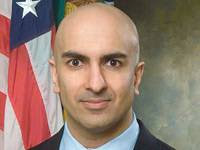 |
| See: Bailout Role Elevates U.S. Official | |
| Hank Paulson ("Dr. Evil") | Neel Kashkari ("Mini-Me") |



