
 RSS Feed
 by Calculated Risk on 9/20/2007 10:36:00 AM
Thursday, September 20, 2007
Late Mortgage Payments Continue to Climb
From the WSJ: Late Mortgage Payments Continue to Climb
Mortgage delinquencies jumped again in August, according to new data from Equifax and Moody's Economy.com. ...As a reminder, here is a chart from BofA analyst Robert Lacoursiere via Mathew Padilla at the O.C. Register. Please see Mathew's discussion from June 29th: (updated URL) BofA Analyst: Mortgage correction just 'tip of the iceberg'.
Nationwide, 3.56% of mortgages were at least 30 days past due last month, up 0.31 percentage points from July. The delinquency rate has increased about 1.5 points since bottoming out at the end of 2005, with fully half of that increase coming in the last three months.
... The rise in bad loans is "broad based," says Mark Zandi, chief economist at Moody's Economy.com. "That signals that foreclosure problems are going to be widespread."

ARM resets are just one cause of rising delinquencies, and most of the problems from resets are still ahead of us.
GSE Portfolio Caps
by Anonymous on 9/20/2007 08:46:00 AM
OFHEO has issued authorization for Fannie Mae and Freddie Mac to increase their portfolio holdings, as most of us expected. The terms of the announcement have a number of people concerned, judging from my email traffic: are they up to some nefarious accounting here? My opinion, if you care about it, is it doesn't look like that to me.
The basic part:
With the ongoing concerns about the subprime mortgage market, both Fannie Mae and Freddie Mac have announced commitments to purchase tens of billions of dollars of subprime mortgages over the next several years. The portfolio cap flexibility plus their ongoing ability to securitize mortgages, sell assets, and replace maturing assets, will enhance each Enterprise’s ability to purchase or securitize, over the next six months up to $20 billion or more of subprime mortgages, refinanced mortgages for borrowers with lower credit scores, and affordable multi-family housing mortgages. These efforts should assist lenders in helping some subprime borrowers avoid foreclosure.$40 billion in the next six months for Fannie and Freddie combined is not, in my view, such a huge number: it's probably less than some parties wanted and more than some parties wanted.
The part that concerns folks is this:
The specific flexibilities are as follows:This does not mean that the GSEs will be allowed to use non-GAAP accounting on the actual balance sheets, whenever we end up seeing those. That's, actually, the issue: given how far behind Freddie and particularly Fannie are with getting financial statements up to date, to require the use of GAAP measures for monitoring these portfolio caps would be to force more resources off that project, if you wanted month-by-month current monitoring of the portfolio growth, which of course we do, or to end up with a several month lag between portfolio acquisition and the reporting thereon. That we don't want.
1. Change the portfolio measure from a GAAP number as reported on the balance sheet to Unpaid Principal Balance (UPB), which the Enterprises use in their publicly released monthly summaries. Under present market conditions, the GAAP value can fluctuate widely and we have concluded this adds unnecessary complexity for the Enterprises in managing to the portfolio cap. UPB, which reflects the original principal balance of mortgages and securities less repayments, is not subject to daily market fluctuations.
2. Set the new UPB portfolio cap at $735 billion on July 1, 2007 and apply it to the third quarter. On that date, the GAAP measured cap was $728.1 billion for Freddie Mac and $727.7 billion for Fannie Mae. (UPB often exceeds the GAAP value for the Enterprises. Due to market fluctuations over the first seven months of 2007, this difference has ranged from $0.1 billion to $9.4 billion.)
So OFHEO is simply changing the measurement used in the cap agreement from GAAP to UPB. We will still see the GAAP measurement on the financials, someday. In the meantime we will see monthly reporting on portfolio limits that uses a "raw" number that is almost always going to be larger than a GAAP number. (GAAP adjusts UPB for things like valuation allowances, discounts and premiums, and contingent liabilities. UPB is just what the borrower owes you since application of the most recent payment.)
As long as the new cap level is also expressed in UPB, not GAAP, then calculating additions to the portfolios in UPB doesn't constitute "cheating." On the contrary, it seems to me that OFHEO is being quite prudent here: by using simpler numbers, the cap monitoring is closer to real time. It will also mean that the numbers in play are closer to what we laypeople think of as "loan amounts," so if you're looking at them to get some sort of sense of how many loans to how many homebuyers are in question here, UPB is a better approximation than GAAP.
Personally, I am looking forward to seeing those monthly reports, to get a handle on how these acquisitions are changing the average characteristics of the GSEs' portfolios. I can live with UPB rather than GAAP if it means I can see those reports every month.
Sallie Mae Deal in Jeopardy
by Calculated Risk on 9/20/2007 12:47:00 AM
From the NY Times: Deal to Buy Sallie Mae in Jeopardy
The consortium that had agreed to buy Sallie Mae for $25 billion plans to return to the negotiating table and seek a lower price ...The $900 million breakup fee is a little higher than the reported percentage writedowns at Lehman and Morgan Stanley. If unsuccessful, this would be the largest deal to fall apart so far in this cycle.
The buyers — the private equity firms J. C. Flowers & Company and Friedman Fleischer & Lowe, as well as two banks, JPMorgan Chase and Bank of America — met Tuesday to discuss the best way to pressure Sallie Mae into accepting a lower price, these people said.
While the group is hoping to renegotiate the price of Sallie Mae, these people said, it may also be willing to walk away and pay the $900 million breakup fee.
Wednesday, September 19, 2007
Saudi Arabia Refuses to Cut Rates
by Calculated Risk on 9/19/2007 06:19:00 PM
From The Telegraph: Fears of dollar collapse as Saudis take fright
Saudi Arabia has refused to cut interest rates in lockstep with the US Federal Reserve for the first time, signalling that the oil-rich Gulf kingdom is preparing to break the dollar currency peg in a move that risks setting off a stampede out of the dollar across the Middle East.This ties back to my post yesterday on a possible vicious cycle. To attract sufficient foreign capital flows to cover the U.S. current account deficit, interest rates in the U.S. may need to rise significantly.
"This is a very dangerous situation for the dollar," said Hans Redeker, currency chief at BNP Paribas.
Saudi Arabia has $800bn (£400bn) in their future generation fund, and the entire region has $3,500bn under management. They face an inflationary threat and do not want to import an interest rate policy set for the recessionary conditions in the United States," he said.
The Saudi central bank said today that it would take "appropriate measures" to halt huge capital inflows into the country, but analysts say this policy is unsustainable and will inevitably lead to the collapse of the dollar peg.
The Greenspan conundrum was that long rates didn't rise at the Fed Funds rate was increased. Bernanke's conundrum may be that long rates don't fall (or maybe even increase) as he lowers the Fed Funds rate!
Moody's Forecasts House Prices to Fall 7.7% Nationwide
by Calculated Risk on 9/19/2007 04:38:00 PM
From CNN Money: Double-digit home price drops coming
According to an analysis conducted by Moody's Economy.com, declines will exceed 10 percent in 86 of the 379 largest housing markets. And 290 of the cities will experience price drops of 1 percent or more.See story for Moody's price forecast for top 100 cities.
The survey attempted to identify the high and low points of housing prices in each of the markets, some of which started declining from their peak in the third quarter of 2005. All are median prices for single-family houses.
Nationally, Moody's is projecting an average price decline of 7.7 percent. That's a jump from the 6.6 percent total price drop that the company was forecasting in June and more than twice that of last October's forecast of a 3.6 percent price decrease.
Here are the top ten by forecasted price declines:
| Rank | Area | State | Peak | Bottom | Peak to bottom home price decline |
| 1 | Stockton | CA | 06Q1 | 08Q4 | -25.0 |
| 2 | Palm Bay-Melbourne-Titusville | FL | 06Q1 | 08Q4 | -24.9 |
| 3 | Sarasota-Bradenton-Venice | FL | 06Q1 | 08Q3 | -24.8 |
| 4 | Reno-Sparks | NV | 06Q1 | 09Q1 | -22.4 |
| 5 | Modesto | CA | 06Q2 | 08Q3 | -22.3 |
| 6 | Detroit-Livonia-Dearborn | MI | 05Q3 | 09Q1 | -21.3 |
| 7 | Fresno | CA | 06Q2 | 09Q1 | -20.0 |
| 8 | Oxnard-Thousand Oaks-Ventura | CA | 06Q2 | 08Q3 | -19.2 |
| 9 | Sacramento--Arden-Arcade--Roseville | CA | 06Q1 | 08Q4 | -19.1 |
| 10 | Las Vegas-Paradise | NV | 06Q2 | 08Q4 | -18.7 |
Look at the price bottoms; Moody's is mostly forecasting the price bottoms to happen in late 2008. That would make this one of the shortest duration housing busts with similar price declines in history. Historically declines of this magnitude have taken 5 to 7 years because house prices are sticky.
My guess is prices will decline further than Moody's is expecting, and the duration of the bust will be longer.
Banks Balk, PHH Deal in Jeopardy
by Calculated Risk on 9/19/2007 02:16:00 PM
From Bloomberg: PHH Sale to GE, Blackstone May Collapse as Banks Balk
PHH Corp., the New Jersey-based mortgage lender that agreed to be bought by General Electric Co. and Blackstone Group LP, said the $1.8 billion sale may unravel as lenders back away from some leveraged buyouts.Other deals in trouble include Genesco and Reddy Ice.. The banks are balking as they report write downs from the LBO loans - and try to avoid more pier loans on their balance sheets. See the WSJ: Fuzzy LBO Math
JPMorgan Chase & Co. and Lehman Brothers Holdings Inc. told Blackstone they may fall $750 million short in funding its part of the deal ...
``There will be some deals that won't get done, but it won't be the big names,'' billionaire financier Wilbur Ross, whose New York-based WL Ross & Co. invests in distressed companies, said today in an interview. ``Some of the smaller deals have better escape hatches.''
The [Morgan Stanley]’s finance chief, David Sidwell, told Bloomberg in an interview that net of fees, Morgan Stanley had $726 million of markdowns on $31 billion of leveraged-loan commitments.
Lehman Brothers Holdings said Tuesday on a conference call that it had “more than” $1 billion of paper losses on $27 billion of such commitments.
Fed: Household Debt Service and Financial Obligations Ratios
by Calculated Risk on 9/19/2007 01:07:00 PM
The Federal Reserve released the Q2 Household Debt Service and Financial Obligations Ratios today.
These ratios show the percent of disposable personal income (DPI) dedicated to debt service (DSR) and financial obligations (FOR) for households. This data has limited value in terms of absolute numbers, but might be useful in looking at trends. Here is the discussion from the Fed:
The limitations of current sources of data make the calculation of the ratio especially difficult. The ideal data set for such a calculation would have the required payments on every loan held by every household in the United States. Such a data set is not available, and thus the calculated series is only a rough approximation of the current debt service ratio faced by households. Nonetheless, this rough approximation may be useful if, by using the same method and data series over time, it generates a time series that captures the important changes in household debt service payments.
 Click on graph for larger image.
After several years of the homeowners financial obligations ratio (FOR) increasing rapidly - due almost entirely to increases in mortgage obligations - it appears the FOR might have peaked at the end of 2006.
The recent rapid increase in the FOR was especially stunning considering interest rates were falling (if the debt to income ratio had stayed stable, the FOR would have declined along with rates).
Even with the small declines over the first half of 2007, the homeowner FOR (and mortgage FOR) are still near record levels. For the FOR to decline to more normal levels requires some mix of an increase in disposable personal income, a decrease in debt, or a decrease in interest rates. This correction process will probably take several years, as U.S. households work to reduce their financial obligations as a percent of DPI.
MMBS: Mountain-Molehill Befuddlement Syndrome
by Anonymous on 9/19/2007 11:30:00 AM
To supplement our regular reporting on MMI (Muddled Metaphor Index), we present our inaugural post on Mountain-Molehill Befuddlement Syndrome. MMBS is characterized by an inability to resist making a front-page story out of anything with 1) "mortgage-backed security" in it plus 2) one quote from some hedge fund guy (whose position is disclosed only in dollars, not in, like, who's getting shorted in the swap market). It's probably incurable, but we fight the good fight here anyway. Call us Quixotic.
Karen Johnson of the Wall Street Journal has a bad case of MMBS:
When fruit-spread purveyor J.M. Smucker Co. started buying mortgage-backed securities in 2004, they seemed like a safe way to diversify some of its investments.Oh, man, this is just not sounding good. Jelly makers hiding the sticky details of MBS holdings. According to some guy who runs a little bitty hedge fund in "Short Hills."
Now, however, that asset class is in a bit of a jam.
Shares of banks and brokerages have fallen sharply since the markets cooled for commercial paper and other securitized debt that might hold mortgage-backed loans. But they aren't the only players with home-loan-related holdings.
In recent years, Smucker joined the ranks of other nonfinancial companies such as Garmin Ltd., Microsoft Corp., Netflix Inc. and Sun Microsystems Inc. by investing in what had been viewed as relatively safe investments that produced slightly better returns than cash and government bonds -- and could be sold quickly if needed. Many of these companies are cash-rich, looking for a secure place to park their millions. And none are expected to cash out any time soon.
The issue for investors is how these companies determine the "fair" value of their mortgage-backed securities in the current environment, and whether they are telling the whole story about how easily these assets can be liquidated -- and for how much.
"It concerns me from the standpoint of transparency, whether the cash stated on the balance sheet is a true representation of the cash available to the company," said Jeffrey Diecidue, a hedge-fund manager at UCA LLC in Short Hills, N.J., who has less than $100 million in assets.
You might as well get off the edge of your seats here, folks.
The amount of mortgage-backed securities owned by nonfinancial companies as a proportion of their total assets is low, and some, like Smucker, say they invest in only highly rated loans. But in the current environment, just saying investments have high credit ratings gives investors little comfort. As the traditionally staid commercial-paper market has shown recently, even triple-A-rated debt can be backed by subprime loans, causing investors to balk, prices to fall and trading to seize up.Hoooo-eee. $41.5 million. 1.2% of assets. You get bonus points here if you know that "noncurrent" in this context has nothing to do with performance. And double-extra bonus points if you have any idea why the metric of percent of noncurrent marketable securities means anything important, useful, or sinister. If you enjoyed the slide from "investors in Smuckers, Inc." to "investors in MBS," vis-a-vis who is balking about what, you win the whole PBJ.
At the end of July, Smucker had $41.5 million in mortgage-backed debt classified as noncurrent marketable securities available for sale, which are assets the company intends to sell for cash if it is needed for future operations. While that debt is just 1.2% of Smucker's total assets, it makes up 22% of the company's total marketable securities and 100% of its noncurrent marketable securities.
Other companies with mortgage-backed securities, including Biomet Inc., Microsoft, Novell Inc., Netflix and Sun Microsystems, declined to comment. Semiconductor maker LSI Corp. didn't respond to requests for comment.So, the CFO guy says, we aren't holding the complicated ones and we aren't holding derivatives of the complicated ones. Therefore the very next paragraph says . . . "still."
John Olson, chief financial officer of memory-chip maker Xilinx Inc., said the company buys only diverse high-grade securities and no collateralized debt obligations, or CDOs, which are debt pools that can carry triple-A ratings while still being backed entirely by subprime debt. "Fortunately, our treasurer was smart enough to know that CDOs aren't always what they say they are," he said. Mortgage-backed securities make up $24.3 million, or 2.5%, of Xilinx's $963.8 million in short-term investments.
Still, complicated investments have hurt other companies in the past. In 1994, for instance, Procter & Gamble Co. sustained heavy losses from derivatives on its balance sheet and sued its financial adviser, Bankers Trust, for selling these complex contracts to the consumer-products company.
For the moment, investors will pretty much have to take companies at their word when they say such mortgage-backed financial instruments are liquid and their stated fair-value estimates are based on market prices. Most nonfinancial companies classify their mortgage-backed securities investments as available for sale, meaning they aren't required to record changes in fair value on the income statement, which is followed closely by investors and analysts.Well, you know, if you're worried about it, you could get out the back of the envelope and write down 100% of Smuckers' MBS holdings, which would reduce assets by 1.2%. Then you could go back to worrying about somebody who has substantial enough MBS holdings to get your knickers in a twist over.
Instead, changes in fair value of such securities are recorded on the balance sheet in "other comprehensive income," which affects shareholders' equity but is less of a focus for Wall Street. Those disclosures will begin to change next year, when a new accounting rule kicks in for U.S. companies. This rule, which will first be required of companies with financial years beginning after Nov. 15, calls for companies to provide more information about financial instruments for which they apply fair, or market, values.
For investors like Mr. Diecidue, the rule can't come soon enough.
"The current market volatility in connection with these asset-backed securities presents a conundrum to the investors, because it's harder to know the true book value of a company," he says, referring to the measure of a company's assets minus its liabilities.
Or maybe you could ferret out some "news" about corporate balance sheets that is somewhat less mortgage-obsessed? Nah . . .
NY Times: TimesSelect is now Free
by Calculated Risk on 9/19/2007 09:54:00 AM
The NY Times is no longer charging for TimesSelect, and their archives are available free back to 1987.
We have ended TimesSelect. All of our Op-Ed and news columns are now available free of charge. Additionally, The New York Times Archive is available free back to 1987.The NY Times archive is a great resource.
Also, economist Paul Krugman has started his own blog: The Conscience of a Liberal.
Housing Starts and Completions for August
by Calculated Risk on 9/19/2007 09:21:00 AM
The Census Bureau reports on housing Permits, Starts and Completions.
Seasonally adjusted permits fell sharply:
Privately-owned housing units authorized by building permits in August were at a seasonally adjusted annual rate of 1,307,000. This is 5.9 percent below the revised July rate of 1,389,000 and is 24.5 percent below the revised August 2006 estimate of 1,731,000.Starts declined:
Privately-owned housing starts in August were at a seasonally adjusted annual rate of 1,331,000. This is 2.6 percent below the revised July estimate of 1,367,000 and is 19.1 percent below the revised August 2006 rate of 1,646,000.And Completions declined slightly:
Privately-owned housing completions in August were at a seasonally adjusted annual rate of 1,523,000. This is 0.2 percent below the revised July estimate of 1,526,000 and is 19.0 percent below the revised August 2006 rate of 1,881,000.
 Click on graph for larger image.
Here is a graph of starts and completions. Completions follow starts by about 6 to 7 months.
My forecast is for starts to fall to around the 1.1 million units per year level; a substantial decline from the current level. Goldman Sachs' forecast is for 1.1 million units, and UCLA is for 1.0 million units.
Even with the declines in permits and starts, this report shows builders are still starting too many projects. Starts will probably fall much further incoming months.
Tuesday, September 18, 2007
Gross, Rosenberg on the Fed and Rates
by Calculated Risk on 9/18/2007 08:29:00 PM
Update: From the Financial Times: Bank acts boldly to avert recession risk (hat tip Steve)
David Rosenberg, chief economist at Merrill Lynch, said it was hard to combat a deflating credit and asset bubble. He said that while markets soared when the Fed cut rates by 50 basis points in January 2001, they soon fell back.The S&P 500 closed at 1,276.05 on January 2nd, 2001. The Fed cut rates 50bps on Jan 3rd. The S&P 500 closed at 1,347.56, up 5.6% for the day. Then the market started to sell off, falling almost 20% by March. Rosenberg is correct (doesn't mean history will repeat).
Bloomberg video has several interviews concerning the Fed rate cuts. Here is PIMCO's Bill Gross:
| Gross of Pimco Sees 3.75% as `Destination' for Fed Rate September 18 (Bloomberg) -- Bill Gross, manager of the world's biggest bond fund at Pacific Investment Management Co., talks with Bloomberg's Michael McKee from Newport Beach, California, about today's decision by the Federal Reserve to lower its benchmark interest rate by a half point to 4.75 percent, the first cut by the central bank in four years. (Source: Bloomberg) |

Rate Cut Reactions
by Calculated Risk on 9/18/2007 04:26:00 PM
The reactions to the Fed funds rate cut are extremely varied - from relief to outrage. Here are a couple excerpts from the WSJ: Economists React: ‘One and Done’?
The FOMC makes it sound like “one and done” as it cuts both the Fed funds and discount rate by 50 basis points but continues to note inflation risks… As of this writing, we no longer look for the Fed to cut rates in October but that position, like the Fed’s, remains data dependent. –Drew Matus, Lehman BrothersAnd outrage:
Today’s irresponsible 50 basis point reduction is really just the hair of the dog that bit us and is a tacit admission that our economy is addicted to cheap money… A Fed bailout in the form of rate cuts will neither prevent the recession nor keep house prices from collapsing. It may slow the process down a few quarters, but it will cost us dearly. –Peter Schiff, Euro Pacific Capital
Fed Funds Rate Cut: Watch Long Rates
by Calculated Risk on 9/18/2007 02:49:00 PM
Virtuous cycle and vicious cycle:
In many parts of economics there is an assumption that a complex system of determinants will tend to lead to a state of equilibrium. When this tendency is absent terms like virtuous circle and vicious circle (or virtuous cycle and vicious cycle) to describe these unstable pattern of events are used. Both circles are complexes of events with no tendency towards equilibrium (at least in the short run). Both systems of events have feedback loops in which each iteration of the cycle reinforces the first (positive feedback). The difference between the two is that a virtuous cycle has favorable results and a vicious cycle has deleterious results. These cycles will continue in the direction of their momentum until an exogenous factor intervenes and stops the cycle.Perhaps, during the housing boom, a Virtuous Cycle was present as depicted in the following diagram:
 Click on diagram for larger image.
Starting from the top (during the housing boom): Lower interest rates led to an increase in housing prices. And those higher housing prices led to ever increasing mortgage equity withdrawal (MEW) by homeowners.
A large percentage of this equity withdrawal flowed to consumption, increasing both GDP and imports during the boom years. There is a strong correlation between the trade deficit and mortgage equity withdrawal, and although correlation doesn't imply causation, it appears mortgage equity withdrawal was a meaningful contributor to the widening trade and current account deficits during the housing boom.
To finance the current account deficit, foreign Central Banks (CBs) invested heavily in dollar denominated securities. Some analysts have suggested that these investments lowered interest rates by between 40 bps and 200 bps (Roubini and Setser: "Will the Bretton Woods 2 Regime Unravel Soon? The Risk of a Hard Landing in 2005-2006")
If these analysts are correct, and foreign CB intervention lowered treasury yields, then this also lowered mortgage interest rates ... and the cycle repeated. The result: a Virtuous Cycle with higher housing prices, more consumption and lower interest rates.
Now that the housing cycle has broken, what happens next?
The Vicious Cycle
The following diagram depicts the possible unwinding of the virtuous cycle.
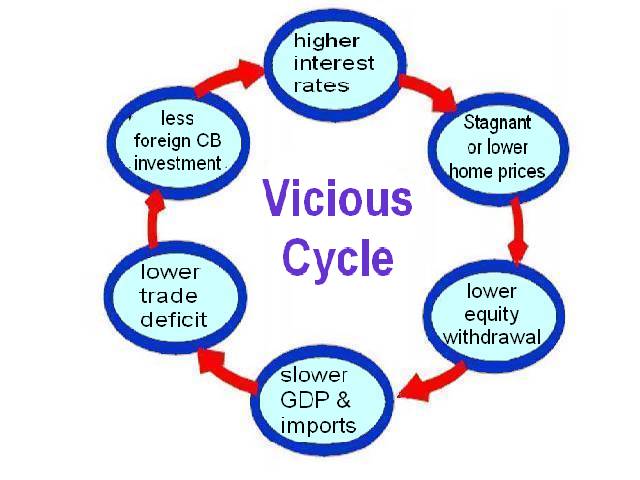
As housing cools down (prices do not need to collapse), mortgage equity withdrawal declines. Then less MEW leads to a slow down in GDP growth and lower imports.
Lower imports might lead to a lower trade deficit, depending on the strength of exports. This could lead to less foreign CB investment in dollar denominated assets. And this could lead to higher interest rates followed by even lower housing prices and the cycle repeats.
The result: a Vicious Cycle with lower housing prices, less consumption leading to higher interest rates.
House prices are now falling. MEW is now falling. And the trade deficit is falling. And the LIBOR rate has increased.
An increase in long rates would be normal if the market expectations for the economy improve. What would be concerning is if long rates increased by more than normal because of the unwinding of investments by foreign CBs. This could lead - for the short term - to a vicious cycle as depicted in the second diagram.
Fed Cuts Rates 50bps
by Calculated Risk on 9/18/2007 02:15:00 PM
Fed Statement (FOMC site swamped, hat tip az_mtb):
The Federal Open Market Committee decided today to lower its target for the federal funds rate 50 basis points to 4-3/4 percent.
Economic growth was moderate during the first half of the year, but the tightening of credit conditions has the potential to intensify the housing correction and to restrain economic growth more generally. Today’s action is intended to help forestall some of the adverse effects on the broader economy that might otherwise arise from the disruptions in financial markets and to promote moderate growth over time.
Readings on core inflation have improved modestly this year. However, the Committee judges that some inflation risks remain, and it will continue to monitor inflation developments carefully.
Developments in financial markets since the Committee’s last regular meeting have increased the uncertainty surrounding the economic outlook. The Committee will continue to assess the effects of these and other developments on economic prospects and will act as needed to foster price stability and sustainable economic growth.
Voting for the FOMC monetary policy action were: Ben S. Bernanke, Chairman; Timothy F. Geithner, Vice Chairman; Charles L. Evans; Thomas M. Hoenig; Donald L. Kohn; Randall S. Kroszner; Frederic S. Mishkin; William Poole; Eric Rosengren; and Kevin M. Warsh.
In a related action, the Board of Governors unanimously approved a 50-basis-point decrease in the discount rate to 5-1/4 percent. In taking this action, the Board approved the requests submitted by the Boards of Directors of the Federal Reserve Banks of Boston, New York, Cleveland, St. Louis, Minneapolis, Kansas City, and San Francisco.
NAHB: Builder Confidence Falls to Record Low in September
by Calculated Risk on 9/18/2007 01:00:00 PM
| Click on graph for larger image. The NAHB reports that builder confidence fell to 20 in September, from 22 in August. This ties the record low of 20 in January 1991. |  |
NAHB Press Release: Builder Confidence Continues Downward In September
Concerns about the substantial inventory of new homes for sale and the effects that deepening mortgage market problems are having on buyer demand caused builder confidence to decline for a seventh consecutive month in September, according to the latest National Association of Home Builders/Wells Fargo Housing Market Index (HMI), released today. The HMI dropped two points to 20, tying its record low reached in January of 1991 (the series began in January 1985).
...
Two out of three component indexes declined in September. The index gauging current single-family home sales declined two points to 20, while the index gauging sales expectations for the next six months fell five points to 26. The index gauging traffic of prospective buyers held steady at 16 for the month.
All four regions of the country reported declines in their September HMI readings. The Northeast posted a three-point decline to 26, while the Midwest posted a single-point decline to 13, the South posted a two-point decline to 22, and the West posted a four-point decline to 18.
The Hanging Out Revolution
by Anonymous on 9/18/2007 12:13:00 PM
We take a brief break from the failure to air the financial sector dirty laundry in order to report on one of my favorite bits of Total Insanity. Thanks, Yves, for the link. The WSJ reporteth:
BEND, Ore. -- It was a sunny, 70-degree day here in Awbrey Butte, an exclusive neighborhood of big, modern houses surrounded by native pines.In the 70s, we burnt our bras to teach you pigs a lesson. Thirty years later, we're hanging them out right in front of you! It's Laundry Liberation Front in the burbs. Out of the way, Stepford Wives! And take your "property values" with you when you go!
To Susan Taylor, it was a perfect time to hang her laundry out to dry. The 55-year-old mother and part-time nurse strung a clothesline to a tree in her backyard, pinned up some freshly washed flannel sheets -- and, with that, became a renegade.
The regulations of the subdivision in which Ms. Taylor lives effectively prohibit outdoor clotheslines. In a move that has torn apart this otherwise tranquil community, the development's managers have threatened legal action. To the developer and many residents, clotheslines evoke the urban blight they sought to avoid by settling in the Oregon mountains.
"This bombards the senses," interior designer Joan Grundeman says of her neighbor's clothesline. "It can't possibly increase property values and make people think this is a nice neighborhood." . . .
Brooks Resources repeated its threat of legal action, and then advised Ms. Taylor to "develop a plan to screen your outdoor laundry and submit the plan to the ARC for review." It also suggested the possibility of formal proceedings to get the rules amended, which would require 51% of homeowners' support in writing.
The following month, Ms. Taylor constructed a fabric screen to conceal her clothesline. The committee, which included Brooks Resources Chairman Michael P. Hollern, gave it a thumbs down. "It doesn't blend with the home or the native surroundings," says Ms. Haworth.
Mr. Hollern says, "Personally, I think people probably ought to screen their laundry from other people's view. If you feel differently, you should probably be living somewhere else."
Many neighbors agree. When Ms. Grundeman first noticed the Taylor clothesline, she assumed it was temporary. "My first thought was, 'Oh gosh, her dryer must have broken,' " says the interior designer.
Foreclosure Activity Increases in August
by Calculated Risk on 9/18/2007 11:05:00 AM
"A greater percentage of homes entering foreclosure are going back to the banks."From MarketWatch: Foreclosures more than double in past year
James Saccacio, chief executive for RealtyTrac
Nearly a quarter of a million foreclosure filings were reported in August, up 115% from a year ago and up 36% from July. Each home in foreclosure can have multiple filings as it moves from default status to bank repossession....See MarketWatch story for audio of full interview with a RealtyTrac executive.
"The jump in foreclosure filings this month might be the beginning of the next wave of increased foreclosure activity, as a large number of subprime adjustable-rate loans are beginning to reset," said James Saccacio, chief executive for RealtyTrac.
Quote of the Day
by Anonymous on 9/18/2007 09:47:00 AM
Thanks to Clyde, we see that Morgan Keegan is having a wee bit of a problem filing a report. Oh, Mommy, will those subprime bonds ever stop being so hard to price?
This, however, is classic:
The lack of liquidity in the fund's securities could result in the fund incurring greater losses on the sale of some its securities than under more stable market conditions, Morgan Keegan said in the supplement filing.How true. Back when the market was "stable" enough to let us all lever up twenty times, this kind of thing didn't happen.
LEND 10-Q: A Heapin' Helpin' of HorseHockey™
by Anonymous on 9/18/2007 09:25:00 AM
LEND finally got around to filing a 10-Q today for Q01. It's jam-packed with exciting self-serving revisionist history masquerading as opening the kimono. I recommend it to connoisseurs of first-rate HorseHockey™.
Lowlights:
In the third quarter of 2006, the non-prime mortgage market in which the Company operates was characterized by increased competition for loans and customers which simultaneously lowered profit margins on loans and caused lenders to be more aggressive in making loans to relatively less qualified customers. By the end of 2006, the non-prime mortgage industry was clearly being negatively impacted. The sustained pricing competition and higher risk portfolios of loans reduced the appetite for loans among whole loan buyers, who offered increasingly lower prices for loans, thereby shrinking profit margins for non-prime lenders. In addition, the higher levels of credit risk taken on by non-prime lenders resulted in higher rates of delinquency in the loans held for investment and in increasing frequency of early payment defaults and repurchase demands on loans that had been sold. These trends accelerated during the first quarter of 2007, and the industry experienced a period of turmoil which has continued into the second and third quarters of 2007. As of August 31 2007, more than 55 mortgage companies operating in the non-prime mortgage industry had failed and many others faced serious operating and financial challenges. The most notable of these failures is New Century Mortgage Corporation (“New Century”), one of the largest non-prime originators in recent years, which filed for bankruptcy protection in April 2007.Yeah, the funny business just happened to happen in Q04 06, which made it visible in Q01 07, which just happens to be the point at which LEND suddenly discovered that it could no longer prepare financial statements. Funny how that works.
It now appears that an underlying reason for the deterioration of industry conditions was the relatively poor performance of loans originated in 2006 in comparison to loans originated in 2004 and 2005. While real estate markets were booming during 2004 and 2005, and some areas experienced significant home price appreciation, many originators extended credit and underwriting standards to meet market demands. When home price appreciation leveled off, or in some areas declined, many of the loans originated in 2006 did not perform up to expectations. This decline in performance led to increases in the cost of securitizing non-prime loans as the rating agencies which rate non-prime securitizations increased loss coverage levels, requiring higher credit support for non-prime securitizations.
At minimum, may we remind everyone that the 2005 subprime mortgage vintage was on track to become the Worst Ever until . . . you know . . . we had data on 2006?
Roll Us Over, LEH Us Down
by Anonymous on 9/18/2007 08:18:00 AM
Daytraders and global stuffees bail out real estate specuvestors! Or something. (Hat tip Turbo, who observes that the TEOTWAWKI has been postponed another quarter):
Sept. 18 (Bloomberg) -- Lehman Brothers Holdings Inc., the largest U.S. underwriter of mortgage-backed bonds, said profit fell less than expected as fees from equities trading and investment banking offset some losses from subprime home loans.
Net income fell 3 percent to $887 million, or $1.54 a share, in the third quarter from $916 million, or $1.57, a year earlier, the New York-based company said today in a statement. The average estimate of 16 analysts surveyed by Bloomberg was $1.48 a share.
Chief Executive Officer Richard Fuld's efforts to reduce the reliance on fixed income by expanding stock trading and merger advice solidified earnings as contagion in the credit markets spread, led by defaults among home-loan borrowers with poor credit histories. Lehman is cutting about 2,000 mortgage-related jobs. Revenue from equities jumped 64 percent to $1.37 billion.



