
 RSS Feed
 by Calculated Risk on 2/01/2025 02:11:00 PM
Saturday, February 01, 2025
Real Estate Newsletter Articles this Week: New Home Sales Increase to 698,000 Annual Rate in December
At the Calculated Risk Real Estate Newsletter this week:
 Click on graph for larger image.
• New Home Sales Increase to 698,000 Annual Rate in December
• Case-Shiller: National House Price Index Up 3.8% year-over-year in November
• Inflation Adjusted House Prices 1.1% Below 2022 Peak
• Freddie Mac House Price Index Increased in December; Up 4.0% Year-over-year
• Final Look at Local Housing Markets in December and a Look Ahead to January Sales
This is usually published 4 to 6 times a week and provides more in-depth analysis of the housing market.
Schedule for Week of February 2, 2025
by Calculated Risk on 2/01/2025 08:11:00 AM
The key reports scheduled for this week are the January employment report and the December trade deficit.
Other key indicators include the January ISM manufacturing index and January vehicle sales.
10:00 AM: ISM Manufacturing Index for January. The consensus is for the ISM to be at 49.5, up from 49.3 in December.
10:00 AM: Construction Spending for December. The consensus is for a 0.1% increase in construction spending.
 All day: Light vehicle sales for January. Sales were at 16.8 million in December (Seasonally Adjusted Annual Rate).
This graph shows light vehicle sales since the BEA started keeping data in 1967. The dashed line is the December sales rate.
Wards expects vehicle sales to decrease to 15.6 million SAAR in January.
2:00 PM: Senior Loan Officer Opinion Survey on Bank Lending Practices (SLOOS).
----- Tuesday, February 4th -----
 10:00 AM ET: Job Openings and Labor Turnover Survey for December from the BLS.
This graph shows job openings (black line), hires (purple), Layoff, Discharges and other (red column), and Quits (light blue column) from the JOLTS.
Jobs openings increased in November to 8.10 million from 7.84 million in October.
The number of job openings (black) were down 9% year-over-year. Quits were down 13% year-over-year.
----- Wednesday, February 5th -----
7:00 AM ET: The Mortgage Bankers Association (MBA) will release the mortgage purchase applications index.
8:15 AM: The ADP Employment Report for January. This report is for private payrolls only (no government). The consensus is for 150,000 payroll jobs added in January, up from 122,000 added in December.
 8:30 AM: Trade Balance report for December from the Census Bureau.
This graph shows the U.S. trade deficit, with and without petroleum, through the most recent report. The blue line is the total deficit, and the black line is the petroleum deficit, and the red line is the trade deficit ex-petroleum products.
The consensus is the trade deficit to be $87.0 billion. The U.S. trade deficit was at $78.2 billion in November.
10:00 AM: ISM Services Index for January.
----- Thursday, February 6th -----
8:30 AM: The initial weekly unemployment claims report will be released. The consensus is for a increase to 214 thousand from 207 thousand last week.
----- Friday, February 7th -----
 8:30 AM: Employment Report for December. The consensus is for 170,000 jobs added, and for the unemployment rate to be unchanged at 4.1%.
There were 256,000 jobs added in December, and the unemployment rate was at 4.1%.
This graph shows the jobs added per month since January 2021.
NOTE: For the household survey, new population controls will be used - and this will boost overall household employment. For the establishment survey, the annual benchmark revision will be included, lowering past job growth.
10:00 AM: University of Michigan's Consumer sentiment index (Preliminary for January).
2:00 PM: Senior Loan Officer Opinion Survey on Bank Lending Practices (SLOOS).
 10:00 AM ET: Job Openings and Labor Turnover Survey for December from the BLS.
 This graph shows job openings (black line), hires (purple), Layoff, Discharges and other (red column), and Quits (light blue column) from the JOLTS.
Jobs openings increased in November to 8.10 million from 7.84 million in October.
The number of job openings (black) were down 9% year-over-year. Quits were down 13% year-over-year.
7:00 AM ET: The Mortgage Bankers Association (MBA) will release the mortgage purchase applications index.
8:15 AM: The ADP Employment Report for January. This report is for private payrolls only (no government). The consensus is for 150,000 payroll jobs added in January, up from 122,000 added in December.
 8:30 AM: Trade Balance report for December from the Census Bureau.
 This graph shows the U.S. trade deficit, with and without petroleum, through the most recent report. The blue line is the total deficit, and the black line is the petroleum deficit, and the red line is the trade deficit ex-petroleum products.
The consensus is the trade deficit to be $87.0 billion. The U.S. trade deficit was at $78.2 billion in November.
10:00 AM: ISM Services Index for January.
8:30 AM: The initial weekly unemployment claims report will be released. The consensus is for a increase to 214 thousand from 207 thousand last week.
 8:30 AM: Employment Report for December. The consensus is for 170,000 jobs added, and for the unemployment rate to be unchanged at 4.1%.
There were 256,000 jobs added in December, and the unemployment rate was at 4.1%.
This graph shows the jobs added per month since January 2021.
NOTE: For the household survey, new population controls will be used - and this will boost overall household employment. For the establishment survey, the annual benchmark revision will be included, lowering past job growth.
10:00 AM: University of Michigan's Consumer sentiment index (Preliminary for January).
Friday, January 31, 2025
January 31st COVID Update: COVID in Wastewater Increasing
by Calculated Risk on 1/31/2025 07:38:00 PM
 Note: Mortgage rates are from MortgageNewsDaily.com and are for top tier scenarios.
For deaths, I'm currently using 4 weeks ago for "now", since the most recent three weeks will be revised significantly.
Note: "Effective May 1, 2024, hospitals are no longer required to report COVID-19 hospital admissions, hospital capacity, or hospital occupancy data." So I'm no longer tracking hospitalizations.
| COVID Metrics | ||||
|---|---|---|---|---|
| Now | Week Ago | Goal | ||
| Deaths per Week🚩 | 773 | 628 | ≤3501 | |
| 1my goals to stop weekly posts. 🚩 Increasing number weekly for Deaths. ✅ Goal met. | ||||
 Click on graph for larger image.
This graph shows the weekly (columns) number of deaths reported since Jan 2023.
Although weekly deaths met the original goal to stop posting, I'm continuing to post now that deaths are above the goal again - and at a minimum, I'll continue to post through the Winter.
Weekly deaths have been increasing, and weekly deaths are well above the low of 313 in early June 2024.
 This appears to be a leading indicator for COVID hospitalizations and deaths.
Nationally COVID in wastewater is "High" according to the CDC.
Initial Q1 GDP Tracking: Mid-to-high 2% Range
by Calculated Risk on 1/31/2025 02:09:00 PM
From Goldman:
We launched our Q1 GDP tracking estimate at +2.6% (quarter-over-quarter annualized) and our Q1 domestic final sales estimate at +2.3%. We launched our past-quarter GDP tracking estimate at +2.3%, in line with the advance reading. [Jan 31st estimate]And from the Atlanta Fed: GDPNow
emphasis added
The initial GDPNow model estimate for real GDP growth (seasonally adjusted annual rate) in the first quarter of 2025 is 2.9 percent on January 31. The initial estimate of last quarter's real GDP growth rate released by the US Bureau of Economic Analysis on January 30 was 2.3 percent, the same as the final GDPNow model nowcast after rounding. [Jan 31st estimate]
Freddie Mac House Price Index Increased in December; Up 4.0% Year-over-year
by Calculated Risk on 1/31/2025 10:42:00 AM
Today, in the Calculated Risk Real Estate Newsletter: Freddie Mac House Price Index Increased in December; Up 4.0% Year-over-year
A brief excerpt:
Freddie Mac reported that its “National” Home Price Index (FMHPI) increased 0.54% month-over-month on a seasonally adjusted (SA) basis in December. On a year-over-year basis, the National FMHPI was up 4.0% in December, up from up 3.9% YoY in November. The YoY increase peaked at 19.0% in July 2021, and for this cycle, bottomed at up 0.9% YoY in May 2023. ...There is much more in the article!
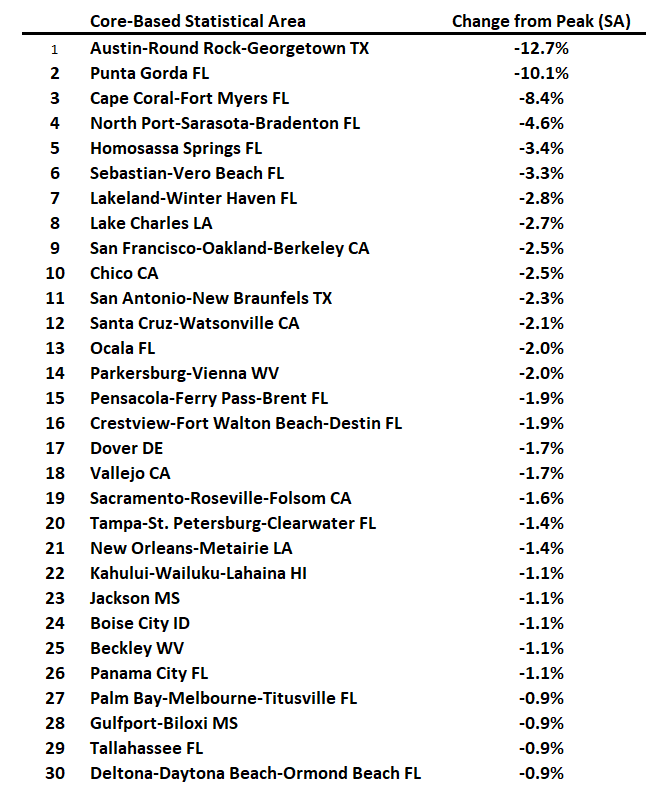
For cities (Core-based Statistical Areas, CBSA), here are the 30 cities with the largest declines from the peak, seasonally adjusted. Austin continues to be the worst performing city. However, 6 of the 7 cities with the largest price declines are in Florida (and Florida has 14 of the 30 cities with the largest price declines).
Personal Income increased 0.4% in December; Spending increased 0.7%
by Calculated Risk on 1/31/2025 08:30:00 AM
The BEA released the Personal Income and Outlays report for December:
Personal income increased $92.0 billion (0.4 percent at a monthly rate) in December, according to estimates released today by the U.S. Bureau of Economic Analysis. Disposable personal income (DPI)—personal income less personal current taxes—increased $79.7 billion (0.4 percent) and personal consumption expenditures (PCE) increased $133.6 billion (0.7 percent).The December PCE price index increased 2.6 percent year-over-year (YoY), up from 2.4 percent YoY in November, and down from the recent peak of 7.0 percent in June 2022.
Personal outlays—the sum of PCE, personal interest payments, and personal current transfer payments—increased $129.5 billion in December. Personal saving was $843.2 billion in December and the personal saving rate—personal saving as a percentage of disposable personal income—was 3.8 percent.
emphasis added
The PCE price index, excluding food and energy, increased 2.8 percent YoY, unchanged from 2.8 percent in November, and down from the recent peak of 5.4 percent in February 2022.
The following graph shows real Personal Consumption Expenditures (PCE) through December 2024 (2017 dollars). Note that the y-axis doesn't start at zero to better show the change.
 Click on graph for larger image.
The dashed red lines are the quarterly levels for real PCE.
Personal income was at expectations, and PCE was slightly above expectations.
The following graph shows real Personal Consumption Expenditures (PCE) through December 2024 (2017 dollars). Note that the y-axis doesn't start at zero to better show the change.
 Click on graph for larger image.
The dashed red lines are the quarterly levels for real PCE.
Personal income was at expectations, and PCE was slightly above expectations.
Inflation was slightly above expectations.
Thursday, January 30, 2025
Friday: Personal Income and Outlays
by Calculated Risk on 1/30/2025 07:30:00 PM
 Note: Mortgage rates are from MortgageNewsDaily.com and are for top tier scenarios.
Friday:
• At 8:30 AM ET, 8:30 AM ET: Personal Income and Outlays for December. The consensus is for a 0.4% increase in personal income, and for a 0.5% increase in personal spending. And for the Core PCE price index to increase 0.2%. PCE prices are expected to be up 2.5% YoY, and core PCE prices up 2.8% YoY.
• At 9:45 AM, Chicago Purchasing Managers Index for January. The consensus is for a reading of 39.7, up from 36.9 in December.
Las Vegas in 2024: Visitor Traffic Up 2.1% YoY; Convention Traffic Unchanged YoY
by Calculated Risk on 1/30/2025 03:59:00 PM
From the Las Vegas Visitor Authority: December 2024 Las Vegas Visitor Statistics
Closing out the year with Dec visitation of 3.4M visitors (+0.2% YoY), Las Vegas hosted approx. 41.7M visitors for the year, up 2.1% from last year’s 40.8M visitors.
With a strong December to end the year, Las Vegas convention attendance reached roughly 6.0M for the year, matching last year's tally.
December occupancy reached 81.9%, up 2.0 pts with ADR and RevPAR seeing YoY increases of +3.7% and +6.3% respectively. For the year, Hotel occupancy landed at 83.6%, just ahead of last year (up 0.1 pts) with annual Weekend occupancy of 90.8% (up 0.1 pts) and annual Midweek occupancy of 80.4%, also up 0.1 pts. Annual ADR reached $193 (+1.0% YoY) with annual RevPAR of $161 (+1.1% YoY).
emphasis added
 Click on graph for larger image.
 The first graph shows visitor traffic for 2019 (Black), 2020 (dark blue), 2021 (light blue), 2022 (light orange), 2023 (dark orange) and 2024 (red).
Visitor traffic was up 0.2% compared to last December. Visitor traffic was down 3.2% compared to December 2019.
Annual visitor traffic was down 2.0% compared to 2019.
The second graph shows convention traffic.

Convention traffic was up 42.7% compared to December 2023, and down 9.1% compared to December 2019. 
Annual convention traffic was down 9.8% compared to 2019.
Final Look at Local Housing Markets in December and a Look Ahead to January Sales
by Calculated Risk on 1/30/2025 12:55:00 PM
Today, in the Calculated Risk Real Estate Newsletter: Final Look at Local Housing Markets in December and a Look Ahead to January Sales
A brief excerpt:
After the National Association of Realtors® (NAR) releases the monthly existing home sales report, I pick up additional local market data that is reported after the NAR. This is the final look at local markets in December.There is much more in the article.
The big story for December was that existing home sales increased year-over-year (YoY) for the third consecutive month following year-over-year declines every month since July 2021. However, sales in December, at 4.24 million on a seasonally adjusted annual rate basis (SAAR) were still historically low. Sales averaged almost 5.4 million SAAR in December 2017, 2018, and 2019. So, sales were still about 21% below pre-pandemic levels.
...
Here is a look at months-of-supply using NSA sales. Since this is NSA data, it is likely this will be the seasonal low for months-of-supply.
Miami is off the charts!
...
More local data coming in February for activity in January!

NAR: Pending Home Sales Decrease 5.5% in December; Down 5.0% Year-over-year
by Calculated Risk on 1/30/2025 10:00:00 AM
From the NAR: Pending Home Sales Fell 5.5% in December
Pending home sales retracted 5.5% in December – following four consecutive months of increases – according to the National Association of REALTORS®. All four U.S. regions experienced month-over-month losses in transactions, with the most significant fall in the West. Year-over-year, contract signings reduced in all four U.S. regions, with the Midwest seeing the largest decrease.Note: Contract signings usually lead sales by about 45 to 60 days, so this would usually be for closed sales in January and February.
The Pending Home Sales Index (PHSI)* – a forward-looking indicator of home sales based on contract signings – slid 5.5% to 74.2 in December. Year-over-year, pending transactions declined 5.0%. Last year’s cyclical low point occurred in July 2024 at 70.2. An index of 100 is equal to the level of contract activity in 2001.
“After four straight months of gains in contract signings, one step back is not welcome news, but it is not entirely surprising,” said NAR Chief Economist Lawrence Yun. “Economic data never moves in a straight line. High mortgage rates have not significantly dented housing demand due to greater numbers of cash transactions.”
...
The Northeast PHSI fell 8.1% from last month to 62.3, down 1.3% from December 2023. The Midwest index shrunk 4.9% to 74.3 in December, down 6.9% from the previous year.
The South PHSI slipped 2.7% to 90.6 in December, down 5.1% from a year ago. The West index tumbled by 10.3% from the prior month to 57.7, down 5.1% from December 2023.
emphasis added



