
 RSS Feed
 by Calculated Risk on 5/10/2021 01:38:00 PM
Monday, May 10, 2021
Atlanta Real Estate in April: Sales Up 32% YoY, Inventory Down 65% YoY
Note: Remember, sales were weak in April last year, so the year-over-year comparison is especially strong this month. I'm tracking data for many local markets around the U.S. I think it is especially important to watch inventory this year.
From the GAMLS for Atlanta:
Total Residential Units Sold in April 2021 were 8,925, up 31.9% from 6,766 in April 2020.
Active Residential Listings in April 2021 were 6,964, down 64.6% from 19,697 in April 2020. Inventory was down 6.1% from 7,418 last month.
Months of Supply was 0.82 Months in April 2021, compared to 2.54 Months in April 2020.
 Click on graph for larger image.
This graph from the Georgia MLS shows inventory in Atlanta over the last several years - and the sharp decline in inventory at the start of the pandemic.
Inventory in Atlanta was at a record low in April.
NMHC: Rent Payment Tracker Shows Households Paying Rent Decreased Slightly YoY in Early May
by Calculated Risk on 5/10/2021 12:09:00 PM
From the NMHC: NMHC Rent Payment Tracker Finds 80.0 Percent of Apartment Households Paid Rent as of May 6
The National Multifamily Housing Council (NMHC)’s Rent Payment Tracker found 80.0 percent of apartment households made a full or partial rent payment by May 6 in its survey of 11.7 million units of professionally managed apartment units across the country.
This is a 0.1 percentage point decrease from the share who paid rent through May 6, 2020 and compares to 81.7 percent that had been paid by May 6, 2019. This data encompasses a wide variety of market-rate rental properties across the United States, which can vary by size, type and average rental price.
“This month’s findings are part of what seems to be an increasingly clear pattern of economic recovery and strong demand for multifamily housing,” said Doug Bibby, NMHC President. “With more and more vaccines being administered, job creation on the rise and tens of billions in rental assistance being distributed to residents and housing providers in need, the outlook for the industry is a positive one.
emphasis added
 Click on graph for larger image.
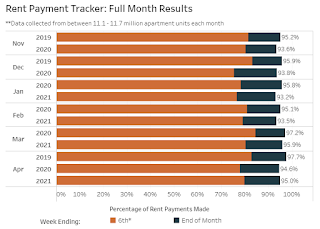
This graph from the NMHC Rent Payment Tracker shows the percent of household making full or partial rent payments by the 6th of the month compared to 2019 and to the first COVID year.
Although payments are down from 2019, rent payments are mostly unchanged from last year.
This is mostly for large, professionally managed properties.
The second graph shows full month payments through April compared to the same month the prior year.
This is mostly for large, professionally managed properties.
The second graph shows full month payments through April compared to the same month the prior year.

For April, rent payments were up compared to April 2020, and down compared to April 2021.
CR Note: There are some timing issues month to month.
Housing Inventory May 10th Update: Slight Increase Week-to-Week
by Calculated Risk on 5/10/2021 10:38:00 AM
One of the key questions for 2021 is: Will inventory increase as the pandemic subsides, or will inventory decrease further in 2021?
Tracking inventory will be very important this year.
 Click on graph for larger image in graph gallery.
This inventory graph is courtesy of Altos Research.
As of May 7th, inventory was at 310 thousand (7 day average), compared to 732 thousand the same week a year ago. That is a decline of 57.6%.
A week ago, inventory was at 307 thousand, and was down 58.4% YoY. Seasonally, inventory might be at a bottom - this has been at about the same level for the last four weeks.
Mike Simonsen discusses this data regularly on Youtube.
Mike Simonsen discusses this data regularly on Youtube.
Seven High Frequency Indicators for the Economy
by Calculated Risk on 5/10/2021 08:27:00 AM
These indicators are mostly for travel and entertainment. It will interesting to watch these sectors recover as the vaccine is distributed.
IMPORTANT: Be safe now - if all goes well, everyone could be vaccinated by June.
----- Airlines: Transportation Security Administration -----
The TSA is providing daily travel numbers.
 Click on graph for larger image.
This data shows the seven day average of daily total traveler throughput from the TSA for 2019 (Light Blue), 2020 (Blue) and 2021 (Red).
The dashed line is the percent of 2019 for the seven day average.
This data is as of May 9th.
The seven day average is down 36.9% from the same day in 2019 (63.1% of 2019). (Dashed line)
There was a slow increase from the bottom, with ups and downs due to the holidays - and TSA data has picked up in 2021.
----- Restaurants: OpenTable -----
The second graph shows the 7 day average of the year-over-year change in diners as tabulated by OpenTable for the US and several selected cities.
----- Hotel Occupancy: STR -----
 This graph shows the seasonal pattern for the hotel occupancy rate using the four week average.
The red line is for 2021, black is 2020, blue is the median, and dashed light blue is for 2009 (the worst year since the Great Depression for hotels - before 2020).
Occupancy is now above the horrible 2009 levels.
This data is through May 1st. Hotel occupancy is currently down 17% compared to same week in 2019). Note: Occupancy was up year-over-year, since occupancy declined sharply at the onset of the pandemic. However, occupancy is still down significantly from normal levels.
Notes: Y-axis doesn't start at zero to better show the seasonal change.
----- Gasoline Supplied: Energy Information Administration -----
 This graph, based on weekly data from the U.S. Energy Information Administration (EIA), shows gasoline supplied compared to the same week of 2019.
Blue is for 2020. Red is for 2021.
As of April 30th, gasoline supplied was off about 10.2% (about 89.8% of the same week in 2019).
Gasoline supplied was up year-over-year, since at one point, gasoline supplied was off almost 50% YoY in 2020.
----- Transit: Apple Mobility -----
This graph is from Apple mobility. From Apple: "This data is generated by counting the number of requests made to Apple Maps for directions in select countries/regions, sub-regions, and cities." This is just a general guide - people that regularly commute probably don't ask for directions.
There is also some great data on mobility from the Dallas Fed Mobility and Engagement Index. However the index is set "relative to its weekday-specific average over January–February", and is not seasonally adjusted, so we can't tell if an increase in mobility is due to recovery or just the normal increase in the Spring and Summer.
 This data is through May 8th for the United States and several selected cities.
The graph is the running 7 day average to remove the impact of weekends.
IMPORTANT: All data is relative to January 13, 2020. This data is NOT Seasonally Adjusted. People walk and drive more when the weather is nice, so I'm just using the transit data.
According to the Apple data directions requests, public transit in the 7 day average for the US is at 70% of the January 2020 level. It is at 70% in Chicago, and 65.0% in Houston - and moving up recently.
----- New York City Subway Usage -----
Here is some interesting data on New York subway usage (HT BR).
 This graph is from Todd W Schneider. This is weekly data since 2015.
The TSA is providing daily travel numbers.
 Click on graph for larger image.
This data shows the seven day average of daily total traveler throughput from the TSA for 2019 (Light Blue), 2020 (Blue) and 2021 (Red).
The dashed line is the percent of 2019 for the seven day average.
This data is as of May 9th.
The seven day average is down 36.9% from the same day in 2019 (63.1% of 2019). (Dashed line)
There was a slow increase from the bottom, with ups and downs due to the holidays - and TSA data has picked up in 2021.
The second graph shows the 7 day average of the year-over-year change in diners as tabulated by OpenTable for the US and several selected cities.
IMPORTANT: OpenTable notes: "we’ve updated the data including downloadable dataset from January 1, 2021 onward to compare seated diners from 2021 to 2019, as opposed to year over year." Thanks!
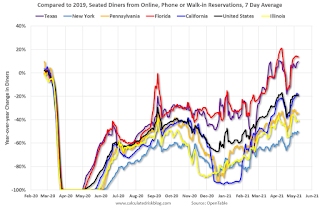 Thanks to OpenTable for providing this restaurant data:
This data is updated through May 8, 2021.
This data is "a sample of restaurants on the OpenTable network across all channels: online reservations, phone reservations, and walk-ins. For year-over-year comparisons by day, we compare to the same day of the week from the same week in the previous year."
Note that this data is for "only the restaurants that have chosen to reopen in a given market". Since some restaurants have not reopened, the actual year-over-year decline is worse than shown.
Dining picked up during the holidays, then slumped with the huge winter surge in cases. Dining was picking up again, but has moved up and down over the last couple of weeks. Florida and Texas are above 2019 levels.
----- Movie Tickets: Box Office Mojo -----
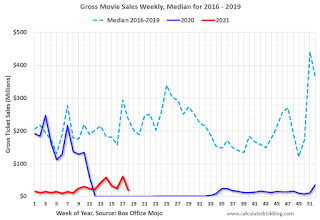 This data shows domestic box office for each week and the median for the years 2016 through 2019 (dashed light blue).
 Thanks to OpenTable for providing this restaurant data:
This data is updated through May 8, 2021.
This data is "a sample of restaurants on the OpenTable network across all channels: online reservations, phone reservations, and walk-ins. For year-over-year comparisons by day, we compare to the same day of the week from the same week in the previous year."
Note that this data is for "only the restaurants that have chosen to reopen in a given market". Since some restaurants have not reopened, the actual year-over-year decline is worse than shown.
Dining picked up during the holidays, then slumped with the huge winter surge in cases. Dining was picking up again, but has moved up and down over the last couple of weeks. Florida and Texas are above 2019 levels.
 This data shows domestic box office for each week and the median for the years 2016 through 2019 (dashed light blue).
 Blue is 2020 and Red is 2021.
The data is from BoxOfficeMojo through May 6th.
Note that the data is usually noisy week-to-week and depends on when blockbusters are released.
Movie ticket sales were at $19 million last week, down about 92% from the median for the week.
Note that the data is usually noisy week-to-week and depends on when blockbusters are released.
Movie ticket sales were at $19 million last week, down about 92% from the median for the week.
 This graph shows the seasonal pattern for the hotel occupancy rate using the four week average.
 The red line is for 2021, black is 2020, blue is the median, and dashed light blue is for 2009 (the worst year since the Great Depression for hotels - before 2020).
Occupancy is now above the horrible 2009 levels.
This data is through May 1st. Hotel occupancy is currently down 17% compared to same week in 2019). Note: Occupancy was up year-over-year, since occupancy declined sharply at the onset of the pandemic. However, occupancy is still down significantly from normal levels.
Notes: Y-axis doesn't start at zero to better show the seasonal change.
 This graph, based on weekly data from the U.S. Energy Information Administration (EIA), shows gasoline supplied compared to the same week of 2019.
Blue is for 2020. Red is for 2021.
As of April 30th, gasoline supplied was off about 10.2% (about 89.8% of the same week in 2019).
Gasoline supplied was up year-over-year, since at one point, gasoline supplied was off almost 50% YoY in 2020.
This graph is from Apple mobility. From Apple: "This data is generated by counting the number of requests made to Apple Maps for directions in select countries/regions, sub-regions, and cities." This is just a general guide - people that regularly commute probably don't ask for directions.
There is also some great data on mobility from the Dallas Fed Mobility and Engagement Index. However the index is set "relative to its weekday-specific average over January–February", and is not seasonally adjusted, so we can't tell if an increase in mobility is due to recovery or just the normal increase in the Spring and Summer.
 This data is through May 8th for the United States and several selected cities.
The graph is the running 7 day average to remove the impact of weekends.
IMPORTANT: All data is relative to January 13, 2020. This data is NOT Seasonally Adjusted. People walk and drive more when the weather is nice, so I'm just using the transit data.
According to the Apple data directions requests, public transit in the 7 day average for the US is at 70% of the January 2020 level. It is at 70% in Chicago, and 65.0% in Houston - and moving up recently.
Here is some interesting data on New York subway usage (HT BR).
 This graph is from Todd W Schneider. This is weekly data since 2015.
 Most weeks are between 30 and 35 million entries, and currently there more than 11 million subway turnstile entries per week - and increasing.
This data is through Friday, May 7th.
Schneider has graphs for each borough, and links to all the data sources.
He notes: "Data updates weekly from the MTA’s public turnstile data, usually on Saturday mornings".
This data is through Friday, May 7th.
Schneider has graphs for each borough, and links to all the data sources.
He notes: "Data updates weekly from the MTA’s public turnstile data, usually on Saturday mornings".
Sunday, May 09, 2021
Sunday Night Futures
by Calculated Risk on 5/09/2021 07:45:00 PM
Weekend:
• Schedule for Week of May 9, 2021
• Second Home Market: South Lake Tahoe in April
• North Texas Real Estate in April: Sales Up 33% YoY, Inventory Down 65% YoY
Monday:
• No major economic releases scheduled.
From CNBC: Pre-Market Data and Bloomberg futures S&P 500 are up 4, and DOW futures are up 34 (fair value).
Oil prices were up over the last week with WTI futures at $65.41 per barrel and Brent at $68.88 per barrel. A year ago, WTI was at $24, and Brent was at $25 - so WTI oil prices are UP sharply year-over-year (oil prices collapsed at the beginning of the pandemic).
Here is a graph from Gasbuddy.com for nationwide gasoline prices. Nationally prices are at $2.95 per gallon. A year ago prices were at $1.83 per gallon, so gasoline prices are up $1.12 per gallon year-over-year.
May 9th COVID-19 Vaccinations, New Cases, Hospitalizations
by Calculated Risk on 5/09/2021 03:50:00 PM
President Biden has set two vaccinations goals to achieve by July 4th:
1) 70% of the population over 18 has had at least one dose of vaccine, and
2) 160 million Americans fully vaccinated.
According to the CDC, on Vaccinations. Total administered: 259,716,989. Yesterday: 257,347,205. Daily: 2.37 million.
1) 58.0% of the population over 18 has had at least one dose.
2) 113.2 million Americans are fully vaccinated.
Note: I'll stop posting this daily once all three of these criteria are met:
1) 70% of the population over 18 has had at least one dose of vaccine, and
2) new cases are under 5,000 per day, and
3) hospitalizations are below 3,000.
And check out COVID Act Now to see how each state is doing.
Over 4,500 US deaths were reported so far in May due to COVID.
 Click on graph for larger image.
This graph shows the daily (columns) 7 day average (line) of positive tests reported.
Note: The ups and downs during the Winter surge were related to reporting delays due to the Thanksgiving and Christmas holidays.
This data is from the CDC.
 Click on graph for larger image.
This graph shows the daily (columns) 7 day average (line) of positive tests reported.
Note: The ups and downs during the Winter surge were related to reporting delays due to the Thanksgiving and Christmas holidays.
This data is from the CDC.
The 7-day average is 40,098, down from 42,446 yesterday, and down sharply from the recent peak of 69,881 on April 13, 2021. This is the lowest since September 18, 2020, but still above the post-summer surge low of 34,668.
The second graph shows the number of people hospitalized.
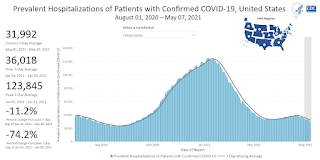 This data is also from the CDC.
The CDC cautions that due to reporting delays, the area in grey will probably increase.
The current 7-day average is 31,992, down from 32,887 reported yesterday, and well above the post-summer surge low of 23,000.
The second graph shows the number of people hospitalized.
 This data is also from the CDC.
The CDC cautions that due to reporting delays, the area in grey will probably increase.
The current 7-day average is 31,992, down from 32,887 reported yesterday, and well above the post-summer surge low of 23,000.
Second Home Market: South Lake Tahoe in April
by Calculated Risk on 5/09/2021 10:18:00 AM
Two months ago, from Jann Swanson at MortgageNewsDaily: Fannie Warns Lenders on Investment Properties and 2nd Homes. This action will result in higher interest rates on 2nd home and investment property mortgages.
I'm looking at data for some second home markets - and will track those markets to see if there is an impact from the lending changes.
This graph is for South Lake Tahoe since 2004 through April 2021, and shows inventory (blue), and the year-over-year change in the median price (12 month average).
Note: The median price is distorted by the mix, but this is the available data.
 Click on graph for larger image.
Following the housing bubble, prices declined for several years in South Lake Tahoe, with the median price falling about 50% from the bubble peak.
Note that inventory was high while prices were declining - and significantly lower inventory in 2012 suggested the bust was over. (Tracking inventory helped me call the bottom for housing way back in February 2012, see:The Housing Bottom is Here)
Currently inventory is just above the record low set last month, and prices are up sharply. This will be interesting to watch.
Saturday, May 08, 2021
North Texas Real Estate in April: Sales Up 33% YoY, Inventory Down 65% YoY
by Calculated Risk on 5/08/2021 08:13:00 PM
Note: Remember, sales were weak in April last year. I'm posting data for many local markets around the U.S. The story is the same everywhere ... inventory is very low.
From the NTREIS for North Texas (including Dallas/Ft. Worth):
Single Family Homes sold in April 2021 were 10,152, up 28.3% from 7,913 in April 2020.
Condos and Townhomes sold in April 2021 were 925, up 124.5% from 412 in April 2020.
Combined, sales were up 33.1% year-over-year.
Single Family Active Listings in April 2021 were 6,967, down 66.6% from 20,881 in April 2020.
Combined, sales were up 33.1% year-over-year.
Single Family Active Listings in April 2021 were 6,967, down 66.6% from 20,881 in April 2020.
For Condos and Townhomes, Active Listings in April 2021 were 1,117, down 48.4% from 2,165 in April 2020.
Combined, active listings declined 64.9% year-over-year.
Combined, active listings declined 64.9% year-over-year.
Although down sharply year-over-year, active inventory was up 12.9% compared to last month.
May 8th COVID-19 Vaccinations, New Cases, Hospitalizations; Lowest 7-Day Average Cases Since Sept 2020
by Calculated Risk on 5/08/2021 07:49:00 PM
President Biden has set two vaccinations goals to achieve by July 4th:
1) 70% of the population over 18 has had at least one dose of vaccine, and
2) 160 million Americans fully vaccinated.
According to the CDC, on Vaccinations. Total administered: 257,347,205.
1) 57.7% of the population over 18 has had at least one dose.
2) 111.6 million Americans are fully vaccinated.
Note: I'll stop posting this daily once all three of these criteria are met:
1) 70% of the population over 18 has had at least one dose of vaccine, and
2) new cases are under 5,000 per day, and
3) hospitalizations are below 3,000.
And check out COVID Act Now to see how each state is doing.
Over 4,500 US deaths were reported so far in May due to COVID.
 Click on graph for larger image.
This graph shows the daily (columns) 7 day average (line) of positive tests reported.
Note: The ups and downs during the Winter surge were related to reporting delays due to the Thanksgiving and Christmas holidays.
This data is from the CDC.
 Click on graph for larger image.
This graph shows the daily (columns) 7 day average (line) of positive tests reported.
Note: The ups and downs during the Winter surge were related to reporting delays due to the Thanksgiving and Christmas holidays.
This data is from the CDC.
The 7-day average is 42,432, down from 43,914 yesterday, and down sharply from the recent peak of 69,881 on April 13, 2021. This is the lowest since September 29, 2020, but still above the post-summer surge low of 34,668.
The second graph shows the number of people hospitalized.
 This data is also from the CDC.
The CDC cautions that due to reporting delays, the area in grey will probably increase.
The current 7-day average is 32,887, down from 33,265 reported yesterday, and well above the post-summer surge low of 23,000.
The second graph shows the number of people hospitalized.
 This data is also from the CDC.
The CDC cautions that due to reporting delays, the area in grey will probably increase.
The current 7-day average is 32,887, down from 33,265 reported yesterday, and well above the post-summer surge low of 23,000.
Schedule for Week of May 9, 2021
by Calculated Risk on 5/08/2021 08:11:00 AM
The key reports this week are April CPI and retail sales.
For manufacturing, the April Industrial Production report will be released on Friday.
No major economic releases scheduled.
6:00 AM ET: NFIB Small Business Optimism Index for April.
 10:00 AM: Job Openings and Labor Turnover Survey for March from the BLS.
 This graph shows job openings (yellow line), hires (purple), Layoff, Discharges and other (red column), and Quits (light blue column) from the JOLTS.
Jobs openings increased in February to 7.367 million from 7.099 million in January. This is close to the series maximum of 7.574 million.
The number of job openings (yellow) were up 5.1% year-over-year, and Quits were down 2.1% year-over-year.
7:00 AM ET: The Mortgage Bankers Association (MBA) will release the results for the mortgage purchase applications index.
8:30 AM: The Consumer Price Index for April from the BLS. The consensus is for 0.2% increase in CPI, and a 0.3% increase in core CPI.
11:00 AM: NY Fed: Q1 Quarterly Report on Household Debt and Credit
8:30 AM: The initial weekly unemployment claims report will be released. The consensus is for a decrease to 480 thousand from 498 thousand last week.
8:30 AM: The Producer Price Index for April from the BLS. The consensus is for a 0.3% increase in PPI, and a 0.4% increase in core PPI.
 8:30 AM ET: Retail sales for April is scheduled to be released. The consensus is for 1.0% increase in retail sales.
This graph shows retail sales since 1992. This is monthly retail sales and food service, seasonally adjusted (total and ex-gasoline).
Retail sales ex-gasoline were up 9.7% in March.
 9:15 AM: The Fed will release Industrial Production and Capacity Utilization for April.
This graph shows industrial production since 1967.
The consensus is for a 1.2% increase in Industrial Production, and for Capacity Utilization to increase to 75.2%.
10:00 AM: University of Michigan's Consumer sentiment index (Preliminary for May).



