
 RSS Feed
 by Calculated Risk on 4/02/2020 11:29:00 AM
Thursday, April 02, 2020
Hotels: Occupancy Rate Declined 67% Year-over-year to All Time Record Low
From HotelNewsNow.com: STR: US hotel results for week ending 28 March
Reflecting the continued impact of the COVID-19 pandemic, the U.S. hotel industry reported significant year-over-year declines in the three key performance metrics during the week of 22-28 March 2020, according to data from STR.The following graph shows the seasonal pattern for the hotel occupancy rate using the four week average.
In comparison with the week of 24-30 March 2019, the industry recorded the following:
• Occupancy: -67.5% to 22.6%
• Average daily rate (ADR): -39.4% to US$79.92
• Revenue per available room (RevPAR): -80.3% to US$18.05
“Year-over-year declines of this magnitude will unfortunately be the ‘new normal’ until the number of new COVID-19 cases slows significantly,” said Jan Freitag, STR’s senior VP of lodging insights. “Occupancy continues to fall to unprecedented lows, with more than 75% of rooms empty around the nation last week. As projected in our U.S. forecast revision, 2020 will be the worst year on record for occupancy. We do, however, expect the industry to begin to recover once the economy reignites and travel resumes.”
emphasis added
 Click on graph for larger image.
The red line is for 2020, dash light blue is 2019, blue is the median, and black is for 2009 (the worst year probably since the Great Depression for hotels).
2020 was off to a solid start, however, COVID-19 has crushed hotel occupancy.
This is the lowest weekly occupancy on record, even considering seasonality. Note the graph is a 4-week average.
BEA: March Vehicles Sales decreased to 11.4 Million SAAR
by Calculated Risk on 4/02/2020 09:28:00 AM
The BEA released their estimate of March vehicle sales this morning. The BEA estimated light vehicle sales of 11.37 million SAAR in March 2020 (Seasonally Adjusted Annual Rate), down 32.1% from the revised February sales rate, and down 34.1% from March 2019.
Sales in February were revised down from 16.83 million SAAR to 16.73 million SAAR.
 Click on graph for larger image.
This graph shows light vehicle sales since 2006 from the BEA (blue) and an estimate for March 2020 (red).
My view - before the health crisis - was that sales would move mostly sideways at near record levels this year. Going forward, the impact of COVID-19 will be significant.
The second graph shows light vehicle sales since the BEA started keeping data in 1967.
 Note: dashed line is current estimated sales rate of 11.37 million SAAR.
Sales collapsed in the second half of March, and will really collapse in April - and will fall below the lowest point of the Great Recession of 9.0 million SAAR.
Trade Deficit decreased to $39.9 Billion in February
by Calculated Risk on 4/02/2020 09:11:00 AM
Note: This data was for February and the outbreak of COVID-19 likely impacted trade with China.
From the Department of Commerce reported:
The U.S. Census Bureau and the U.S. Bureau of Economic Analysis announced today that the goods and services deficit was $39.9 billion in February, down $5.5 billion from $45.5 billion in January, revised.
February exports were $207.5 billion, $0.8 billion less than January exports. February imports were $247.5 billion, $6.3 billion less than January imports
emphasis added
 Click on graph for larger image.
Both exports and imports decreased in January.
Exports are 26% above the pre-recession peak and down slightly compared to February 2019; imports are 7% above the pre-recession peak, and down 5% compared to February 2019.
In general, trade both imports and exports have moved more sideways or down recently.
The second graph shows the U.S. trade deficit, with and without petroleum.
 The blue line is the total deficit, and the black line is the petroleum deficit, and the red line is the trade deficit ex-petroleum products.
Note that the U.S. exported a slight net positive petroleum products in recent months.
Oil imports averaged $57.24 per barrel in February, down from $61.93 in January, and down from $57.70 in February 2019.
The trade deficit with China decreased to $16.0 billion in February, from $24.8 billion in February 2019.
Weekly Initial Unemployment Claims Increase to 6,648,000
by Calculated Risk on 4/02/2020 08:35:00 AM
The DOL reported:
In the week ending March 28, the advance figure for seasonally adjusted initial claims was 6,648,000, an increase of 3,341,000 from the previous week's revised level. This marks the highest level of seasonally adjusted initial claims in the history of the seasonally adjusted series. The previous week's level was revised up by 24,000 from 3,283,000 to 3,307,000. The 4-week moving average was 2,612,000, an increase of 1,607,750 from the previous week's revised average. The previous week's average was revised up by 6,000 from 998,250 to 1,004,250.The previous week was revised up.
emphasis added
The following graph shows the 4-week moving average of weekly claims since 1971.
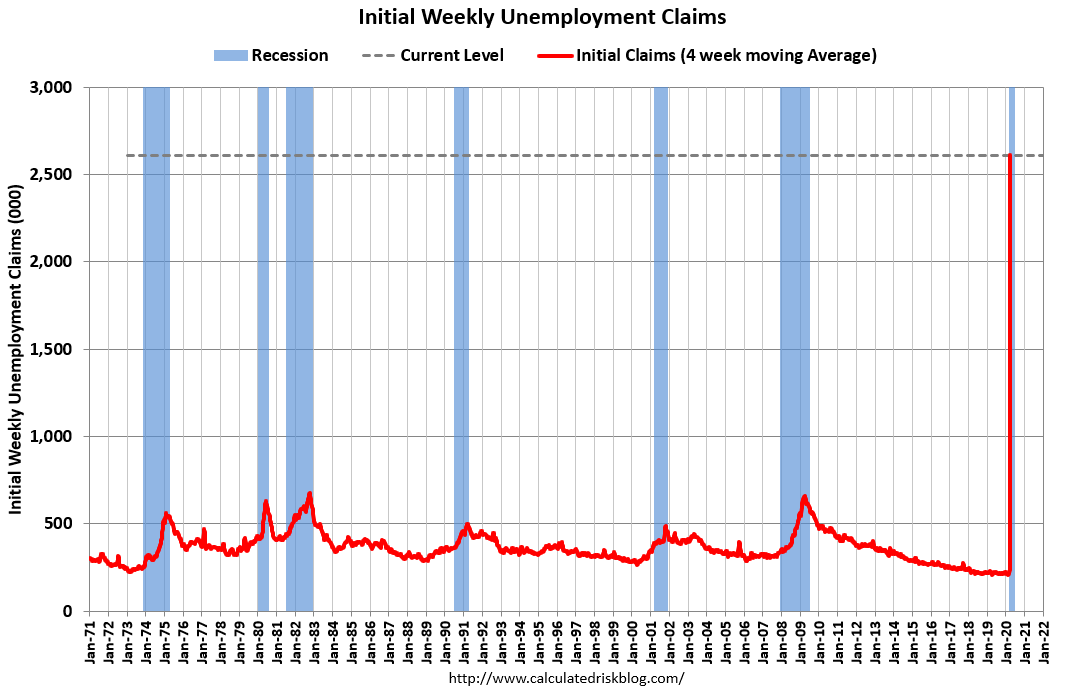 Click on graph for larger image.
The dashed line on the graph is the current 4-week average. The four-week average of weekly unemployment claims increased to 2,612,000.
This was much higher than the consensus forecast.
The second graph shows seasonally adjust continued claims since 1967 (lags initial by one week while increasing sharply).
 At the worst of the Great Recession, continued claims peaked at 6.635 million, but then steadily declined.
Over the next few weeks, continued claims will increase rapidly to a new record high, and then will likely stay at that high level until the crisis abates.
Wednesday, April 01, 2020
Thursday: Unemployment Claims, Trade Deficit
by Calculated Risk on 4/01/2020 10:43:00 PM
Thursday:
• At 8:30 AM, The initial weekly unemployment claims report will be released. The consensus is for a 3.000 million initial claims, down from 3.283 million the previous week.
• At 8:30 AM, Trade Balance report for January from the Census Bureau. The consensus is the trade deficit to be $40.0 billion. The U.S. trade deficit was at $45.3 billion in January.
• Early, BEA Light vehicle sales for March. The consensus is for light vehicle sales to be 11.9 million SAAR in March, down from 16.8 million in February (Seasonally Adjusted Annual Rate).
April 1 Update: US COVID-19 Tests per Day; More Testing Needed
by Calculated Risk on 4/01/2020 05:39:00 PM
There is still far too little testing in the U.S.
We need:
1) More testing.
2) Better reporting (all tests, positive and negative).
3) A national test-and-trace program. Name the head of the program now - so that person can update everyone on the progress.
Test-and-trace is a key criteria in starting to reopen the country. My current guess is test-and-trace will require around 300,000 tests per day at first since the US is far behind the curve.
Notes: Data for the previous couple of days is updated and revised, so graphs might change.
Also, I include all tests in the total including pending.
The percent positive excludes the pending tests.
There were 101,147 tests reported over the last 24 hours.
 Click on graph for larger image.
This data is from the COVID Tracking Project.
The percent positive over the last 24 hours was 26% (red line - going the wrong way).
Testing must continue to be expanded until the percent positive declines to 5% or lower. This is based on results from South Korea.
Test. Test. Test. Protect healthcare workers first!
Zillow Case-Shiller February Forecast: "Ancient History"
by Calculated Risk on 4/01/2020 02:38:00 PM
The Case-Shiller house price indexes for January were released yesterday. Zillow forecasts Case-Shiller a month early, and I like to check the Zillow forecasts since they have been pretty close.
From Matthew Speakman at Zillow: January Case-Shiller Results & February Forecast: Ancient History
It may have been only two months ago, but in many ways it might as well be ancient history. ...
The national Case-Shiller Home Price Index rose 3.9% year-over-year in January. The smaller 10- and 20-city composite indices grew more slowly, at 2.6% and 3.1% year-over-year, respectively.
emphasis added
 The Zillow forecast is for the year-over-year change for the Case-Shiller National index to be at 4.0% in February, up from 3.9% in January.
 The Zillow forecast is for the 20-City index to be up 3.2% YoY in February from 3.1% in January, and for the 10-City index to increase to 2.7% YoY compared to 2.6% YoY in January.
But this is all "ancient history".
Fannie Mae: Mortgage Serious Delinquency Rate Declined in February, Lowest Since 2007
by Calculated Risk on 4/01/2020 12:07:00 PM
Fannie Mae reported that the Single-Family Serious Delinquency was declined to 0.65% in February, from 0.66% in January. The serious delinquency rate is down from 0.76% in February 2019.
These are mortgage loans that are "three monthly payments or more past due or in foreclosure".
This is the lowest serious delinquency rate for Fannie Mae since June 2007.
The Fannie Mae serious delinquency rate peaked in February 2010 at 5.59%.
 Click on graph for larger image
By vintage, for loans made in 2004 or earlier (2% of portfolio), 2.46% are seriously delinquent. For loans made in 2005 through 2008 (4% of portfolio), 4.07% are seriously delinquent, For recent loans, originated in 2009 through 2018 (94% of portfolio), only 0.35% are seriously delinquent. So Fannie is still working through a few poor performing loans from the bubble years.
I expect the serious delinquency rate will increase in a few months due to COVID-19.
Note: Freddie Mac reported earlier.
Construction Spending Decreased in February
by Calculated Risk on 4/01/2020 10:19:00 AM
From the Census Bureau reported that overall construction spending increased in February:
Construction spending during February 2020 was estimated at a seasonally adjusted annual rate of $1,366.7 billion, 1.3 percent below the revised January estimate of $1,384.5 billion. The February figure is 6.0 percent above the February 2019 estimate of $1,289.0 billion.Both private and public spending decreased:
emphasis added
Spending on private construction was at a seasonally adjusted annual rate of $1,025.8 billion, 1.2 percent below the revised January estimate of $1,038.5 billion. ...
In February, the estimated seasonally adjusted annual rate of public construction spending was $340.9 billion, 1.5 percent below the revised January estimate of $345.9 billion.
 Click on graph for larger image.
This graph shows private residential and nonresidential construction spending, and public spending, since 1993. Note: nominal dollars, not inflation adjusted.
Private residential spending had been increasing - but turned down in the 2nd half of 2018. It started increasing again, but will slow due to the pandemic. Residential spending is 17% below the previous peak.
Non-residential spending is 11% above the previous peak in January 2008 (nominal dollars).
Public construction spending is 5% above the previous peak in March 2009, and 30% above the austerity low in February 2014.
 The second graph shows the year-over-year change in construction spending.
On a year-over-year basis, private residential construction spending is up 11.3%. Non-residential spending is down slightly year-over-year. Public spending is up 7.4% year-over-year.
This was well below consensus expectations of a 0.6% increase in spending, however construction spending for December and January were revised up.
Construction spending will decline due to COVID-19, although construction is considered an essential service in most areas.
ISM Manufacturing index Decreased to 49.1 in March
by Calculated Risk on 4/01/2020 10:04:00 AM
The ISM manufacturing index indicated contraction in March. The PMI was at 49.1% in March, down from 50.1% in February. The employment index was at 43.8%, down from 46.9% last month, and the new orders index was at 42.2%, down from 49.8%.
From the Institute for Supply Management: March 2020 Manufacturing ISM® Report On Business®
Economic activity in the manufacturing sector contracted in March, and the overall economy grew for the 131st consecutive month, say the nation's supply executives in the latest Manufacturing ISM® Report On Business®.This was above expectations of 45.0%, and suggests manufacturing contracted in March.
The report was issued today by Timothy R. Fiore, CPSM, C.P.M., Chair of the Institute for Supply Management® (ISM®) Manufacturing Business Survey Committee: “The March PMI® registered 49.1 percent, down 1 percentage point from the February reading of 50.1 percent. The New Orders Index registered 42.2 percent, a decrease of 7.6 percentage points from the February reading of 49.8 percent. The Production Index registered 47.7 percent, down 2.6 percentage points compared to the February reading of 50.3 percent. The Backlog of Orders Index registered 45.9 percent, a decrease of 4.4 percentage points compared to the February reading of 50.3 percent. The Employment Index registered 43.8 percent, a decrease of 3.1 percentage points from the February reading of 46.9 percent.
emphasis added
The index will be much worse in April due to COVID-19.



