
 RSS Feed
 by Calculated Risk on 4/30/2018 08:36:00 AM
Monday, April 30, 2018
Personal Income increased 0.3% in March, Spending increased 0.4%
The BEA released the Personal Income and Outlays report for March:
Personal income increased $47.8 billion (0.3 percent) in March according to estimates released today by the Bureau of Economic Analysis. Disposable personal income (DPI) increased $39.8 billion (0.3 percent) and personal consumption expenditures (PCE) increased $61.7 billion (0.4 percent).The March PCE price index increased 2.0 percent year-over-year and the March PCE price index, excluding food and energy, increased 1.9 percent year-over-year.
...
Real PCE increased 0.4 percent. The PCE price index increased less than 0.1 percent. Excluding food and energy, the PCE price index increased 0.2 percent.
The following graph shows real Personal Consumption Expenditures (PCE) through March 2018 (2009 dollars). Note that the y-axis doesn't start at zero to better show the change.
 Click on graph for larger image.
The dashed red lines are the quarterly levels for real PCE.
The increase in personal income was slightly below expectations, and the increase in PCE was at expectations.
PCE growth was weak in Q1, however inflation is now near the Fed's target.
Sunday, April 29, 2018
Monday: Personal Income, Chicago PMI, Pending Home Sales
by Calculated Risk on 4/29/2018 10:01:00 PM
Weekend:
• Schedule for Week of Apr 29, 2018
Monday:
• At 8:30 AM ET, Personal Income and Outlays for March. The consensus is for a 0.4% increase in personal income, and for a 0.4% increase in personal spending. And for the Core PCE price index to increase 0.2%.
• At 9:45 AM, Chicago Purchasing Managers Index for April. The consensus is for a reading of 57.8, up from 57.4 in March.
• At 10:00 AM, Pending Home Sales Index for March. The consensus is for a 1.0% increase in the index.
• At 10:30 AM, Dallas Fed Survey of Manufacturing Activity for April. This is the last of the regional Fed surveys for April.
From CNBC: Pre-Market Data and Bloomberg futures: S&P 500 are up 7, and DOW futures are up 50 (fair value).
Oil prices were mixed over the last week with WTI futures at $67.93 per barrel and Brent at $74.22 per barrel. A year ago, WTI was at $49, and Brent was at $50 - so oil prices are up about 40% year-over-year.
Here is a graph from Gasbuddy.com for nationwide gasoline prices. Nationally prices are at $2.81 per gallon. A year ago prices were at $2.39 per gallon - so gasoline prices are up 42 cents per gallon year-over-year.
April 2018: Unofficial Problem Bank list declines to 94 Institutions
by Calculated Risk on 4/29/2018 08:31:00 AM
Note: Surferdude808 compiles an unofficial list of Problem Banks compiled only from public sources.
Here is the unofficial problem bank list for April 2018.
Here are the monthly changes and a few comments from surferdude808:
Update on the Unofficial Problem Bank List for April 2018. The list had a decline of four insured institutions to 94 banks. Aggregate assets declined during the month by $956 million to $18.9 billion. A year ago, the list held 148 institutions with assets of $36.1 billion.CR Note: When the unofficial weekly was list was first published on August 7, 2009 it had 389 institutions. The list peaked at just over 1,000 institutions in 2011. Now there are only 94 banks on the unofficial list (the FDIC reported 95 banks on the official problem bank list at the end of 2017).
Actions were terminated against American Bank of the North, Nashwauk, MN ($550 million); Affinity Bank, Atlanta, GA ($260 million); Allied First Bank, SB, Oswego, IL ($94 million); and South Carolina Community Bank, Columbia, SC ($53 million).
The FDIC's official problem bank list is comprised of banks with a CAMELS rating of 4 or 5, and the list is not made public (just the number of banks and assets every quarter). Note: Bank CAMELS ratings are also not made public.
CAMELS is the FDIC rating system, and stands for Capital adequacy, Asset quality, Management, Earnings, Liquidity and Sensitivity to market risk. The scale is from 1 to 5, with 1 being the strongest.
As a substitute for the CAMELS ratings, surferdude808 is using publicly announced formal enforcement actions, and also media reports and company announcements that suggest to us an enforcement action is likely, to compile a list of possible problem banks in the public interest.
Saturday, April 28, 2018
Schedule for Week of Apr 29, 2018
by Calculated Risk on 4/28/2018 08:11:00 AM
The key report this week is the April employment report on Friday.
Other key indicators include the March Personal Income and Outlays report, March Trade deficit, April ISM manufacturing and non-manufacturing indexes, April auto sales, and the April ADP employment report.
The FOMC meets on Tuesday and Wednesday, and no change to policy is expected.
8:30 AM: Personal Income and Outlays for March. The consensus is for a 0.4% increase in personal income, and for a 0.4% increase in personal spending. And for the Core PCE price index to increase 0.2%.
9:45 AM: Chicago Purchasing Managers Index for April. The consensus is for a reading of 57.8, up from 57.4 in March.
10:00 AM: Pending Home Sales Index for March. The consensus is for a 1.0% increase in the index.
10:30 AM: Dallas Fed Survey of Manufacturing Activity for April. This is the last of the regional Fed surveys for April.
 10:00 AM: ISM Manufacturing Index for April. The consensus is for the ISM to be at 58.7, down from 59.3 in March.
Here is a long term graph of the ISM manufacturing index.
The PMI was at 59.3% in March, the employment index was at 57.3%, and the new orders index was at 61.9%.
10:00 AM: Construction Spending for March. The consensus is for a 0.5% increase in construction spending.
 All day: Light vehicle sales for April. The consensus is for light vehicle sales to be 17.2 million SAAR in March, down from 17.4 million in March (Seasonally Adjusted Annual Rate).
This graph shows light vehicle sales since the BEA started keeping data in 1967. The dashed line is the March sales rate.
7:00 AM ET: The Mortgage Bankers Association (MBA) will release the results for the mortgage purchase applications index.
8:15 AM: The ADP Employment Report for April. This report is for private payrolls only (no government). The consensus is for 193,000 payroll jobs added in April, down from 241,000 added in March.
2:00 PM: FOMC Meeting Announcement. The FOMC is expected to announce no change to policy at this meeting.
8:30 AM ET: The initial weekly unemployment claims report will be released. The consensus is for 220 thousand initial claims, up from 209 thousand the previous week.
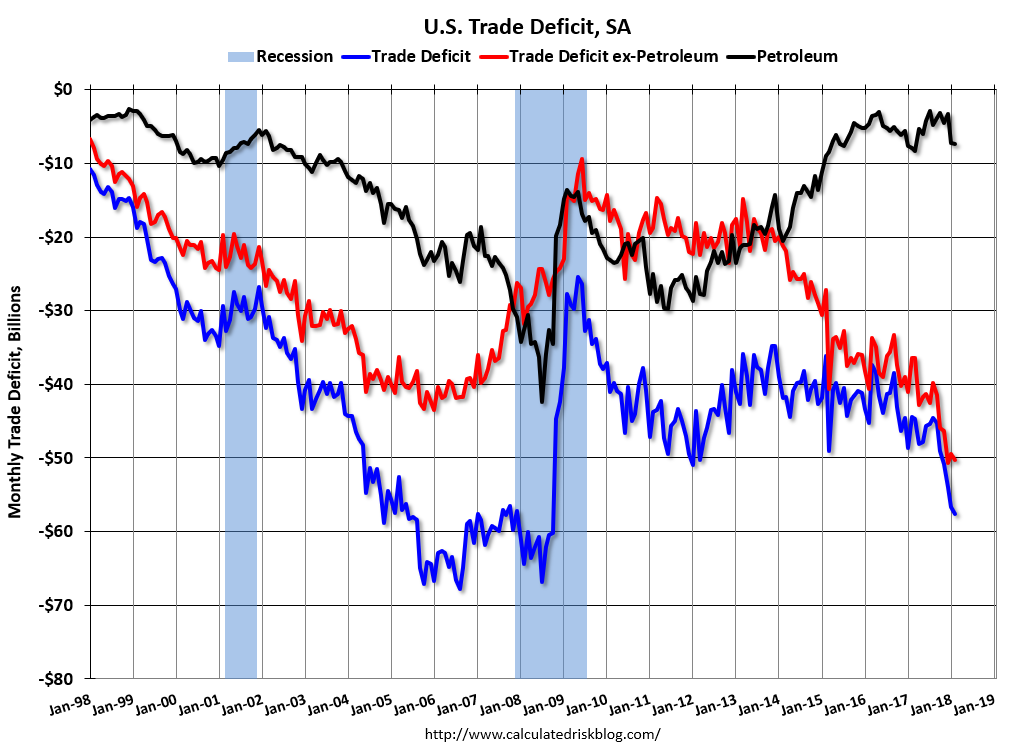 8:30 AM: Trade Balance report for March from the Census Bureau.
 This graph shows the U.S. trade deficit, with and without petroleum, through February. The blue line is the total deficit, and the black line is the petroleum deficit, and the red line is the trade deficit ex-petroleum products.
The consensus is for the U.S. trade deficit to be at $50.0 billion in March from $57.6 billion in February.
10:00 AM: the ISM non-Manufacturing Index for April. The consensus is for index to decrease to 58.5 from 58.8 in March.
8:30 AM: Employment Report for April. The consensus is for an increase of 190,000 non-farm payroll jobs added in April, up from the 103,000 non-farm payroll jobs added in March.
 The consensus is for the unemployment rate to decrease to 4.0%.
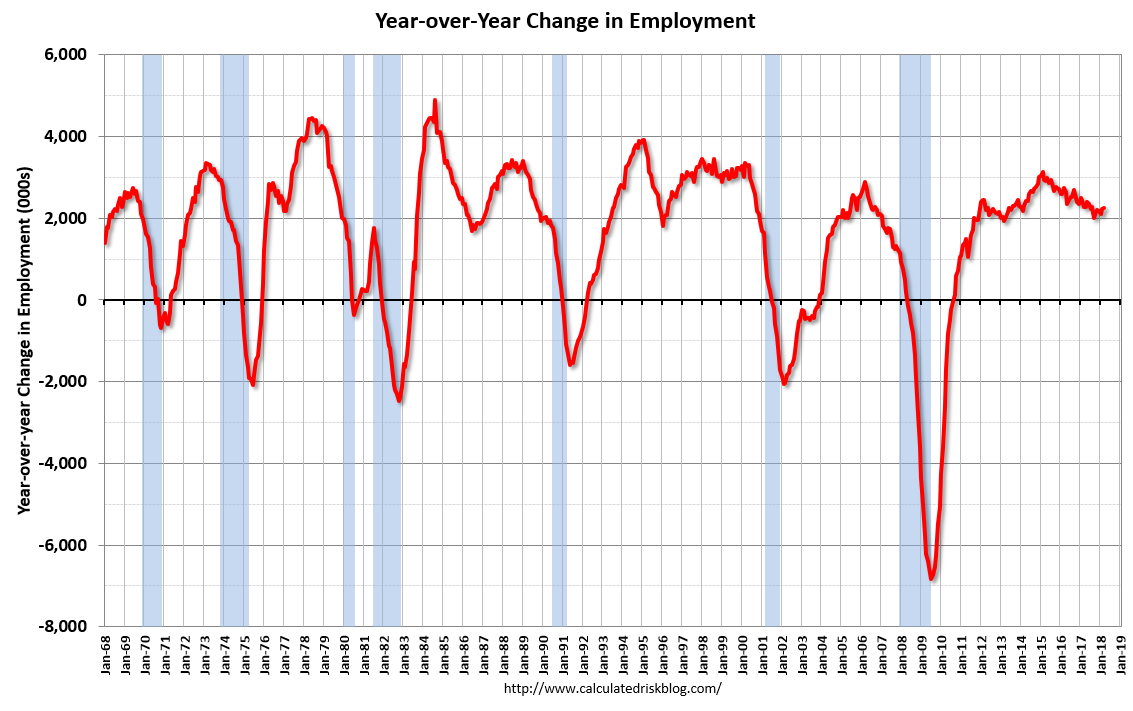
This graph shows the year-over-year change in total non-farm employment since 1968.
In March the year-over-year change was 2.261 million jobs.
A key will be the change in wages.
Friday, April 27, 2018
Oil Rigs: "Beginning of Shale's Super-Goldilocks Period?"
by Calculated Risk on 4/27/2018 04:05:00 PM
A few comments from Steven Kopits of Princeton Energy Advisors LLC on Apr 27, 2018:
• Total US oil rigs were up, +5 to 825
• Horizontal oil rigs were up, +11 at 734
...
• The major action again was back in the Permian, +6 horizontal oil rigs
• Cana Woodford added 9 rigs, but is still below its level of earlier this year.
• Vertical oil rigs are at their lowest level since November 2016
• The Brent spread has moved up to $6.50 / barrel – and speaks to ungodly demand strength outside the US
• With the current Brent spread, expect continued upward pressure in oil prices
 Click on graph for larger image.
CR note: This graph shows the US horizontal rig count by basin.
Graph and comments Courtesy of Steven Kopits of Princeton Energy Advisors LLC."
Freddie Mac: Mortgage Serious Delinquency Rate Decreased in March
by Calculated Risk on 4/27/2018 12:36:00 PM
Freddie Mac reported that the Single-Family serious delinquency rate in March was 0.97%, down from 1.06% in February. Freddie's rate is up from 0.92% in March 2017.
Freddie's serious delinquency rate peaked in February 2010 at 4.20%.
These are mortgage loans that are "three monthly payments or more past due or in foreclosure".
 Click on graph for larger image
The recent increase in the delinquency rate was due to the hurricanes - no worries about the overall market (These are serious delinquencies, so it took three months late to be counted).
After the hurricane bump, maybe the rate will decline to a cycle bottom in the 0.5% to 0.8% range.
Note: Fannie Mae will report for March soon.
Q1 GDP: Investment
by Calculated Risk on 4/27/2018 09:32:00 AM
IMPORTANT NOTE: In the GDP report, real residential investment was unchanged in Q1. But residential investment (RI) as a percent GDP actually increased in Q1! How can that be? The answer is that the price index for residential investment increased sharply in Q1 (up 8.5% annualized). The large increase in the residential investment price index follows what we are hearing from home builders - that material costs have increased sharply (the tariffs haven't helped, but other prices are up too). This hurts both builders and home buyers.
The first graph below shows the contribution to GDP from residential investment, equipment and software, and nonresidential structures (3 quarter trailing average). This is important to follow because residential investment tends to lead the economy, equipment and software is generally coincident, and nonresidential structure investment trails the economy.
In the graph, red is residential, green is equipment and software, and blue is investment in non-residential structures. So the usual pattern - both into and out of recessions is - red, green, blue.
The dashed gray line is the contribution from the change in private inventories.
 Click on graph for larger image.
Residential investment (RI) was unchanged in Q1 (0.0% annual rate in Q1). Equipment investment increased at a 4.7% annual rate, and investment in non-residential structures increased at a 12.3% annual rate.
On a 3 quarter trailing average basis, RI (red) is up, equipment (green) is solidly positive, and nonresidential structures (blue) is up slightly.
Recently real RI has been soft.
I'll post more on the components of non-residential investment once the supplemental data is released.
 The second graph shows residential investment as a percent of GDP.
Residential Investment as a percent of GDP increased in Q1, and RI has generally been increasing. RI as a percent of GDP is only just above the bottom of the previous recessions - and I expect RI to continue to increase for the next couple of years.
The increase is now primarily coming from single family investment and home remodeling.
I'll break down Residential Investment into components after the GDP details are released.
Note: Residential investment (RI) includes new single family structures, multifamily structures, home improvement, broker's commissions, and a few minor categories.
 The third graph shows non-residential investment in structures, equipment and "intellectual property products". Investment in equipment - as a percent of GDP - picked up.
BEA: Real GDP increased at 2.3% Annualized Rate in Q1
by Calculated Risk on 4/27/2018 08:34:00 AM
From the BEA: Gross Domestic Product: First Quarter 2018 (Advance Estimate)
Real gross domestic product (GDP) increased at an annual rate of 2.3 percent in the first quarter of 2018, according to the "advance" estimate released by the Bureau of Economic Analysis. In the fourth quarter, real GDP increased 2.9 percent.The advance Q1 GDP report, with 2.3% annualized growth, was above expectations.
...
The increase in real GDP in the first quarter reflected positive contributions from nonresidential fixed investment, personal consumption expenditures (PCE), exports, private inventory investment, federal government spending, and state and local government spending. Imports, which are a subtraction in the calculation of GDP, increased.
The deceleration in real GDP growth in the first quarter reflected decelerations in PCE, residential fixed investment, exports, and state and local government spending. These movements were partly offset by an upturn in private inventory investment. Imports, which are a subtraction in the calculation of GDP, decelerated.
emphasis added
Personal consumption expenditures (PCE) increased at 1.1% annualized rate in Q1, down from 4.0% in Q4 (this is weak). Residential investment (RI) was unchanged in Q1. Equipment investment increased at a 4.7% annualized rate, and investment in non-residential structures increased at a 12.3% pace.
I'll have more later ...
Thursday, April 26, 2018
Friday: Q1 GDP
by Calculated Risk on 4/26/2018 07:11:00 PM
A few GDP forecasts:
From Merrill Lynch:
[T]he data added 0.2pp to 1Q GDP tracking, bringing it up to 1.9% qoq saar heading into tomorrow's advance release. [April 26 estimate].And from the Altanta Fed: GDPNow
emphasis added
The final GDPNow model estimate for real GDP growth (seasonally adjusted annual rate) in the first quarter of 2018 is 2.0 percent on April 26, unchanged from April 17.[April 17 estimate]From the NY Fed Nowcasting Report
The New York Fed Staff Nowcast stands at 2.9% for 2018:Q1 and 3.0% for 2018:Q2. [April 20 estimate]Friday:
• At 8:30 AM ET, Gross Domestic Product, 1st quarter 2018 (Advance estimate). The consensus is that real GDP increased 2.0% annualized in Q1, down from 2.9% in Q4.
• At 10:00 AM, University of Michigan's Consumer sentiment index (Final for April). The consensus is for a reading of 98.0, up from 97.8.
Vehicle Sales Forecast: Sales Around 17 Million SAAR in April
by Calculated Risk on 4/26/2018 05:48:00 PM
The automakers will report April vehicle sales on Tuesday, May 1st.
Note: There were 24 selling days in April 2018, down from 26 in April 2017.
From WardsAuto: U.S. Light-Vehicle Forecast: April Sets Stage for Strong Q2
The Wards Intelligence forecast calls for U.S. automakers to deliver 1.35 million light vehicles in April. ... The report puts the seasonally adjusted annual rate of sales for the month at 17.1 million units, below last month’s 17.4 million but slightly above year-ago’s 17.0It appears April will be another solid month. So far sales in 2018 are running at about the same rate as in 2017.
emphasis added



